
If you have ever stared at a single word on your screen and wondered what it just did to your conversation, you already know why the hmmm meaning in text is worth a proper explanation. A friend sends a plan, you reply with enthusiasm, and back comes one small word: hmmm. No emoji. No follow-up. Suddenly the whole conversation feels different, and you cannot quite say why.
That is the whole job of hmmm. It is not an answer, not a question, and not a word with a fixed definition. It is a pause you can see: the written version of the sound people make when they are thinking, and like a real pause, its meaning lives in what surrounds it — what came before it, how long it is, and what happens after it. This article gives you a way to read all three, so you stop guessing and start seeing.
What HMMM Actually Is — and What It Is Not
First, clear away the most common misunderstanding. Hmmm is not an acronym, and it does not stand for anything. There is no full form hiding behind it, and the playful expansions floating around online are jokes, not meanings. What hmmm actually is, according to Wiktionary, is the elongated form of hmm, an interjection that indicates thinking or pondering. It is a sound written down, the same noise a person makes out loud when they need a second to think. Dictionaries class it as a hesitation marker, a piece of language whose job is to manage the flow of conversation rather than to state a fact.
That one fact explains almost everything confusing about it. Because hmmm is a sound and not a word with a fixed definition, it bends toward whatever is happening around it. The same four letters can mean genuine thought, polite doubt, quiet curiosity, or a gentle refusal to commit, and the letters themselves will not tell you which one. Only the context will.
There is one more dictionary sense worth knowing, because it catches people off guard. Wiktionary also lists hmm as a demand for an answer to a question, as in a pointed “Just where were you until 2 a.m.? Hmm?” That is a different move from the thinking pause: the hmmm is not buying time there, it is applying pressure. If the hmmm you received came right after a question you were supposed to answer, it is probably that second sense, not the first.
Two corrections to the old version of this article belong here, stated plainly. The old article said hmmm “stands for” a thinking sound, wrong framing for something that is not an abbreviation at all. And it described hmmm as widely used and very common, claims this update withdraws, because no usage study supports them. Familiar is not the same as measured, and this article will not dress up familiarity as data.
A close cousin is worth knowing: uhm is the nervous sibling, the sound of someone unsure what to say next, while hmmm is the sound of someone actively turning something over. For the full hesitation family, read the guide to uhm meaning in text alongside this one.
Run the Three-Beat Test
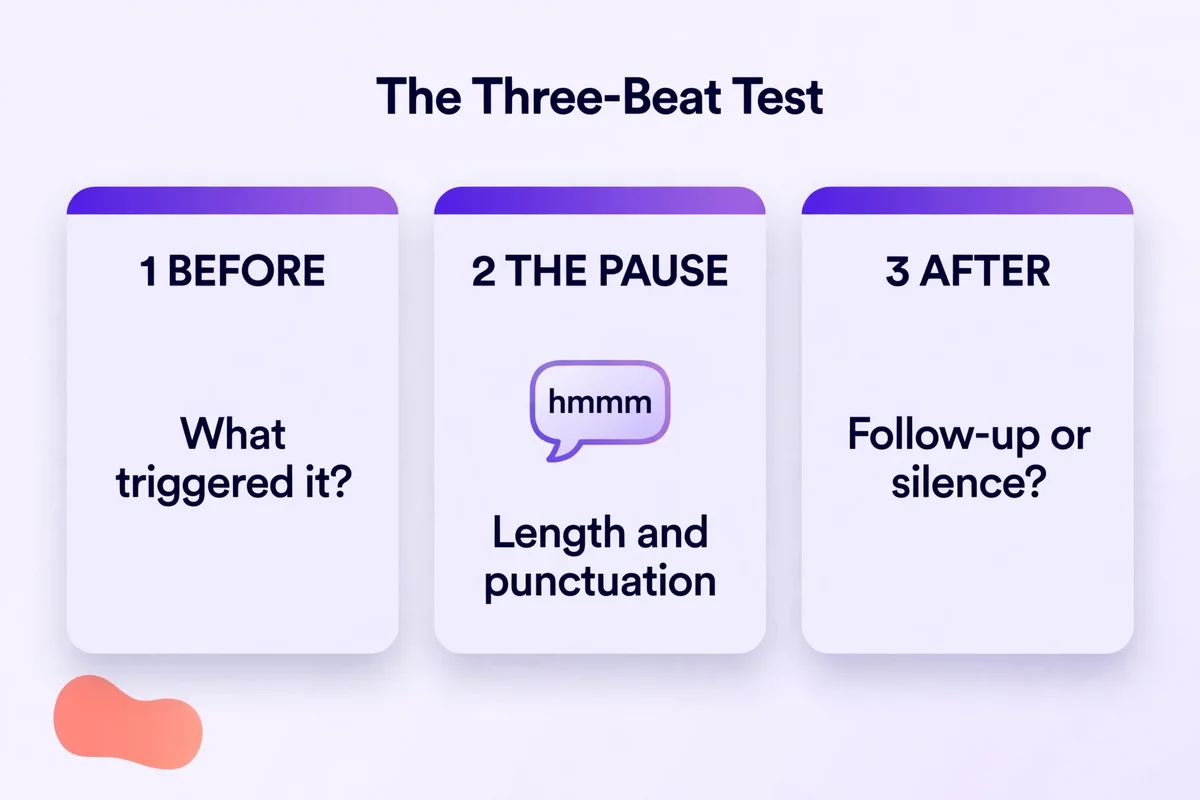
Here is the tool this article is built around. Do not ask what a hmmm means in isolation, because in isolation it means almost nothing. Instead, run the Three-Beat Test: read the message in three beats, and let the three beats vote together.
Beat one is BEFORE. What triggered the hmmm? Was it a question, a claim, an invitation, or a piece of news? A hmmm after “Want to come on Saturday?” is doing different work from a hmmm after “I think the new manager is doing a great job.” The trigger sets the range of possible readings before you even look at the hmmm itself.
Beat two is THE PAUSE. How is the hmmm itself shaped? Count the m’s, look at the punctuation, and notice whether an emoji is riding along. A short “hm” with a period lands differently from a long “hmmmm…” with an ellipsis, and both differently from a sharp “hmmm?” with a question mark. The next section breaks this down in full.
Beat three is AFTER. What does the sender do next? Follow up with a real sentence, change the subject, or go quiet? This is the beat most people skip, and it decides the most. A hmmm followed five minutes later by “Okay, let’s do it, but can we go later?” was thinking. A hmmm followed by silence and then a completely different topic was almost certainly a no that did not want to say the word no.
Now put the three beats together on four common readings. First, plain thinking: the trigger is a real question, the pause is medium length with an ellipsis, and the follow-up is a genuine answer. That is the default reading, start there. Second, doubt: the trigger is a claim the sender is not buying, the pause is long, and the follow-up is a challenge or a skeptical question. Third, the soft no: the trigger is an invitation, the pause is short and closed with a period, and the follow-up is silence or a subject change. Fourth, the tease: the trigger is something flirty or playful, the pause is long and warm, and the follow-up keeps the game going. None of these readings lives in the letters alone; each one is a verdict the three beats reach together.
The value of the test is that it stops the two classic mistakes: reading every hmmm as rejection, which turns a thinking friend into a crisis, and reading every hmmm as harmless thought, which lets a soft no drag on for days. Run the beats, and you will know which mistake you were about to make.
The test does not turn you into a mind reader. If the three beats disagree, say so to yourself and ask a clarifying question instead of picking the reading you fear most. A better guess followed by one honest question beats a confident misreading every time. The contrast with a word that commits is instructive: where tbh plants a flag and says something definite, hmmm deliberately withholds, and the guide to tbh meaning in text shows what commitment sounds like when you want it.
The M-Count Ladder
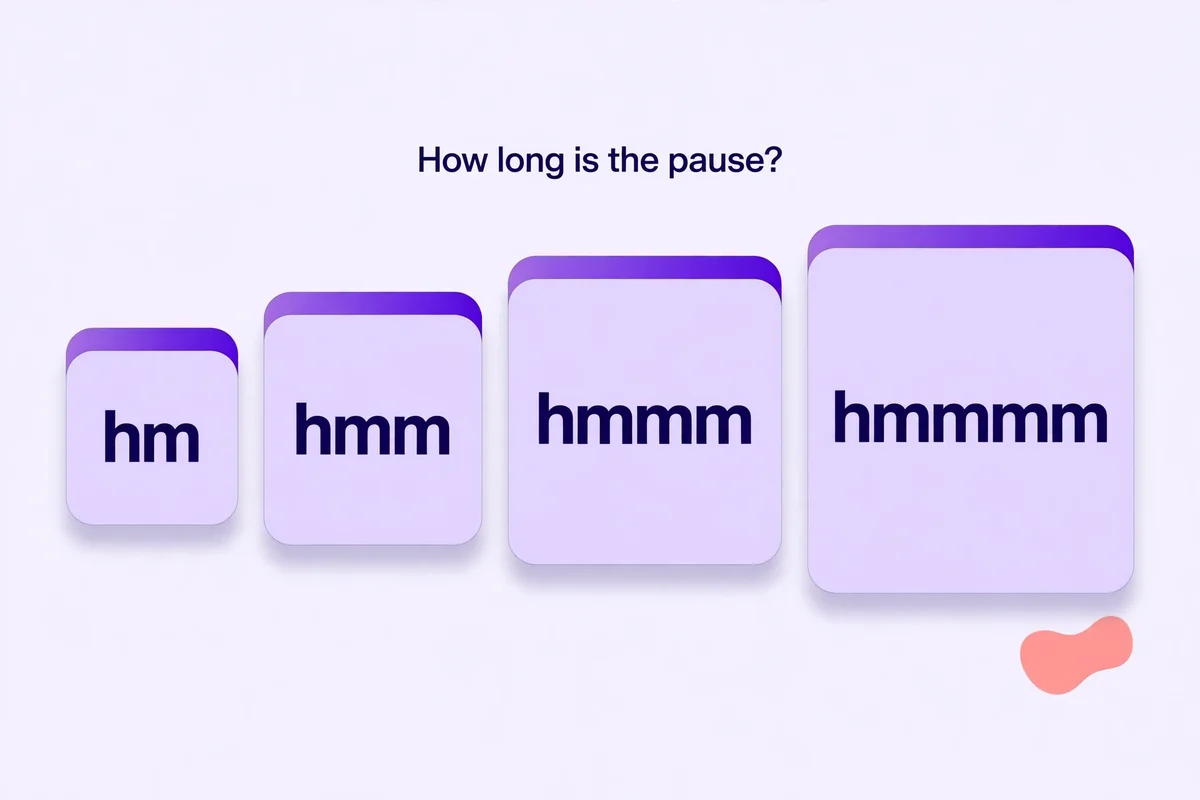
Length is the most visible part of beat two, so it deserves its own section, with one honest warning attached. Guides agree on the direction of the ladder, but no dictionary or study fixes exact cutoffs, so treat what follows as a folk pattern, not a rule.
At the bottom sits hm, one m, the quickest version: a brief acknowledgment, the kind of thing someone taps out while still half-listening. One rung up is hmm, two m’s, the standard spelling and the dictionary form: ordinary thinking or mild uncertainty, the neutral default.
Then comes hmmm, three m’s, the spelling this article is about: a deeper pause, a moment where the sender is genuinely weighing something or letting a little skepticism show. Above it sits hmmmm and beyond, four or more m’s, where the pause starts to perform itself. A very long hmmmm can read as heavy doubt, theatrical disbelief, or playful teasing, and which one depends entirely on the other two beats.
Punctuation does as much work as length. A period closes the pause: “hmmm.” sounds settled, even final, and it is the version most likely to be a soft no. An ellipsis leaves it open: “hmmm…” sounds like thought still in progress, an invitation to wait or to add more information. A question mark turns the pause into a probe: “hmmm?” asks you to explain yourself, and it is closest to the dictionary’s demand-for-an-answer sense. An exclamation mark flips the whole thing into surprise: “hmmm!” is closer to a realization than to doubt.
Emoji change the temperature without changing the structure. A thinking-face emoji doubles down on the thinking reading, a laughing emoji softens it toward teasing, and no emoji at all leaves the pause at its coldest, which is why a bare hmmm after bad news can feel so heavy. None of this is a code with fixed values, only tendencies, and tendencies are all a pause can honestly offer.
One more contrast helps. Where hmmm holds a conversation open, idc closes it. A sender who writes idc has finished thinking, at least for now, and the guide to idc meaning in text shows how that closing move works. Hmmm is the opposite move: the door left ajar.
HMMM on TikTok, Instagram, Snapchat, and in Text Messages
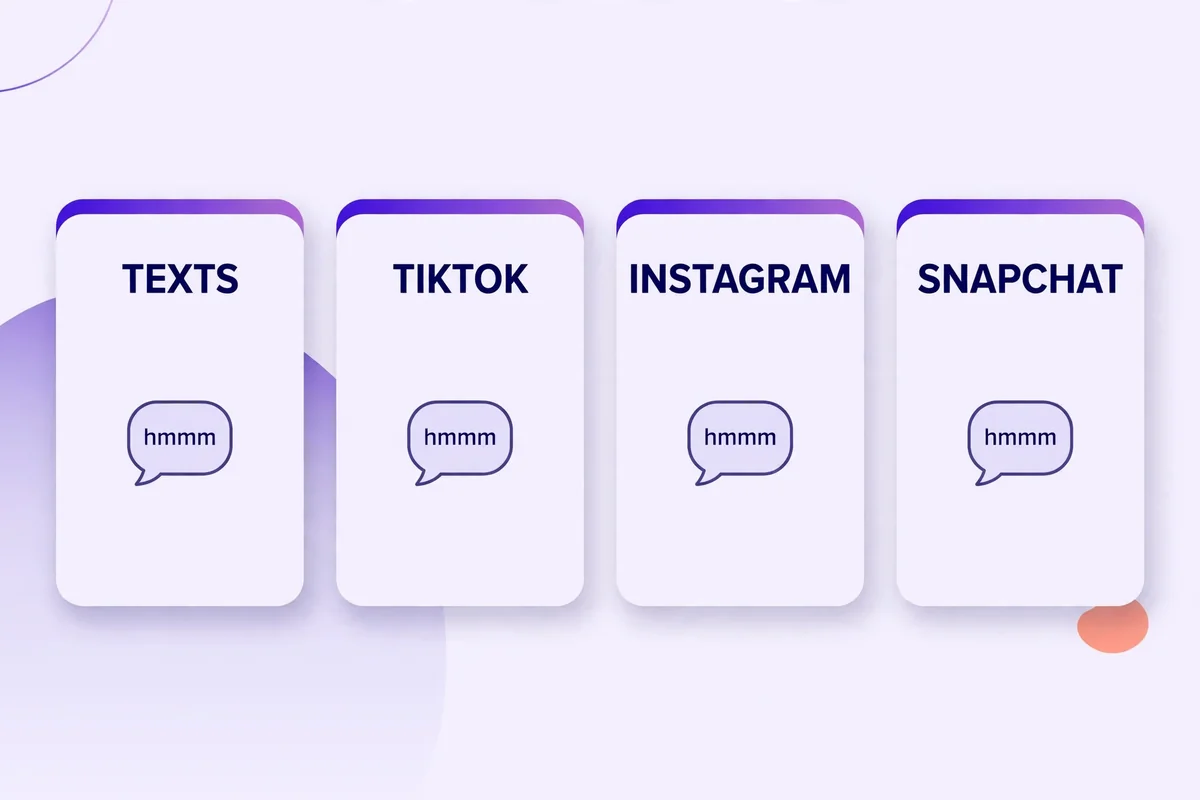
The core meaning of hmmm does not change from one app to another. What changes is the packaging, and packaging changes how the same pause feels. This section describes those shifts honestly, without inventing a separate meaning for each platform, because no source supports one.
In plain text messages, hmmm is at its most classic. A one-to-one chat is where the thinking pause lives naturally, and a hmmm there usually means exactly what it meant before phones existed: give me a second, I am thinking. The stakes feel higher in texts precisely because there is no audience, just you and the pause.
On TikTok, hmmm mostly shows up in comments, and comments are a public stage. A lone hmmm under a bold claim reads as side-eye, a public way of saying “I am not sure about this” without starting a fight. It is also used ironically, dropped under something obviously true as a joke, which is why TikTok hmmms are the easiest to misread at face value.
On Instagram, hmmm appears in comments and in direct messages, and the two spots differ. In a comment, it leans toward curiosity or quiet skepticism. In a DM, it behaves much more like a text message, a pause between two people who know each other. Ask which room it arrived in before you decide what it means.
On Snapchat, hmmm is casual and fast, a pause inside a conversation that is already moving quickly. Because snaps disappear and chats feel light, a hmmm there rarely carries the weight it can carry in a text thread. It is more often a beat of hesitation than a verdict, and treating it as a verdict is the most common Snapchat misreading.
The practical point is simple: do not carry a TikTok reading into a text thread, or a text-thread reading into a TikTok comment. The pause is the same, the room is different, and the room is part of beat one. Two reply moves work on any platform: a gentle “no worries, take your time” keeps the door open, and the guide to dw meaning in text explains why that reassurance works, while a short “let me know what you think” moves things along, as the guide to lmk meaning in text shows.
When HMMM Is a Soft No
This is the reading people most want help with, so it gets a section of its own. A soft no is a refusal that avoids the word no, and hmmm is one of its favorite vehicles. Here is how to recognize it without over-reading every pause as a rejection.
The pattern has three parts, and you need all three before you call it. First, the trigger is something that wanted a yes: an invitation, a request, a plan, a proposal. Second, the pause is short and closed, often a bare hmmm or hmmm with a period, not the long open ellipsis of genuine thought. Third, and decisively, the follow-up is an exit: silence, a subject change, or a vague “we’ll see” that never becomes a plan. One of these alone means nothing; all three together, twice in a row, is a soft no.
Sender context colors the soft no without changing its shape. From a friend, it usually means “I don’t want to do this but I don’t want to say so.” From a crush, it can mean interest mixed with caution, a pause testing whether you will push or give space, and pushing is almost always the wrong answer there. From a partner, a hmmm after a serious message can mean “I heard you and I am not ready to answer,” which deserves patience, not pressure. In a work chat, a hmmm is risky for the sender, because it reads as passive or hesitant.
The right response to a suspected soft no is to make the no easy to say. Try “No pressure either way, just let me know,” and then actually accept the answer if it comes. Chasing a soft no with repeated questions turns a gentle refusal into an awkward one, and it teaches the other person to stop answering at all.
There is a family resemblance here worth noting. TTYL is another famous non-answer, a pause dressed up as a promise, and the guide to ttyl meaning in text shows how it works. BRB is the shorter version, a pause with a built-in return time, and the guide to brb meaning in text explains why it feels safer. Hmmm is the least committed member of the family, which is exactly why it gets used when someone cannot bring themselves to say even ttyl.
HMMM vs UMM, IDK, and Okay
Comparisons are only useful if they draw real lines, so here are three. Hmmm versus umm: hmmm is thinking, umm is nervous. Umm fills a gap because the speaker does not know what to say; hmmm fills a gap because the speaker is deciding what they think. Swap them, and you swap confidence for anxiety.
Hmmm versus idk: hmmm is processing, idk is missing information. Someone who writes idk is telling you the answer is not in their head. Someone who writes hmmm is telling you the answer might be in their head but is not ready yet. Pressing a hmmm for an answer is reasonable; pressing an idk for one is not, because there is nothing to press toward.
Hmmm versus okay: hmmm is undecided, okay is agreement. This is the most expensive confusion of the three, because treating a hmmm as an okay sends you forward on a plan the other person never approved. If you catch yourself doing that, rewind and ask.
A final comparison, for the reply side: hmb is a request for a response, the opposite move from hmmm. Where hmmm withholds, hmb asks outright, and the guide to hmb meaning in text shows how that directness lands.
How to Reply to HMMM
Replying well to a hmmm is mostly about resisting the urge to fill the silence with noise. The best replies do one of three things, and no more.
First, ask one clarifying question, and make it a real one. “What part are you unsure about?” beats “What??” because it gives the other person something specific to answer. “Want me to send more details?” beats “Hello?” because it offers help instead of demanding attention.
Second, offer an easy out. “No rush, think it over” works when the pause is genuine thought, and “No pressure either way” works when you suspect a soft no. Both replies share a virtue: they make the other person safer, and safer people answer more honestly.
Third, mirror once and stop. Replying “hmmm” to a hmmm can be playful between friends. Doing it twice stops being playful and starts being a standoff. One mirror is a joke. Two is a deadlock.
What not to do matters just as much. Do not send three follow-up messages demanding an answer; that turns a pause into a pressure campaign. Do not interpret the hmmm out loud (“So you’re saying no then?”) before the other person has said anything of the sort. And do not punish a hmmm with your own silence and call it even, because now nobody is talking and both of you are annoyed about a pause that started out innocent.
Quick Answers
What does hmmm mean in text?
Hmmm is a written thinking sound, not an acronym. In text it usually means the sender is thinking, unsure, or weighing something, and the exact shade depends on what came before it, how long it is, and what the sender does next. Run the Three-Beat Test in this article instead of guessing from the letters alone.
Is hmmm an acronym with a full form?
No. Hmmm has no full form and stands for nothing. It is the elongated form of hmm, an interjection for thinking or pondering. Playful expansions you may see online are jokes, not definitions, and this article does not repeat them as fact.
Does adding more m’s mean more doubt?
Generally, yes, but only as a tendency, not a rule. Shorter versions read as a quicker pause and longer versions as a heavier one, and guides agree on that direction. No dictionary or study fixes exact cutoffs, so do not treat the m-count ladder as a code with precise values.
Is hmmm rude?
Not by itself. A single hmmm is usually neutral, a thinking pause like any other. It starts to read as dismissive when it is repeated, when it follows a sensitive message with no follow-up, or when it is paired with silence after a question that deserved an answer. Tone and timing decide, not the letters.
What does hmmm mean from a crush?
It usually means interest mixed with caution, a pause that is testing whether you will push or give space. Do not treat it as a yes or a no. Read the three beats, give space, and let the follow-up tell you more than the pause ever will.
How should I reply to hmmm?
Ask one clarifying question, such as what part they are unsure about, or offer an easy out, such as no rush or no pressure either way. Do not send multiple follow-ups demanding an answer, and do not interpret the pause out loud before the other person has explained it.
Final Thoughts
Hmmm is small, but it is not simple, and that is why it keeps confusing people. It is a sound, not a word; a pause, not an answer; a shape that takes its meaning from its neighbors. The Three-Beat Test is the whole method in one line: check what triggered it, read how it is shaped, and watch what happens next. Do that, and most hmmms stop being mysteries and start being information.
Two habits will carry you further than any list of meanings. First, default to the generous reading, genuine thought, until the beats tell you otherwise, because most hmmms really are just thought. Second, when the beats do point to a soft no, accept it gracefully instead of chasing it. A pause is only a problem when you refuse to let it be a pause. Read it, reply once, and let the conversation breathe.
