
A message lands on your phone. One word, three letters, no question, no context: "hyy." You stare at it a second longer than you should, because a greeting that short should be simple — and yet you are not quite sure what it wants from you. Is it friendly? Flirty? A typo? The short answer to the hyy meaning in text question is reassuringly plain: hyy is a stylized, softer way of writing "hey." It is a greeting, not a code, and it does not secretly stand for anything.
But that plain answer is only half the job, because a bare "hyy" carries almost no information. The letters tell you someone wants your attention. They do not tell you why. The rest of this article gives you the tool for that second question: read the second line, not the first word.
What Does HYY Mean in Text?
At its core, hyy means "hey" — or, near enough, "hi." Every competitor guide read for this update agrees on that: hyy is an informal greeting used to start a conversation, get someone’s attention, or check in casually. It shows up in texts, WhatsApp, Instagram DMs, Snapchat streaks, and TikTok messages, always in the same job: opening a chat, not carrying one.
The important part is what hyy is not. It is not an acronym. Unlike BRB or LOL, which expand into phrases, hyy has no official expansion. It is a respelling of a greeting, in the same family as "heyy," "hiii," and "heyyy" — words stretched to carry tone that plain text otherwise cannot. The doubled "y" is the whole trick: it softens the greeting and signals casual friendliness rather than formality.
That softness is also why hyy gets misread so often. A greeting that is mostly tone invites people to read extra meaning into it — flirtation, excitement, boredom — when most of the time it is just someone saying hello in a slightly cuter font. The tone is real, but it is thin: it colors the greeting, it does not replace it.
Real-world hyy, in its natural habitat:
- "Hyy! Long time no talk." — A warm reopening after a gap.
- "Hyy, you free tonight?" — A greeting plus a question, doing two jobs at once.
- "Hyy guys!" — A group-chat opener, grabbing the room’s attention.
- "Hyy" — alone, with nothing after it. This is the interesting one, and it gets its own section below.
One honest note: there is no dictionary entry behind this meaning. Wiktionary’s page for "hyy" lists only an old Finnish word for slush — partially melted snow — which has nothing to do with texting. The texting meaning rests on consistent usage across guides and real chats, not on a reference work. That is normal for young slang, but the honest claim is "everyone who writes about it agrees," not "the dictionary says so."
The Second-Line Test
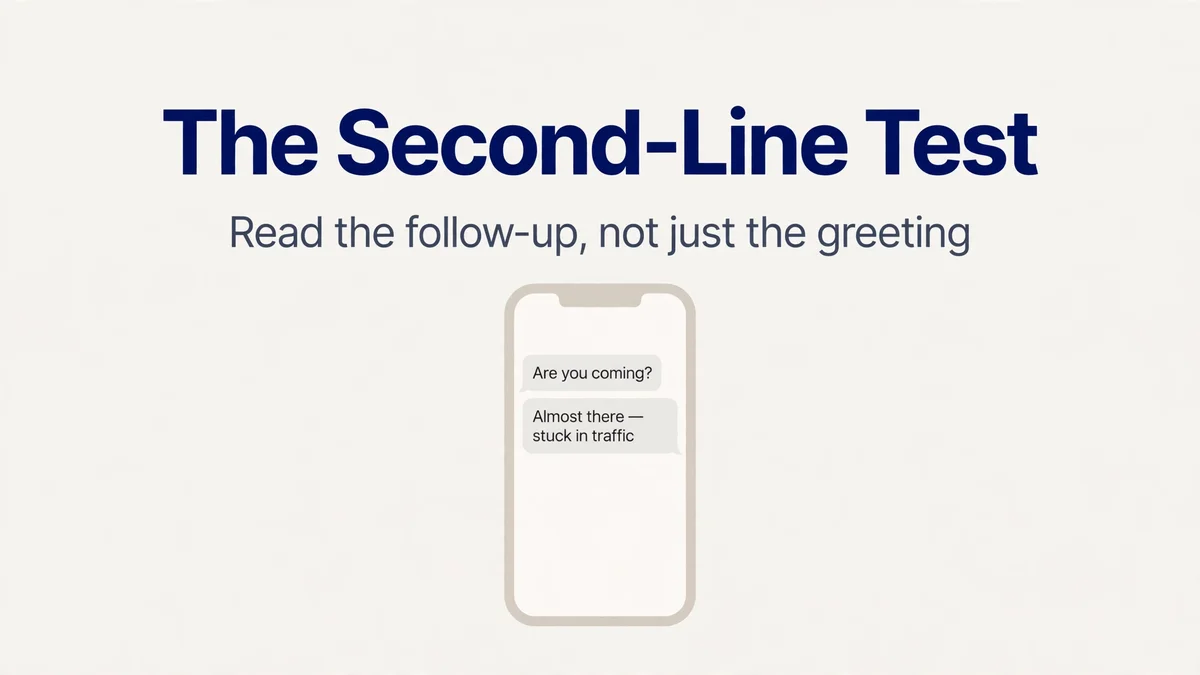
Here is this article’s named method. Call it the Second-Line Test: when you receive a bare or near-bare "hyy," ignore the greeting itself and read what comes after it — or, if nothing comes after it, read the history around it. Three checks, in order.
Check 1: The follow-up. What is the second line? Most hyys are not actually alone. "Hyy, you free tonight?" is a plan. "Hyy, did you see the post?" is a pointer. "Hyy" followed five minutes later by a photo is a reaction. The second line is the message; the greeting was just the knock on the door. Answer the question, or react to the news.
Check 2: The history. Who is this, and what do you two usually do? A "hyy" from your best friend at 11 p.m. means something different from a "hyy" from an account you have never spoken to, though the letters are identical. With a friend, it is a check-in: they want to talk and have not decided about what yet. With a stranger, it is an opening move, and you may wait for the second line before investing anything.
Check 3: The signal. What do the spelling, punctuation, and emoji add? This is the finest check, and the easiest to over-read. "Hyy!" is brighter than "hyy." with a full stop, which reads flat or tired. "Hyyy" stretches further toward excitement; a heart-eyes emoji warms it considerably. But the signal only ever adjusts the greeting — it never invents a new meaning. A heart emoji does not turn a greeting into a confession.
Run the test on two messages. A friend sends "hyy" and then "you up?" Follow-up: a question. History: a friend, late at night. Verdict: a casual check-in — reply to the question, not the greeting. Now a stranger sends "hyy" with no follow-up at all. Follow-up: none. History: none. Verdict: there is nothing to answer yet. Waiting is not rude; you are waiting for a message that has not arrived.
Why the Extra Y Matters (and Why It Does Not Mean More)
English texting has a long habit of stretching greetings to show feeling: "hi" becomes "hiii," "hey" becomes "heyyy," and somewhere in that habit sits "hyy." In speech, you can say "hey" warmly or flatly and the listener hears the difference instantly. In text, you cannot — so writers bend the spelling instead. The extra letter is a tone knob, turned slightly toward warm.
How far the knob turns depends on the variant, and the differences are small but real:
| Greeting | Usual feel | What the spelling adds |
|---|---|---|
| Hi | Neutral, safe anywhere | Nothing — the baseline |
| Hey | Casual, standard | Relaxed, everyday |
| Hyy | Soft, playful, slightly cute | Warmth without much excitement |
| Heyy / heyyy | Warm, enthusiastic, sometimes flirty | More energy than hyy; the longer the stretch, the louder the feeling |
| Hiii | Sweet, excited | Enthusiasm, often between close friends |
| Yo | Bold, energetic | Confidence and punch, the opposite of hyy’s softness |
Notice the pattern: every variant is still just a greeting, not a separate word with a separate definition. Hyy sits on the soft end of the scale — gentler than "hey," quieter than "heyyy."
HYY on Texting, Snapchat, Instagram, TikTok, and WhatsApp
Hyy means the same thing on every platform: a soft "hey." No app gives it a special definition. What changes is the room — and the room changes how the knock on the door sounds.
Texting (SMS, WhatsApp, iMessage). This is hyy’s home ground: one-to-one, usually with someone you know. Here it is almost always a check-in or opener — "hyy, you free?" or "hyy, long time!" The relationship does the heavy lifting; the greeting just warms it up. A BTW-style aside has the same low-stakes energy.
Instagram. In DMs, hyy behaves like texting, with one difference: it often arrives from someone you do not know well. A "hyy" in a DM request from a stranger is an opening move, not a conversation. Wait for the second line; a greeting from a stranger has not earned a reply yet.
Snapchat. Here hyy has a second job: streak maintenance. A bare "hyy" sent daily to a friend may not be an invitation to talk at all — it may be keeping a streak alive. If someone sends you "hyy" every day and never follows up, you are looking at a streak, not a conversation waiting to happen.
TikTok. In comments and DMs, hyy is an attention-grabber: "hyy, love this!" under a video is appreciation wearing a greeting’s clothes. The public setting makes it feel louder, but the meaning has not changed — only the audience.
Group chats. "Hyy guys!" is the group version of clearing your throat before speaking. It gathers attention before the actual point, and it is almost always followed within seconds by that point. If it is not, the group will usually ignore it, correctly.
Sender Context: Friend, Crush, Stranger, or Streak?
The letters never change. The sender does, and the sender is most of the meaning. Four senders, four readings.
From a close friend. This is the default, lowest-stakes case. A friend’s "hyy" means "I want to talk to you, and I haven’t decided about what yet." It is warm, easy, and almost never a puzzle. Reply as you would to "hey" — with a greeting back, or a question of your own. Inventing a hidden test here will only make a simple chat feel strange.
From a crush, or someone you are dating. This is where over-reading does its damage. A crush’s "hyy" feels loaded because everything a crush sends feels loaded — but the letters carry no more romance than a crush’s "hey" would. What warms it is everything around it: the emoji, the timing, the follow-up line. Judge the crush by the conversation, not the greeting: "hyy" followed by "missed you" is affectionate; followed by "did you finish the assignment?" it is a classmate.
From a stranger. A stranger’s "hyy" is an opener, and openers from strangers deserve caution. It may be friendly, it may be spam, it may be a bot account warming you up — a bare greeting is exactly how low-effort spam accounts begin. You owe it nothing. Wait for the second line, check the profile, and decide then. A DW-style reassurance applies in reverse: don’t worry about seeming rude for not answering a greeting that asked nothing.
From a streak or routine contact. The daily "hyy" from someone you mostly exchange streaks with is maintenance, not conversation. Treat it as a wave: wave back if you like, and do not read a wave as a request for a chat. They were never starting something. They were keeping something alive.
How to Reply to HYY
Your reply depends on what the Second-Line Test found. Match the reading, keep it short, and answer the second line rather than the greeting.
If there is a second line with a question: answer the question. "Hyy, you free tonight?" gets "hey! Yeah, after 7." The greeting needs no separate reply; it was the wrapper, not the gift.
If the hyy is bare but from a friend: mirror it and hand the conversation back. "Hyy! What’s up?" is the whole reply. If they wanted something specific, they will say it now.
If the hyy is bare and from a stranger: you may wait, and waiting is a complete strategy. If you do reply, keep it neutral — "hi" — and let their next message decide whether the conversation continues.
If the hyy feels flirty and you welcome it: match the energy, not the spelling — "hyy, missed me?" works better than decoding their letters back at them. If you do not welcome it, a plain "hey, what’s up?" resets the temperature without a confrontation.
If you are not sure what it means: ask, briefly. "Hey! What’s up?" resolves almost every hyy ambiguity in four words. When in doubt, end with LMK-style clarity: "hey, what’s up — lmk what you need." Most senders will simply tell you.
If it is a streak: a matching "hyy" back, or an emoji, is enough. Nobody expects a paragraph in return.
HYY vs Similar Greetings
Hyy sits in a family of greetings, all easy to confuse because they all open conversations. The difference is what each one adds to a plain "hello."
| Term | What it adds | When it fits |
|---|---|---|
| Hyy | Softness, warmth | "Hyy, you free?" — a gentle opener |
| Hey | Nothing special — the standard | Any casual greeting, any time |
| Hiii | Excitement, sweetness | Close friends, happy news |
| Yo | Energy, boldness | Friends, group chats, hype moments |
| BRB | A pause, not a greeting | "BRB" steps away; hyy steps in |
| GTG | An exit, not a greeting | "GTG" ends a chat; hyy starts one |
| HMB | A callback request | "HMB" asks for a reply later; hyy asks for attention now |
| WYA | A location question | "WYA?" follows a greeting; it is often hyy’s second line |
The useful pairs: hyy versus "heyyy" is softness versus energy — same greeting, different volume. Hyy versus "yo" is softness versus boldness — same job, opposite temperature. BRB, GTG, and HMB are movement words, not greetings: answering a hello with a goodbye is nonsense. And WYA is the classic second line — the question that so often follows a bare "hyy" that the two are practically a double act.
Corrections: What the Old Article Got Wrong
The old article’s core meaning was right — hyy is a stylized "hey" — but it repeated that one fact across roughly twenty sections, and several supporting claims do not survive a fresh look. They are withdrawn or fixed here, openly.
- "Very common" and "highly popular" — withdrawn. The old article claimed hyy is very common and highly popular, but no study, survey, or usage count supports any popularity claim for this spelling. It appears in chats and on social platforms; how widely, nobody has measured. This article claims only what the evidence shows.
- "Especially popular among teenagers and younger users" — withdrawn as stated. No age-breakdown data exists for hyy specifically. Younger users experiment with spellings more in general, but that is not a measured fact about hyy, so the article no longer assigns it an age group.
- Flirtation presented as a main use — corrected. The old article gave flirty conversations their own section, implying flirtation is a core meaning. The evidence says otherwise: flirtation is a possible coloring, supplied by emoji, timing, and relationship — not by the letters. It is now treated as one sender-context coloring among several, not a definition.
- Platform-specific meanings — withdrawn. The old article implied hyy works differently on each platform. It does not: the meaning is constant, and only the room, audience, and sender change.
- The repeated "attention-grabber / conversation starter / emotional expression" table — removed. Listing the same greeting three times with three labels is not analysis: those labels described jobs a greeting does, not meanings it has. They are replaced by the Second-Line Test, which helps a reader decide what a specific message wants.
- No origin date, no acronym expansion, no gender split — all refused. Competitor claims that hyy began in the early 2000s or the late 2000s are unsourced guesses that disagree with each other; this article dates nothing. Joke expansions ("hey you, yes?") and acronym guesses ("heck yeah, yo," "how you?") have no evidence and are not repeated as meanings. And "what does hyy mean from a girl?" gets the only honest answer: the same as from anyone else.
- Finnish "slush" — noted, not hidden. Wiktionary’s only hyy entry is an unrelated Finnish word. A reader who looks it up deserves to know why, rather than finding a contradiction the article never mentions.
When Not to Use HYY
Hyy is a joy in its habitat and a misfire outside it. Skip it when:
- The setting is formal. Work emails, messages to a teacher or employer, and any first contact where you want to seem serious all want "hello" or "hi." Hyy reads as casual by design, and casual is the wrong signal there.
- You are messaging someone for the first time about something serious. A stylized greeting before a serious request creates a mismatch: the reader must decide whether you are friendly or not taking the matter seriously. Use a plain greeting instead.
- You are sending a bare "hyy" with no second line. As the sender, you are handing the other person a chore. Add the reason — "hyy, quick question" — and you have turned a knock into a message.
- The other person does not use stylized spellings. Match the room: if someone always writes "hello" or "hi," a "hyy" can read as oddly intimate.
- You mean it as a test. Sending a bare greeting to see how fast someone replies turns a hello into a small experiment on a real person. If you want to talk, say what about.
Quick Answers
What does hyy mean in text?
Hyy means "hey" — a casual, slightly softened greeting used to start a conversation or get someone’s attention. It is a stylized spelling, not an acronym.
Does hyy mean someone is flirting with me?
Not by itself. Flirtation comes from the emoji, the timing, the relationship, and especially the second line — not from the letters. Treating every hyy as flirty is the most common misreading of this word.
Is hyy the same as heyy?
Almost. Both are playful versions of "hey." Hyy is softer and quieter; "heyy" and especially "heyyy" carry more energy. The difference is volume, not meaning.
What should I reply to a bare hyy?
If it is from a friend, mirror it and ask a question: "Hyy! What’s up?" If it is from a stranger, you may wait for the second line — a greeting that asked nothing does not oblige a reply.
Is hyy formal or informal?
Informal, firmly. It belongs in chats with friends and casual social messages — not in work emails or formal first contact.
Can hyy be a typo?
Yes. Sometimes a fast thumb turns "hey" into "hyy." If the rest of the message reads fine with "hey" in that slot, the simplest explanation is a slip — and the second line is still the real message.
Final Thoughts
Hyy is three letters doing the work of a smile and a raised hand: a soft "hey" that opens a conversation without quite starting one. The letters are the least interesting part. What matters is everything around them — the second line that says what the sender actually wants, the history that says who they are to you, and the small signals that warm or flatten the greeting. Run the Second-Line Test before you overthink a hyy and before you send a bare one: read past the greeting, answer the real message, and when you are the sender, give the other person a second line to answer.
If you enjoyed this guide, you may also like the TTYL guide, which covers another greeting-family abbreviation — the one you send when a conversation is ending rather than beginning.
