
Someone just sent you three letters — “awl” — and you have no idea what they meant. Were they saying “all,” melting over something cute, or signing off with love? That is the whole puzzle of awl meaning in text: AWL has no single settled meaning. It has three, and the sentence around it decides.
Here is the short version. In a casual text, awl is usually a relaxed spelling of “all” (“you ate awl the fries”). On its own as a reaction, it is usually a softer spelling of “aww” (“awl, that puppy is tiny”). And at the end of a warm message, capital AWL often stands for “Always With Love.”
What AWL Means in Text
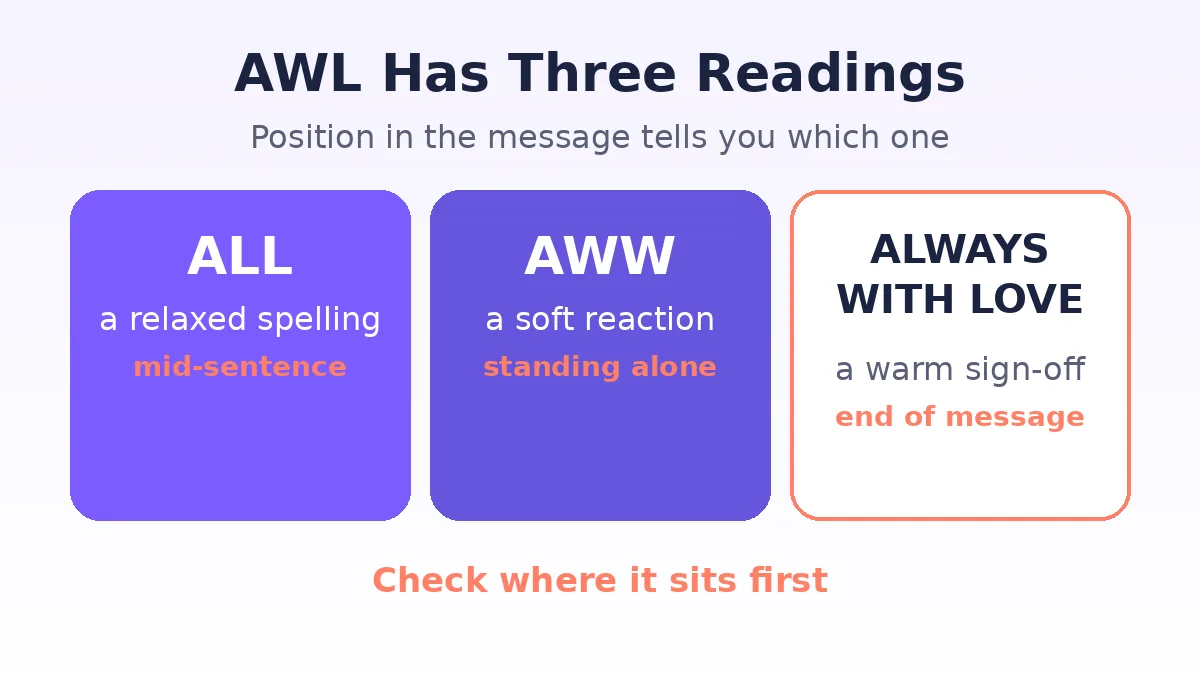
AWL is unusual because it is not really one abbreviation at all. It is three different things sharing the same three letters — plus a real English word and an academic initialism that sometimes wander into the same chats.
Reading one: “all.” The most common meaning in everyday texting. People type “awl” instead of “all” to sound relaxed or playful, the same instinct that turns “though” into “tho.” The meaning is exactly the same as “all”; only the spelling changes.
Reading two: “aww.” When “awl” stands alone as a reaction, it is usually a softer spelling of “aww” — the sound people make at something cute, sweet, or sad. “Awl, that puppy is so tiny” means “aww, that puppy is so tiny.”
Reading three: “Always With Love.” Capital AWL at the end of a message is often a sign-off. “Had a great time today. AWL, Sarah” is Sarah signing off warmly, the way an older generation signed letters “with love.”
The AWL Position-and-Swap Test
Here is this article’s named reader test: the AWL Position-and-Swap Test. Three questions; the first one does most of the work.
Question 1: Where does it sit? At the end of a message, AWL is almost always the sign-off. In the middle of a sentence, right before a noun (“awl the snacks”), it is “all.” Standing alone as a reaction (“awl, that is adorable”), it is “aww.”
Question 2: The Swap Test — put the plain word back in. Replace “awl” with “all”: “You ate awl the pizza” becomes “You ate all the pizza.” Now try “aww”: “Awl, you remembered my birthday” becomes “Aww, you remembered my birthday.” One swap will fit cleanly; the other will sound wrong.
Question 3: Who or what is it about? A quantity (“awl the loot”) means “all.” A person or moment being praised or pitied (“awl, look at her”) means “aww.” A farewell (“talk soon, AWL”) means the sign-off. The same idea powers the test in what WYM means in text: read what sits around the letters before you decide.
AWL in Real Conversations
As “all” — the quantity reading. The workhorse use, usually mid-sentence.
Sam: “You finished awl the pizza?”
Alex: “Not awl of it. I saved you two slices.”
As “aww” — the reaction reading. This one stands alone, often at the start of the message.
Priya: “My little brother made me coffee this morning.”
Jordan: “Awl, that is so sweet. How did it taste?”
As “Always With Love” — the sign-off reading. This one closes the message, often with a name.
Mom: “I am so proud of you. AWL, Mom.”
One counts things, one reacts to them, and one says goodbye. A quick “thanks” often rides along with the reaction reading — usually what TY means in text doing the same warm job in different letters.
How Punctuation, Spelling, and Emojis Change AWL

AWL has no tone of voice, so spelling and punctuation do the job instead.
Lowercase “awl” mid-sentence is the “all” reading: casual and relaxed. “You took awl my fries” is a joke about quantities. Lowercase “awl” on its own, especially with a comma after it (“awl, stop it”), is the “aww” reading: a soft reaction to something cute.
Capital “AWL” at the end of a message is the sign-off. Capitalization is a real clue: the acronym reading almost always arrives in capitals, while “all” and “aww” usually arrive in lowercase. “Awlll” with stretched letters is the “aww” reading turned up — the longer the word, the warmer the reaction.
Emojis settle the argument. A heart (“AWL ❤️”) confirms the sign-off; a heart-eyes face confirms the “aww” reaction. No emoji at all, mid-sentence, points to “all.”
AWL on TikTok, Snapchat, Instagram, and in Texting
In texting, SMS, and WhatsApp, AWL is at home in all three readings: “all” in everyday chats, “aww” between close friends reacting to news, and the sign-off at the end of longer, warmer messages, often from family. Texting is the one place where all three genuinely compete — the same fast-chat habit that keeps what BRB means in text alive.
On Snapchat, AWL usually arrives as a fast reaction: a friend replies “awl” to a snap of a pet, a baby, or a sweet moment — a quick burst of warmth before the snap disappears. The “all” reading appears too (“you ate awl that?”), but the reaction reading is the one Snapchat is built for.
On Instagram, AWL lives in comments, captions, and DMs. Under a family photo — “A wonderful day with the people I love most! AWL ❤️” — it is the sign-off. Under a cute video — “awl this is adorable” — it is “aww.”
On TikTok, AWL is a comment-section regular under cute pet videos, romantic clips, and emotional stories. “Awl this made me smile” is the “aww” reading doing its usual job. TikTok slang changes fast, so read the whole comment, not just the word.
Who Sent It Changes What It Means
From a close friend, AWL is almost always easy: “awl the snacks” is a joke about quantities, “awl, that is cute” is warmth. From a crush, the “aww” reading carries a playful charge (“awl, you remembered”), but it is still a reaction, not a confession.
From a parent or an older relative, AWL is most often the sign-off. “Take care and stay safe. AWL, Mom” is a warm goodbye — the sign-off is an older texting habit, while the “all” and “aww” spellings skew younger. From a teacher or a classmate, AWL probably means the Academic Word List — “our exercises are based on the AWL” is a vocabulary lesson, not a love letter.
From a stranger or a new dating-app match, AWL is genuinely ambiguous, because you do not yet know their habits. Run the Position-and-Swap Test: a warm note ending in AWL leans toward the sign-off; a mid-sentence “awl” leans toward “all.”
A friendly sign-off has its own shorthand too: what TTYL means in text closes a conversation without the warmth, while AWL closes it with love attached.
The Other AWLs: “A Whole Lot,” the Academic Word List, and the Tool
Most AWLs you meet are “all,” “aww,” or “Always With Love.” A few readings claimed online — “a while later,” “aww lol,” “away” — have no credible source behind them. But three more readings exist, and knowing them keeps you from misreading a message that was never slang at all.
“A Whole Lot” is a real but single-source reading. One slang guide defines AWL as “a whole lot,” used for emphasis: “I miss you AWL!” The examples make sense, but no other source we checked corroborates it, so treat it as a possible reading, not an established one. A candid “for real” often rides along with emphasis like this, and what FR means in text does the same intensifying job with far more attestation behind it.
The Academic Word List is the education reading. In a classroom or a language-learning app, AWL means the Academic Word List: 570 word families that appear across academic subjects. If the conversation is about school, this reading wins outright.
The tool is the oldest reading of all. An awl is a pointed instrument for piercing small holes in leather or wood. It is a standard dictionary word, not slang.
| Reading | What it means | Where it sits | How sure we are |
|---|---|---|---|
| all | A relaxed spelling of “all” | Mid-sentence, before a noun | Strongly supported |
| aww | A soft reaction: cute, sweet, sympathy | Alone, or at the start | Strongly supported |
| Always With Love | A warm sign-off | End of the message, often with a name | Strongly supported |
| A Whole Lot | Emphasis: “very much” | End of an exclamation | Contextually supported (one source) |
| Academic Word List | 570 academic word families | School / study context | Strongly supported (education only) |
| awl (tool) | A pointed piercing tool | Craft / leatherwork context | Strongly supported (dictionary word) |
AWL vs AWOL vs AWW
AWL gets confused with two lookalikes more than with anything else. The table clears it up at a glance.
| AWL | AWOL | AWW | |
|---|---|---|---|
| What it is | “all” / “aww” / “Always With Love” | “Absent Without Leave” | The sound of melting over something cute |
| Core job | Spelling, reaction, or sign-off | Saying someone is missing | Reacting warmly |
| Difference | Three readings, position decides | A different word entirely — the extra O matters | Aww is always a reaction; AWL is often a quantity |
AWOL means “absent without leave” — someone who has gone missing without permission: “My coworker has gone AWOL again.” AWL is not AWOL. The extra O makes all the difference.
AWW is the sound itself — the “aww” that AWL sometimes spells. As the reaction reading, AWL is simply AWW with an L; as the “all” reading, it has nothing to do with AWW at all.
How to Reply to AWL
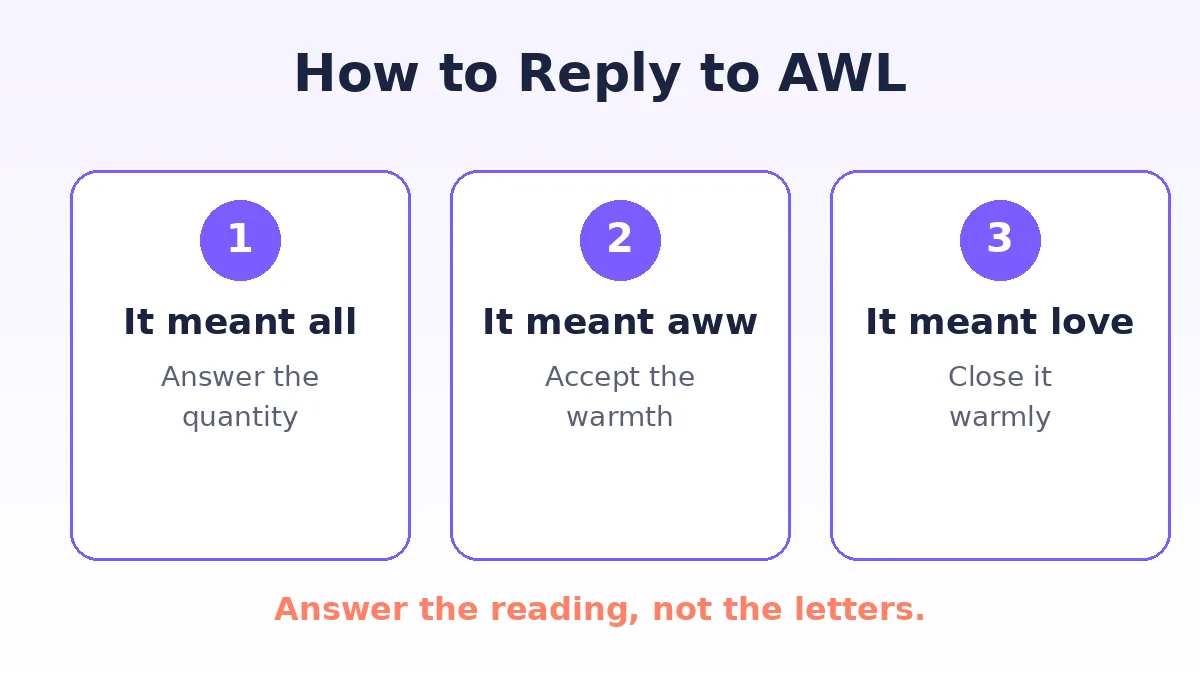
Pick your reply by the reading, not by habit.
When AWL meant “all,” answer the quantity. “You ate awl the fries?” gets “Not all of them — I saved you some” or “Guilty. They were too good.” When AWL meant “aww,” accept the warmth and keep it moving: “I know, right?” or “Stop, you will make me emotional” or simply “Thanks.” An honest opener often sits next to the reaction: “AWL, that is adorable. To be honest, I watched it five times.”
When AWL meant “Always With Love,” close the conversation warmly. “AWL, you too” or “Love you too, talk soon” matches the energy. Do not leave a sign-off hanging. When you are unsure which reading it was, answer the sentence around it rather than the letters: “Haha, all of it?” works either way.
When it was probably a typo, treat it as one and move on — “awl” sits close to “all” on a keyboard and in the ear. A short follow-up keeps the thread warm: what LMK means in text — “Let me know if that makes sense.”
When Not to Use AWL
Leave AWL alone in professional emails, job applications, and messages to customers, where a stylized spelling reads as careless. Skip it in serious or emotional conversations — “awl” after bad news can look dismissive. Do not use it with anyone who may not know texting slang, and do not stack it: “awl awl awl” reads as a glitch, not a feeling.
If you need a clear answer, spell the word out. “I reviewed all the reports” takes a fraction of a second longer than “I reviewed awl the reports” and removes all doubt. A quick check-in has its own shorthand instead: what WBU means in text — “What about you?”
Quick Answers About AWL
What does AWL mean in text?
In text, AWL most often means “all” (a relaxed spelling), “aww” (a soft emotional reaction), or “Always With Love” (a warm sign-off). The position in the message tells you which one it is.
What does AWL mean on TikTok?
On TikTok, AWL usually means “aww” — it appears in comments under cute pet videos, romantic clips, and emotional stories.
What does AWL mean on Snapchat?
On Snapchat, AWL is usually a fast “aww” reaction to a snap — a friend replying “awl” to a cute or wholesome photo.
What does AWL mean on Instagram?
On Instagram, AWL can be all three readings: the sign-off in captions, the “aww” reaction in comments, and the “all” spelling in DMs. Position decides.
Is AWL rude?
AWL is not rude on its own. It is casual and warm in all three of its main readings, though it can feel out of place in formal messages.
What is the difference between AWL and AWOL?
AWL means “all,” “aww,” or “Always With Love.” AWOL means “absent without leave” — someone who has gone missing. The extra O changes everything.
Does AWL mean “a whole lot”?
Possibly, but it is a single-source reading: one slang guide defines AWL as “a whole lot” for emphasis. No other source we checked corroborates it.
When should I not use AWL?
Avoid AWL in professional emails, formal messages, school messages about coursework, and serious conversations. If clarity matters more than speed, write “all” or “aww” in full instead.
The Bottom Line on AWL
AWL is three letters doing three jobs: counting (“all”), reacting (“aww”), and saying goodbye with love (“Always With Love”). Run the Position-and-Swap Test — check where it sits, swap the plain word back in, and ask what it is aimed at. AWL is confusing only until you know where to look. Now you do.
