
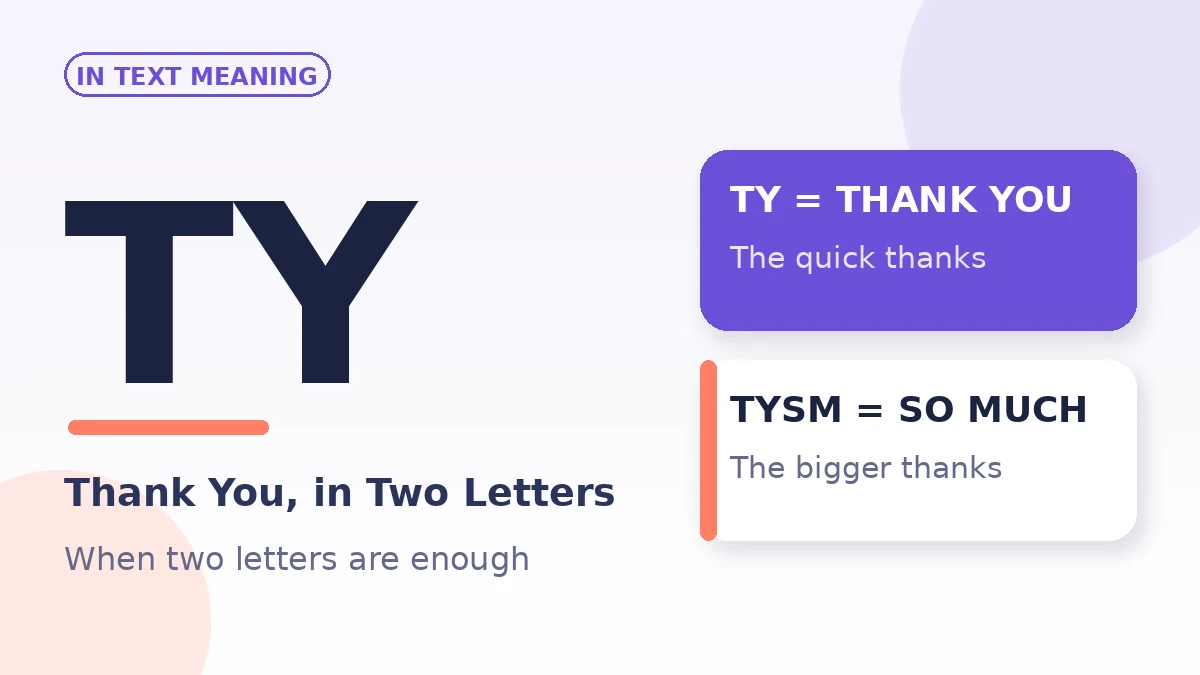
Someone does you a favor, you send two letters back — "ty" — and somehow the whole conversation goes quiet. Was that rude? Was it fine? That tiny moment of doubt is the whole story of ty meaning in text: two letters that say "thank you" and, depending on the moment, can sound warm, lazy, or even cold.
TY almost always means "thank you" in a text, a chat, or a comment. But "thank you" is not one feeling. It can be a quick nod between friends or a badly undersized reply to a real kindness. This guide explains what TY means, how its tone shifts, and when two letters are not enough.
What TY Means in Text
TY is an initialism of "thank you": the first letters of the two words, read aloud as "T-Y." Wiktionary lists it as internet slang and text messaging shorthand for exactly that, and every major guide agrees. It is a shortcut that grew up with early internet chat, forums, and SMS texting in the late 1990s and early 2000s, when typing was slow and every character cost effort. The habit stuck.
TY works as a complete reply on its own — "Ty!" — or as the start of a longer thanks: "Ty for sending the file!" It acknowledges help, a gift, a compliment, useful information, or a favor. What it does not do is carry much weight by itself. A full "thank you" says you stopped and meant it. TY says you noticed and moved on.
The TY Effort-Match Test
Here is the named reader test for this article: the TY Effort-Match Test. Run through it before you send a bare "ty."
Question 1: How much effort did the other person put in? A link sent in two seconds costs almost nothing, and a bare "ty" matches it. A home-cooked dinner or an hour of help costs a lot, and a bare "ty" underpays it.
Question 2: How much does this moment matter? A routine update is a low-stakes moment; "ty" is plenty. A birthday gift or help during a hard week is a high-stakes moment; "ty" alone will feel thin.
Question 3: The Swap Test — replace TY with "thank you" and read it aloud. If "thank you" sounds right, TY is fine. If even the full "thank you" sounds too small, TY is definitely too small: upgrade to a sentence. "Thank you, that really saved my evening" costs five seconds and changes the whole feeling.
TY in Real Conversations
A quick favor between friends. The most natural home for TY.
Maya: "I sent you the notes from class."
Leo: "Ty! You are a lifesaver."
Acknowledging a group chat. TY works as a fast receipt for the whole group: "Ty everyone for the suggestions, really helpful."
A compliment answered in passing. Short, warm, and done: "TY! I am glad it landed."
A big effort answered too small. This is where TY gets people into trouble — the same two letters, the wrong moment.
Priya: "I spent the whole afternoon cooking your favorite dinner for when you get home."
Sam: "ty"
Nothing in those two letters is rude on its own, but the gap between the effort and the reply is loud. A candid reply in the same spirit is what NGL means in text.
How Punctuation, Capitalization, and Emojis Change TY
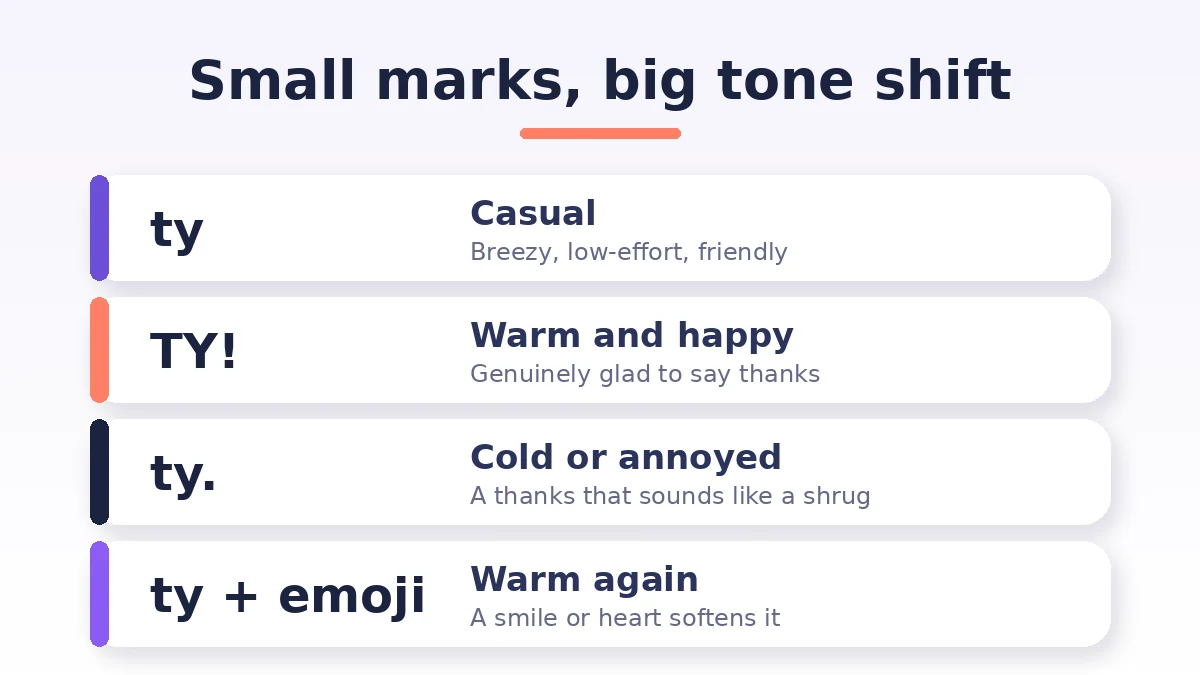
TY has no tone of voice, so punctuation and emojis do the talking — and they can flip the meaning completely.
"ty" in lowercase is the default: breezy, casual, low-effort. "TY" in capitals is louder: enthusiastic from a friend ("TY! You are the best"), or just someone typing with caps lock on. "Ty" with a capital T only is best avoided, because it looks like a person's name.
"ty!" with an exclamation mark is genuinely happy. "ty." with a period is the dangerous one: it can read as annoyed, cold, or "I am acknowledging you because I have to." "ty!!" with two exclamation marks is warm and playful.
Emojis rescue TY. "Ty 🙏" reads respectful. "Ty ❤️" reads heartfelt. "Ty 😊" reads warm and polite. "Ty 😂" reads playful. Without an emoji, a bare "ty" after a big favor can feel dry; with one, the same two letters feel warm.
TY on TikTok, Snapchat, Instagram, and in Texting
TY means "thank you" on every app — but the odds of it landing well change, because each app has its own pace.
In texting, SMS, and WhatsApp, TY is at home: a fast receipt for a file, a link, or an update. On Snapchat, TY is a quick reply to a snap or a story — fast, disposable, and fine, because the whole conversation is fast and disposable.
On Instagram, TY is the standard reply to a compliment: "Love your outfit!" gets "Ty ❤️" back. On TikTok, TY lives in the comments: a creator thanking viewers for praise, or a viewer thanking a creator for a useful video.
In gaming chats and on Discord, TY is the gold standard. When a teammate saves you or shares supplies, you have about half a second to acknowledge it. "Ty for the heal!" is correct, polite, and fast. The same shorthand that keeps a game moving is what BRB means in text.
Who Sent It Changes What It Means
From a close friend, TY is almost always easy: it is the shorthand of people who do not need formalities. A "ty" from a best friend after you send a meme is not low effort; it is intimacy. From a crush or someone you are dating, TY is trickier: a bare "ty" after a thoughtful gesture can read as uninterested, and on a dating app, repeated one-word replies can quietly end a conversation. Adding one more line — "Ty! What made you say that?" — keeps the door open. Honesty about that feeling has its own shorthand: what TBH means in text. From a parent, TY is usually just fast gratitude, though some parents hear brevity as rudeness. From a boss, TY in a quick internal chat is fine if they use it first; in an email to a client or a manager, it reads as careless.
TY vs TYSM vs Thanks vs Thank You
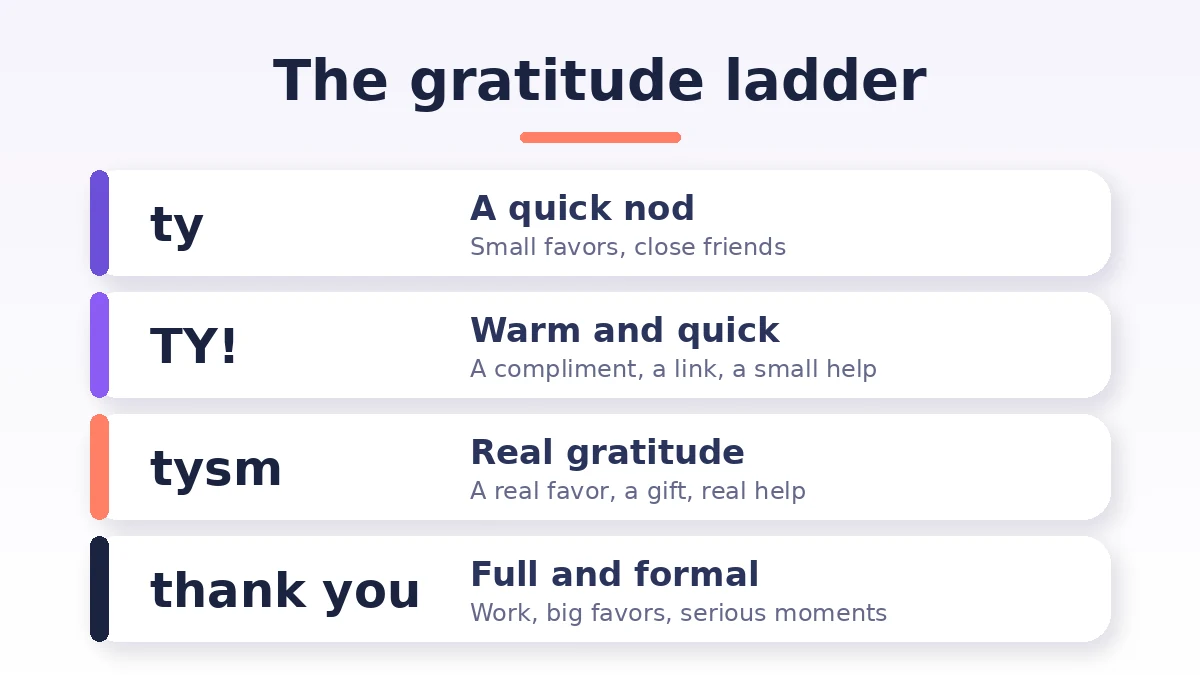
TY is one rung on a ladder, and picking the wrong rung is the most common TY mistake.
TY is the quick nod: "Got it, thanks." Thanks is the everyday default: friendly, complete, and safe almost everywhere. TYSM — thank you so much — is the enthusiastic step up, and what TYSM means in text covers it in full. Thank you in full is the grown-up version: polite, sincere, and appropriate everywhere, including work.
The golden rule is simple: match the energy. If someone sends you a heartfelt message, give them a heartfelt thanks. If they send you a grocery list, "ty" is your best friend.
Other Meanings of TY — and the Ones to Ignore
Most of the time, TY means "thank you" — but the letters have a few other readings.
"Ty" as a name is strongly supported outside messaging. Ty is a person's name, nickname, and brand name, so "Ty" at the start of a sentence can be a person, not a thanks. "Transition year" is strongly supported — in Irish schools only. Wiktionary lists TY as the initialism of "transition year," the school year between junior and senior cycle in Ireland. "Total yield" and "tax year" are contextually supported in niche professional use only.
Meanings to reject outright: TY is not a standard abbreviation for "type," "typical," "technology," or "terabyte" — the abbreviation for terabyte is TB, not TY. "Take your," "trust yourself," and "turn you" are not established definitions either. TY carries no automatic romantic or flirty meaning, and no credible source supports a specific monthly search figure for TY or an exact date for its first use. The opposite of thanks has its own shorthand: what NTY means in text.
TY vs Lookalikes: TYT, TQ, THX, and One to Keep Masked
TY gets confused with its neighbors, and two of them are genuinely ambiguous.
TYT is the trickiest. It is often listed as "take your time," but some guides also read it as "thank you too," and one major guide warns not to teach it as a standard alternative to TY at all. Read the sentence around it: "TYT, no rush" is clearly "take your time," while "TYT!" after a thanks is probably "thank you too."
TQ means "thank you" too, and it is common in Malaysia and Singapore. THX is just "thanks" with the vowels removed. TYSM and TYVM are TY with the volume turned up: "thank you so much" and "thank you very much."
There is also an intensified, profanity-laced variant of tysm that shows up in one guide — spelled out as t-y-s-f-m — used only between close friends who swear at each other anyway. It is not a standard abbreviation, and it never belongs in a polite message or a formal note. Two letters that look almost identical cause a different kind of confusion: what TB means in text.
How to Reply to TY
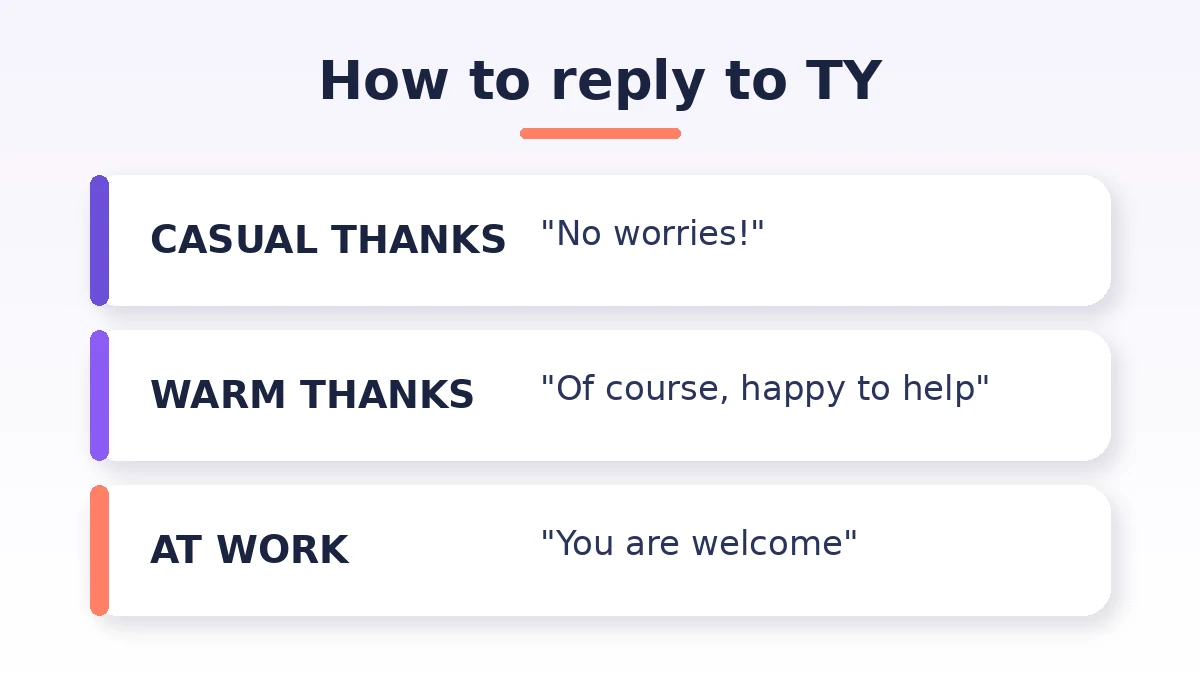
The right reply depends on who thanked you and how much you did. Pick your script by the moment, not by habit.
When the thanks was casual, keep it light: "No worries!" or "Anytime 😊" or "You got it!" When someone thanks you at work, stay professional: "You're welcome" or "Happy to assist."
When you sent TY and it landed badly — someone read your two letters as cold — fix it fast with a real sentence: "Sorry, I just meant thank you — I really appreciate it." When someone thanks you for something big, do not answer with a mirror-image "ty." Upgrade: "That means a lot, thank you." The standard reply to any thanks is what YW means in text.
When Not to Use TY
Leave TY alone for serious or emotional news, where it reads as cold or dismissive, and at work, where a client or a manager may hear "I could not be bothered to type five more letters." Skip it after a big favor, a heartfelt message, or a gift — that is the moment a full sentence earns its keep. Do not use it with anyone who may not know slang, and do not use it as your only form of gratitude for weeks on end: if every thanks you send is "ty," people start to feel your appreciation is cheap.
Watch out for one technical trap: many phones try to autocorrect "ty" to "to" or "the," so you may have to fight your own keyboard to send it at all. If your phone keeps changing it, add "ty" as a text-replacement shortcut in your settings. A laughing reply has its own shorthand too: what LMAO means in text.
Quick Answers About TY
What does TY mean in text?
TY means "thank you." It is a short, informal way to express gratitude in text messages, chats, and social media comments.
Is TY rude?
TY is not rude on its own, but it can sound rude in the wrong moment. A bare "ty" after a big favor can feel low-effort, and "ty." with a period can sound cold or annoyed.
What is the difference between TY and TYSM?
TY means "thank you," while TYSM means "thank you so much." TYSM shows deeper gratitude and fits bigger favors, gifts, and real help.
Can I use TY at work?
In quick internal chats with familiar colleagues, TY is fine. In emails to clients or managers, write "thank you" in full.
What does "ty." with a period mean?
A period can make TY sound brief or slightly cold — sometimes even annoyed. "TY!" or "Ty 😊" sounds warm instead.
Does TY mean anything other than thank you?
In texting, almost never. Outside messaging, Ty can be a person's name, and TY is "transition year" in Irish schools.
What does TYT mean?
TYT is ambiguous: it usually means "take your time," but it is also used for "thank you too." Read the sentence around it, and do not rely on it when clarity matters.
When should I not use TY?
Avoid TY in formal emails, job applications, messages to clients, and after big favors or heartfelt messages. If the moment matters, write the thanks out in full.
The Bottom Line on TY
TY is two letters that say "thank you" — and almost nothing else.
Use it for quick favors, close friends, and fast games. Upgrade it when the effort was real or the moment was big.
