
You’re scrolling and a friend texts: “you have to see the BTS from last night.” Your brain stalls for half a second. Did something happen behind the scenes — or is this about the band? Few abbreviations create that exact double-take, and it’s the whole reason BTS deserves a proper explanation.
In texts and on social media, BTS almost always means “behind the scenes” — the unfiltered, unpolished moments that happen around a photo, video, event, or project. But it’s also the name of one of the biggest music groups on the planet, and context alone decides which one you’re looking at. This guide covers both readings, how BTS actually behaves in sentences, the content it labels, and how to reply when someone sends it.
Two Meanings, One Abbreviation
Let’s settle the big question first. BTS has two legitimate readings, and they’re completely unrelated:
1. “Behind the scenes” — the texting and social-media meaning. The rehearsal before the performance, the mess before the perfect photo, the bloopers after the final cut. When someone shares the process instead of the product, that’s BTS.
2. The K-pop group — BTS (Bangtan Sonyeondan, Korean for “Bulletproof Boy Scouts”), the South Korean group that later added “Beyond the Scene” to its brand identity. In music conversations, fan chats, and pop-culture contexts, BTS means the band, full stop.
Which one wins in a text? The topic decides. Photos, videos, shoots, events, projects → behind the scenes. Music, concerts, albums, fandom → the band. Most everyday texting falls in the first camp; most music talk falls in the second. The confusion lives in the overlap — and we’ll sort that out below.
What “Behind the Scenes” Actually Covers
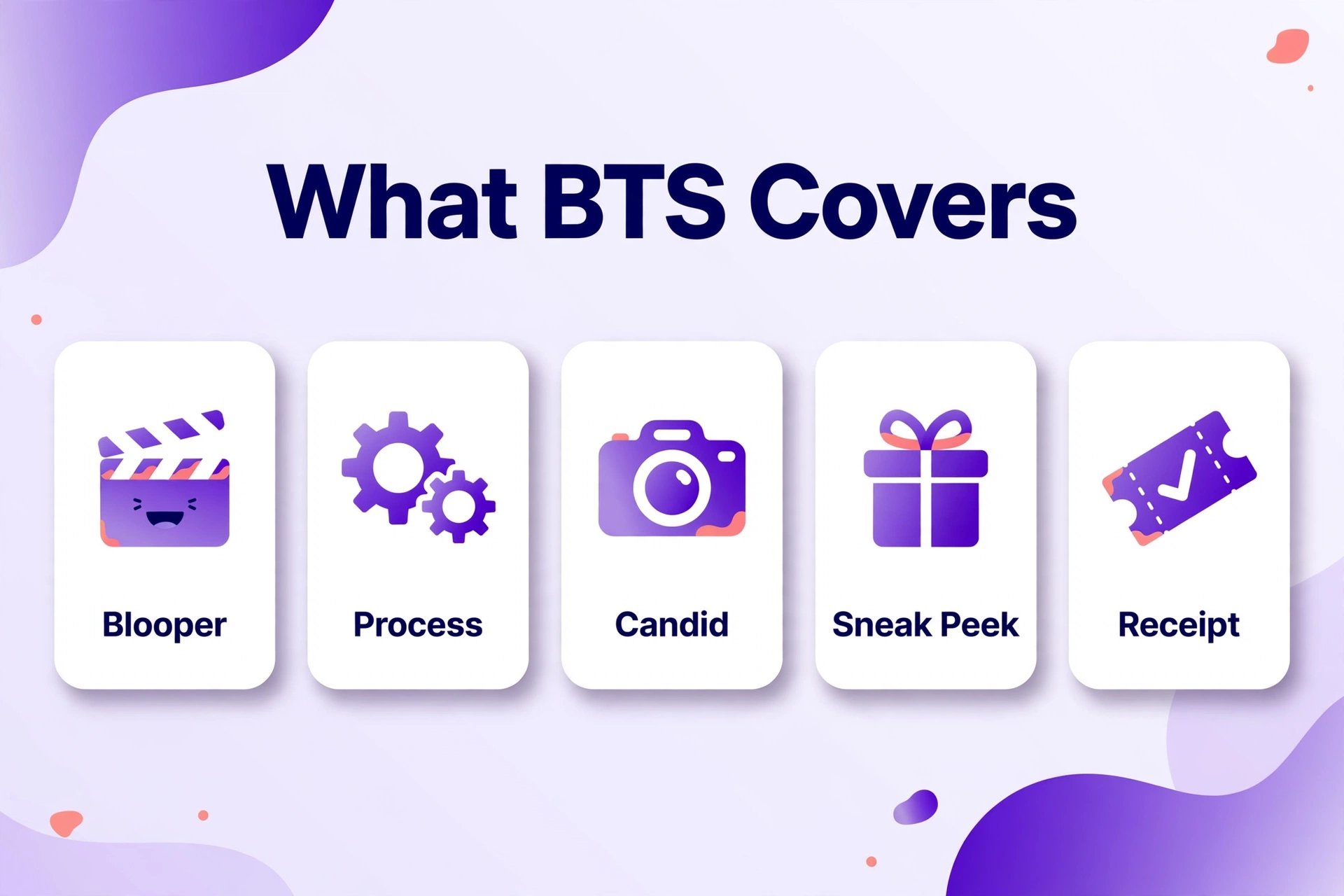
“Behind the scenes” sounds like a film-industry term, and it started that way. In texting, though, it’s become a label for five kinds of unpolished content:
The blooper. The outtake that’s funnier than the final version — the laugh-out-loud moment that didn’t make the cut. “Posting the BTS because I can’t stop laughing at this.”
The process. Setup, rehearsal, drafts, the work before the work. “Here’s the BTS of the wedding setup — six hours for six minutes of photos.”
The candid. Unposed, unfiltered moments around an event. Not the group photo; the chaos five minutes before it.
The sneak peek. A deliberate tease of something unfinished. Creators drip-feed BTS clips because exclusivity builds FOMO — see the mess now, wait for the polish later.
The receipt. Proof it happened: the venue before doors, the cake before the candles. BTS as evidence, not art.
The thread connecting all five: BTS content is valuable because it isn’t the main thing. It’s the human margin around the polished center.
How BTS Behaves in a Sentence
BTS is unusually flexible for an abbreviation. It works three ways:
As a modifier before a noun — the most common job. “BTS footage,” “BTS pics,” “BTS video,” “BTS clips.” It labels the content that follows: this is the unpolished version.
As a standalone noun. “Did you see the BTS?” “The BTS is better than the actual video.” Here it means “the behind-the-scenes stuff” as a category.
As a hashtag or caption tag. “#BTS” on a post signals: what follows is raw, real, unfiltered. It’s a promise about the content’s register, not just its subject.
What it doesn’t do: BTS doesn’t describe people (“he’s so BTS” means nothing) and it isn’t a verb (“let’s BTS this” isn’t a thing). It labels content — that’s its whole job.
BTS in the Wild
The exchanges below are illustrative examples, not real messages.
The creator tease
- Maya: “wedding video is almost done!!”
- Zoe: “drop the BTS first, I know the setup was chaos”
- Maya: “lol you have no idea — posting tonight”
Zoe wants the process, not the product. The BTS is the main event here.
The group-chat share
- Jay: “party pics are up”
- Sam: “the posed ones are mid, send the BTS”
- Jay: “the BTS is unhinged, you’re not ready”
Everyone in the chat understands instantly: BTS = the real, unfiltered shots.
The mix-up (and the save)
- Alex: “BTS just announced a tour!!”
- Robin: “wait, the band??”
- Alex: “no lol — behind the scenes tour of the new studio”
- Robin: “ohhh. you can’t just say BTS like that”
This is the ambiguity in action. Alex meant the content label; Robin heard the band. Two extra words (“tour of the studio”) would have prevented it — which is the whole lesson of this abbreviation.
The patient wait
- Kim: “where’s the final video?”
- Pat: “still editing — BTS now, full cut ETA Friday”
BTS as the appetizer, with a timeframe attached. The ETA does the heavy lifting; the BTS keeps people interested meanwhile.
The K-pop Collision
The band isn’t a footnote — it’s half the reason people search this term. A few honest notes on the collision:
When the band wins: any conversation about music, concerts, albums, charts, or fandom. “BTS tickets,” “new BTS album,” “BTS on tour” — the group, always. Fan communities (the fandom calls itself ARMY) use BTS exclusively for the band.
The grammar test: the band takes verbs and articles like a proper noun — “BTS is performing,” “I love BTS.” The content label takes content nouns — “BTS footage,” “the BTS.” If you can swap in a band name and the sentence still works, it’s the band.
In DMs, clarify once: if you’re texting a K-pop fan about “BTS content,” say “behind-the-scenes” the first time. In a fan chat, unmarked “BTS” will always be heard as the group.
The trivia: the group’s Korean name, Bangtan Sonyeondan, translates roughly to “Bulletproof Boy Scouts” — and in 2017 they added “Beyond the Scene” as an English-language brand meaning. That’s why you’ll see both expansions; neither is wrong.
BTS and Its Neighbors
BTS lives in a small ecosystem of content labels. Here’s how it differs from the ones it gets mixed with:
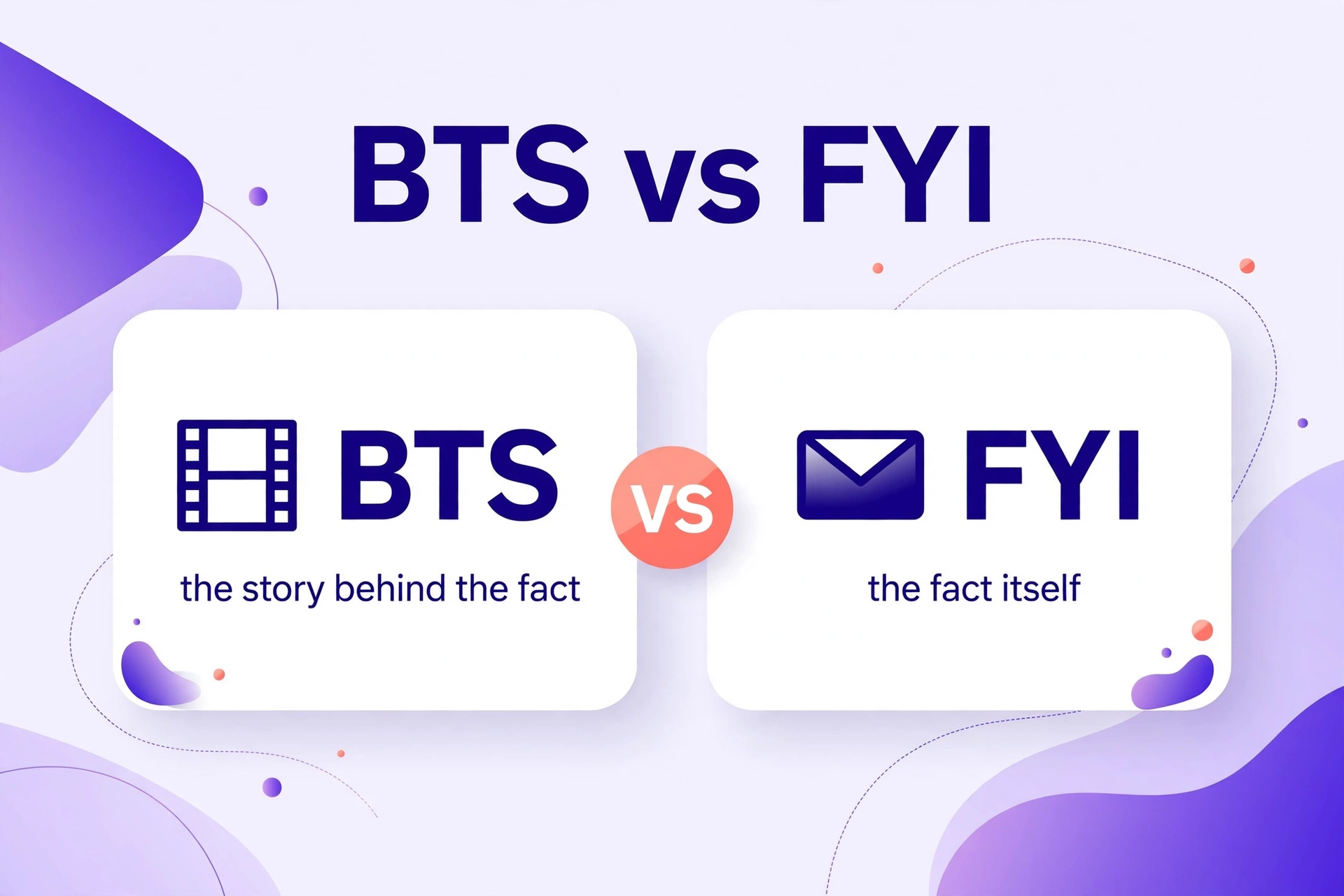
FYI hands you the fact; BTS hands you the story behind the fact. “FYI, the video is live” is information. “Here’s the BTS of making it” is the journey. One informs, the other immerses.
Different jobs — WTW (“what’s the word”) asks what’s happening; BTS shows what happened off-camera. They meet in one natural exchange: “wtw with those BTS clips you promised?” — the question chasing the content.
BTS vs. throwback labels.
BTS is about the process behind current work; throwback content is about the past. A BTS clip from yesterday’s shoot isn’t a throwback — it’s fresh. Time direction is the difference: BTS looks sideways at the present; throwbacks look backward.
Not competitors — partners. Creators post BTS precisely because partial access creates FOMO: you saw the setup, now you need the finale. If someone’s “BTS dump” feels like bait, that’s because it is — friendly bait.
Reading the Room
BTS is casual by design. It fits texts, group chats, DMs, captions, and comments — anywhere the register is informal and the audience knows the shorthand.
Spell it out when the audience might not: work emails, client messages, older relatives, anyone outside internet culture. “Behind-the-scenes footage” costs little and confuses nobody. In a professional context, the abbreviation reads as sloppy even when the meaning is clear.
And in fan spaces, remember the collision: unmarked “BTS” in a K-pop conversation will be read as the band. A few extra words — “behind-the-scenes clip” — cost nothing and prevent the exact mix-up from the dialogue above.
One more: BTS promises rawness. Don’t label polished content as BTS — the audience can tell, and the label loses its meaning when everything gets it.
How to Reply When Someone Sends You BTS
A BTS message is a share, not a question — so your reply is about engagement, not answers.
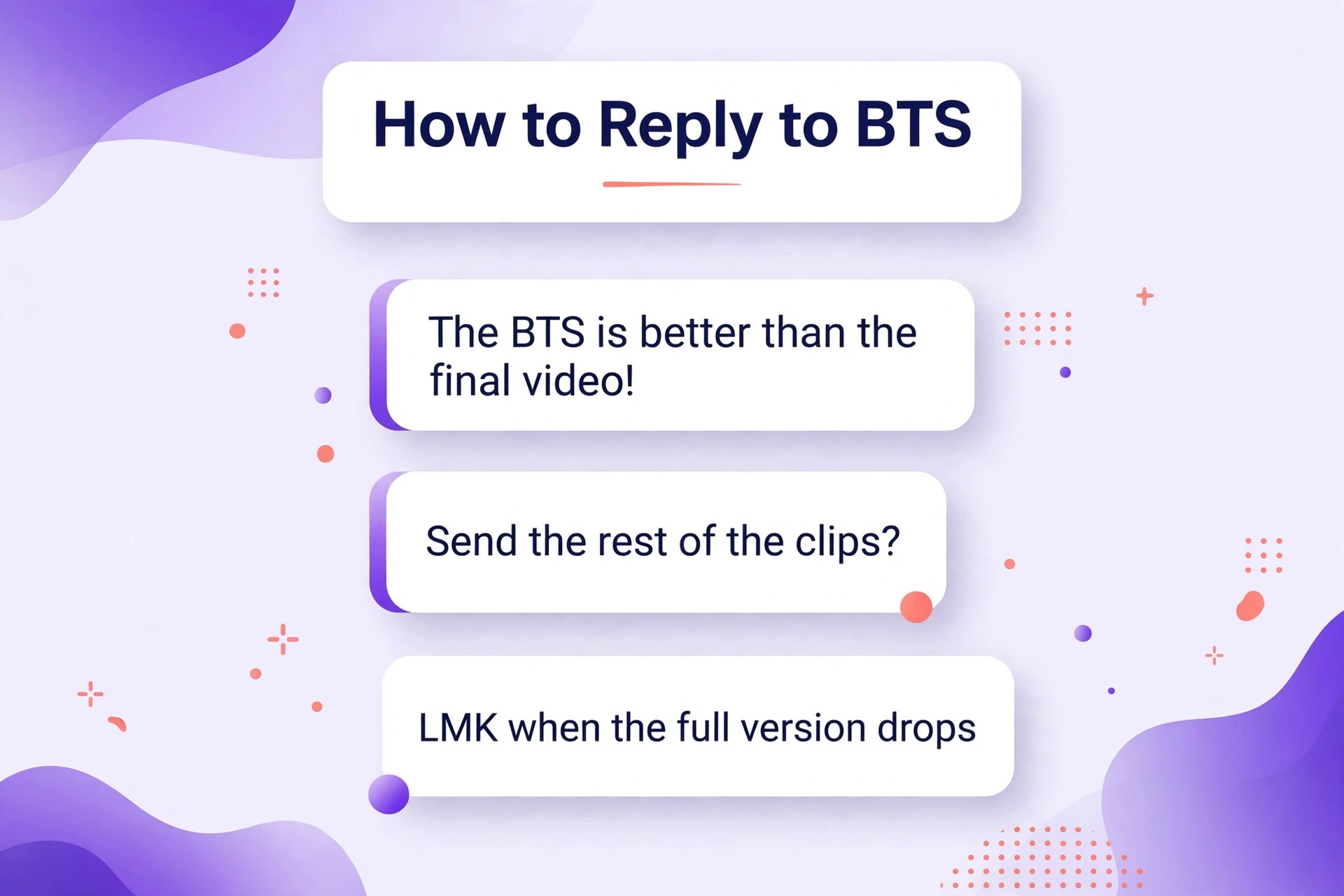
- Enjoy it out loud: “the BTS is better than the final video” — the highest compliment in this economy.
- Ask for more: “wtw with the rest of the clips?” or “lmk when the full version drops” — both keep the exchange alive.
- Match the energy: if they sent chaos, react to the chaos. A flat “nice” under someone’s unhinged BTS is a conversation killer.
- If you meant the band: and they meant the content (or vice versa), laugh it off and clarify: “ohh you meant behind-the-scenes — I thought you meant the group.” The mix-up is common enough that nobody minds.
Quick Answers
Q: What does BTS mean in text?
A: “Behind the scenes” — the unfiltered moments around a photo, video, event, or project: bloopers, setup, rehearsals, candid shots.
Q: Does BTS always mean behind the scenes?
A: No. It’s also the K-pop group BTS (Bangtan Sonyeondan). In music and fan contexts, the band meaning wins. Topic decides.
Q: What’s the difference between BTS the band and BTS the slang?
A: The band is a proper noun — “BTS is touring.” The slang labels content — “BTS footage.” If the sentence is about music, it’s the band; if it’s about photos or videos, it’s behind the scenes.
Q: Can BTS mean “be there soon”?
A: Rarely, and only in messages about travel or arrival (“parking now, BTS”). Don’t assume this reading — it’s the exception, not the rule.
Q: Is BTS formal or informal?
A: Informal. Fine for texts, chats, and captions; spell it out as “behind-the-scenes” in work emails and professional settings.
Q: Why do creators post BTS content?
A: Because rawness builds connection — and because partial access creates FOMO that keeps audiences waiting for the finished piece.
Q: What should I write instead of BTS formally?
A: “Behind-the-scenes” with hyphens, as an adjective: “behind-the-scenes footage.” As a noun phrase: “a look behind the scenes.”
Q: Is BTS only for videos?
A: No — photos, audio, text drafts, events, projects. Anything with a polished final version can have a BTS.
Q: How do I avoid the band/content mix-up?
A: Add one clarifying word: “BTS footage” (content) vs. “BTS tickets” (band). In fan chats, default to spelling out “behind-the-scenes.”
Q: Does BTS have a hidden or flirty meaning?
A: No. It’s a neutral content label — no secret second meaning in texting.
The Short Version
BTS is “behind the scenes” — the bloopers, the setup, the chaos before the polished final version. It’s also one of the world’s biggest bands, and the topic of conversation decides which one you’re looking at. Use it to label unpolished content in casual chats and captions, spell it out for professional audiences and fan spaces, and when someone sends you BTS, do the natural thing: enjoy the mess. Three letters, two meanings, zero confusion — once you know which room you’re in.
