
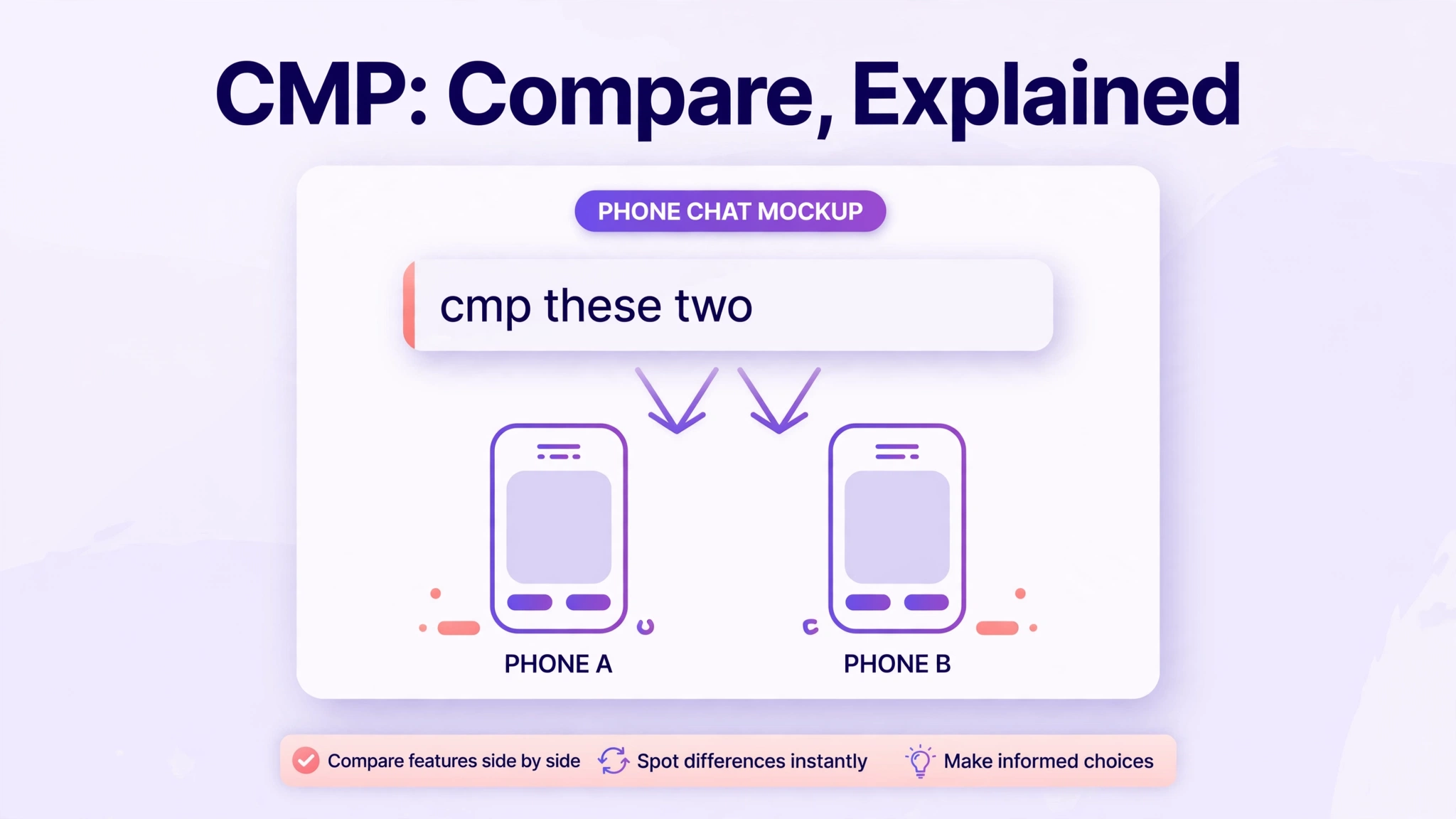
Three letters that are secretly a verb. When someone texts “cmp these two,” they’re not naming a thing — they’re giving an order: compare. CMP is “compare,” clipped to its consonants, and it almost always shows up as a command. That’s the insight most guides miss, and it’s what makes this article different.
If you’re looking up the cmp meaning in text, here’s the honest rebuild: “compare” is the strong, default meaning. The old version of this article taught “complete” and “campaign” as texting meanings — but there’s no evidence for either in real usage. This guide gives you the evidence-honest meaning set, the verb-command insight, the TikTok usage, a disambiguation box for other fields’ CMPs, and a reply playbook.
The Short Answer
| Question | Answer |
|---|---|
| What it means | “Compare” — almost always used as a verb/command |
| What it does | Asks someone to compare two or more things |
| Tone | Casual, direct, efficient — it’s a shortcut, not small talk |
| Where it sits | Usually starts the message: “cmp these two” |
| Register | Casual — texts, group chats, TikTok comments/captions |
| Formal alternative | “Can you compare these?” spelled out |
The Verb-Command Insight
Here’s what nobody articulates: CMP is a verb in disguise. Look at how it actually appears:
- “cmp these two phones”
- “cmp our screenshots lol”
- “cmp the fits”
- “quick cmp: A or B?”
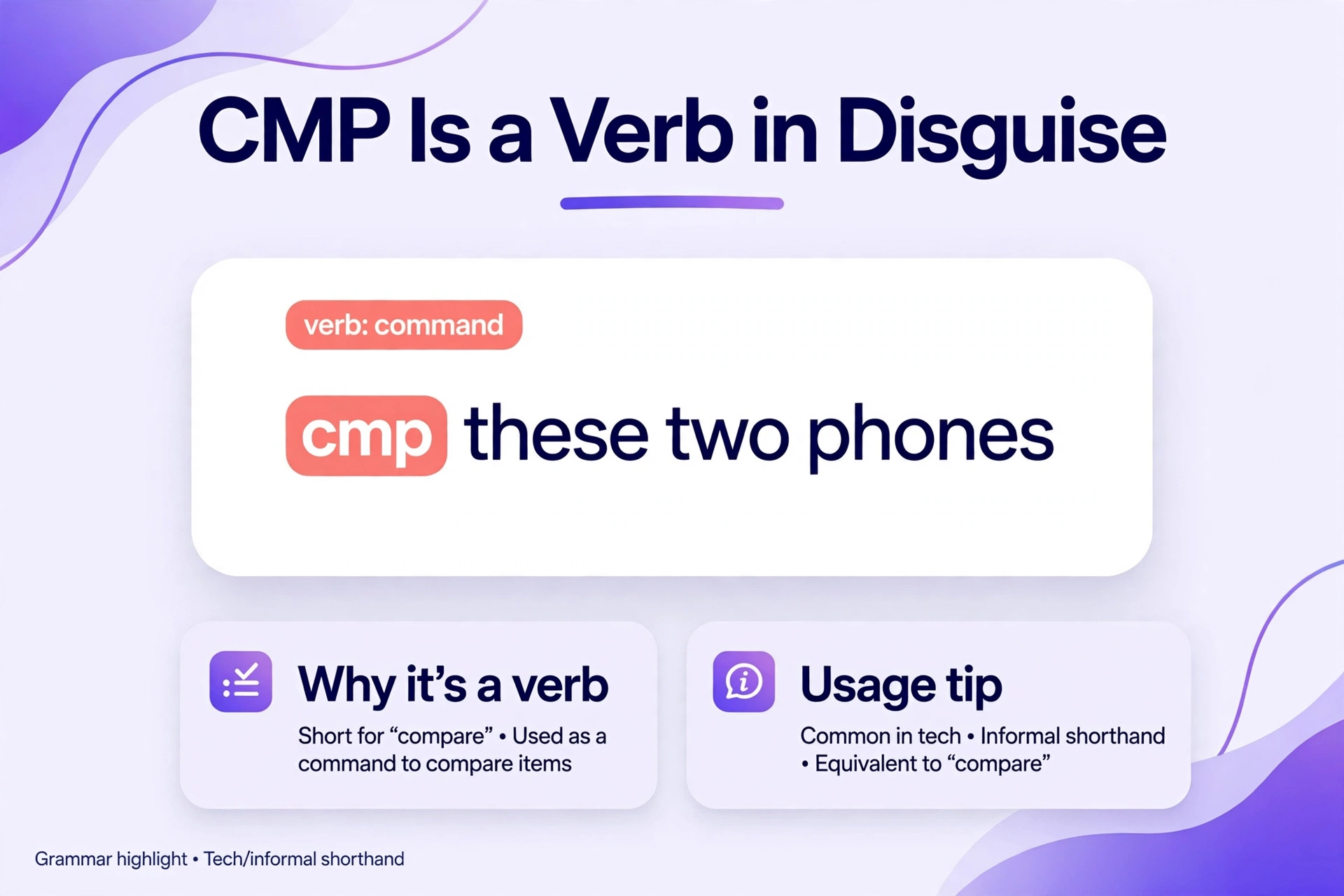
It’s always imperative — do the comparing. Nobody texts “I did a cmp yesterday” or “the cmp was interesting.” The acronym skipped the noun phase entirely and went straight to verb, the way “DM” became “dm me” and “text” became “text me.”
Why? The SMS era. When messages were capped at 160 characters, every keystroke cost money and space. “Compare” is seven letters; “cmp” is three. The clipping wasn’t laziness — it was economics. And the verb form stuck because it’s genuinely useful: “cmp these” is faster to type than “can you compare these,” and in a chat about two phone screenshots, everyone knows exactly what’s being asked.
This grammatical observation is the article’s core differentiator. Once you see CMP as a command, the usage patterns all make sense — including why it feels bossy without a softener (more below). It’s the same verb-first logic behind lmk (“let me know”) — another command disguised as an acronym — and behind gtg in its “good to go” readiness sense. Texting loves the imperative; CMP is just the most honest about it.
The Evidence-Honest Meaning Set
Not every meaning you’ll find online deserves equal weight. Here’s the honest ranking:
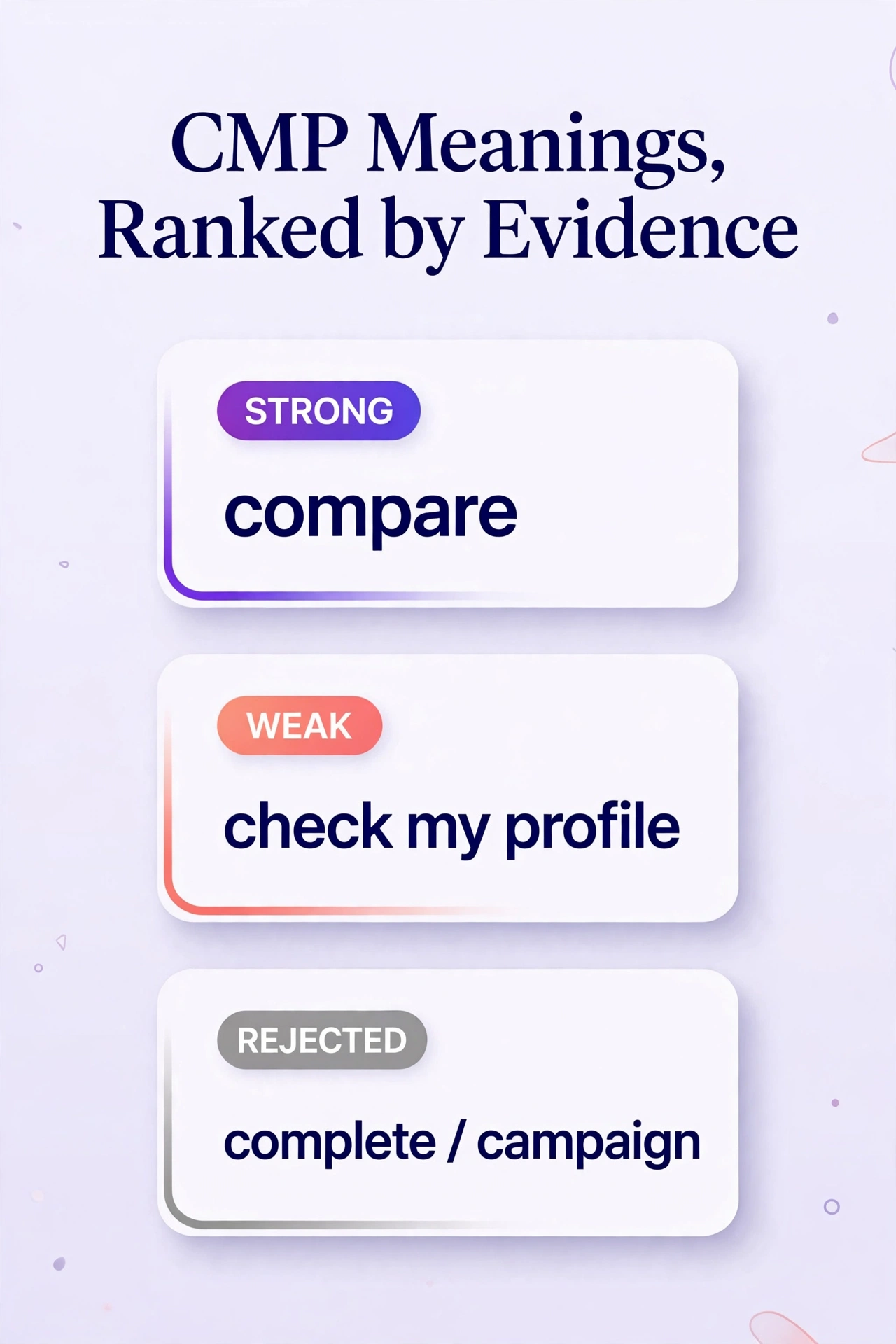
“Compare” — STRONG. The default texting meaning, verified across multiple competitors (dogizle: “most common — default texting meaning”; knowff, punscrunch, socialmediagirlsforum all confirm). Verb-command usage: “cmp these two options.” TikTok caption usage: “cmp the fits” (compare the outfits). This is CMP in texting, full stop.
“Check my profile / check my post” — LOW, hedged. A couple of sources list this as occasional usage. It exists, but it’s niche — and it overlaps confusingly with the verb reading (“cmp my profile” could mean compare my profile or check it). Present as occasional, not primary.
“Call my phone” — very low. One low-quality source. Mentioned here so you know it exists; don’t use it, don’t expect it.
“Complete” — no support found. The old article taught this as a texting meaning (“Report CMP and submitted”). No external source supports it in texting usage. The confusion likely comes from work-chat status shorthand (“c’mplt”) or project management — not from anyone texting “cmp” to mean “complete.” Cut.
“Campaign” — not a texting meaning. A real word in marketing (“ad campaign”), never a texting abbreviation. The old article’s “CMP performance increased” examples read invented. Cut.
The pattern: the old article padded its meaning set with guesses. This one doesn’t. “Compare” does the heavy lifting; everything else is footnoted honestly.
Other Fields, Other CMPs (the Disambiguation Box)
CMP is a busy acronym outside texting. None of these are texting meanings, but you’ll meet them in search results — here’s the quick map so you don’t get confused:
- Marketing: “Campaign” — ad campaigns, email campaigns. (“Our Q3 CMP launches Monday.”)
- Tech: “Content Management Platform” — software for managing digital content.
- Finance: “Current Market Price” — what an asset is worth right now.
- Semiconductors: “Chemical Mechanical Planarization/Polishing” — a chip-manufacturing process.
- Medicine: “Comprehensive Metabolic Panel” — a blood test.
- Events: “Certified Meeting Professional” — a credentials acronym.
If the conversation is about chips, blood tests, or ad spend, it’s one of these. If it’s a text about two photos, it’s “compare.” Context is absolute.
CMP on TikTok and Social
The verb-command found its natural habitat on TikTok, where comparison is content:
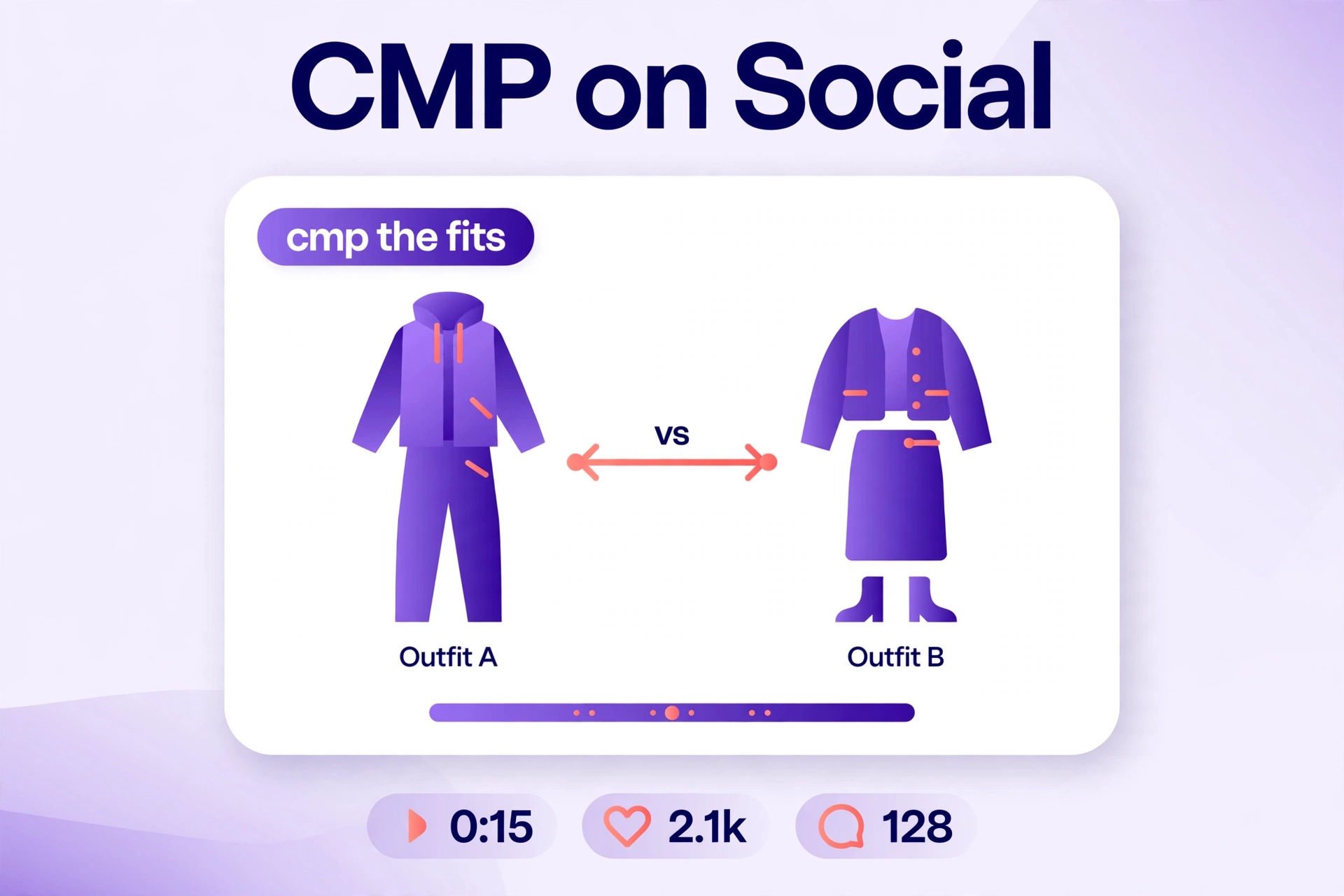
- Captions: “cmp the fits 🔥” — inviting viewers to judge two outfits.
- Comments: “cmp 1 vs 3” — voting in a comparison video.
- Hashtags: #cmp on comparison posts.
This is CMP at its most native: public, visual, imperative. The TikTok usage confirms the verb reading — nobody captions a video “complete the fits.” It’s always compare.
The social version also softens the bossiness (below), because the command is aimed at an audience, not a person. “Cmp these 👇” to a million viewers reads as engagement; “cmp these” to one friend reads as an order. Same letters, different social weight.
Tone Forensics: The Bossiness Problem
CMP’s verb form makes it efficient — and occasionally rude. A bare command with no softener reads as an order:
- “cmp these” — direct. Fine between close friends; bossy to anyone else.
- “cmp these two pls” — the softener fixes it. Three extra letters, completely different tone.
- “quick cmp?” — the question form. Turns the command into a request.
- “cmp??” — impatient. The double question mark adds pressure.
- “can you cmp these for me 🙏” — the full polite version. For anyone you don’t text daily.
The rule: CMP is a tool for speed, and speed reads as brusqueness. With friends, the bare form is fine — efficiency is the love language of close chats. With anyone else, add “please,” make it a question, or spell it out. The three letters you save aren’t worth the tone you lose.
CMP in Real Conversations
The exchanges below are illustrative examples, not real messages.
The phone debate
- Alex: sends two phone screenshots
- Alex: “cmp these two, which camera is better?”
- Riley: “second one, no contest 📸”
Textbook verb-command. The screenshots are the context; “cmp” is the instruction.
The TikTok comment
- Video: creator tries on three outfits
- Comment: “cmp 1 vs 3 🔥”
Public comparison-voting. The imperative is aimed at the audience, and the fire emoji marks it as enthusiastic, not bossy.
The softened request
- Sam: “can you cmp these two apartments for me? 🙏”
- Jordan: “on it, give me 10 min”
“Can you” + “for me” + emoji = the polite stack. Same request as the bare “cmp these,” completely different feel.
The ambiguous one
- Casey: “cmp my profile”
- Morgan: “compare it to what? 😅”
The “check my profile” reading collides with the verb reading. Morgan’s reply — “compare it to what?” — is the right move: it surfaces the ambiguity with humor instead of guessing wrong.
The WYA pivot
- Taylor: “cmp these restaurants”
- Jamie: “wya? I can just meet you at the better one lol”
Jamie answers the comparison and moves the conversation forward. The wya pivots from deciding to doing — which is usually what the “cmp” was for in the first place.
How to Reply to “cmp this”
- You can compare: just do it. “Second one — better battery, worse camera” is the complete reply.
- You need context: “cmp with what?” — fair and common. The command assumes shared context; if you don’t have it, ask.
- It’s bossy: “sure! which two?” — polite, and it gently notes that the bare command needed softening.
- On TikTok: vote. “1 🔥” is the whole exchange. That’s the point of the caption.
- You disagree with the premise: “they’re not really comparable tbh” — honest and fine. Not everything needs a winner.
- You want to move past deciding: once the comparison’s done, pivot to action. “Second one’s better — wya? let’s go get it” turns the verdict into plans. (And if the whole thing was about leaving, brb is the exit, not “cmp.”)
CMP vs Its Neighbors
CMP doesn’t live alone — it has cousins in the comparison/request family, and knowing the differences keeps you precise:
CMP vs lmk. Both are commands, but they ask for different things. “Cmp these” wants judgment (which is better?); “lmk” wants information (what’s the answer?). “Cmp the apartments” → pick one. “Lmk what you decide” → tell me later.
CMP vs “rate.” TikTok’s “rate this 1-10” and “cmp 1 vs 3” do similar jobs, but “rate” asks for a score while “cmp” asks for a choice. Rating is absolute; comparing is relative.
CMP vs ttyl. Unrelated meanings, but they often appear in the same conversations — the comparison happens, a decision gets made, and someone wraps with “ttyl.” The acronyms are bookends: CMP opens the deliberation, TTYL closes the chat.
CMP vs mb. You’ll see them together when a comparison goes wrong: “cmp these — oops wrong pics, mb” — the fastest correction in texting. The “my bad” cleans up the “compare” instantly.
Quick Answers
What does CMP mean in text?
“Compare” — almost always used as a verb/command: “cmp these two” means compare these two.
Is CMP a verb?
Functionally, yes. It appears as an imperative (“cmp this”) far more than as a noun. The verb form comes from SMS-era clipping.
Does CMP mean “complete”?
No — there’s no evidence for “complete” as a texting meaning. The old article taught it, but no source supports it. Don’t use it.
Does CMP mean “campaign”?
Not in texting. “Campaign” is a marketing term; it’s never abbreviated to “cmp” in chats.
What does “cmp the fits” mean?
“Compare the outfits” — TikTok caption/comment usage inviting viewers to judge between looks.
What does CMP mean on TikTok?
Same as texting: “compare,” usually as a caption or comment inviting comparison (“cmp 1 vs 3”).
How do I reply to “cmp these”?
Do the comparison, or ask “compare with what?” if you lack context. On TikTok, just vote.
Is “cmp” rude?
The bare command can read as bossy to anyone outside your inner circle. Add “please” or make it a question (“quick cmp?”) for anyone else.
The Short Version
CMP is “compare” — a verb in disguise, born from SMS-era clipping, living its best life as a command: “cmp these two.” The old article’s “complete” and “campaign” meanings had no evidence; this one cuts them and says so. Learn the verb-command insight, soften it for anyone outside your inner circle (“can you cmp these? 🙏”), know the TikTok usage (“cmp the fits”), and keep the other fields’ CMPs (marketing, medicine, chips) in their own box. Three letters, one job: compare.
