
You open a second app and there it is, alone in the chat: “CYC.” Nothing before it, nothing after it. No link, no photo, no “I just sent you something.” You stare at it the way you would stare at a signpost in an empty field. It is pointing, but at what?
That confusion is the whole story of the cyc meaning in text, and it is also why most explanations of it are wrong. They pick one expansion — usually “Check Your Chat” — print it as the answer, and move on. But CYC does not have one answer. Ask ten guides and you will get ten expansions: check your chat, check your comments, see you around, see you soon, catch you later, call you cell, create your character, check your calendar. A word with that many supposed meanings does not have a meaning problem. It has a pointing problem. CYC is not a message. It is an arrow, and an arrow is only useful if you can see what it is pointing at.
CYC Meaning at a Glance
| Term | CYC |
| Job | A pointer: “go look at the thing I already sent” — or, at the end of a chat, a casual farewell |
| Strongest readings | “Check Your Chat” in private chats; “Check Your Comments” in comment threads |
| Farewell readings | “See You Around,” “See You Soon,” “Catch You Later” — when CYC closes a conversation |
| Tone | Neutral to friendly, always casual |
| Common in | Texts, WhatsApp, Instagram DMs and comments, TikTok comments, Snapchat chats |
| Example | “Just sent the photos — CYC.” |
| Watch out for | A bare CYC with nothing sent first: an arrow pointing at nothing |
| Formal alternative | “Could you check the message I just sent?” |
One honest warning before anything else: no major dictionary entry for texting-slang CYC was verified while researching this guide, and no usage study ranks its meanings. That is not a gap in this article. It is evidence. CYC has never settled the way BRB or TTYL settled, and any guide that crowns one meaning as “the” meaning is guessing.
Run the Arrow Test
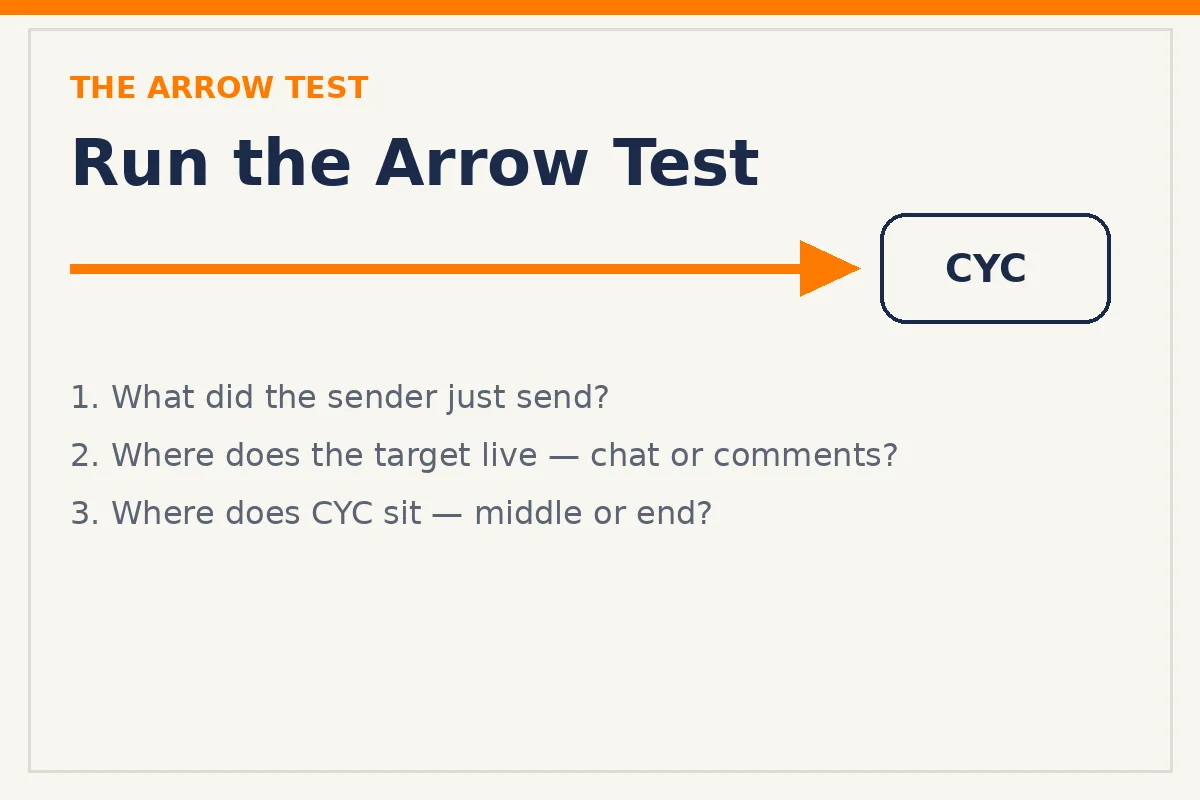
Here is this article’s named method. Call it the Arrow Test, because that is what CYC is: three letters shaped like an arrow, pointing backward at something that already happened. Run it on any CYC you receive, in this order, before you reply.
Check 1: What did the sender just send? An arrow needs a target. Scroll up, switch apps, check the other thread. Did this person send you a message, a photo, a file, a comment reply, or a tag in the last few minutes? If yes, CYC almost certainly means “go look at that.” If no — if CYC arrived alone, with nothing before it anywhere — then the pointer reading fails, and you are probably looking at a farewell or a misfire.
Check 2: Where does the target live? A target in a private chat gives you “Check Your Chat.” A target in a public comment thread gives you “Check Your Comments.” Same arrow, different address — and the address is decided by the room, not by the letters. Ask “where would I look?” and the expansion follows.
Check 3: Where does CYC sit in the conversation? A CYC in the middle of an exchange is a pointer: the conversation is still open, and something needs your eyes. A CYC at the very end, after the goodbyes have started, is a farewell: “see you around” in three letters. Position is the tiebreaker when Checks 1 and 2 are unclear. “Gotta run, CYC” is not asking you to check anything. It is waving.
The Two Pointer Readings: Check Your Chat, Check Your Comments
These two readings are really one job with two addresses, and they are the strongest readings CYC has.
“Check Your Chat” is the private-room version. It shows up when the sender has put something somewhere you have not looked yet: a message in another app, a photo in your DMs, a file in the group chat. The classic shape is a two-part delivery: the thing first, the arrow second. “Sent you the address, CYC.” “CYC, I just texted you the details.” In each case CYC adds no new information. It adds urgency and direction: stop scrolling here, go look there. That is also why it fails so badly on its own. “CYC” with no prior message is like a tour guide pointing at an empty room.
“Check Your Comments” is the public-room version. It lives on Instagram, TikTok, and anywhere a conversation happens in public under a post. “CYC, I replied to you” means: scroll back up the thread, my answer is there. The tell is the word “above” or “there” hiding nearby, or the fact that the conversation is happening in comments at all. Nobody says “check your comments” about a private DM, and nobody says “check your chat” about a public thread, so the room you are standing in usually settles this one before you even think about it.
A third pointer reading, “Check Your Cell,” shows up in some guides: the same job with a clumsier address. Reach for it only when the chat and comment readings both fail.
The Farewell Readings: See You Around, See You Soon, Catch You Later
Now the other half of CYC, and the reason it confuses people who only know the pointer reading. At the end of a conversation, CYC can be a wave rather than an arrow. “Gotta run, CYC.” “Great catching up — CYC!” In these, nobody is asking you to check anything. The conversation is closing, and CYC is doing the job of “see you around” or “catch you later”: a friendly exit without a fixed plan.
How do you tell a farewell CYC from a pointer CYC? Check 3 of the Arrow Test does the work. A farewell CYC comes with exit language: “gotta go,” “great talking,” “later.” A pointer CYC comes with delivery language: “sent,” “just posted,” “tagged you.” If the sentence around CYC is about leaving, read it as a farewell. If it is about something sent, read it as a pointer.
One caution about the farewell family: the letters C-Y-C do not spell “see you around,” “see you soon,” or “catch you later” in any clean way. Firm abbreviations spell themselves — TTYL is literally “talk to you later” — while CYC’s farewell readings are more like vibes a community attached to three handy letters. That looseness is another reason this article refuses to crown one expansion.
CYC on Text Messages, WhatsApp, Instagram, TikTok, and Snapchat
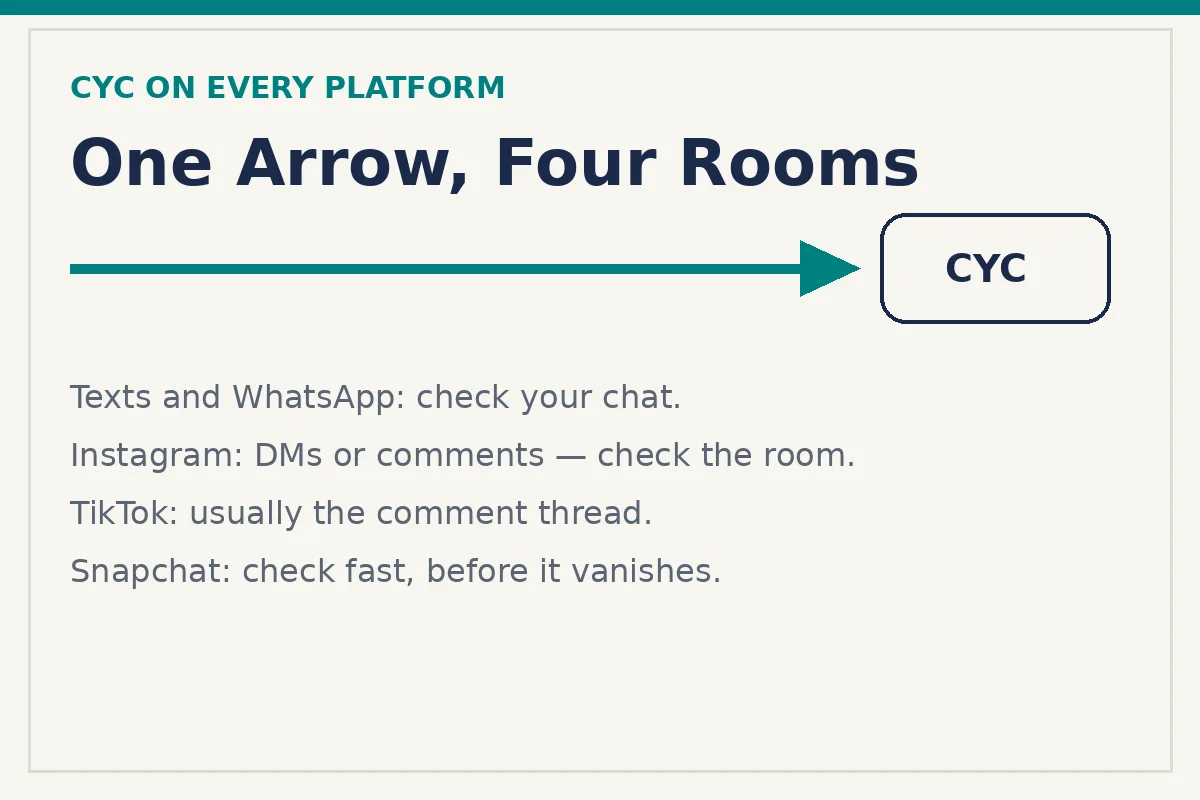
CYC’s meaning does not change by platform, but the room changes which reading to expect first.
Text messages and WhatsApp. This is the pointer’s home turf. In one-to-one texts, CYC almost always means “Check Your Chat,” because texts are where the second delivery happens: the photo went to WhatsApp, the arrow lands in SMS, or the other way around. “Sent it on WhatsApp, CYC” is the purest example in this whole guide. In group chats, CYC does the same job at scale: “CYC, I dropped the plan above” points the whole group at one message they may have missed in a busy thread.
Instagram. Instagram splits CYC in two, which is why it confuses people. In DMs, it is “Check Your Chat”: a friend who sent something to your inbox and nudges you from another channel. In comments, it is “Check Your Comments”: a reply under a post, pointing you back to the thread. The same person can mean two different things on the same app in the same hour, and the Arrow Test’s Check 2 — where does the target live? — is the only reliable way to tell them apart.
TikTok. TikTok is comment-thread territory. Creators reply to comments with CYC when they want a commenter to find the answer they already posted, and viewers use it to point each other at replies buried in long threads. If you see CYC on TikTok, start with “Check Your Comments” and only switch if the conversation is private.
Snapchat. Snapchat is the hardest room for CYC, and the most honest place to admit it. Chats disappear, stories expire, and a pointer to something that no longer exists is useless. “CYC” on Snapchat usually means “check the Snap I just sent before it vanishes,” and the urgency is real. If you open the chat and find nothing, the Snap may already be gone — reply “missed it, resend?” rather than guessing at another meaning.
Sender Context: Who Sent It Changes the Read
The same three letters land differently depending on who typed them. Read the sender before you read the arrow.
From a friend, CYC is routine plumbing. Friends send things across apps all day — a meme on Instagram, the plan on WhatsApp, the photo in the group chat — and CYC is the nudge that keeps the plumbing from leaking. A friend’s bare CYC is almost always a pointer with a target you can find by scrolling. If you cannot find it, ask; friends do not mind the question.
From a crush, CYC is usually still plumbing, but the temperature is higher. A crush who writes “CYC, sent you something” wants you to look quickly, and the thing they sent is the message that matters, not the arrow. Do not over-read the CYC itself — it carries no flirtation of its own. Read the thing it points at.
From a partner, CYC is shorthand inside a shared system. Partners know each other’s apps and threads, so a partner’s CYC can be extremely compressed: “CYC” alone, sent two minutes after a photo, needs no explanation. The risk is assumption: if you genuinely cannot find the target, say so fast, because a partner may wait on a reply that never comes.
From a group chat, CYC is a broadcast pointer. It means someone in the group missed a message. The polite response is to check before asking what it is, because the answer is usually sitting right there. The rude version is a CYC aimed at one person with no name attached, in a group of twenty — name the person or quote the message, or your arrow points at everyone and therefore at no one.
From a stranger, CYC is a yellow flag. A stranger has no shared threads with you, so a pointer from them usually points at a comment you left somewhere public, or at a trap: a link, a pitch, or a thread they want you to open. Run the Arrow Test strictly here. If there is no target you recognize, do not go looking for one in unfamiliar places.
From a boss or coworker, CYC is a red flag — about the choice, not the sender. An ambiguous three-letter pointer is the worst possible work message: it demands attention without saying what deserves it. If a coworker sends it, answer with the target, not a guess: “Got it, checking the file now” if you found it, or “Which message do you mean?” if you did not. Never send CYC at work yourself.
How to Reply to CYC: The Reply Playbook
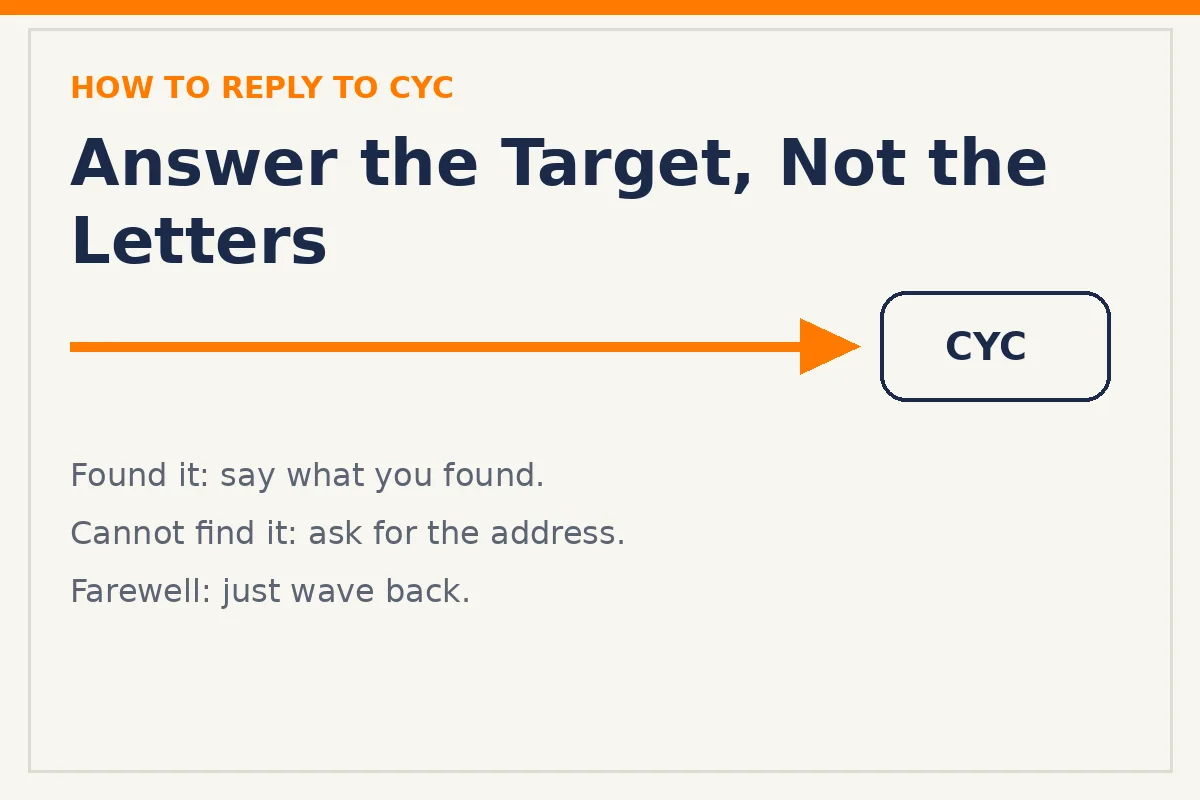
Replying well to CYC means answering the arrow, not the letters. Three moves cover nearly every case.
If you found the target, say what you found. “Got it, love the photos.” “Read the comment, replying there.” “Saw the plan, I’m in.” This closes the loop the sender opened and proves the arrow worked. The worst reply to a pointer CYC is a bare “ok,” which tells the sender nothing about whether you actually looked.
If you cannot find the target, ask for the address, not the meaning. “Check where, sorry — the chat or the comments?” “I don’t see anything new, can you resend?” This is faster and kinder than “what does CYC mean?” because it assumes the sender had a real target and just pointed badly.
If it was a farewell, wave back. “CYC! Talk soon.” A farewell CYC needs no more than a mirror. Do not reply to a farewell with a hunt through your chats for a target that was never sent — that is the Arrow Test’s most common failure mode, and it turns a goodbye into a chore.
And when you send CYC yourself, earn the arrow. Send the thing first, then the pointer, and add one word about what it is: “CYC — the photos.” That single extra word is the difference between a helpful nudge and a riddle.
CYC vs Similar Terms
| Term | What it does | How it differs from CYC |
|---|---|---|
| DM | Names a private room | DM is the room; CYC points at something inside a room |
| LMK | Asks for a future answer | LMK waits for something new; CYC points at something already sent |
| FYI | Flags information you should have | FYI carries the information; CYC only points at it |
| BRB | Announces a short absence | BRB is about the sender leaving; CYC is about you looking |
| TTYL | Closes a chat with a promise of later | TTYL ends the conversation; a pointer CYC keeps it going |
| HBU | Returns a question to you | HBU asks about you; CYC asks you to look somewhere |
| WYA | Asks where you are | WYA asks for your location; CYC asks for your attention |
The comparison that matters most is CYC vs LMK: they point in opposite directions in time. LMK points forward, at an answer that does not exist yet. CYC points backward, at a message that already does. Mix those up and you will either wait for something already sent, or hunt for something nobody has written yet.
Mistakes, Misreadings, and When Not to Use CYC
The bare-arrow mistake. Sending CYC without sending anything first is the original sin of this abbreviation, and the old article’s best advice — always send the message first — remains the rule. A bare CYC is not mysterious or efficient. It is a signpost in an empty field.
The “Call You Cell” trap. Some guides claim CYC means “Call You Cell,” as in “I will call your phone soon.” The phrase is ungrammatical, the reading appears in almost no other guide, and it confuses CYC with a phone call nobody promised. Do not repeat this reading as if it were established.
The gaming mix-up. In gaming communities, CYC can mean “Create Your Character,” on character-creation screens and in role-playing discussions. That reading is real in its own room and irrelevant in a text chat.
The CYA confusion. CYC is not CYA. CYA is a farewell (“see ya”) that also carries a vulgar second expansion (“cover your a**”), and the two terms share only their first two letters and their casual register.
When not to use CYC at all. Never at work, never in a formal message, never with someone who does not text much, never as the only message in an important exchange, and never when the target matters enough that missing it has consequences. In all of those cases, write the full sentence.
Quick Answers
What does CYC mean in text?
CYC has no single settled meaning, which is the honest answer and the useful one. In private chats it usually means “Check Your Chat,” and in comment threads it usually means “Check Your Comments” — one pointer job with two addresses. At the end of a conversation it can also be a farewell, along the lines of “See You Around” or “Catch You Later.”
Is CYC the same as “Check Your Chat”?
Not exactly. “Check Your Chat” is the strongest reading in private chats, and it is the reading the old article crowned as the only answer. But CYC also points at comment threads, and it also closes conversations as a farewell. Use the pointer reading when there is something to point at, and the farewell reading when the conversation is ending.
What does CYC mean on Instagram?
It depends on the room inside Instagram. In DMs, CYC means “Check Your Chat”: someone sent you something privately and is nudging you toward your inbox. In comments under a post, it means “Check Your Comments”: someone replied in the thread and wants you to find it. The same app, two addresses.
What does CYC mean on Snapchat?
Usually “check the Snap I just sent before it disappears.” Snapchat’s disappearing messages give CYC a real deadline: the arrow points at something with a timer on it. If you open the chat and find nothing, the Snap may already be gone — reply “missed it, resend?” rather than guessing at another meaning.
Is CYC formal or rude?
Neither. CYC is informal, always — too casual for work emails, client messages, or anything formal — but it is not rude by itself. It is neutral to friendly, and its tone comes entirely from the message it points at and the relationship behind it. The one form that reads badly is the bare CYC with no target: not rude, exactly, but careless.
Should I use CYC every day?
No, and this is where the old article’s advice was weakest. CYC is a poor daily default precisely because so many readers will not know it and because its meaning changes with the room. Use it only with people who already understand the pointer job, and only when you have actually sent something first. For everyone else, and for anything important, write it out: “Could you check the message I just sent?”
The Short Version
CYC is an arrow, not a message. Most of the time it points backward at something the sender already sent — a chat message in private, a comment reply in public — and sometimes, at the end of a conversation, it waves instead: see you around, catch you later. The guides that crown one expansion are all partly right and all incomplete, because CYC never settled the way firmer abbreviations did. Run the Arrow Test on every one you get — what was just sent, where does it live, where does CYC sit — and when you send one yourself, earn the arrow: send the thing first, and say what it is.
