
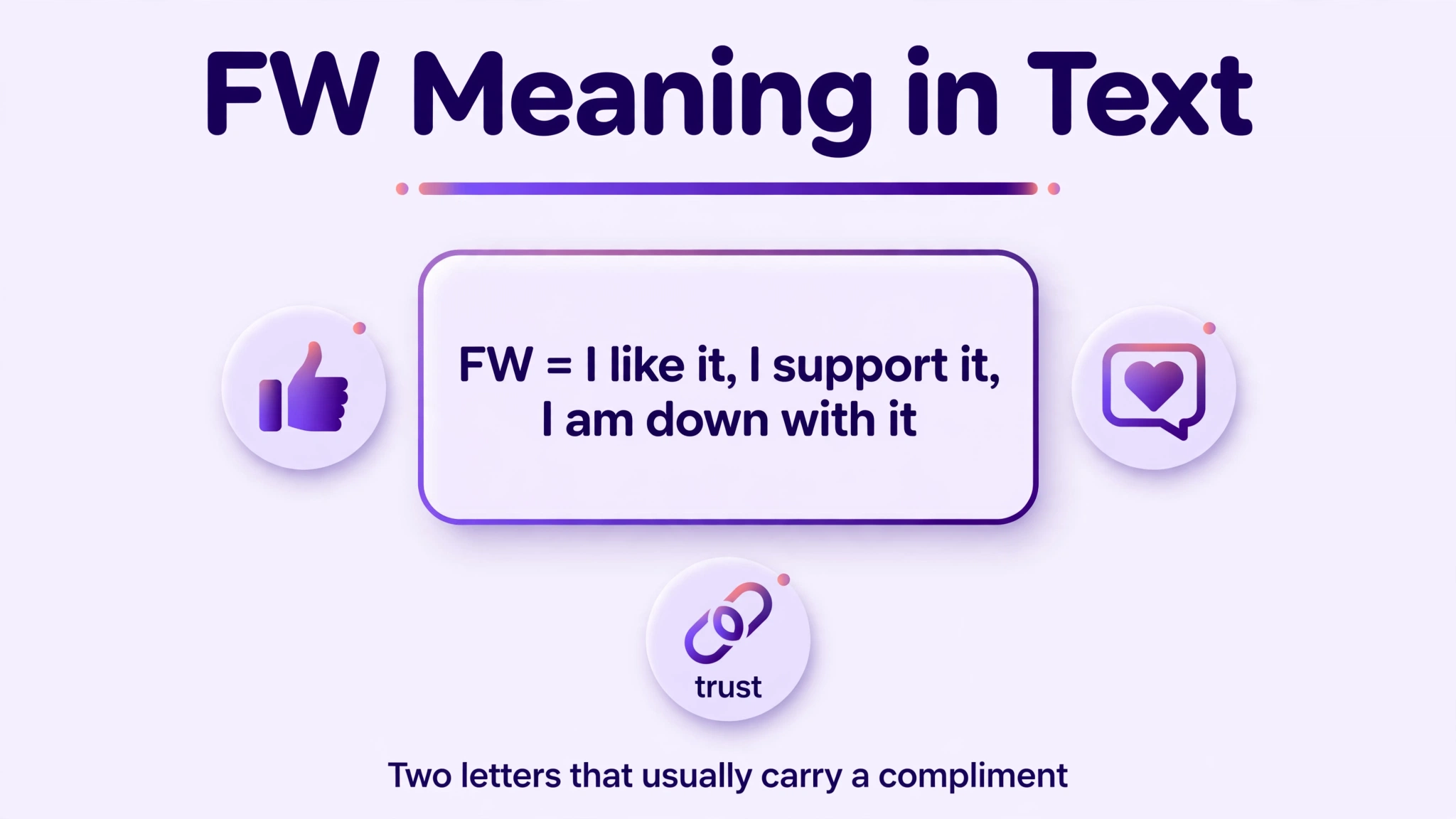
Two letters that confuse everyone the first time: “ngl I fw you.” Is that an insult? A threat? Surprisingly, it’s a compliment. If you’re looking up the fw meaning in text, this guide covers the main slang meaning, the small word that flips it completely, the completely separate email meaning, and how to reply when someone says it to you.
In texting, FW stands for “f*ck with” — but the slang phrase doesn’t mean what it sounds like. In everyday use, “I fw you” means I like you, I trust you, I’m down with you. It’s approval compressed into two letters. The catch: add one small word — “don’t” — and the whole thing reverses into rejection. FW is less about the letters than about the company they keep.
The Short Answer
| Question | Answer |
|---|---|
| What it means | “F*ck with” — slang for liking, supporting, or vibing with someone or something |
| What it does | Expresses approval and connection: “I’m into this,” “I trust you,” “I support this” |
| The flip | “I don’t fw that” reverses it: I don’t like it, I don’t deal with them |
| Other meaning | In email, “FW:” means “forward” — a forwarded message; unrelated to the slang |
| Tone | Warm and casual in slang use, despite the strong word inside it |
| Register | Very casual only — friends, comments, DMs; never work or family-formal chats |
| Formal alternative | “I really like that,” “I support this,” or “I’m a fan of” spelled out |
What “I FW You” Actually Means
Start with the surprise: the phrase inside FW sounds aggressive, but the slang built on it is mostly positive. To “fw” a person or thing in current slang is to associate with it willingly and gladly — to like it, back it, and be seen with it.
The phrase comes out of African American Vernacular English and hip-hop usage, where “f*cking with” someone meant dealing with them, rolling with them, being in their corner — long before it was shortened to two letters for texting. That history is why the meaning bends positive: the phrase was never mainly about conflict. It was about allegiance. “I fw you” says you’re my people.
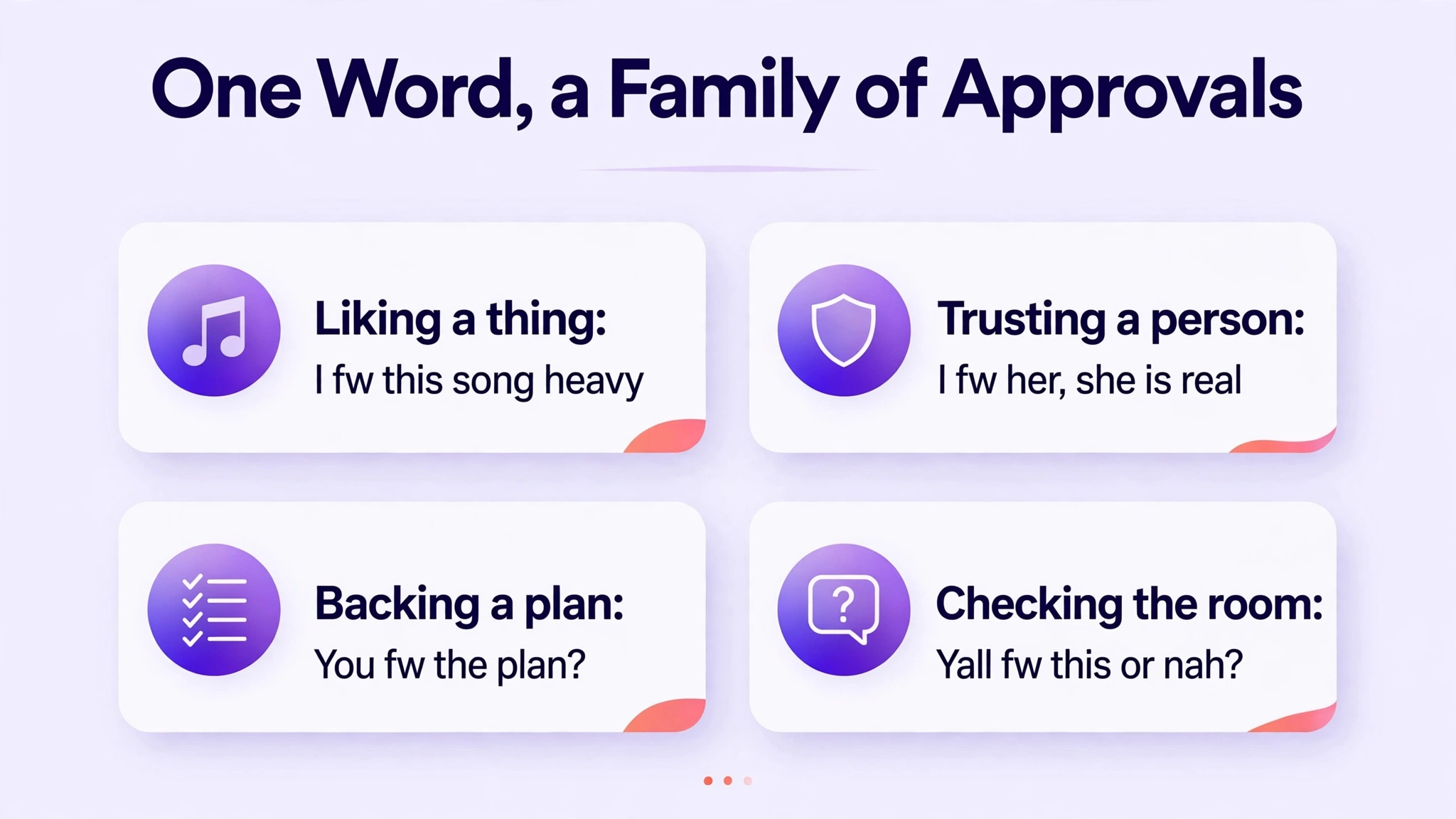
In practice, it covers a small family of approvals:
- Liking a thing: “I fw this song heavy.” — I really like this song.
- Trusting a person: “I fw her, she’s real.” — I respect her; she’s genuine.
- Backing an idea or plan: “You fw the plan?” — Are you in / do you support it?
- Checking the room: “Y’all fw this or nah?” — Do you like this or not?
The intensifier matters too: “heavy” or “hard” after it (“I fw you heavy”) turns approval into strong approval — the slang equivalent of underlining.
The Word That Flips Everything: “Don’t”
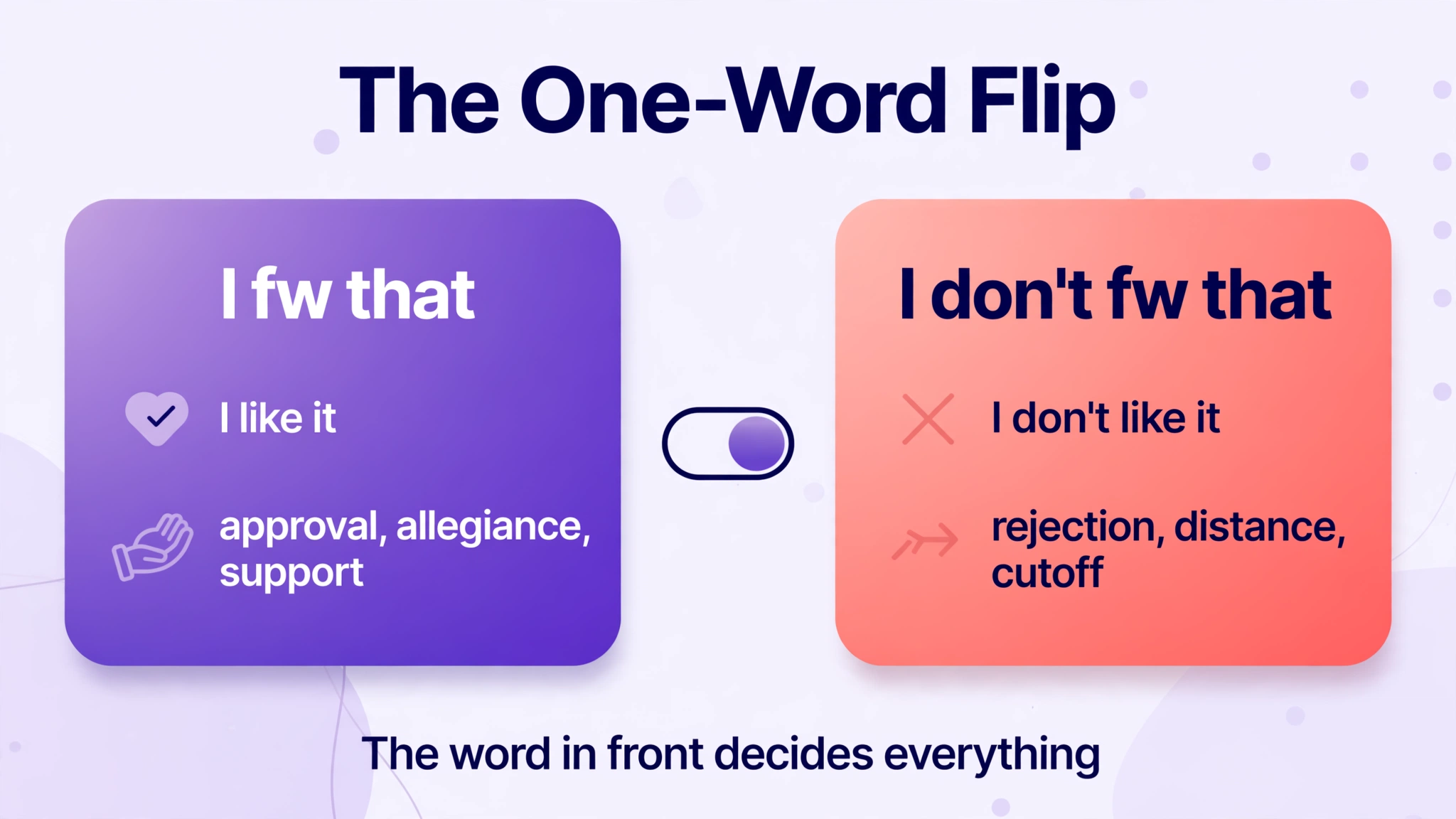
FW has one moving part, and it’s the word in front of it:
- “I fw that” → I like it. Approval.
- “I don’t fw that” → I don’t like it, I want nothing to do with it. Rejection.
- “He doesn’t fw me anymore” → He cut me off / stopped associating with me. Distance.
The negative form also carries the phrase’s older, more literal flavor — messing with. “I don’t fw fake people” means I don’t deal with them. And in a warning, the literal sense comes back entirely: “Don’t fw me right now” means do not bother me — one of the few times FW is actually a caution rather than a compliment.
So the reading rule is simple: FW alone approves; “don’t FW” refuses. If someone sends you “I fw you,” take the compliment. If a friend says “I don’t fw him,” they’re telling you the association is over.
FW in Real Conversations
The exchanges below are illustrative examples, not real messages.
The compliment
- Alex: “posted my new track, kinda nervous”
- Sam: “bro I fw this heavy 🔥”
Pure support. “Heavy” underlines it. This is the most common FW in the wild — approval with emphasis.
The fit check
- Jordan: (sends an outfit photo)
- Riley: “ok I fw the fit”
“I like the outfit.” Short, warm, done. In comment sections, “fw this or nah?” is the same move turned into a question.
The cutoff
- Casey: “are you and Drew still cool?”
- Morgan: “nah, I don’t fw him after that party”
The “don’t” did all the work. Nothing about the letters changed — the small word in front reversed the allegiance.
The warning (rare, literal)
- Taylor: (teasing for the fifth time)
- Jamie: “don’t fw me today, I’m serious”
Here FW keeps its literal edge: don’t mess with me. The “I’m serious” confirms this isn’t the compliment version.
The Email Meaning: FW = Forward
Completely separate from the slang, FW: in an email subject line means “forward” (often written “Fwd:”). When a message arrives titled “FW: Meeting Notes,” someone has passed an existing message along to you. Email clients add the prefix automatically, and it has nothing to do with approval, slang, or the phrase above.
The two meanings never really collide — nobody reads a forwarded agenda as a compliment — but they explain why a search for FW turns up office results next to slang ones. Context decides instantly: subject line = forward; chat message = the slang.
One work-chat crossover does exist: “Can you fw me that doc?” uses FW as a verb meaning forward it to me. Even there, spelling out “forward” is safer in anything formal.
Look-Alikes: FW Is Not FWB or NSFW
Because the letters overlap, three different terms get confused:
- FW — the slang above (like/support), or “forward” in email.
- FWB — “friends with benefits,” a specific kind of relationship arrangement. Despite sharing letters, “I fw you” does not mean this. When someone says they fw you, they’re expressing approval or trust — read the full FWB guide before assuming anything more.
- NSFW — “not safe for work,” a content warning label. It contains “FW” only by coincidence of letters.
A rarer reading also exists: in relationship talk, FW occasionally stands for “friends with” (“are you still fw her?” = are you still friends with her?). It’s much less common than the main meaning, and context — usually a conversation already about who is friends with whom — gives it away.
FW vs. Neighboring Slang
FW vs. WTW. WTW (“what’s the word?”) opens a conversation and asks what’s happening. FW delivers a verdict inside one. “Wtw?” gets plans started; “I fw that plan” approves them.
FW vs. OML. OML (“oh my lord”) is a reaction of surprise or exasperation — no position taken. FW takes a position: in or out, like or don’t. “Oml, that song” reacts; “I fw that song” endorses.
FW vs. MB. Unrelated jobs. MB (“my bad”) apologizes for a mistake; FW expresses allegiance. They can meet in one chat — “mb, sent the wrong link — but yeah I fw the idea” — apology first, verdict second.
FW vs. TTYL. TTYL (“talk to you later”) closes conversations. FW lives mid-conversation, where opinions are being exchanged. Different ends of the chat entirely.
Where FW Works and Where It Doesn’t
Where it works: close friends, comment sections, fan communities, group chats where slang is the house language. The strong word inside it is softened by the initials — most people who use FW type the two letters, not the phrase.
Where it doesn’t: work email (where it means “forward” anyway), messages to teachers or managers, family chats with anyone who’d read the phrase literally, and any context where you don’t want to explain yourself. The approval can be said a dozen safer ways: “I’m a fan,” “I’m down,” “I support this.”
The audience rule: FW signals in-group fluency. Used with people inside that culture, it’s warm and efficient. Used outside it, it reads as either confusion (“forward?”) or a phrase that sounds much harsher than you meant. Match the slang to the room.
How to Reply When Someone Says “I FW You”
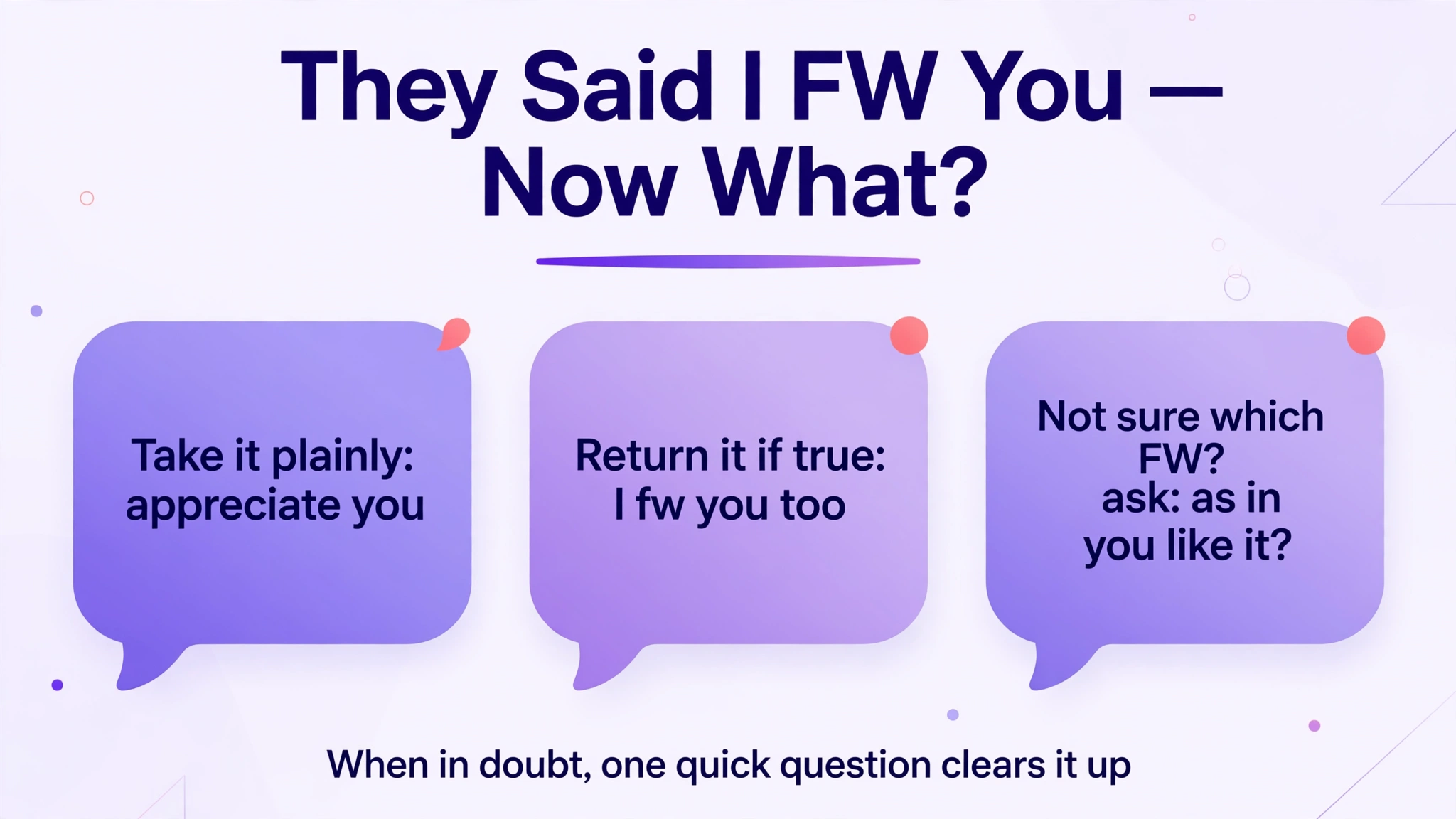
- Take the compliment plainly: “appreciate you 🙏” or “that means a lot” — the slang is casual, so a warm, short reply matches it.
- Return it if it’s true: “I fw you too, fr” — the mirror response, and the most natural one.
- If it’s about your work: thank them and keep it moving. “You fw the new track?” → your reply can ask what part they liked.
- If you’re told someone doesn’t fw you: don’t argue the acronym. “Fair enough” closes it with dignity; the details, if any, are a real conversation, not a texting one.
- If you can’t tell which FW arrived: context-check with one question — “as in you like it?” Nobody minds; the two letters genuinely carry both.
- Pairing with plans: “I fw that plan — lmk the time” approves and moves to logistics in one breath, which is how FW usually flows in group chats.
Quick Answers
What does FW mean in text?
“F*ck with” — but in slang use it usually means the opposite of what it sounds like: to like, support, trust, or vibe with someone or something. “I fw you” is a compliment.
What does “I fw you heavy” mean?
“I really like/trust you” — “heavy” intensifies the approval. It’s one of the warmest things the slang can say.
What does “I don’t fw that” mean?
The reverse: I don’t like it, I don’t deal with it, I want nothing to do with it. Adding “don’t” flips FW from approval to rejection.
What does FW mean in an email?
“Forward.” An “FW:” (or “Fwd:”) subject line means the message was forwarded to you. Unrelated to the slang.
Is FW the same as FWB?
No. FWB means “friends with benefits,” a relationship arrangement. “I fw you” expresses approval and trust — a different statement entirely.
Does FW ever mean “friends with”?
Occasionally, in relationship conversations (“are you still fw her?”). It’s a minor reading; the main slang meaning is far more common.
Is FW rude?
The phrase inside it contains strong profanity, so keep it out of formal, work, and mixed-company chats. Between friends, though, it’s usually friendly — often a compliment.
How do I reply to “I fw you”?
Warmly and briefly: “appreciate you,” or return it — “I fw you too.” It was a compliment, so receive it like one.
The Short Version
FW is a compliment wearing a scary costume. Short for “f*ck with,” it means — in its everyday slang use — I like this, I support this, I’m down with you. Add “don’t” and it flips into refusal: I don’t deal with that. In email, forget the slang entirely: FW: just means the message was forwarded. Read the word in front of it, remember it isn’t FWB or NSFW, and when someone says they fw you — say thanks. They meant it nicely.
