
It is 1 a.m., the chat has been going for hours, and then a single message lands: "gts." No emoji, no explanation, just three letters. If you have ever wondered whether you were being wished goodnight, told off, or shown a photo caption, this guide clears it up. In short, the gts meaning in text is almost always "go to sleep": a late-night sign-off that ends the conversation for the night.
That simplicity hides a twist: the same three letters can also mean "good times" under a happy photo, a brush-off reply in a public thread, or a put-down after a bad opinion. The letters never tell you which one you got. The test below shows you how to read it.
What GTS Means in Text
GTS is an initialism for "go to sleep," sometimes read as "going to sleep": the same reading, not two meanings. Spoken aloud, it is letter by letter, "gee-tee-ess," not a word.
What makes GTS different from a plain "goodnight" is that it carries a reason. "Goodnight" is a wish; GTS says: I am heading to bed, so do not expect a reply until morning.
One honest note: Wiktionary's GTS entry lists no bedtime sense, only other-world senses. The bedtime meaning rests on unanimous agreement across every major texting guide: strong consensus, but guide consensus, not a dictionary entry.
GTS also points in two directions. "I'm so tired, gts" means the sender is going to bed; "It's nearly two, GTS!" means the sender is telling you to go to bed. A bare "gts" at the end of a long chat almost always means the sender is signing off. The next section gives you a test for the rest. When it is not bedtime at all, reach for TTYL, talk to you later, which pauses a conversation without claiming anyone is asleep.
The Who-Where-Tone Test
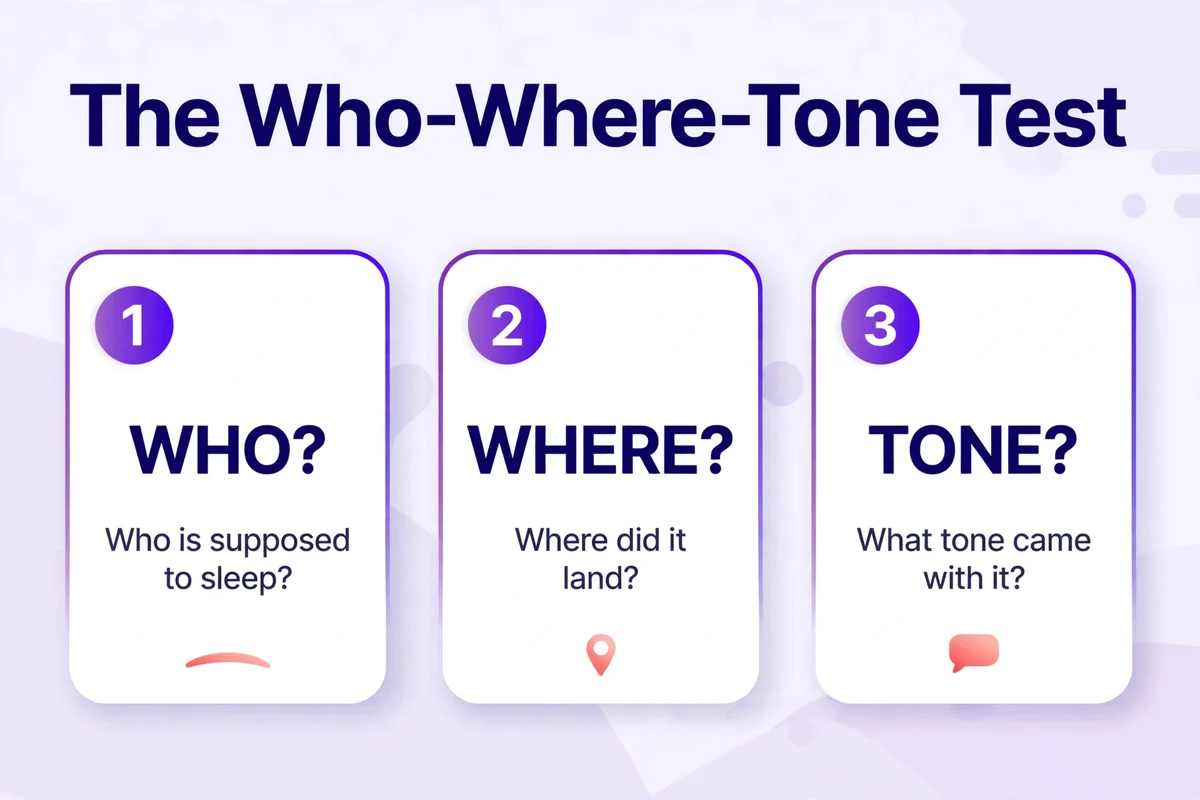
Here is this article's named method, the Who-Where-Tone Test: three checks.
Check 1: WHO is supposed to sleep? "I'm gts" points to the sender, "you should gts" to you, and a bare "gts" at the end of a chat to the sender signing off. If you were the tired one complaining, it is probably aimed at you; if they were, it is about them.
Check 2: WHERE did GTS land? Placement is the biggest clue. At the end of a late-night conversation, GTS means sleep; under a happy photo or shared memory, "good times"; as a reply to a searchable question in a public thread, the Google reading; in a car or racing chat, the game title. The room and the placement decide, not the app.
Check 3: WHAT tone came with it? Warm words or a sleepy emoji point to the bedtime reading, nostalgia and celebration to good times, impatience after an obvious question to the Google reading, and a mocking tone after an argument to the put-down reading, covered below.
Watch the same bare message change meaning three times. First: 11:47 p.m., end of a two-hour chat, previous message "I'm fading fast" — the sender is going to sleep. Second: a beach-trip photo dump captioned "gts!!" — good times. Third: a public thread where someone asked how to reset their earbuds, reply "gts" — the Google reading. Nothing about the letters changed.
When GTS Is Not About Sleep
Most GTS messages are about sleep. The rest fall into four groups.
Good times. The warmest alternative: GTS as a caption on a fun night out, a trip, or a throwback photo. The tells are nostalgia and celebration, no bedtime anywhere in sight. "Remember last summer? Absolute gts" is a toast, not a sign-off.
The Google reading. In public threads, on Reddit, in Discord servers, and in TikTok comments, GTS can be shorthand dismissal: "Google that s***." It answers a question the replier thinks was easy to look up, and the tone runs from playful jab between friends to impatience from strangers. The tells are a searchable question, a public room, and no bedtime context. From a friend it lands as a joke, from a stranger as a brush-off.
The going-through reading. Rare and easy to miss: "I've been kinda gts lately" can mean "going through s***," a quiet way of saying life is hard. The tells are a venting context and lowercase letters. If you see this one, do not answer with a joke.
The put-down. The reading most guides skip. After a hot take in a group chat, a bare "gts" can mean "your opinion is so bad you should go to bed and rethink it": a shutdown dressed as a bedtime wish. The tells are an argument just before it, no bedtime context, and a mocking tone. Like LOL, which drifted from laughter into a tone marker, the put-down GTS has drifted from a wish into a tone.
Finally, the other-world names. In wrestling talk, GTS is a finishing move, "Go 2 Sleep," listed by Wiktionary itself. In car talk, it is the game Gran Turismo Sport. Elsewhere, it is field shorthand. None of these is a texting meaning.
GTS on TikTok, Snapchat, Instagram, and in Texting
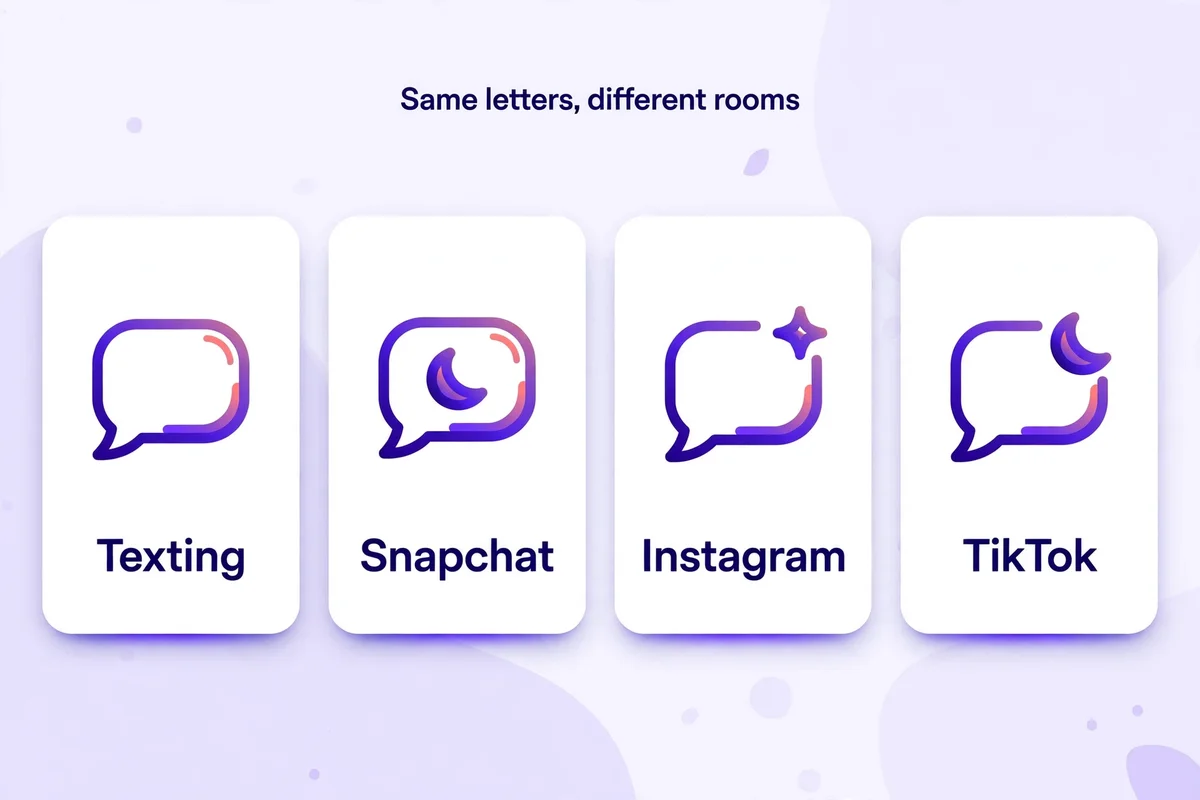
On every platform, the app never decides the meaning. What changes is which rooms you are likely to be standing in.
In plain texting, GTS is at home: one-to-one chats, late at night, often after hours of talking. A text that says "gts, talk tomorrow" needs no further decoding. If you are sorting out similar late-night shorthand, the DM guide covers that room.
On Snapchat, GTS does two jobs. Late at night it ends streaks and chats the same way it ends texts. Under memories and throwback snaps, it turns into "good times." Guides disagree about which use is more common, which is why no fixed rule like "on Snapchat it means good times" can be trusted. A snap sent at 1 a.m. is a sign-off; a caption on a beach photo is a toast.
On Instagram, the split is similar: direct messages mean the bedtime sign-off, captions on shared photos lean toward good times. A story that says "gts" over a party photo is celebrating, not sleeping.
On TikTok, the public rooms dominate: in comments and public threads, the Google reading shows up far more than anywhere else, where searchable questions get asked. In TikTok direct messages, the bedtime reading returns. The pattern: private rooms at night say sleep, public rooms with photos say good times, public rooms with questions say Google.
Tone and Sender Context: Who Is Saying GTS, and Why It Lands Differently
GTS is a small message with a wide emotional range, and the sender matters as much as the letters.
From a close friend, GTS is almost always warmth with tiredness attached. A bare "gts" after a long chat is not anger; it is someone whose eyes are closing. The kindest reply is a short goodnight.
From a crush or a partner, GTS is usually just an honest goodnight, nothing deeper. "gts, talk tomorrow" with a warm emoji reads as friendly and open, and a bare "gts" mid-conversation is more likely tiredness than disinterest. GTS marks the end of a day the way TGIF marks the end of a week.
From family, GTS often arrives as a caring nudge: "you should gts, early morning tomorrow." The direction is the message.
From a stranger, GTS usually arrives in a public thread as the Google reading: not a personal insult, but not friendliness either. From a gaming lobby, GTS is a log-off: "last round then gts." If the lobby is talking about cars instead, check whether the game title is the reading.
At work, GTS does not belong. A manager, client, or new colleague should get "Goodnight" or "Logging off" in full; bedtime shorthand reads as careless, and the Google reading as rude.
How to Reply to GTS, and When to Spell It Out
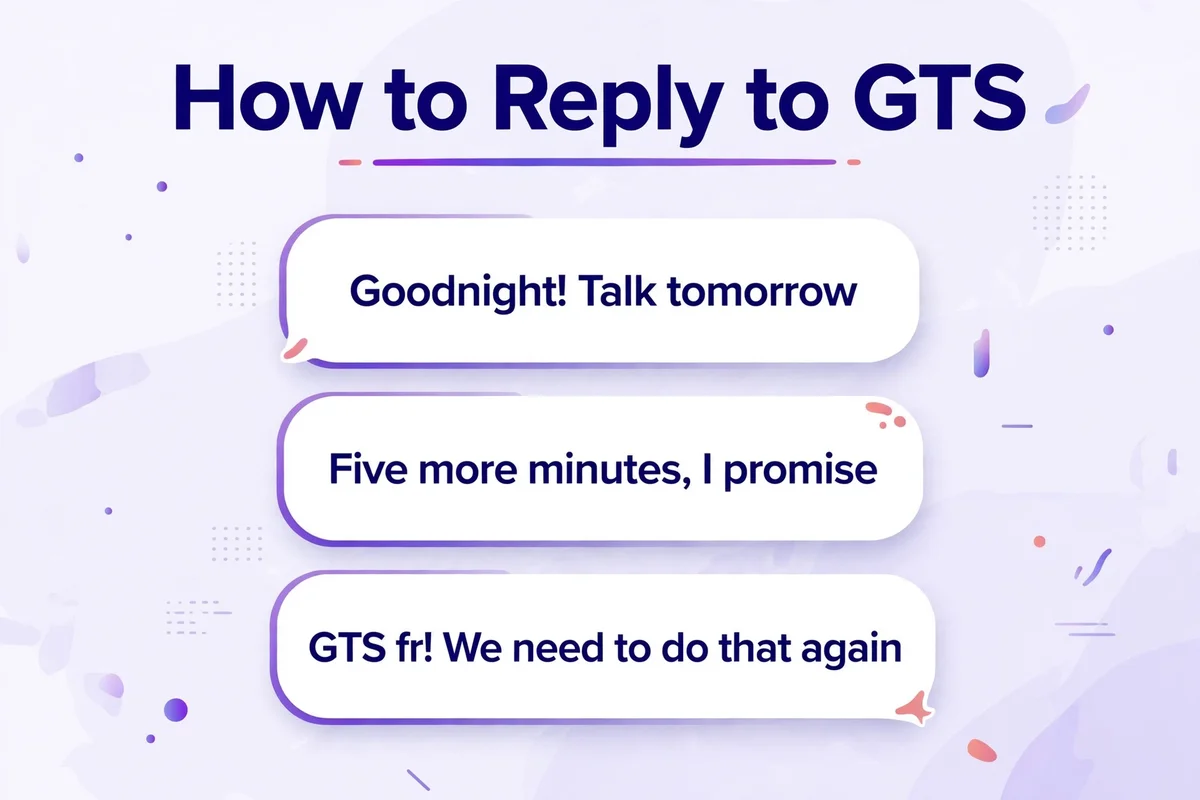
Match the reading, keep it short, and you are done.
If they are going to sleep, a short, warm goodnight is the whole reply: "Goodnight! Talk tomorrow" or "Sleep well, catch you in the morning." Leaving the chat quiet until morning is fine.
If you are being told to sleep, play along or push back lightly: "Yes, boss, going now" or "Five more minutes, I promise" or simply "Ok ok, goodnight!"
If it was good times, match the energy and add a memory: "GTS fr! We need to do that again."
If it was the Google reading, look the thing up and move on: "Fair enough" or "On it." If your question was genuinely reasonable, "I tried, couldn't find it" does not escalate.
If it was the put-down, do not take the bait at midnight. "Ok, goodnight" ends it cleanly; pick the disagreement up tomorrow. If it still bothers you, say so the next day.
If it was the going-through reading, lead with care: "I'm here, want to talk about it?" A joke is the wrong response to someone quietly saying life is hard. And do not send an HMB at 1 a.m. to someone who just said GTS.
There are times to spell it out instead. Use "Goodnight, heading to bed" in full for professional contacts, for anyone who may not know the slang, and after a tense exchange, where a bare "gts" would read as a shutdown. In that case, add the reason and the promise: "I'm exhausted, gts, let's talk tomorrow." Capitalization changes tone, not meaning: lowercase "gts" feels softer, uppercase "GTS" firmer.
GTS vs GN, GTG, and BRB
GTS sits in a family of exits. The difference is what they end, and for how long.
| Term | Full form | What it actually ends |
|---|---|---|
| GTS | Go to sleep | The day. You are heading to bed; expect silence until morning. |
| GN | Goodnight | The conversation, with a wish. It does not say anyone is actually sleeping. |
| GTG | Got to go / Good to go | Any departure, for any reason: dinner, class, work, errands. |
| BRB | Be right back | A pause of minutes, not hours. The person is coming back to the same conversation. |
GN is a wish, GTS a sign-off with a reason, which is why people write "gts gn." GTG is the general exit, GTS the bedtime-only exit. BRB is the shortest exit: at midnight it means stepping away, not sleeping. TTYL is the exit for when it is not bedtime at all.
Debunked: What GTS Does NOT Mean
Short letters collect false meanings, and GTS has collected a few.
GTS does not mean one fixed thing per app. The idea that Snapchat always means good times and TikTok always means Google is contradicted by the guides themselves. Placement and tone decide.
GTS is not always rude. The bedtime reading is friendly: a sign-off that respects the other person enough not to vanish silently. Only the Google and put-down readings can sting.
GTS is not a precise statistic. Claims like "99% of the time" come from listicles, not studies, so this article never prints a percentage.
GTS is not a dictionary word for sleep. Wiktionary lists wrestling, technical, and medical senses, but no bedtime sense. That makes the bedtime meaning guide-supported rather than dictionary-backed.
When Not to Use GTS
GTS is a joy in its habitat and a misfire outside it. Skip it when:
- The setting is formal. Emails, client messages, and first professional introductions are not the place for bedtime shorthand.
- The reader may not know it. With someone unfamiliar with texting slang, spell it out: "Goodnight, heading to bed."
- You are ending an argument. A bare "gts" after a disagreement reads as a shutdown. Add a reason and a tomorrow promise.
- You mean the Google reading to a stranger. A brush-off to someone who asked a genuine question makes you look impatient, even meant as a joke.
- The context cannot carry it. A bare "gts" at noon to a new contact, with no bedtime, photo, or question in sight, is just confusing.
Quick Answers
What does GTS mean in text?
GTS usually means "go to sleep" or "going to sleep": a late-night sign-off saying the sender is heading to bed, or telling you to do the same.
Is GTS "go to sleep" or "going to sleep"?
Both wordings are the same reading, not two meanings: bedtime.
Who is supposed to sleep when someone sends GTS?
Check one of the Who-Where-Tone Test: "I'm gts" means the sender, "you should gts" means you, and a bare "gts" at a chat's end usually means the sender is signing off.
What does GTS mean on Snapchat?
Usually the bedtime sign-off late at night, and "good times" under happy photos. The app does not decide; the placement does.
Is GTS rude?
As a goodnight, no. As the Google reading it can sound condescending, and as a put-down it is meant to sting.
What is the difference between GTS and GN?
GN is a goodnight wish. GTS is a sign-off with a reason: someone is actually heading to bed.
What is the difference between GTS and GTG?
GTG means "got to go" and covers leaving for any reason. GTS is bedtime only.
Can I use GTS at work?
No. Spell it out: "Goodnight" or "Logging off." GTS reads as careless at work, and the Google reading as rude.
Final Thoughts
GTS is three letters doing the work of a door closing gently for the night: "I'm done, I'm heading to bed, talk tomorrow." Run the Who-Where-Tone Test before you read it and before you send it: who is supposed to sleep, where did it land, and what tone came with it. Get that right, and GTS stays what it should be.
If you liked this guide, you may also enjoy the FT guide, which tackles another abbreviation whose meaning flips completely with context.
