
It's 4:47 PM on a Friday. Your phone lights up: "TGIF 🙌" You don't need a dictionary — you feel it in your shoulders. But what exactly sits inside those four letters, where did they come from, and why does the same message hit different on a Monday? Let's decode the tgif meaning in text properly, because this one has a fifty-year backstory hiding inside a casual text.
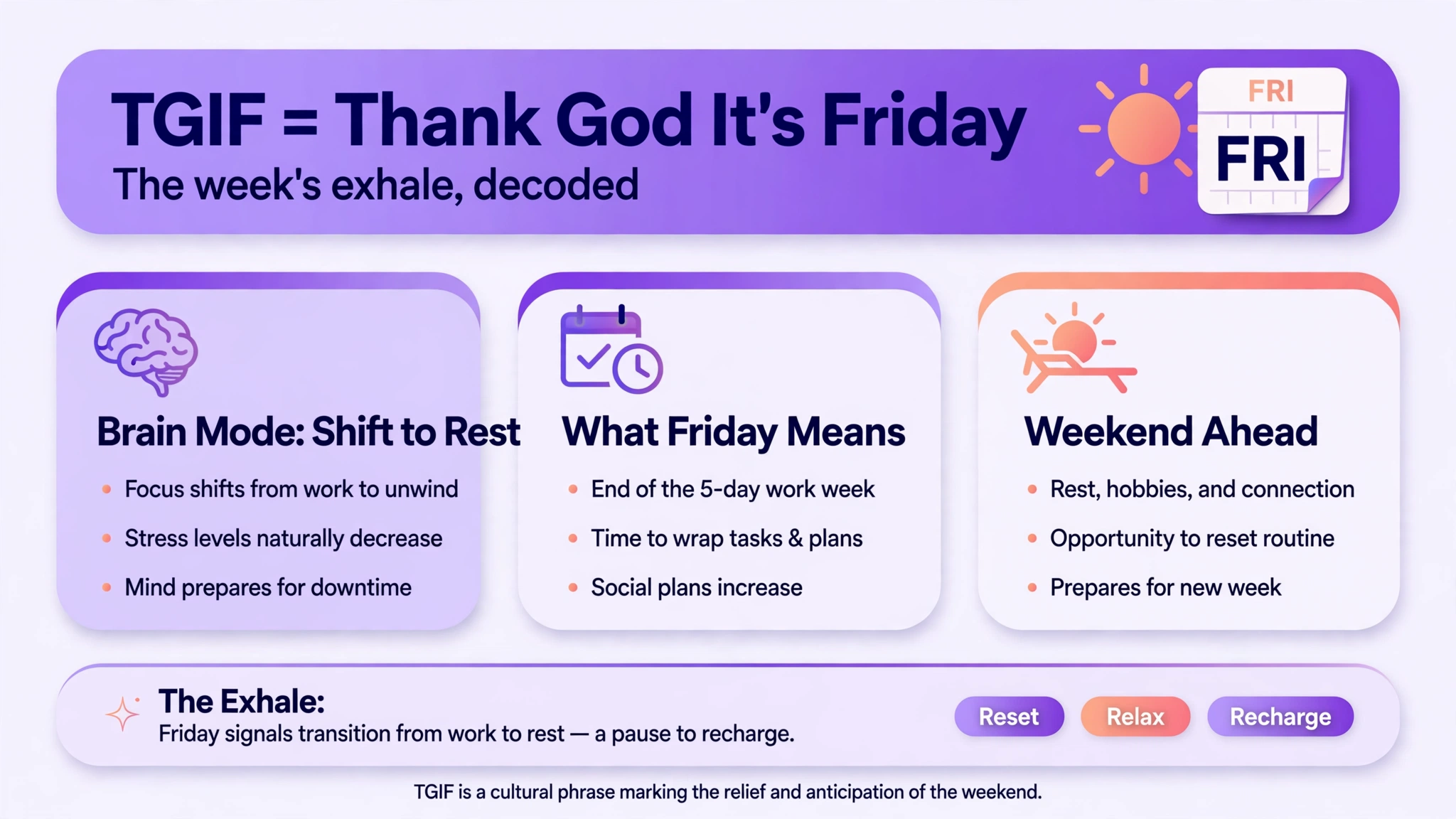
TGIF stands for "Thank God It's Friday." It's the week's exhale in abbreviation form — relief, celebration, and weekend anticipation packed into four capital letters.
What Does TGIF Mean in Text?
TGIF means "Thank God It's Friday" — an expression of relief and celebration that the work week is over. Wiktionary carries it as a direct headword, established dictionaries attest it, and every usage guide agrees: in texting, TGIF has exactly one meaning, and it's this one.
Two honest notes up front, because they matter:
Most people use it non-religiously. Every source agrees on this: TGIF is used casually and secularly by the vast majority of texters. The "God" in the expansion is idiomatic — like saying "oh my god" at good news. Nobody assumes you're making a theological statement, and a secular variant ("thank goodness it's Friday") exists for anyone who prefers it.
The meaning never changes — only the day does. TGIF on a Friday is genuine relief. TGIF on a Monday is sarcasm, a joke, or a meme quote. The letters stay the same; the calendar does the talking. (More on this in the Calendar Check below.)
In a text, TGIF usually travels with company: "TGIF 🙌" / "TGIF!! finally" / "TGIF, drinks later?" It's a feeling first and a message second — which is exactly why it works as a standalone text. Nobody replies "what do you mean?" to a TGIF. They reply with the feeling.
The Calendar Check
Here's the named test for reading any TGIF you receive. It's called the Calendar Check, and it's the only test this term needs — because TGIF is the rare abbreviation whose meaning depends on what day it is.
Step 1: Check the actual day.
- It's Friday → read it straight. Genuine relief, genuine celebration. The sender made it through the week and they're exhaling. Respond to the feeling.
- It's any other day → someone's being funny. A Monday TGIF is sarcasm ("only four more days, ha"). A Wednesday TGIF is wishful thinking. A Sunday-night TGIF is mourning the weekend. The letters didn't change meaning — the sender is playing with the calendar.
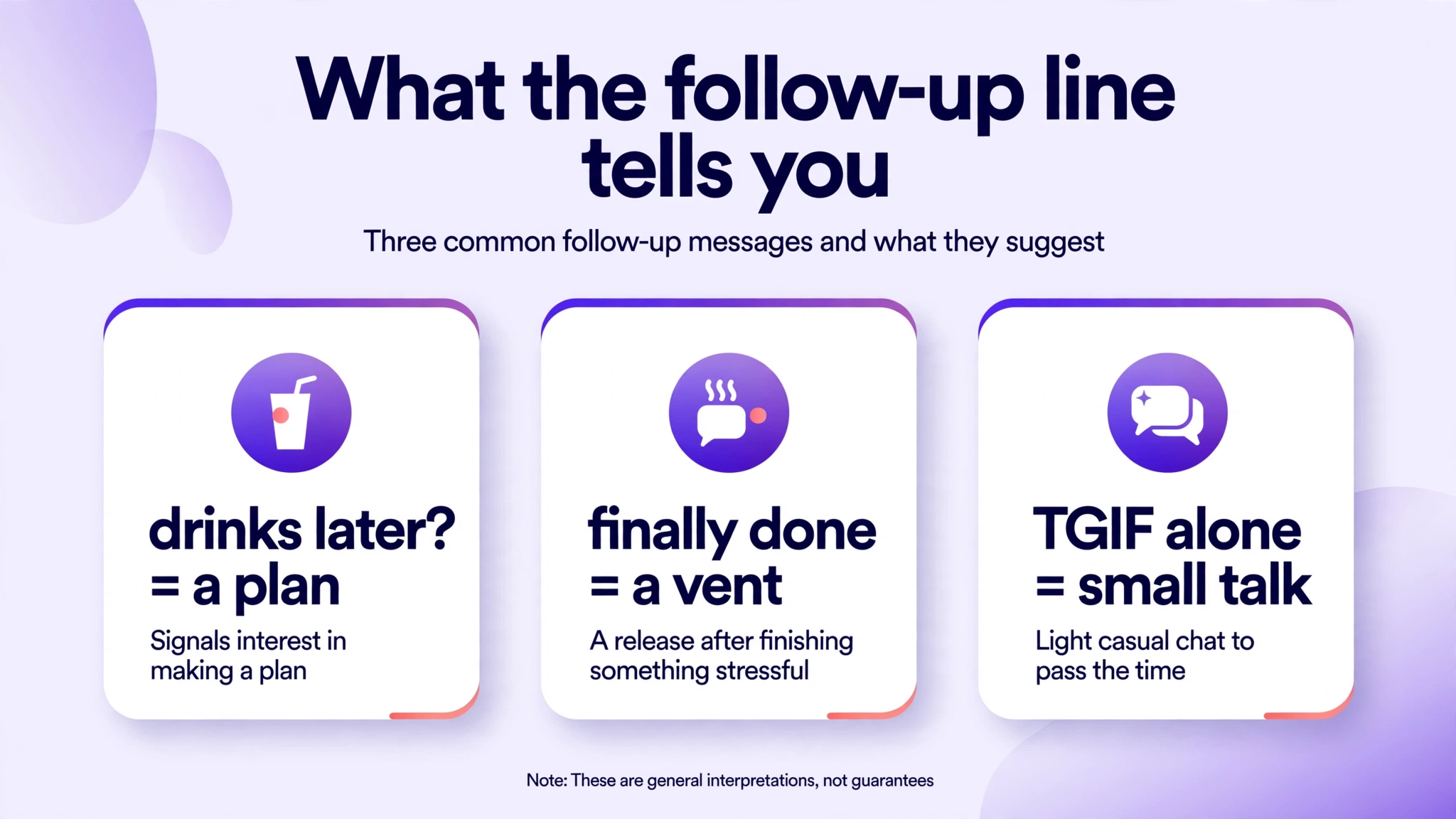
Step 2: Read the follow-up line. TGIF is almost always the opening, not the whole message. The line after it is the real content:
- "TGIF! drinks later?" → a plan. The TGIF was the invitation's drumroll.
- "TGIF, finally done with that project" → a vent. They're not inviting you; they're exhaling at you. Acknowledge the win.
- "TGIF 🙌" (standalone) → small talk. It's the texting equivalent of a Friday high-five — closer to HBU small talk than to an actual question. High-five back.
Step 3: Match, don't fix. If someone sends a sarcastic Monday TGIF, the correct reply is to play along ("lol only 96 hours to go"), not to correct them ("but it's Monday?"). The joke is the message. A TBH-style honesty rule applies: nobody sending a Monday TGIF thinks it's Friday. They're telling you the week already feels long.
No competitor frames TGIF this way — as a timing-dependent read with a three-step method. They list "sarcastic use" as a bullet point. The Calendar Check turns it into a skill.
TGIF Tone Spectrum: Excited, Relieved, or Sarcastic?
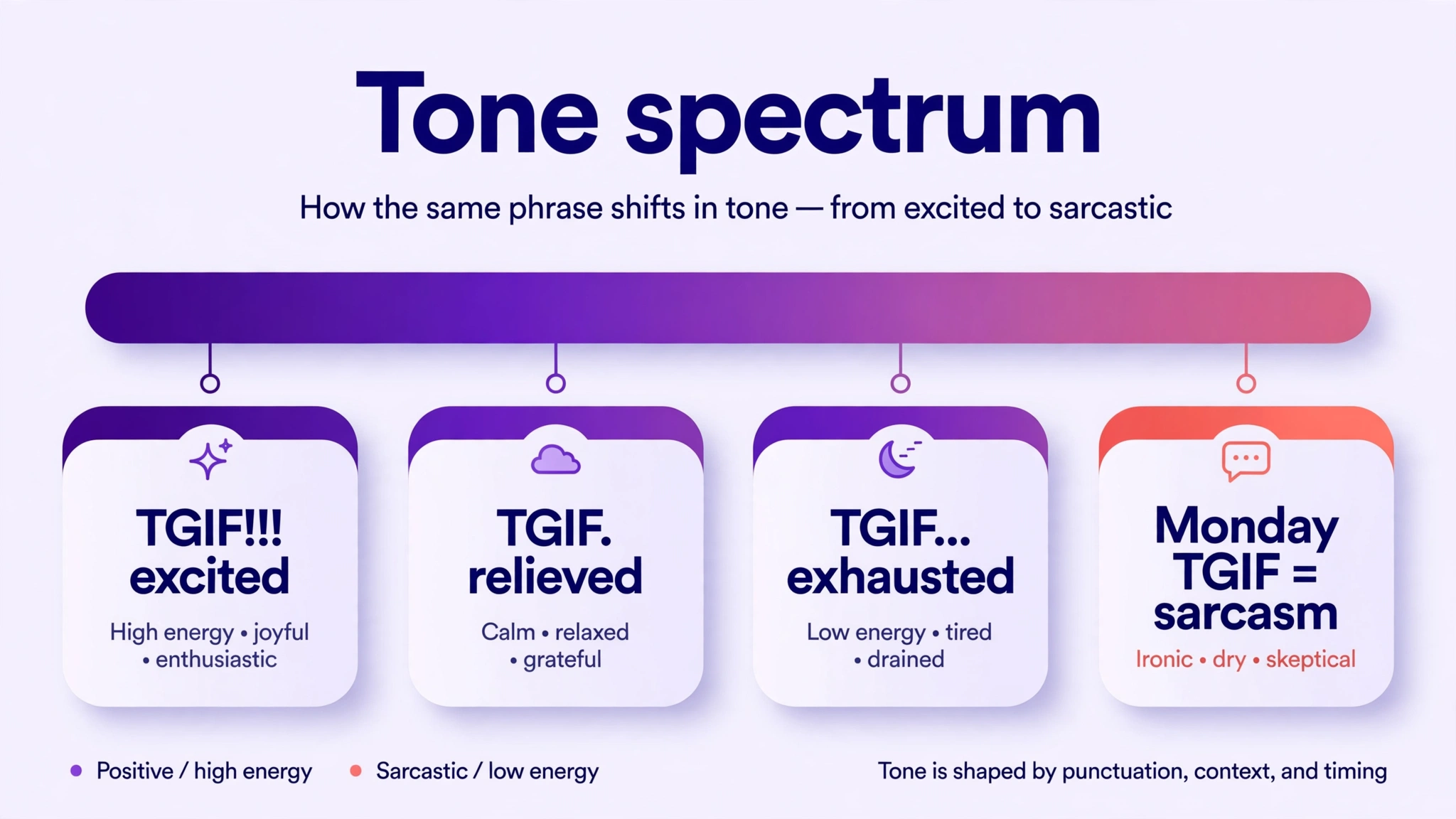
TGIF has no fixed volume — punctuation and casing are the entire tone system. Here's the spectrum, from genuine to joking:
"TGIF!!!" — excited. Multiple exclamation marks are pure celebration. This person is thrilled it's Friday. Weekend plans are probably already made. Match the energy or get out of the way.
"TGIF 🙌🎉" — festive. Emoji-paired TGIF is the social-media native form — performative joy, meant to be seen. It's the Friday equivalent of a party photo: the feeling is real, the audience is everyone.
"TGIF." — relieved. The period flattens it into an exhale. "TGIF." after a brutal week isn't celebration — it's survival. This is the "I made it" TGIF, and it deserves a "you earned it" more than a party emoji.
"TGIF…" — exhausted. The ellipsis is the tell: relief mixed with depletion. This person is happy it's Friday the way a marathoner is happy to see the finish line — too tired to sprint through it.
"tgif" (lowercase) — casual. The lowercase version is the quiet high-five: same feeling, less ceremony. Common in quick chats and among people who type everything lowercase anyway.
"TGIF?" — the rare question form. Almost always sarcastic or disbelieving: "TGIF? it's only Tuesday??" The question mark turns the celebration into a challenge. Read it as a joke about the calendar, not a question about the acronym.
Wrong-day TGIF — sarcasm or meme. Covered in the Calendar Check, but worth repeating as tone: the further from Friday, the funnier (or sadder) it gets. A Monday TGIF is comedy. A Thursday-night TGIF is anticipation wearing a costume.
Where You'll See TGIF: TikTok, Snapchat, Instagram, and Texting
TGIF means the same thing on every platform — one meaning everywhere, no exceptions. What varies is the style of the celebration:
Texting (1:1 and group chats). The classic habitat: standalone "TGIF!" texts, Friday-morning group-chat openers, the "TGIF, who's free tonight?" plan-launcher. In texts it's a feeling shared, not information delivered — nobody texts TGIF to inform you what day it is.
Instagram. Caption and hashtag country: "Weekend mode: activated. #TGIF #FridayVibes" under a sunset photo, story stickers counting down to 5 PM. Instagram TGIF is the most performative version — the celebration is the content.
TikTok. Text overlays on weekend-themed videos: "POV: it's finally TGIF" over someone collapsing onto a couch. The acronym becomes a meme template — the format carries the joke, the letters carry the feeling.
Snapchat. Short and playful: TGIF over a Friday selfie, a streak snap of weekend plans, a filter-enhanced "we made it." Snapchat's TGIF is the quickest version — here and gone with the snap, like the work week should have been.
Workplace chats. The lighthearted Friday sign-off: "TGIF everyone, great week 👏" in the team channel. All sources agree it's welcome in casual internal chats — and all agree it stays out of formal correspondence, reports, and anything going to clients.
The constant, stated plainly: same four letters, same meaning, every platform. Only the costume changes.
From Offices to Texting: The TGIF Story
TGIF didn't start as texting slang — it's older than the internet, and the backstory is genuinely interesting. Here's the chain, as documented across usage guides:
1960s–70s: the office. TGIF emerges as American workplace slang — the Friday-afternoon exhale of office workers, said out loud long before it was ever typed. The phrase captured something universal: the collective relief of a culture built around the five-day week.
1978: the disco film. Thank God It's Friday hits theaters — a Donna Summer-era time capsule that cemented the phrase in pop culture. The movie didn't invent the saying, but it gave it a marquee.
1989–2000: the TV block. ABC brands its Friday-night sitcom lineup "TGIF" (later jokingly expanded as "Thank Goodness It's Funny"). For a generation of kids, those four letters meant Step by Step and Family Matters — the phrase became Friday-night furniture.
The restaurant. TGI Fridays takes the acronym mainstream-commercial, putting it on signage across the country. By the 2000s, TGIF was one of the most recognized four-letter sequences in American life.
The texting era. And then it shrank into our phones — same letters, same feeling, new medium. The journey from office slang to text abbreviation took about forty years, which makes TGIF one of the oldest pieces of slang still thriving in chats.
This is context, not texting evidence — but it's the kind of context that makes an article worth reading instead of just ranking. No competitor tells it as one story; they list disconnected trivia. The chain is the upgrade.
How to Reply to TGIF Without Sounding Robotic
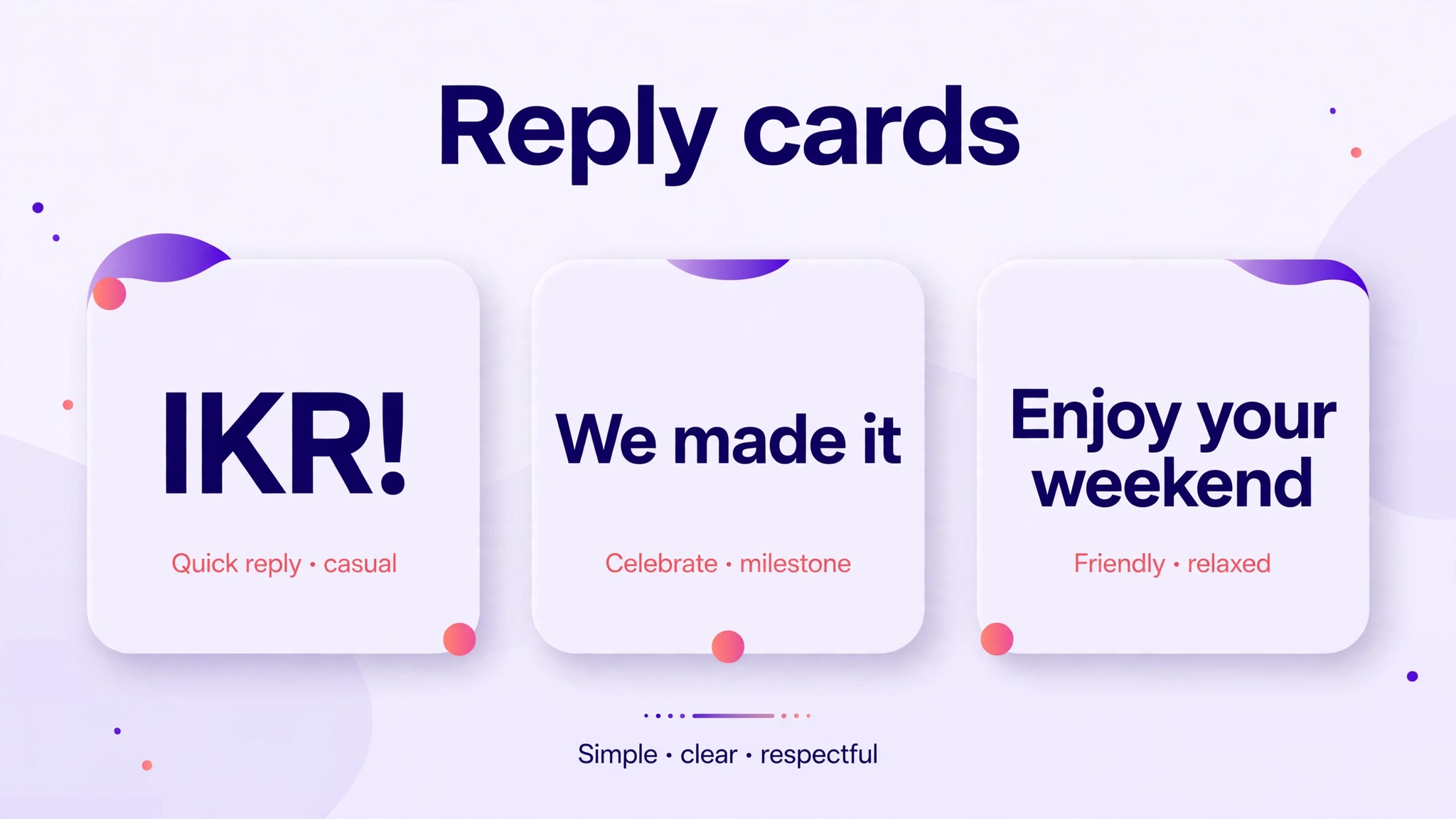
"TGIF!" lands in your chat. The wrong reply is "yeah" — the conversational equivalent of a shrug. Here's how to actually respond:
Match the energy (the 90% answer). "IKR 🙌" / "Finally!!" / "We made it 🎉" — mirror the feeling and move on. TGIF is a high-five; high-five back.
Turn it into plans. "TGIF! WBU tonight?" or "TGIF — LMK if you're free Saturday, planning something." The acronym opened the door; walk through it. Friday texts that stay at the high-five level are missed opportunities.
Acknowledge the vent. "TGIF, that project nearly killed me" deserves more than an emoji: "DW, the week is over — you earned this weekend." Relief shared is relief doubled. A FR-style genuine reply beats a performative one.
Play along with the sarcasm. Monday TGIF? "Lol only 4 more days 😭" / "Manifesting Friday over here." The joke is the message — laugh with it.
The warm close. "Enjoy your weekend!" / "Have the best weekend 🎉" — for the TGIF that ends a conversation rather than starting one. Simple, kind, complete.
What not to do: don't correct a wrong-day TGIF ("it's Tuesday?"), don't reply with a different acronym that kills the vibe, and don't BTW-pivot straight into Monday's problems ("TGIF! btw the deadline moved up" ruins the exhale). And don't leave a heartfelt "TGIF, I barely survived this week" on read. Some TGIFs are just confetti. Some are cries for company. The Calendar Check tells you which.
Debunked: What TGIF Does NOT Mean
Four letters, one meaning — but the internet still invents extras. Honest grading:
- "Thank Gaia It's Friday" — invented. Appears on exactly one site with zero sourcing. There is no eco-pagan TGIF movement. Leave it out.
- Gender-specific meanings ("from a girl" vs "from a guy") — fabricated filler. At least one competitor runs both sections with identical meanings — pure SEO padding. The meaning of TGIF does not change by sender, full stop. This article refuses the fake sections; sender context lives in the follow-up line, not the acronym.
- "30 million posts" / "top 10 hashtags" / Google Trends timing stats — unsupported. Quoted without data by thin sites. No frequency claim appears in this article, because no frequency study exists.
- The "University of California gratitude study" — reads fabricated. Cited by one site with no verifiable source. Not repeated here.
- Technical expansions (marketing acronyms, beer parties, biochemistry factors) — real elsewhere, never in texting. Wiktionary lists other senses; none of them is what your friend meant. Different worlds, different TGIFs.
- A religious statement — no. The non-religious, idiomatic use is the documented norm. Nobody's TGIF text is a sermon.
When Not to Use TGIF
TGIF is beloved in its habitat and baffling outside it. Skip it when:
- It's not Friday and you're not joking. A sincere TGIF on a Wednesday confuses everyone. The Calendar Check cuts both ways — send wrong-day TGIF only when the sarcasm is obvious.
- The setting is formal. Reports, client emails, job applications, academic writing — TGIF stays home. "Thank goodness it's Friday" in full words is barely acceptable in casual professional writing; the acronym isn't.
- Someone's week was genuinely awful. If a friend just got fired on a Thursday, your "TGIF!! 🎉" is a slap. Read the room before celebrating the calendar.
- You're the bearer of bad Friday news. "TGIF! btw we're restructuring 😬" — the acronym makes the blow worse, not better. Some messages need full sentences and zero confetti.
- Every single Friday. The weekly TGIF text to the same group chat has a half-life. Vary it — "we survived," "weekend mode," an actual plan — or the high-five starts feeling automatic.
Quick Answers
What does TGIF mean in text?
TGIF means "Thank God It's Friday" — an expression of relief and celebration that the work week is over. It's used casually and non-religiously by the vast majority of texters.
Is TGIF religious?
No, not in practice. The "God" in the expansion is idiomatic — like saying "oh my god" at good news. A secular variant, "thank goodness it's Friday," exists for anyone who prefers it.
What does it mean when someone texts TGIF on a Monday?
They're being sarcastic or joking — playing with the calendar. The meaning of the letters doesn't change; the sender is commenting on how long the week already feels. Play along, don't correct them.
Can I use TGIF in a work email?
In casual internal chats on a Friday, yes — it's a welcome sign-off. In formal emails, reports, client correspondence, or anything serious: no.
What's the difference between TGIF and "finally Friday"?
Nothing meaningful — they're the same feeling in different packaging. TGIF is just the faster, more text-native version.
Does TGIF mean something different when a girl sends it vs a guy?
No. The meaning never changes by sender — any site running separate "from a girl / from a guy" sections is padding. What changes is the follow-up line ("drinks later?" = plan; "finally done" = vent), not the acronym.
TGIF is forty years of Friday feeling compressed into four letters. Run the Calendar Check before you reply, read the follow-up line for the real message, and never let a fake "from a girl" section tell you the meaning changes by sender. Some abbreviations are complicated. This one is just happy — on Fridays, anyway.
