
You have not heard from someone in weeks, maybe months, and then your phone lights up with three letters and a question mark: “HYB?” Nothing else. No name, no news, no reason. It carries a large question: does this person actually want to talk, or did they just tap out the easiest possible opener? The hyb meaning in text is worth getting right, because the answer decides what you write back — and a lazy answer to a real check-in can quietly close a door someone just tried to reopen.
Here is the short version. HYB most often stands for “How You Been?” — a casual check-in sent to restart a conversation after a gap. It is an opener, not a full conversation: a knock on the door, not someone already inside the house. This article gives you a way to read that knock, a second meaning to watch for, and a reply playbook better than “good, you?”.
What HYB Actually Means — and the One Spelling Trap
HYB stands for “How You Been?” — H for How, Y for You, B for Been — a compressed form of “How have you been?” It usually opens a conversation, often bare or with a greeting: “Hey, HYB?”, “HYB bro, long time no see.” The job is always the same: reopen the channel and ask for a general update.
That “after a gap” part is the whole point: HYB looks backward, asking about the time since you last spoke. A plain “how are you” can be asked of someone you saw yesterday; HYB only makes sense when there is a stretch of silence behind it. A HYB from someone you talked to this morning usually means the gap is emotional, not calendrical.
Now the spelling trap, because the old version of this article fell into it. The old article listed “How Ya Been” as a second, separate meaning of HYB, with its own section and examples. That is wrong, and this update corrects it plainly. “How ya been” is not a different meaning; it is the same greeting written the way it sounds when people talk fast. “How you been”, “how ya been”, and “how have you been” are one sense in three spellings, not three senses.
Two more corrections belong here. First, the old article listed “Hit You Back” as a rare meaning. This update drops it: no guide repeating it gives a real exchange or a dictionary citation. Second, the old article’s frequency claims (“very popular”, “widely used”, “widely accepted”) are withdrawn — no study, count, or survey supports them.
One honest gap: no established dictionary entry for HYB could be verified — a direct check of the leading open dictionary was refused at research time. Every guide agrees on it, but this article will not dress up guide agreement as dictionary authority.
Run the Doorstep Test
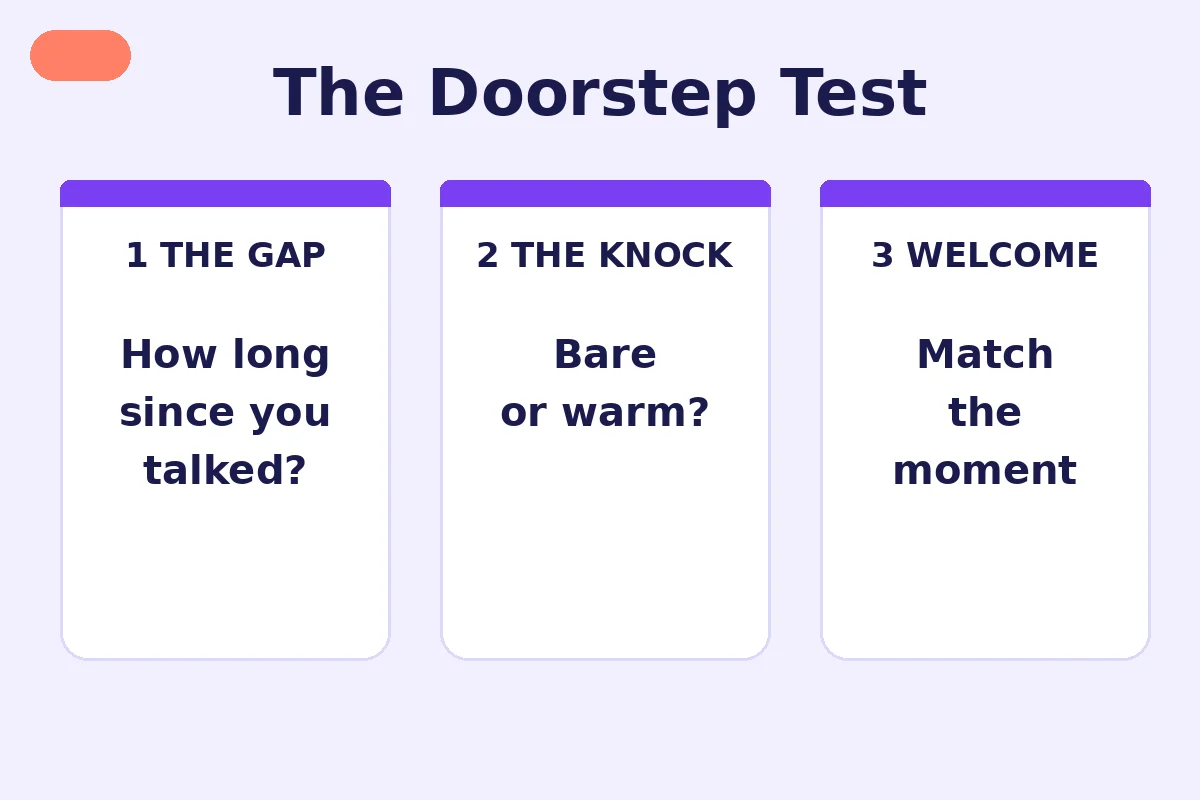
Think of a HYB as someone knocking on your door after time away. Run the Doorstep Test: three checks, in order, on any HYB you receive.
Check one is THE GAP. How long has it actually been since you last talked? A HYB after three months is a genuine reconnection attempt, and it deserves a real answer. A HYB after three days is barely a gap — usually a soft hello, not a catch-up request. A HYB after a fight is different again: the gap is emotional, testing whether the door is still open.
Check two is THE KNOCK. How did the HYB arrive? A bare “hyb?” with nothing around it is the lightest possible knock — low effort, low risk, easy to send and easy to ignore. A warm knock carries wrapping: “Hey! HYB, long time no see, how’s the new job going?” A knock with a detail is almost always sincere; a bare knock is unproven, so do not invest more than it did.
Check three is THE WELCOME. What does this moment call for? Long gap plus warm knock calls for a real update: one honest detail plus a question back (see the playbook below). Short gap plus bare knock calls for a light welcome: a short answer and a question back. If the gap is emotional, acknowledge the silence itself before reporting news. “Yeah, it’s been a minute, sorry about that” opens more doors than any life update.
HYB is an opener, not a pause. If someone needs to step away, the honest move is a pause word, and the guide to brb meaning in text shows how that works. HYB does the opposite job: it starts something, or restarts it. Answering it with silence wastes the one thing the sender offered, which was a beginning. Long gap plus warm knock means a real conversation is on offer; take it. Short gap plus bare knock means a casual hello; keep it light. Emotional gap plus any knock means the silence itself is the topic; name it first.
The Second Meaning: When HYB Stops Asking and Starts Telling
There is a second HYB, easy to miss if you only know the greeting. In motivational, tough-love, and hype contexts, HYB can stand for “Handle Your Business” — a directive, not a question. “Stop stressing and HYB, you got this.” Nobody sending those is asking how you have been; they are telling you to deal with your responsibilities.
Telling the two apart is a matter of sentence job, not guesswork. If the HYB is a question — usually with a question mark, usually at the start of a conversation, usually after a gap — it is “How You Been?” If the HYB is a command — no question mark, sitting where an instruction would sit, surrounded by talk of work, problems, or goals — it is “Handle Your Business.” A “HYB?” never tells anyone to handle their business, and a “HYB.” in a pep talk never asks about anyone’s week.
Register matters, too. “Handle Your Business” HYB is encouraging between friends, blunt between people who trust each other, occasionally sharp when someone is dodging responsibility. Mistaking it for the greeting produces a funny misread: replying “I’m good, you?” to someone who just told you to handle your business.
Meanings This Article Refuses to Count
First, “Hit You Back.” Guides repeat it, but none evidences it, so it is dropped, not downgraded: do not treat a received HYB as a promise of a later reply unless the surrounding sentence says so in plain words. Second, “Hell Yeah, Brother” and its vulgar cousin. A minority of guides list these as rare or playful uses, again without example exchanges. They read like backronyms invented after the fact. Third, “How You Bout?” — one guide’s regional claim, meaning roughly “what are you up to?”, unattested and not counted.
Fourth, and most importantly, the collisions from outside texting. In business and technical writing, HYB is a shortening of “hybrid” — hybrid cars, hybrid work models — and in finance it stands for “high-yield bond.” Organizations use it as initials, too. None of those are texting meanings — the room decides: if the conversation is about a car or a bond fund, the HYB in it is not asking how you have been. The principle is simple: a meaning earns its place in real exchanges, not on lists.
HYB on TikTok, Instagram, Snapchat, and in Text Messages
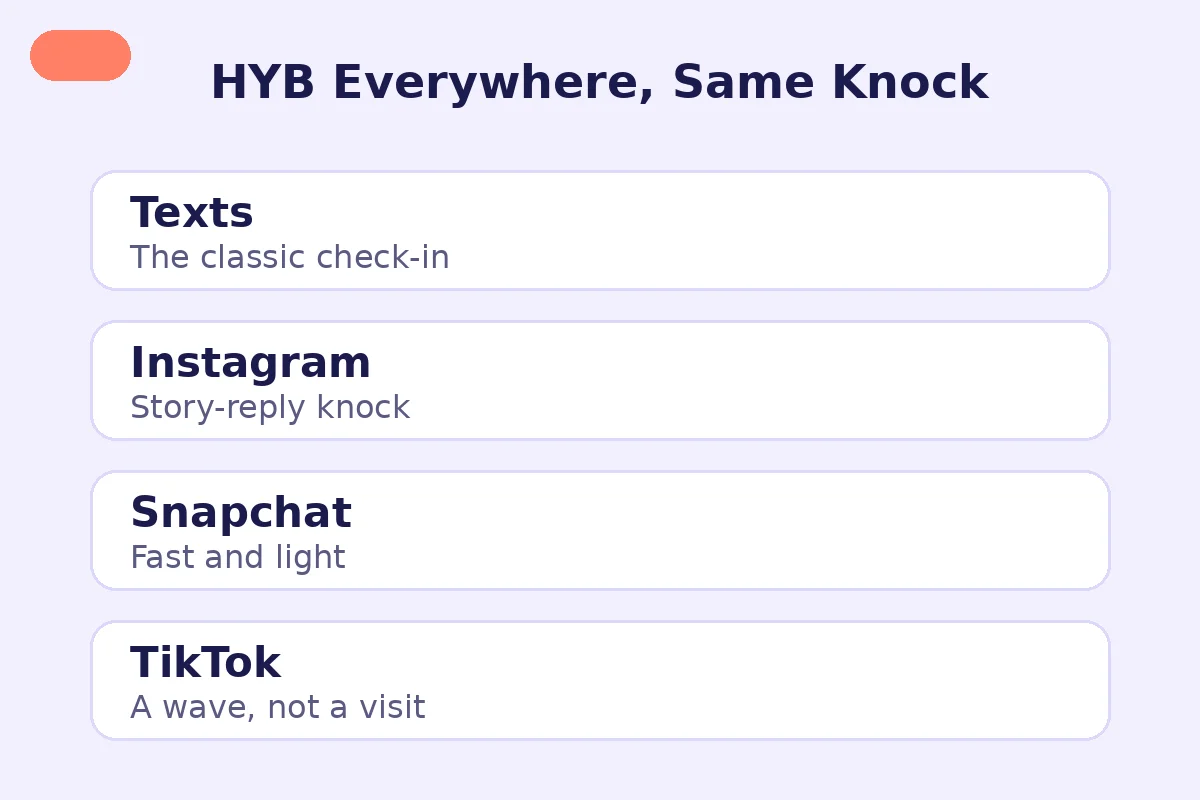
The core meaning of HYB does not change from one app to another. What changes is the room it arrives in, and the room changes how the same knock sounds. No source supports a separate meaning per platform, so this section describes shifts, not new senses.
In plain text messages, HYB is at its most classic. A one-to-one text thread is where the after-a-gap check-in lives naturally, and a HYB there usually means exactly what it has always meant: I have been thinking of you, it has been a while, how has life been? A texted HYB after months of quiet deserves a real answer.
On Instagram, HYB most often arrives in direct messages, frequently as a reply to a story. Someone watches your story and sends “HYB?”, sometimes with a reaction emoji. The story gave them a reason to knock and a topic to open with. A story-reply HYB is usually warmer, because the sender is responding to something specific.
On Snapchat, HYB is fast and light, a knock inside a conversation that is already moving quickly. Snaps disappear and chats feel low-stakes, so a Snapchat HYB rarely carries a texted one’s weight. It is usually a casual hello, not a genuine reconnection after a long gap. The Doorstep Test prevents over-reading it: the gap check shows there was barely a gap.
On TikTok, HYB is mostly a public comment, not a private message. Performed for an audience, it is lighter and more formulaic: a wave, not a visit. Do not carry a TikTok reading into a text thread, or a text-thread reading into a Snapchat streak.
Who Sent It: Friend, Crush, or Acquaintance After a Gap
The same three letters land differently depending on who typed them, because a knock means something different from each kind of visitor. From a close friend, HYB is pure habit and genuine warmth at once. Answer with one detail and one question back. The only mistake is the empty “good, you?” in reply to a friend who made an effort.
From a crush, HYB does quiet extra work. A crush’s HYB after a gap is often a low-risk test: they want to talk, but not risk a big, vulnerable opener, so they send the smallest possible invitation. The tell is in the knock: a crush who adds a detail (“HYB, how was the trip?”) is investing, and the right move is to invest back. A bare “hyb?” is a toe in the water; reply warmly without over-investing. HYB alone never proves romantic interest; the rest of the conversation is where that difference lives.
From an acquaintance after a gap — an old classmate, a former coworker, someone from a group chat that went quiet — HYB is usually exactly what it looks like: a polite, low-cost way to reopen a thin connection. A light answer is the right size: one detail, one question, no obligation to rebuild a friendship on the spot. From a family member, HYB is straightforward warmth — often a parent borrowing your shorthand to say they miss you.
A special note: the person who went quiet after a hard time, or after you did. If their HYB follows a silence with a reason — a rough patch, a disagreement, a stretch when you stopped replying — the gap itself is the message. Acknowledge the silence before the news. “Yeah, it’s been a minute, I’m sorry I went quiet” is worth more than any update, because it answers the real question: is the door still open?
How to Answer HYB Well: The Catch-Up Reply Playbook
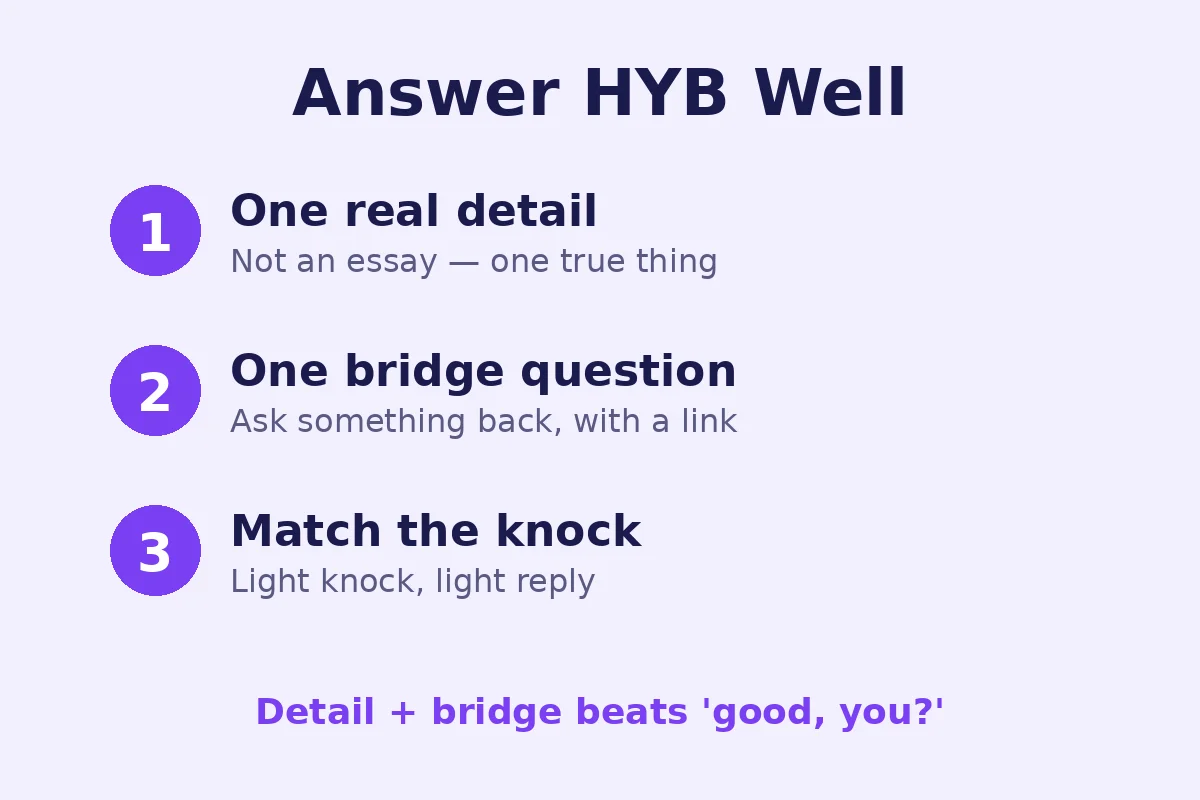
Answering HYB well is a skill, because the obvious answer — “good, you?” — is also the worst one. It gives the other person nothing to respond to, so the conversation they tried to restart dies in the same message that was supposed to save it. Here is the playbook that replaces it.
Move one: give one real detail. Not an essay, not a life story — one specific, true thing about how you have actually been. “Pretty good, finally finished that course I kept talking about.” One detail is a gift: it turns a generic check-in into a conversation with a topic.
Move two: ask one bridge question back. Not “you?” alone, but a question with a bridge in it — something connecting to them or shared history. “How about you, did you ever take that trip?” So the classic shape is detail plus bridge: “Pretty good, finally finished that course. How about you, did you ever take that trip?”
Move three: match the knock. A bare “hyb?” earns a light reply; a warm knock with a detail earns a warmer one.
Move four: when the HYB is really worry in disguise, answer the worry first. Sometimes a HYB arrives because you went quiet or had a hard week the sender knows about — really asking whether you are okay, not asking for news. A reassuring line first does that job, and the guide to dw meaning in text explains why it lands so well. “Dw, I’m all good, just been swamped — how about you?” answers the feeling and the question in one breath.
Move five: leave a thread, not a wall. End with something pick-up-able: a question, a half-finished story, an invitation to continue. If you want to keep the door open beyond this exchange, the guide to lmk meaning in text shows how a light “lmk if you want the long version” hands them the next move without pressure. Do not answer with only “you?”, do not reply with an essay when a detail would do, and do not leave a warm HYB unanswered for days — a knock unanswered twice stops being a knock.
A note on honesty, because the playbook only works if the detail is true. If you have not been good, do not lie smoothly about it. “Honestly, it’s been a weird month” is a complete answer, and it invites a better conversation than a fake “great!” ever will. The guide to tbh meaning in text describes that certification effect: a small honest marker that makes a sentence land as real. “Tbh, it’s been a weird month, but I’m getting through it. How about you?” beats any polished version.
HYB vs HRU, HBU, and WYA
HYB versus HRU: HRU asks “How Are You?” — about right now. HYB asks “How You Been?” — about the stretch since you last spoke. The difference is time direction, as the guide to hru meaning in text shows. Use HRU for regular contacts, HYB after a gap: sending HYB to someone you saw yesterday implies a gap that does not exist.
HYB versus HBU: HBU returns a question. It means “How About You?” and it only makes full sense after someone has shared something first. HYB opens; HBU bounces back. The guide to hbu meaning in text calls this the bounce-back job: HYB starts the exchange, HBU keeps it two-sided. That is why “good, hbu?” beats “good, you?” but still loses to a detail plus a bridge.
HYB versus WYA: WYA asks “Where You At?” — a location or availability question, usually tied to plans happening right now. HYB asks about your life over time. The guide to wya meaning in text puts it well: WYA is social logistics, HYB is a catch-up. Answering a HYB with your location misses the question; answering a WYA with a life update misses the plan. If someone sends “HYB?” at midnight, they are checking in; if they send “WYA?” at midnight, they are asking whether you are free.
One more boundary, for senders: HYB opens a conversation; it does not close one. If you are leaving a chat, close it properly instead — the guide to ttyl meaning in text shows how a pause, not a promise, works.
When Not to Send HYB
HYB is friendly, but it is not universal. Do not send HYB in formal or professional settings. A HYB to a manager, a client, a teacher, or anyone you do not know well reads as careless, because the abbreviation itself announces casualness. Write “How have you been?” in full.
Do not send HYB when someone needs a real answer, not a greeting. After serious news, a loss, a crisis, or a difficult conversation, a three-letter check-in reads as avoidance. Do not send HYB as a substitute for an apology either: after a guilty silence, it does not count as one.
Do not send HYB to someone who has repeatedly not understood your abbreviations — a greeting that needs a glossary is not a greeting. Do not send a bare “HYB?” twice to someone who did not answer the first: one unanswered knock is a missed connection, two is pressure. Finally, only knock if you are willing to come in: sending HYB out of boredom and then answering “good, you?” wastes someone’s honesty.
Quick Answers
What does HYB mean in text?
HYB most often means “How You Been?” — a casual check-in used to restart a conversation after a gap.
Is “How Ya Been” a different meaning of HYB?
No. “How ya been” is the same greeting in casual spelling, not a separate sense. This update corrects the old article’s error: “how you been”, “how ya been”, and “how have you been” are one meaning in three spellings.
Does HYB also mean “Hit You Back”?
Not on any evidence this article could verify. Several guides list it, but none quotes a real exchange or cites a dictionary, so this article drops it.
What does HYB mean from a crush?
The same as from anyone else — a low-risk invitation to talk after a gap — except it may test whether you invest back. A crush who adds a detail (“HYB, how was the trip?”) is investing; match it. But HYB alone never proves romantic interest.
How should I reply to HYB?
Give one real detail about how you have been, then ask one bridge question back — something connected to them or to shared history. “Pretty good, finally finished that course. How about you, did you ever take that trip?” beats “good, you?” every time. Match the knock: light knocks get light replies, warm knocks get warmer ones.
Is HYB formal or rude?
Neither, exactly: it is informal, and informality is only a problem in the wrong room. HYB is friendly by default; in formal messages, write “How have you been?” in full.
Final Thoughts
HYB is three letters doing the work of a knock: I noticed the silence, I am still here, how has life been since we last talked? Answer it kindly: one true detail, one real question, matched to the knock you received. Run the Doorstep Test before you reply: name the gap, read the knock, size the welcome. Default to the greeting, switch to “Handle Your Business” only when the sentence is a command, and refuse the meanings that only ever lived on lists.
This update replaces the old list with a test, a playbook, and three honest corrections: the folded spelling, the dropped “Hit You Back”, and the withdrawn popularity claims. Answer a HYB like you mean to have one, and most of the time, you will.
