
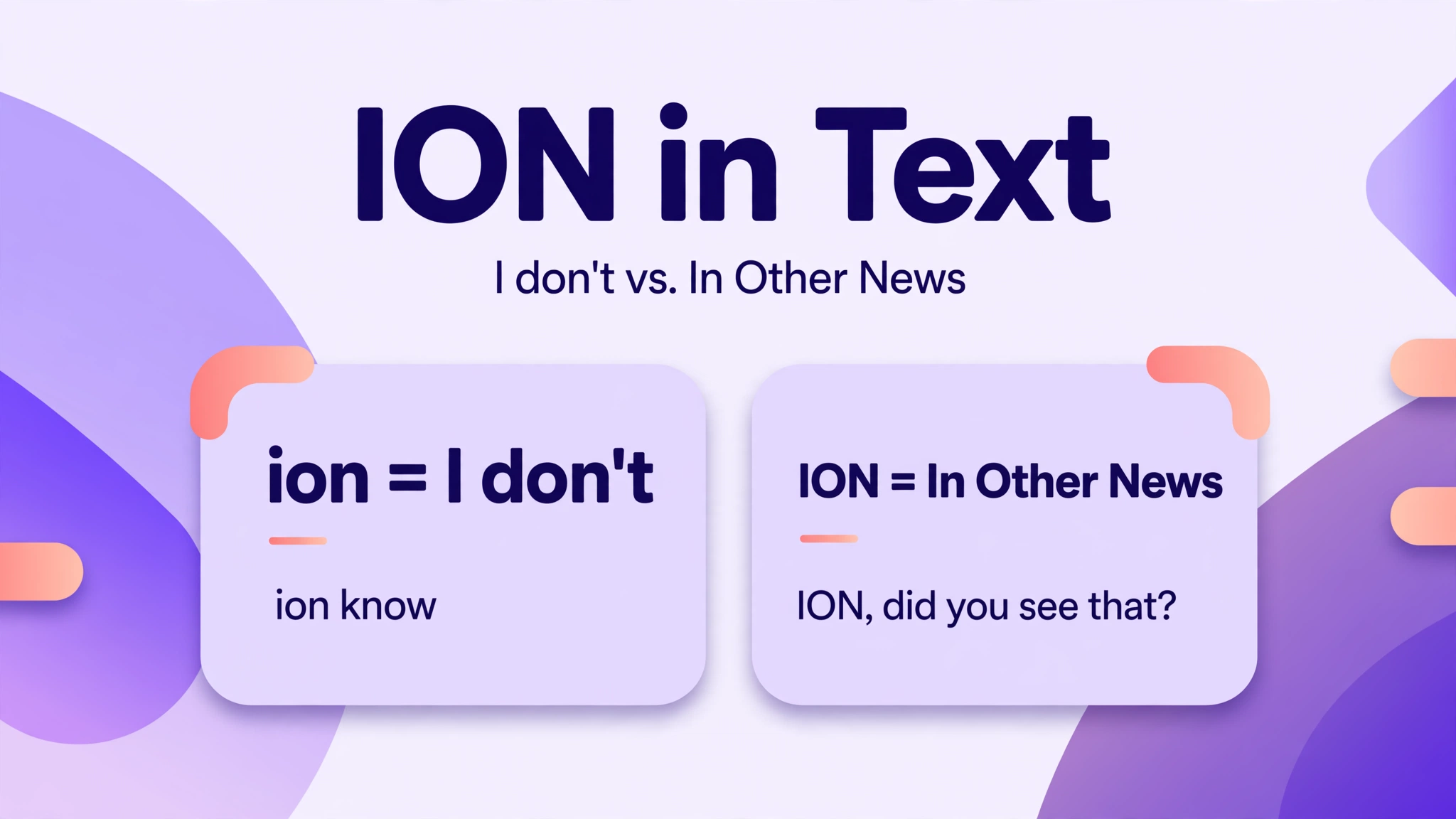
Three letters, two completely different jobs. When someone types “ion” in lowercase, it almost always means “I don’t” — as in “ion know” for “I don’t know.” When it’s written “ION” in capitals, it usually means “in other news” — a quick way to change the subject. The catch: phone keyboards, autocorrect, and lazy capitalization mean you can’t always trust the letters’ case. This guide covers both readings, how to tell them apart, what to send back, and the cases where neither one applies.
The Short Answer
“ION” = “In Other News”
The uppercase version is a different creature entirely. ION stands for “in other news,” and it works like “anyway” or “btw” — a signal that the speaker is switching topics:
- “That exam was brutal. ION, did you hear we’re getting a new teacher?”
- “ION, my sister just got engaged”
- “we should probably leave soon. ION, who wants food?”
Here it has nothing to do with negation. It’s a transition marker: “I’m done with the last topic; here’s a new one.” It shows up most at the start of a standalone sentence, often after a period, and it introduces something that doesn’t connect to what came before. Think of it as the chat version of a news anchor pivoting to the next story.
How to Tell Which One It Is
Most of the time the sentence does the work for you. Run this quick test:
- Is it followed by a verb? “ion wanna,” “ion know,” “ion care” — that’s the “I don’t” contraction. ION as “in other news” never sits directly before a verb.
- Does it start a new, unrelated thought? “ION, guess what happened” — that’s the topic change. The contraction doesn’t introduce fresh topics.
- Read the sentence both ways. “ion like Mondays” only makes sense as negation. “ION did you see that email” only makes sense as a subject change. The wrong reading sounds immediately off.
One honest caveat: don’t treat capitalization as law. Some people type everything in lowercase, some leave caps lock habits to autocorrect, and plenty of people just don’t bother. “ion, did you see that?” with lowercase letters is still “in other news” if the sentence structure says so. Case is a hint; grammar is the evidence.
ion in Realistic Conversations
The exchanges below are illustrative examples, not real messages.
What to Send Back
The reply depends entirely on which “ion” you received — but neither one needs a dramatic response.
They said “I don’t” (declining or unsure):
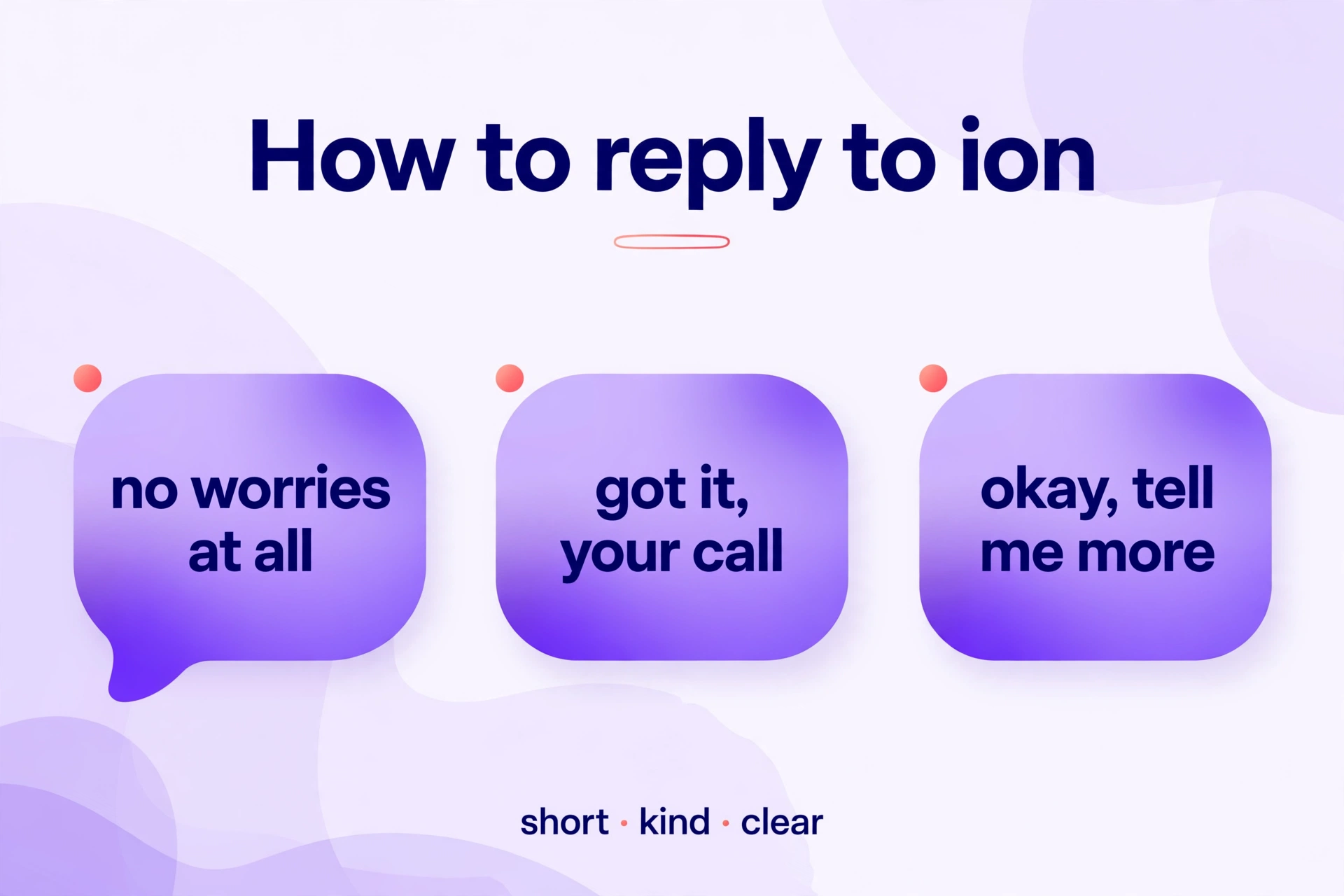
- “no worries at all”
- “got it, your call”
- “okay, tell me more”
If their “ion” turned down an invitation, a natural follow-up is a gentle let me know: “no worries — lmk if anything changes.” If you’re the one leaving rather than declining, GTG (got to go) is the phrase for that. And when someone’s “ion” came from genuine confusion, a sincere follow-up (FR) keeps things honest: “fr, what part’s confusing?”
They said “in other news” (changing the topic):
- Just follow the new topic. That’s the whole point of the phrase.
- If the old topic still needed an answer, loop back: “wait, before we move on —” and then give your TTYL or actual answer.
You genuinely can’t tell which one it is: ask. “you mean ‘I don’t’ or ‘in other news’?” takes two seconds and saves a misread.
ion vs. Similar Slang
Short negation slang clusters together, so it helps to keep the neighbors straight.
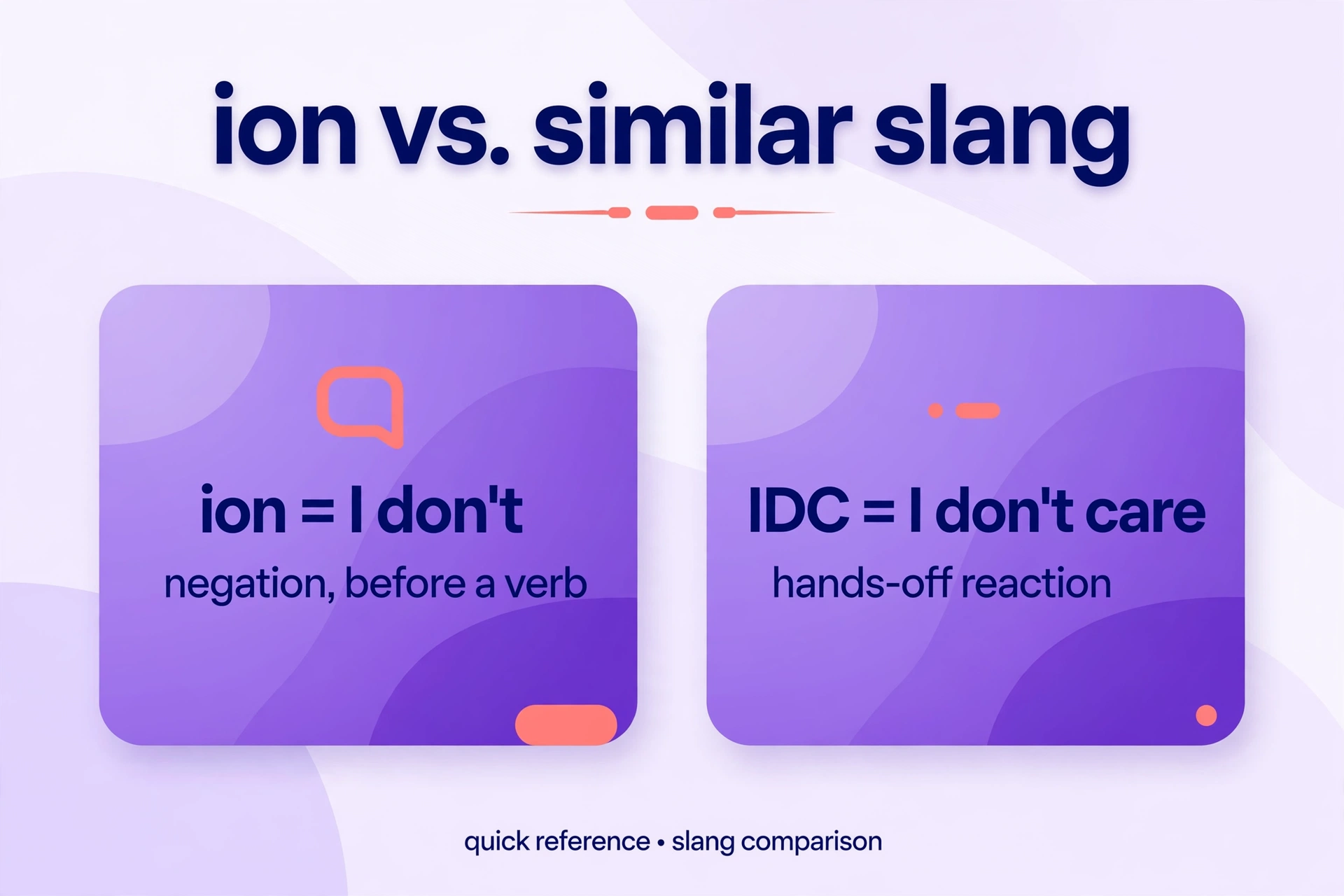
ion vs. IDC (I don’t care). These overlap in spirit but differ in grammar. “ion care” is a clause — it needs the rest of the sentence. IDC is a complete reaction on its own. Both brush something off, but “ion” builds the sentence while IDC ends the thought.
ion vs. “nah.” “Nah” is a one-word no — a complete refusal. “ion” is the start of a refusal that continues: “ion wanna” explains what the no is about. “Nah” closes; “ion” explains.
ion vs. “nope.” Same family as “nah,” just a different flavor. Both are standalone; “ion” always needs a verb after it to finish the thought.
ion vs. SMH. These do different jobs entirely. SMH (shaking my head) is a reaction of disappointment or disbelief — it judges something from the outside. “ion” is plain negation — it just says “I don’t.” One reacts; the other denies.
The through-line: “ion” is the only one of these that’s a phonetic respelling of ordinary grammar rather than a reaction word. It says “I don’t” the way it sounds.
What ion Is Not
It’s not a chemistry reference. Yes, “ion” is also a science word for a charged atom. In a text message, nobody is talking about chemistry. If the chat isn’t about science class, assume the slang reading.
It’s not always distinguishable by capitalization. This is worth repeating because it’s the main trap. The lowercase/uppercase split is the intended pattern, but real typing habits break it constantly. Trust the sentence structure, not the shift key.
It’s not universal. Outside of the circles where this slang lives, “ion” will draw a blank. If the other person looks confused, just say “I don’t” — the whole point of slang is that it’s shared, and when it isn’t shared, it’s noise.
Frequently Asked Questions
What does “ion” mean in a text?
Usually “I don’t” — a phonetic spelling of the phrase, as in “ion know” (“I don’t know”). In capitals as “ION,” it usually means “in other news.”
What does “ion know” mean?
“I don’t know.” It’s the most common form of the contraction — “ion” + “know.”
Is “ion” the same as “in other news”?
Only when written as “ION” and used to change the subject. Lowercase “ion” before a verb is the “I don’t” contraction. The sentence structure tells you which one.
Does capitalization matter?
It’s a helpful hint but not a rule. Plenty of people type “ion” in lowercase for both meanings, so check whether the word sits before a verb (negation) or starts a new topic (subject change).
Where does “ion” come from?
The “I don’t” spelling comes from Black American Vernacular English (AAVE) speech, where “I don’t” said quickly compresses into a sound like “ion.” Social media spread the written form.
What does “iont” mean?
The same as “ion” — the “t” is a leftover from “don’t.” It’s a rarer variant spelling of the same contraction.
Can I use “ion” at work?
No. It’s casual slang with a specific cultural flavor. In professional settings, write “I don’t” in full — and “in other news” as “anyway” or “by the way.”
How do you respond to “ion”?
Match the reading: “no worries” for a refusal, “got it” for indifference, and follow the new topic when it’s “in other news.”
The Short Version
Lowercase “ion” is “I don’t” typed the way it sounds — a quick, casual negation that opens a clause. Uppercase “ION” is “in other news” — a topic-change marker that opens a new thought. Capitalization hints at which one you’re looking at, but the sentence structure is the real test: before a verb means negation, before a new topic means subject change. Both are informal, both are chat-only, and neither belongs in a professional message.
The casual refusal
- A: “You coming to the study group tonight?”
- B: “ion think I can make it, got a shift at work”
- B is declining plainly. The “ion” is doing the work of “I don’t.”
The indifference
- A: “Should we watch the horror movie or the comedy?”
- B: “ion care, you pick”
- B is handing the decision over — indifference, not rudeness.
The topic change
- A: “That lecture was so boring”
- B: “ION, did you see they finally fixed the wifi in the dorms?”
- B heard A, then pivoted. The ION is the pivot.
The mixed-case confusion (and how to survive it)
- A: “ion, what’s the plan for tomorrow?”
- B: “wait — you don’t have a plan, or you’re changing the subject?”
- A: “lol changing the subject — ION. what’s the plan for tomorrow?”
- This is exactly the kind of exchange the lowercase/uppercase blur creates. Asking is always fine.
Where You’ll See Each Version
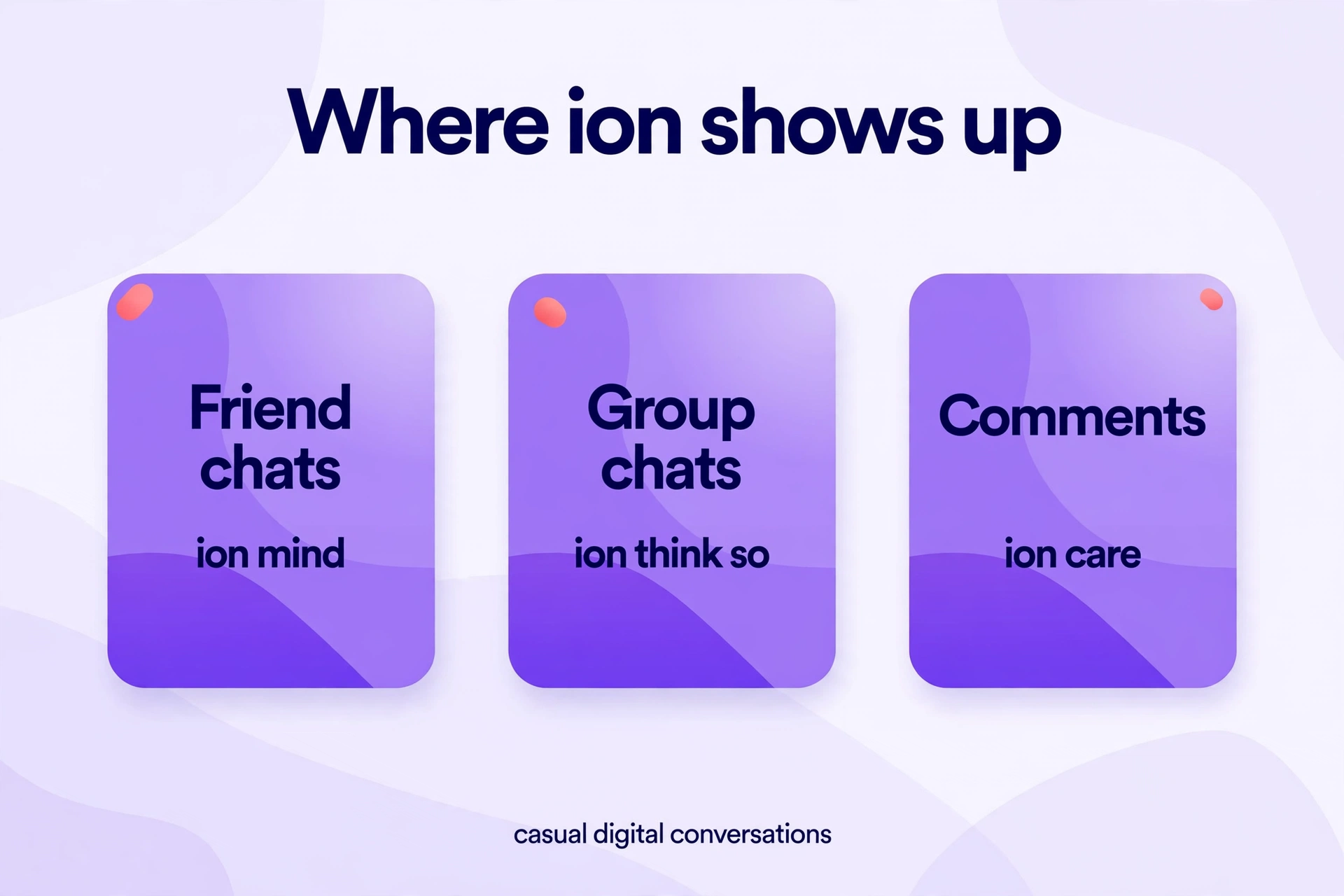
- One-to-one texts and DMs: the home turf of the “I don’t” contraction. Quick, personal, and where phonetic spellings feel most natural.
- Group chats: both readings live here. “ion wanna” declines something; “ION, new topic” redirects the whole thread.
- Comments and replies: the “I don’t” version shows up under posts as a reaction — “ion about that look” is shorthand disapproval.
- Social media captions and posts: “ION” as a topic change works well here, the same way people use “anyway” mid-thread.
- Not for formal messages: neither version belongs in work emails, messages to a manager, or school writing. Write “I don’t” and “anyway” in full.
- Lowercase “ion” means “I don’t” — a phonetic spelling of the phrase said quickly, as in “ion care” (“I don’t care”).
- Uppercase “ION” means “in other news” — a topic-change marker, like “anyway” or “by the way.”
- Capitalization is a useful clue but not a reliable one. Phones and fast typing blur the two, so context is the real tiebreaker.
- The “I don’t” spelling comes out of Black American Vernacular English (AAVE) speech, where “I don’t” said quickly compresses into something that sounds like “ion.”
- Neither reading is formal. Keep both out of work emails and anything professional.
“ion” = “I Don’t”
This is the reading you’ll meet most often. “ion” works as a straight substitute for “I don’t” — it appears before verbs, usually at the start of a clause, and it carries the same plain negation:
- “ion know what to do about it” → “I don’t know what to do about it”
- “ion care where we eat, you pick” → “I don’t care where we eat, you pick”
- “ion think that’s gonna happen” → “I don’t think that’s gonna happen”
The spelling is phonetic: say “I don’t” fast and the middle sounds melt together into something like “ion.” Writing it that way is just typing the sound rather than the standard spelling. It sits in the same family as “gonna” (going to) and “wanna” (want to) — casual speech written the way it sounds.
A few things about how it behaves:
- It almost always opens a clause. You’ll see “ion want to” far more than “the reason ion want to.” It’s a blunt, punchy opener.
- It can decline, dismiss, or express indifference. “ion wanna go” is a refusal; “ion care” is indifference; “ion know” is uncertainty. The verb after it does the work.
- A rarer spelling, “iont,” exists too — the “t” is a leftover from the original “don’t.” It’s less common than “ion,” but it means the same thing.
You’ll also see the double meaning stacked: “ion care” (“I don’t care”) looks a lot like IDC (I don’t care), and in spirit they’re cousins — both brush something off. IDC is a standalone reaction; “ion care” is part of a sentence. Usage entries on Urban Dictionary document the same “I don’t” contraction as the standard reading.