
You get a message with three letters in it: kmg. No emoji, no explanation. You look it up, and the first guide tells you it means “Kill Me, God.” The second says “Kiss My Grits.” The third says it probably means nothing at all — your friend just meant to type OMG and missed.
All three are, sort of, right. That is what makes kmg meaning in text such a strange search: KMG never got one fixed definition. No dictionary lists it, and different corners of the internet filled the same three letters with different phrases. This guide ranks the four real readings and gives you a test that settles almost every case in five seconds.
The Short Answer: Four Readings, One Typo Check
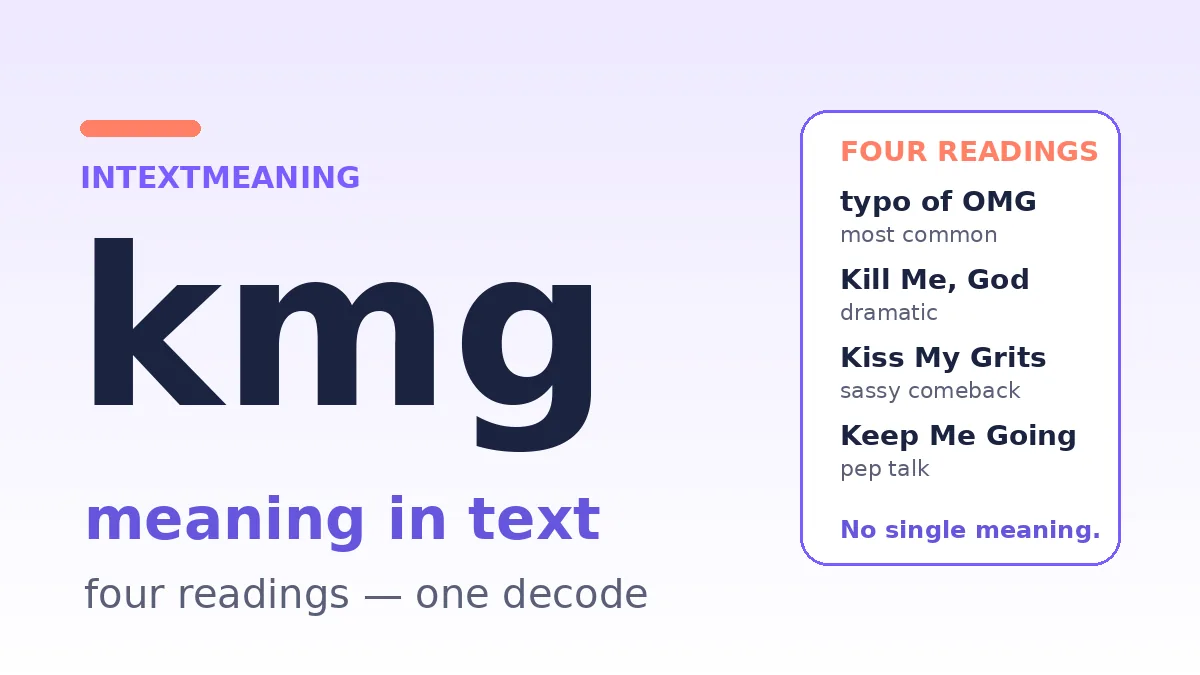
In texting, KMG has no single official meaning. Depending on the message around it, it usually means one of four things: a typo of OMG (the most common cause — check this first); “Kill Me, God,” a dramatic joke about embarrassment; “Kiss My Grits,” a sassy retro comeback from a 1970s sitcom; or “Keep Me Going” / “Keep Me Guessing,” a motivational sign-off or a teasing line.
There is no dictionary-standardized version of KMG the way there is for LOL or BRB, and the guides that rank for it cannot agree on which reading is “most common” — there is no data behind any of their claims. Run the test first, then read.
The Typo Test: Is It Just OMG With a Slip?
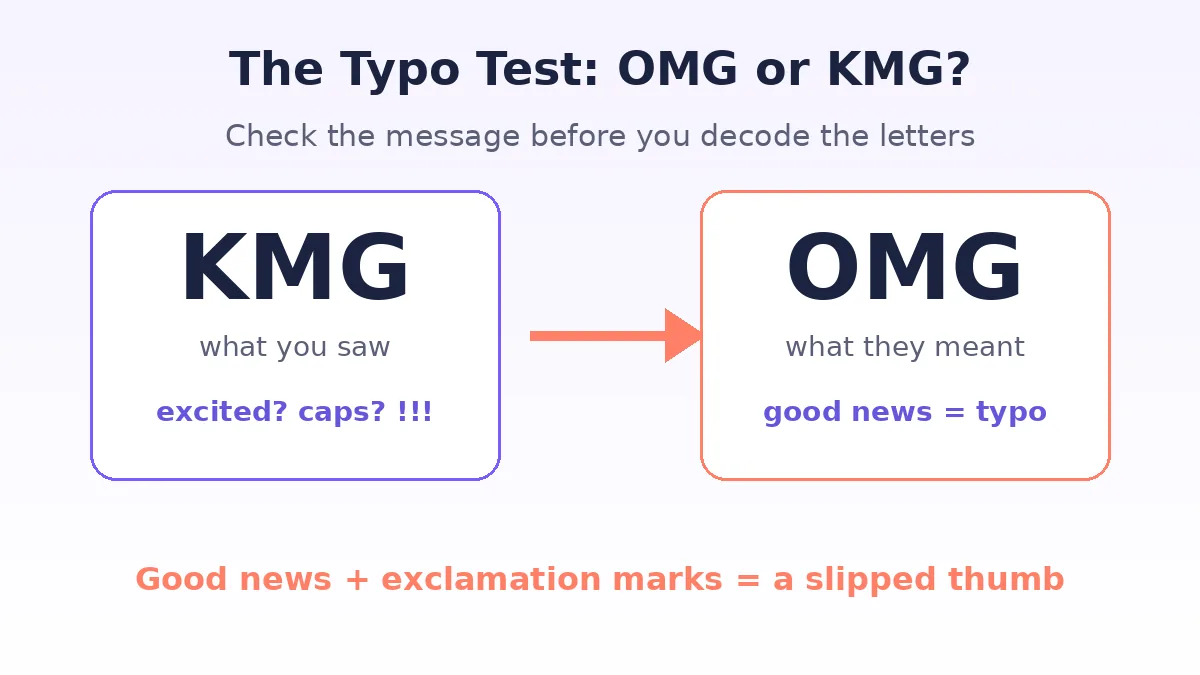
Before you decode anything, ask the simplest question: did your friend mean to type OMG?
The most-upvoted Urban Dictionary entry for KMG says it plainly: if your friend just texted you “KMG,” it was just a typo of “OMG.” Its example makes the point: “KMG!!! HARRY STYLES IS COMING TO MONTREAL!!!!!” Nobody writes that about a pop star and means “Kiss My Grits.”
First, read the sentence. Excited or happy — concert news, gossip, good news — means it is almost certainly OMG. Second, look at the punctuation. A typo’d OMG keeps OMG’s energy: exclamation marks, caps, screaming emojis. “KMG!!!” is OMG wearing a disguise; a lone lowercase “kmg.” is a different animal. Third, check the sender’s history. Fast typer with near-miss typos? Believe the typo. Retro-slang collector? Believe the comeback.
One correction: some guides claim K and O sit close together on the keyboard, which is why the typo happens. On a standard phone keyboard, they do not — the typo comes from fast typing and autocorrect misses. If the Typo Test says “typo,” stop decoding and reply as if they wrote OMG, because they did.
Where “Kiss My Grits” Actually Comes From
Of all the things KMG can stand for, only one has a real origin story. “Kiss my grits” was the signature comeback of Flo, the sharp-tongued waitress played by Polly Holliday on the sitcom Alice (1976–1985). When a customer got fresh, Flo fired back “Kiss my grits!” — a Southern way of saying “get lost” without getting rude enough to be fired. The line ended up on T-shirts and is still quoted whenever anyone wants a sassy brush-off that stays TV-safe.
That is the key: “Kiss My Grits” is a polite insult. It belongs to a family of “Kiss My …” phrases, and KMG is the well-behaved cousin — “leave me alone” with a wink, not a slammed door.
Grits are part of the joke: a humble Southern breakfast food. Telling someone to kiss your grits is telling them to kiss something ordinary and entirely yours. So when is KMG “Kiss My Grits”? When the message is a comeback — somebody teases or nags you, and you answer with a grin: “You think I’m waking up early on Sunday? KMG.” The emoji usually gives it away.
The Four Readings, One by One
1. A typo of OMG. The tell: excitement, exclamation marks, good news, caps-lock energy. “KMG!!! HE FINALLY TEXTED BACK” is OMG — treat it as OMG and nobody will know the difference.
2. “Kill Me, God.” The tell: embarrassment — the kind of moment where you want the floor to swallow you. “I waved back at someone who wasn’t waving at me. kmg.” “Three exams tomorrow. kmg.” It is dramatic hyperbole, the same family as KMS: “This is too much, laugh with me about it.” Nobody means it literally, and “Kill Me Gently” is the same feeling in softer phrasing, not a separate meaning.
3. “Kiss My Grits.” The tell: a comeback, a tease, a brush-off with a smile — usually answering a dare, a nag, or a joke at your expense. “You forgot your own birthday cake.” “kmg stop.” It is sassy, not angry, and the emoji marks the difference: a laughing face means the grits are a joke; no emoji after a real argument means they might have an edge.
4. “Keep Me Going” — or “Keep Me Guessing.” The tell: effort or mystery. “Finals week is brutal, but I’ve got this. KMG” is a pep talk typed out loud; “Are you free this weekend?” “KMG” with a smirk is a tease. Honestly, it is the weakest of the four — both guides that list it use invented examples, and no real conversation clearly shows KMG meaning “Keep Me Going.” Treat it as a possibility, not a definition. The same goes for the “Keep Me …” fill-ins some guides publish: any K-M-G phrase can be invented on the spot, and that is a word game, not a meaning.
The Three-Question Decode
When the Typo Test does not settle it, use this. Three questions, in order, settle almost every real KMG you will ever receive.
Question 1: What came right before it? Embarrassing story: “Kill Me, God.” Tease or dare: “Kiss My Grits.” Pep talk: “Keep Me Going.” Flirty question: “Keep Me Guessing.” Good news: the typo. Read the message before the message.
Question 2: What emoji rides along? Crying-laughing face or skull: drama — “Kill Me, God.” Laughing face or eye-roll: a comeback. Flexed arm or fire: motivation. Smirk: a tease. No emoji: lean harder on questions 1 and 3.
Question 3: Who sent it? A close friend’s KMG is almost always a joke. A crush’s KMG borrows the thread’s tone. A coworker’s is usually the dramatic reaction. A stranger’s is usually aimed at the post, not you. Forget the “KMG from a girl” sections some guides run — there is no gender-specific definition; the relationship matters, not the gender.
Still unsure after all three? Just ask: “Wait — typo, or actual embarrassment?” Asking is not awkward; it is the correct move.
KMG on TikTok, Snapchat, Instagram, and in Plain Texting
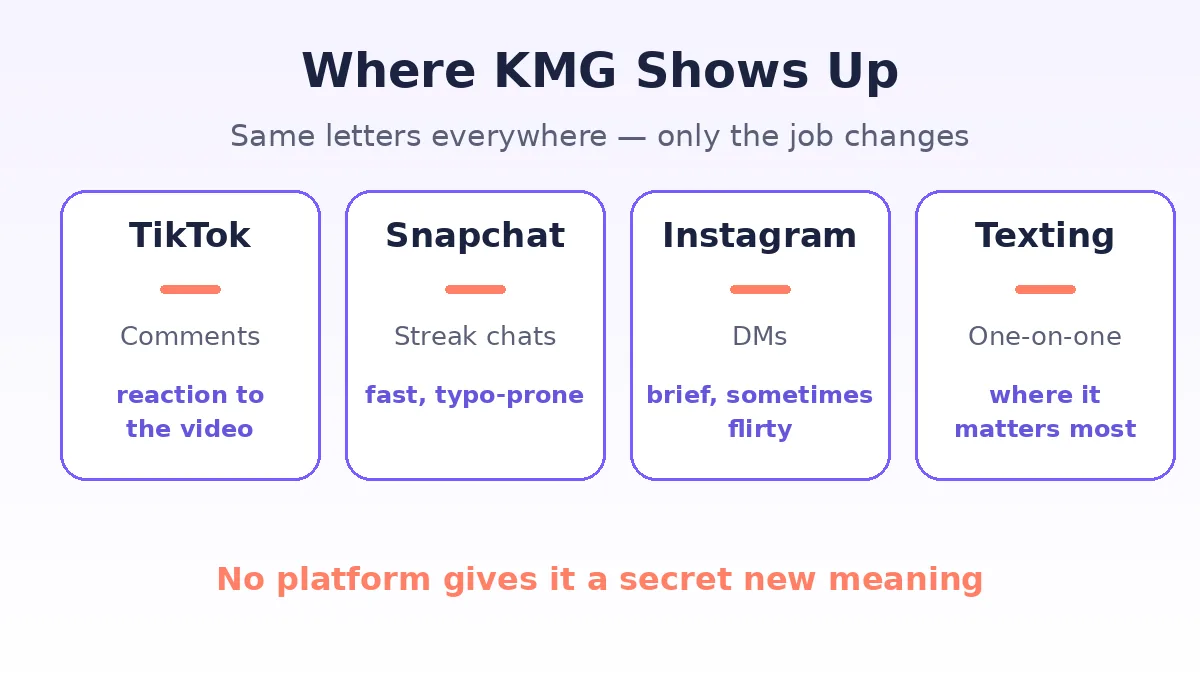
KMG does not change its meaning from platform to platform — it changes its job. The letters stay the same; the room changes what they do.
On TikTok, KMG lives in the comments as a reaction to the video. “KMG this outfit is everything” is excitement — run the Typo Test first, because that one is OMG in disguise. “The way she said that — KMG” is the dramatic reaction.
On Snapchat, KMG shows up in fast, private streak chats, where speed matters more than precision — which is why the typo reading is so common here. When intentional, it is usually the dramatic reaction or the comeback.
On Instagram, KMG appears in DMs and comment replies — like texting in DMs, like TikTok in comments. Watch for the flirty reading here: “Keep Me Guessing” turns up in dating-adjacent DMs more than anywhere else, usually with a smirk and a question left unanswered.
In plain texting — iMessage, WhatsApp, SMS — KMG is at its most personal, because the message before it is a real conversation with someone you know. “Just spent three hours untangling my earphones. KMG.” The Decode works best here, because you know the sender. In gaming chats, KMG is frustration after a loss; in work chat, it barely belongs at all — in a relaxed team thread it is the dramatic reaction, and anywhere more formal, type the full sentence.
KMG vs OMG vs KMS vs SMH
KMG gets confused with its neighbours because they all live in the same emotional neighbourhood: big reactions, typed fast.
KMG vs OMG. OMG is pure surprise — happy, shocked, or excited, good news or bad. KMG is narrower: a dramatic joke about an awkward moment. Surprised? OMG. Embarrassed or overwhelmed? Maybe KMG. And remember the Typo Test — plenty of KMGs are OMGs, mistyped.
KMG vs KMS. KMS is the standardized version of the joke KMG reaches for — the same “kill me” hyperbole with darker wording. KMG’s “Kill Me, God” is the same joke with a softer landing.
KMG vs SMH. SMH is deadpan disapproval — disappointed, unimpressed, done. KMG is louder and funnier; SMH is quieter and colder. “KMG, I can’t believe I did that” laughs at yourself; “SMH…” judges yourself. Same moment, different temperature.
KMG vs GTFO. GTFO is the aggressive cousin of the “Kiss My Grits” reading — a hard “get out,” rude and final. KMG’s comeback keeps the joke alive: a door slamming is GTFO; a door closed with a grin is KMG.
KMG vs IDC. IDC means “I don’t care” — flat indifference; the sender checked out. KMG is never flat: even its coldest reading has energy. IDC ends a conversation; KMG performs in one.
When KMG Goes Wrong: Three Mistakes
Mistake 1: Answering a typo as if it were an insult. Your friend sends “KMG!!!” about concert tickets and you reply, “Whoa, what did I do?” You have turned their excitement into a conflict that never existed. Run the Typo Test first.
Mistake 2: Answering a joke with a serious spiral. Someone sends “kmg I just tripped in front of my whole class” and you reply with a paragraph about whether they are okay. They were joking; your reply just made the moment awkward for real. Laugh first, check in second. A single flat K would be worse — it answers drama with ice.
Mistake 3: Using KMG where clarity matters. KMG is ambiguous by nature. Do not use it when the other person needs to know exactly what you mean: not in a serious conversation, not at work, not when someone just shared bad news. A warm KK at least says “message received”; a bare KMG says nothing anyone can rely on. And “Kiss My Grits” is sassy, not mean — but only when the relationship can carry it. Sent to a stranger, it stops sounding like Flo and starts sounding like a dismissal.
How to Reply When Someone Sends KMG
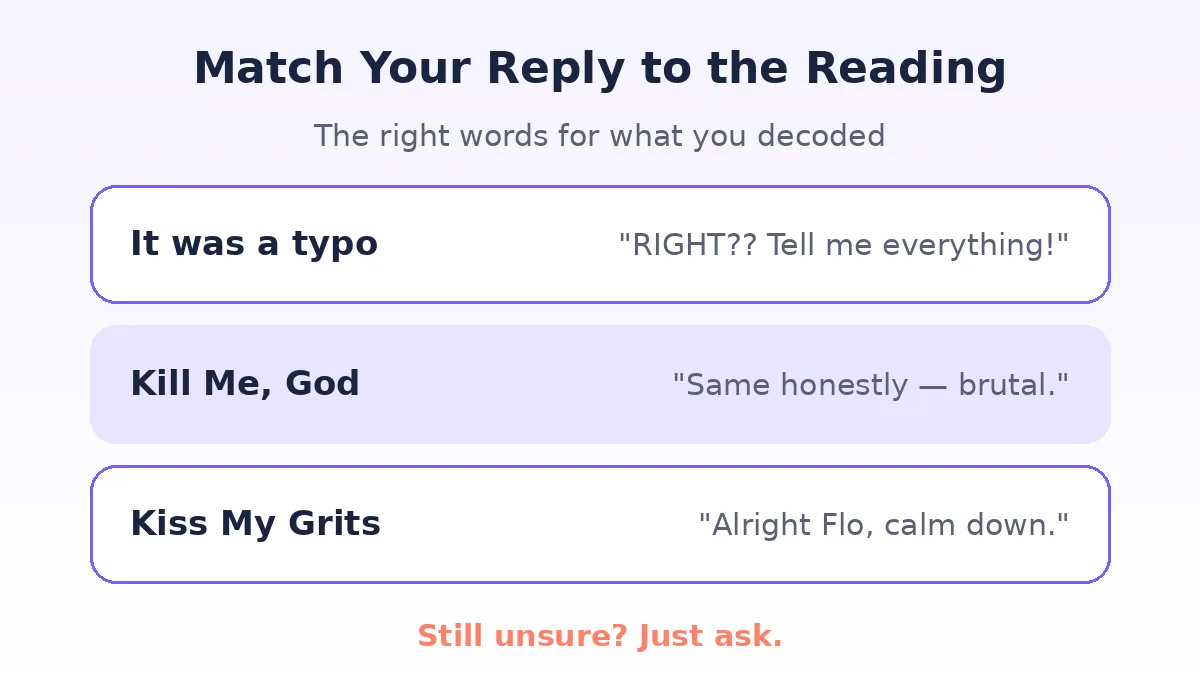
Your reply should match the reading you landed on, not the letters you received.
If it was a typo of OMG: match the excitement. “RIGHT??” “I KNOW.” “No way, tell me everything.” Reply like it is OMG — the way you would answer an IKR with agreement, not a question.
If it was “Kill Me, God”: laugh with them, then move on. “I’m crying, that’s brutal.” “Same honestly, I’d never leave the house again.”
If it was “Kiss My Grits”: play back. “Alright Flo, calm down.” “Haha okay okay!” The comeback invites you to keep joking — unless the argument underneath is real, in which case drop the bit and talk properly.
If it was “Keep Me Going” or “Keep Me Guessing”: for the pep talk, “You’ve got this.” For the tease, “Fine, I’ll guess — Friday?”
If you genuinely cannot tell: ask, lightly: “Wait — typo, or actual embarrassment?” Nobody minds; the letters are genuinely ambiguous.
Quick Answers
What does KMG mean in text?
No single official meaning: usually a typo of OMG, “Kill Me, God,” “Kiss My Grits,” or “Keep Me Going” / “Keep Me Guessing.” Check the message around it.
Is KMG a typo of OMG?
Often, yes — the most-upvoted Urban Dictionary entry says so. Excited message, exclamation marks? Treat it as OMG.
What does “Kiss My Grits” mean?
A playful, Southern way of saying “leave me alone” without being rude — the catchphrase of Flo (Polly Holliday) on the 1970s–80s sitcom Alice. As KMG, a sassy comeback, not an insult.
Is KMG rude or offensive?
Usually not — cheeky and dramatic, but not generally rude. It can sting as a dismissal, so save it for people who know you are joking.
What does KMG mean on TikTok?
In comments, as a fast reaction to the video — excitement (often a typo of OMG), a dramatic reaction, or a sassy comeback.
What does KMG mean on Snapchat?
Usually the dramatic “Kill Me, God” reaction or the “Kiss My Grits” comeback — and the typo reading is common too, because Snapchat typing is fast. No Snapchat-only definition exists.
What does KMG mean from a girl?
No gender-specific definition — meaning shifts by context and relationship. Flirty thread: “Keep Me Guessing.” Friend banter: “Kill Me, God” or “Kiss My Grits.”
How do I reply when someone sends KMG?
Match the reading, not the letters: excitement gets excitement back, an embarrassing story gets a laugh, a comeback gets a playful reply, a tease gets you playing along. Unsure? Ask — “typo, or actual crisis?”
The Final Word on KMG
The honest summary the other guides would not print: KMG does not have a meaning. It has four readings, a typo, and a history. The typo is the most common real-world cause; “Kill Me, God” the most common intentional meaning; “Kiss My Grits” the oldest and most charming; “Keep Me Going” real but rare. Most other expansions are word games, not usage.
That is how slang works when nobody standardizes it: three letters, filled in by whoever is typing, shaped by the message around them. The skill is reading the room — the message before it, the emoji beside it, the person who sent it. So next time those three letters show up, do not panic and do not guess. Run the Typo Test, ask the three questions, and reply to the person, not the abbreviation.