
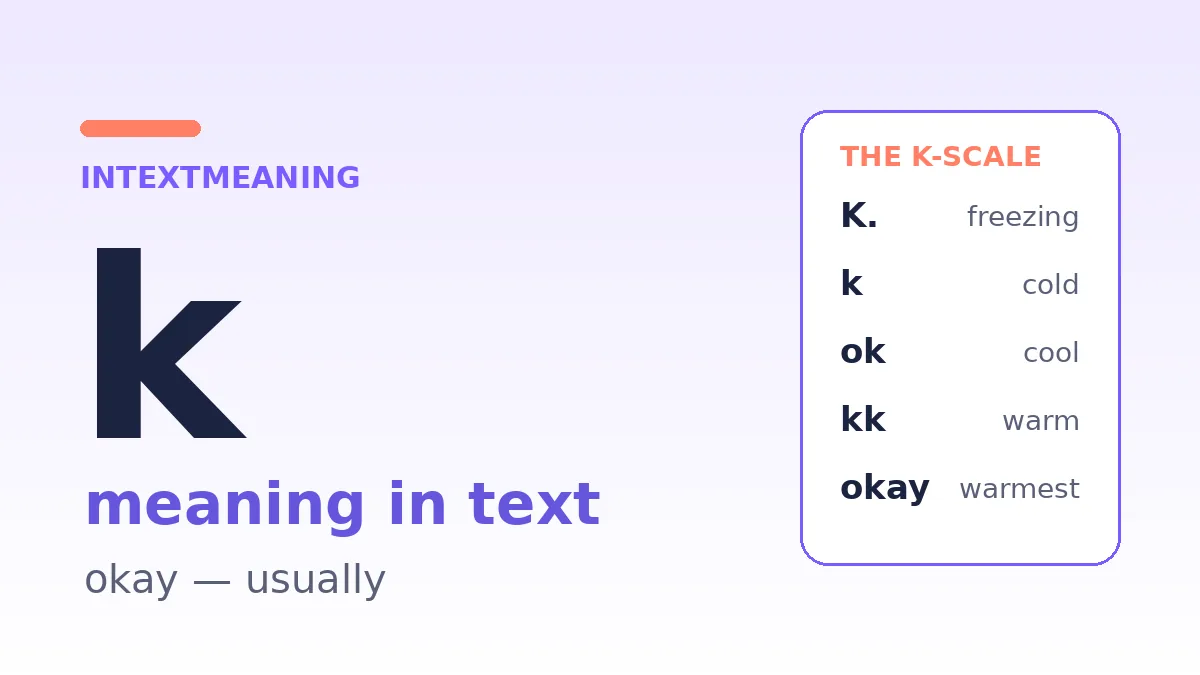
You send a message you actually thought about. The reply comes back: “k”. One letter — no emoji, no punctuation, no follow-up. Suddenly you are doing detective work on a single keystroke: are they mad, busy, bored, or just done talking? That is the whole puzzle of the k meaning in text: the definition takes two seconds to learn, and the tone takes the rest of the article.
K means “okay.” It is a clipped form of OK — Wiktionary lists it as a clipping of OK in text messaging and internet slang, and Merriam-Webster lists K as a common texting abbreviation for “okay.” When someone types it, they are saying, “I read your message and I accept it.” Everything interesting about K lives in the space between the definition and the feeling it leaves behind.
The Short Answer: K Is “Okay” — With the Warmth Taken Out
Think of “okay” as a yes with a handshake: four letters, a whole word, a sign that the sender stopped to type it. K says the same yes with the handshake removed. Same meaning, minus the warmth.
That is why K is the most argued-over letter in texting: nobody argues about what it means — every guide agrees it means “okay.” People argue about what it signals. A “k” after “Dinner’s at 7” is a receipt; the same “k” after a long message about a bad day feels like a door closing.
The K-Scale: One Letter, Five Temperatures
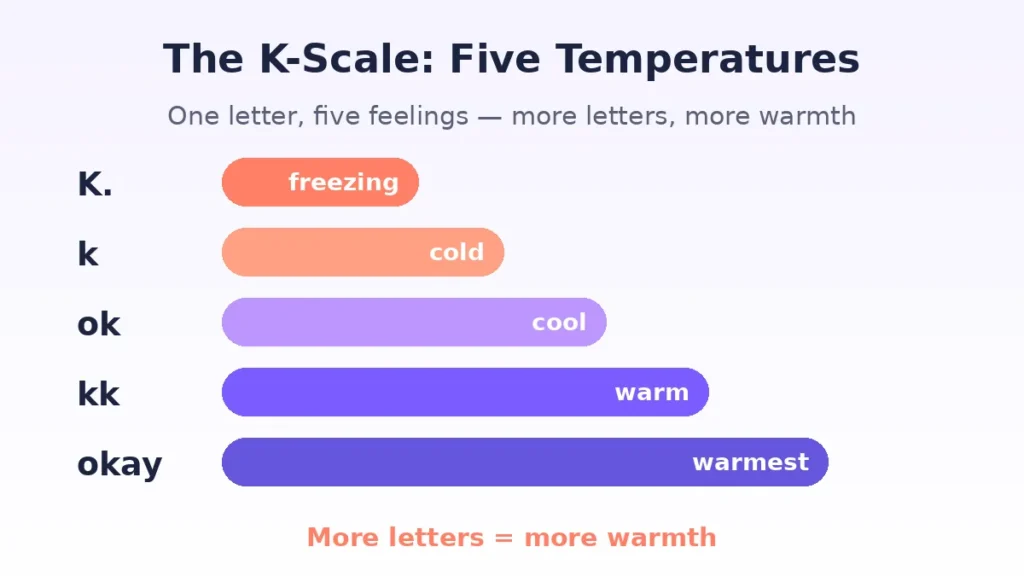
Here is the named idea of this article — the K-Scale: five ways to write the same “okay,” coldest to warmest.
Temperature 1: “K.” — freezing. One letter plus a period. The period adds finality — a sense that the conversation is over and the sender has decided it. “K.” after an argument is a verdict. Use it almost never.
Temperature 2: “k” — cold. The plain single letter, lowercase — the most common form and the most argued about. In a fast logistics thread it is neutral; after anything emotional, it reads as distant. The tell is what came before it: short and practical means “k” is fine, long and personal means it is a chill.
Temperature 3: “ok” — cool, but fine. Two letters, one extra keystroke, and the whole feeling changes. “Ok” is the safe default: neutral, polite enough, clearly an acknowledgement.
Temperature 4: “kk” — warm. Doubling the letter doubles the friendliness. KK meaning in text is the casual, upbeat cousin: “okay, cool,” said with a nod — “got it” and “I’m engaged” at once, for one keystroke more.
Temperature 5: “okay” — warmest. The full word — four letters, no abbreviation, no ambiguity. After an emotional message, “okay” is the minimum that shows you actually read what was said. Use it for apologies, bad news, and anything where the other person needs to feel heard.
A Short History: From OK in 1839 to K in Your Pocket
K is the last step in a 180-year chain of shortening. The word OK first appeared in the Boston Morning Post on March 23, 1839, as a joke abbreviation of “oll korrect” — a humorous misspelling of “all correct.” When SMS texting took off in the late 1990s and early 2000s, every character cost money or time, so “okay” became “ok” and “ok” became “k”: an Urban Dictionary entry in February 2003, a Rice University slang list in 2004, and by the mid-2000s a standard quick reply on AIM and MSN Messenger. The shortening outlived its reason: K survives as a social signal, the shortest possible reply.
Why One Letter Feels So Cold: The Effort Test
There is a real reason “k” stings more than “ok”: effort asymmetry. When you send a message you invested in and the reply invests almost nothing, the gap itself feels like a message. Typing “ok” costs one extra keystroke over “k” — choosing “k” anyway tells the reader their message was not worth even that. Research summarized by Fast Company found single-letter replies like “k” among the most negatively received responses in digital conversations. Text messages also strip out everything that softens a blunt reply in person: tone of voice, facial expression, a reassuring gesture. What is left is the words alone, and when the words are a single letter, the brain fills the gap with the worst plausible interpretation. That is the Effort Test: compare the effort in the message you sent with the effort that came back. A big gap means the reply was probably cold — or at least, that is how it will land.
The Three-Signal Read
Here is the named test for this article — the Three-Signal Read. Three signals, checked in order, settle almost every “k” you will ever receive. Signal 1: Who sent it? A close friend who always texts in shorthand is different from a partner who normally writes paragraphs. If the sender’s normal style is short, a “k” is just their voice; if they normally write full sentences and suddenly send one letter, something changed. Signal 2: How long did it take? An immediate “k” in a logistics thread is different from a delayed “k” after something personal. Fast means busy; slow means the sender sat with your message and still chose one letter. Signal 3: What punctuation came with it? “k” is ambiguous. “K.” is a shut-down. “k 👍” is friendly. The period is the only punctuation that makes “k” colder. If two signals point cold, treat the “k” as cold. If two point neutral, let it go. If you still cannot tell, ask once: “All good?”
Where K Shows Up: TikTok, Snapchat, Instagram, and Plain Texting
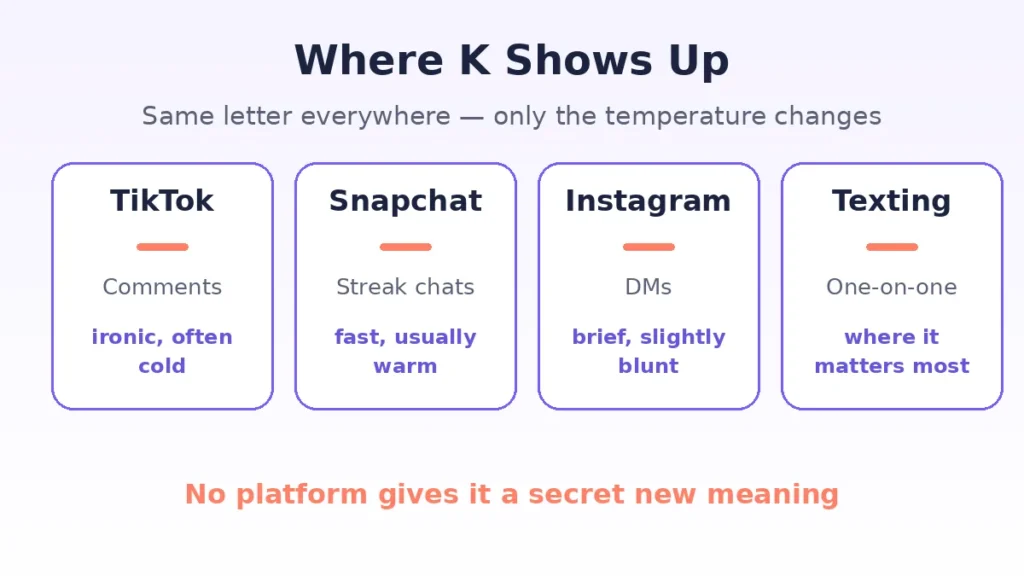
K means “okay” everywhere it appears. No platform gives it a secret new meaning. What changes by platform is the temperature.
TikTok is where K is funniest — and coldest. In comment sections, “K” is often a joke: someone writes a long opinion, and the top reply is a single “K,” used ironically to show indifference. But that same irony is why a plain “K” in a TikTok DM can sting.
Snapchat is where K is warmest. Streak chats and fast DMs move so quickly that a one-letter reply is just the pace of the room. “Send the video later.” “K.” Nobody reads emotion into it. Instagram DMs sit in the middle: a “k” there reads as brief and slightly blunt, and often ends the conversation.
Plain texting — SMS, WhatsApp, iMessage — is where K matters most, because these are the threads where the relationship lives. In a group chat, a “k” is invisible noise; in a one-on-one thread, it stands out like a slammed door. Gaming chats are the one room where K is purely practical. “Start the match.” “K.” — speed matters more than tone, and the reply means “understood, ready.” If the person you are waiting on has stepped away entirely, BRB meaning in text is the abbreviation for that status — and when the game ends, GTG meaning in text is how people leave.
K From Three Different Senders
The same letter lands differently depending on who sends it.
From a crush. A “k” from someone you are just getting to know feels like a verdict on the whole conversation, because it might be one. Early dating runs on effort signals, and a one-letter reply after you wrote something real reads as low interest — but it is not proof. One “k” is noise; five in a row is a signal.
From a partner. This is the “k” that hurts most, because you know their normal style. A partner who writes paragraphs and suddenly sends “k” is telling you something — usually annoyance, overwhelm, or that they are done with this conversation for now. Answer the situation, not the letter: “Hey, you seem quiet — everything okay?”
From a boss, or a parent. A “k” from a manager after a detailed update reads as dismissive, even when it is not meant that way — at work, acknowledgement is part of the job. Never send “k” to a boss yourself. A parent’s “k” is the opposite: parents who did not grow up texting use it with no awareness of the connotation.
K Next to KK, OK, Okay, and LMK
K belongs to a family of short replies, and picking the wrong cousin is how messages get misread.
K vs KK. The closest pair. K is flat; KK is friendly — the casual “okay, cool,” a nod with a smile. K vs OK and Okay. “OK” is the safe default — neutral, polite enough. “Okay” is the full word, the warmest version, the one for emotional conversations. Think of it as a ladder: K is the bottom rung, OK is the middle, Okay is the top.
K vs LMK, NGL, TBH, and IMO. LMK meaning in text — “let me know” — is a request, not an answer. “K” closes a conversation; “LMK” opens one. NGL meaning in text (“not gonna lie”) and TBH meaning in text (“to be honest”) are honesty labels — they tell you how sincere the message is. K tells you nothing about sincerity; it only tells you the message was received. And when someone gives you an opinion rather than a fact, IMO meaning in text (“in my opinion”) is the label for that. K never labels an opinion, only a receipt.
When K Goes Wrong: Three Mistakes
Mistake 1: Answering feelings with “k.” Someone shares something emotional and you reply with one letter. Even if you mean nothing by it, the reader will hear dismissal. If the message took courage to send, it deserves more than a keystroke back.
Mistake 2: Sending “K.” as a weapon. The period turns a reply into a statement, and using it to punish someone is the one use of K that is genuinely hostile. It escalates; it does not resolve. If you are annoyed enough to type “K.”, say what is actually wrong — or come back later.
Mistake 3: Mirroring it back. They sent “k.” You send “k.” Now you are both being cold, and neither of you knows who started it. The mirror feels fair, and it is a trap: it doubles the distance instead of closing it. Break the pattern with warmth: “Got it, talk later” costs four words and ends the standoff.
How to Reply When Someone Sends Just “K”
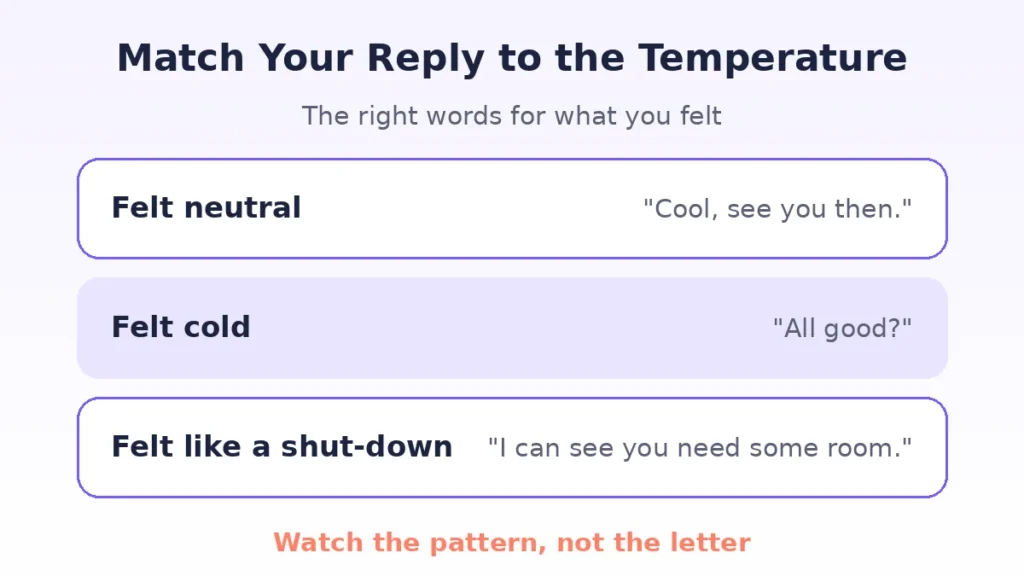
Match your reply to the temperature you felt.
If it felt neutral: continue naturally. “Cool, see you then.” “Sounds good.” “Thanks!”
If it felt cold but you are not sure: ask once, lightly. “All good?” A low-effort clarifier beats a spiral of assumptions. Avoid “Are you mad at me?” — that puts them on the defensive immediately.
If it felt like a shut-down: give space, not pressure. “I can see you need some room. I’m here when you’re ready to talk.” If the thread is already hostile, the best reply is often no reply at all — and TTYL meaning in text is the clean way to step out.
If it keeps happening: stop reading single letters and start reading the pattern. One “k” from a shorthand texter means nothing. Five consecutive minimal replies after a period of warmth means something. Watch the trend, not the letter — and if the trend is real, have the conversation out loud, not in text.
Quick Answers
What does “k” mean in texting?
K means “okay” — a clipped form of OK: “I read it, I accept it.”
Is “k” rude?
Not by itself, but it often feels rude: one letter carries no warmth, so after an emotional message or an argument it reads as cold or dismissive. In a fast thread between friends, it is completely neutral.
What does “K.” mean with a period?
The period makes it colder and more final. “K.” reads as a deliberate shut-down — the sender is ending the conversation. It is the coldest variant on the K-Scale.
What is the difference between “k” and “kk”?
KK is noticeably warmer: the doubled letter reads as friendly and engaged — “okay, cool” — while a single “k” can feel flat. For one extra keystroke, type “kk.”
What does “k” mean from a crush?
It still means “okay,” but in early dating a one-letter reply reads as low interest — dating runs on effort signals. One “k” is noise; a pattern of short replies is the signal.
What does “k” mean on TikTok?
The same thing — “okay” — but on TikTok it is often ironic: in comment sections, a single “K” is a joke reply to a long opinion. In a TikTok DM, though, it can sting.
What does “k” mean on Snapchat and Instagram?
On Snapchat, usually just a fast confirmation — streak chats move too quickly for anyone to read emotion into one letter. On Instagram DMs it reads as brief and slightly blunt, and often ends the conversation.
Can I use “k” at work?
Avoid it. In workplace chats “k” can look careless or dismissive, because the reader cannot tell whether you understood the task. Use “Got it” instead — and never use K in an email.
The Final Word on K
K is one letter doing an enormous job: the shortest possible “okay,” and the reply that says the least about how you feel. It costs nothing to send — and it can cost you a conversation in the wrong room.
The skill is not memorising the definition — anyone can do that in two seconds. The skill is the scale: hearing whether a “k” is logistics, warmth, distance, or a door closing, and replying to the temperature, not the letter. The next time a lone “k” lands in your chat, reach for the scale, not a dictionary.