
A friend sends you a meme at midnight, and your entire reply is four letters: lmao. You were not, in any literal sense, rolling on the floor. You may not even have laughed out loud. You smiled, you tapped four letters, and the conversation moved on — and that is exactly why the lmao meaning in text deserves a better explanation than a one-line definition. Those four letters are doing more work than they look like they are doing, and the work changes with the message around them.
This article gives you a way to read that work. LMAO is a laugh signal, not a laugh report, and it can mean real laughter, polite softening, or outright sarcasm. The test in this article — the Second-Line Test — reads the line that comes after the lmao, because that line is where the truth lives.
What LMAO Actually Means — and Why the Mask Matters
Let us start with the definition, stated once and clearly. LMAO stands for “Laughing My A** Off.” The masked form is used throughout this article on purpose: the expansion contains a mild swear word, and Wiktionary tags the term “mildly vulgar.” That label matters for the whole article, because it decides where lmao belongs and where it does not. With close friends it is harmless; in a message to a teacher, a client, or a stranger, the vulgarity rides along with the laugh whether you meant it to or not.
Wiktionary lists lmao as an interjection used to indicate great amusement, usually exaggerated, and also as a verb, with forms like “LMAOing” and “LMAOed” attested in print as far back as 2009. The exaggeration is the point: nobody who types lmao has literally laughed anything off. The phrase is hyperbole for “much funnier than an ordinary laugh,” and the letters inherited it when they moved online.
The spelled-out phrase was already in casual speech decades before the abbreviation, which shows up in early-1990s online chat, with the first user-generated dictionary entry dated June 2002. That entry is attestation only — it proves people were using the term, not that any authority had defined it — but the timeline is consistent across guides: lmao is a child of chatrooms and instant messaging, not of the smartphone era.
Two corrections to the old version of this article belong here, stated plainly. The old article called lmao “one of the most popular” slang expressions, “extremely popular,” and “widely used.” This update withdraws all three claims, because no usage study supports them. Familiar is not the same as measured, and this article will not dress up familiarity as data. The old article also presented a flat intensity ladder — LOL weaker than LMAO weaker than ROFL and the longer variant — as if it were a measured scale. It is not, and the ladder section below re-grades it as tendency, not fact.
One useful contrast before the test: where uhm performs hesitation, lmao performs reaction. A sender who types uhm is buying time before they commit to a sentence; a sender who types lmao has already reacted, and the reaction is the message. For the full hesitation family, read the guide to uhm meaning in text alongside this one.
Run the Second-Line Test
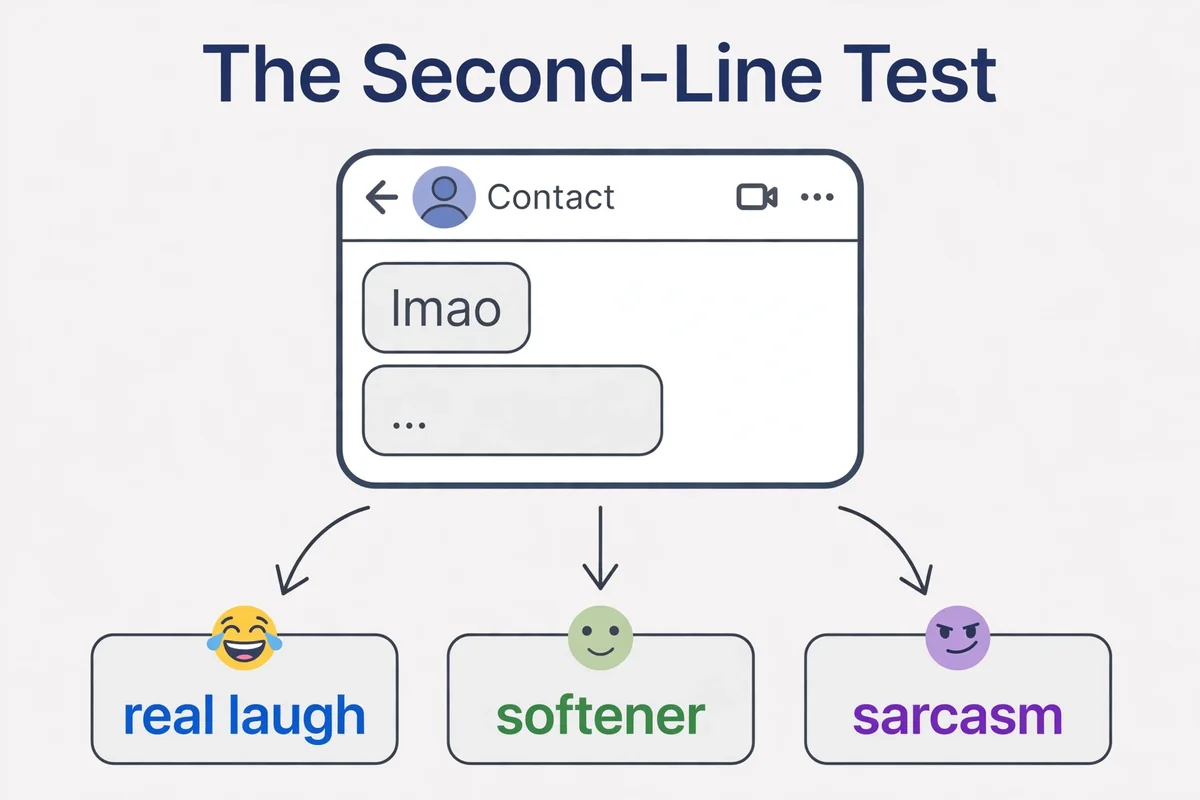
Here is the tool this article is built around. Do not ask what a lmao means in isolation, because in isolation it is a coin flip between three jobs. Instead, run the Second-Line Test: read the line that comes after the lmao — in the same message, or in the sender’s next message — and let that line decide which job the lmao was doing.
The test has three verdicts. First, real laughter: the second line keeps the joke going. “lmao I literally just snorted” or “lmao stop, I can’t breathe” are second lines that add genuine amusement, and they confirm the lmao was a real laugh. The joke is still alive in the second line, and the lmao was its applause.
Second, the softener: the second line is ordinary, friendly, and not funny at all. “lmao yeah, sounds good” or “lmao, anyway, what time are we meeting?” are second lines where the lmao is doing social work, not laughter work. It is keeping the message light, signaling “I am friendly, this is casual,” the way a smile softens a sentence in person. Most everyday lmaos live here — the reading most people miss.
Third, sarcasm: the second line contradicts the laugh. “lmao sure, because that worked so well last time” or “lmao ok” after a message the sender clearly did not enjoy are second lines where the lmao is ironic. The laugh is a costume, and the second line is the face underneath it. The tell is mismatch: the words claim amusement, and everything else in the message denies it.
Two details sharpen the test. Punctuation and case set the volume before the second line speaks: “LMAO!!!” is louder and more likely a real laugh, while a flat lowercase “lmao” with a period is more likely a softener or a shrug. A lone lmao with no second line is the hardest case: default to the softener reading between friends, and ask a follow-up when the stakes are higher.
The value of the test is that it stops the two classic mistakes: taking every lmao as a roar of laughter, which makes you over-trust a polite softener, and taking every lmao as sarcasm, which turns a friendly chat into a quarrel. Read the second line first, and the letters stop lying to you.
The Laugh Ladder, Honestly Graded
Every guide to laughter slang prints a ladder, and every ladder is partly fiction. Here is the honest version, labeled as tendency, not measurement: LOL sits at the light end, a quick laugh or a friendly signal; LMAO sits above it, a stronger claim of amusement; ROFL sits at the extreme end, a physical exaggeration about rolling on the floor. The direction is real — guides agree on it, and speakers feel it — but no study has measured how much stronger one rung is than another, and no dictionary fixes the gaps between rungs. Treat the ladder as a slope, not a staircase with numbered steps.
Case changes the rung more than most people realize. Guides consistently report that uppercase “LMAO” reads as a bigger, more uproarious laugh, while lowercase “lmao” reads as a chuckle, a small laugh, or even a filler word tucked before or after a sentence. That is the casual-use reality the old article noted but did not develop: people type lmao when only mildly amused, because the lowercase form has drifted from “huge laugh” toward “light, friendly reaction.”
The longer variant — the one that adds an intensifying word in front of the masked word — is stronger and more explicit than lmao, and it is the one to avoid first when the audience is anyone but close friends. It is not expanded in this article on purpose: if you need the stronger form, you already know it, and spelling it out adds vulgarity without adding information. The practical rule is simple: when in doubt, step down the ladder, not up it. LOL is always the safer send.
For the light end of the ladder in full, read the guide to lol meaning in text. LOL is the word lmao is most often confused with, and the confusion runs one way: people upgrade to lmao when lol would have done the job, and the upgrade carries vulgarity that lol does not.
LMAO on TikTok, Instagram, Snapchat, and in Text Messages
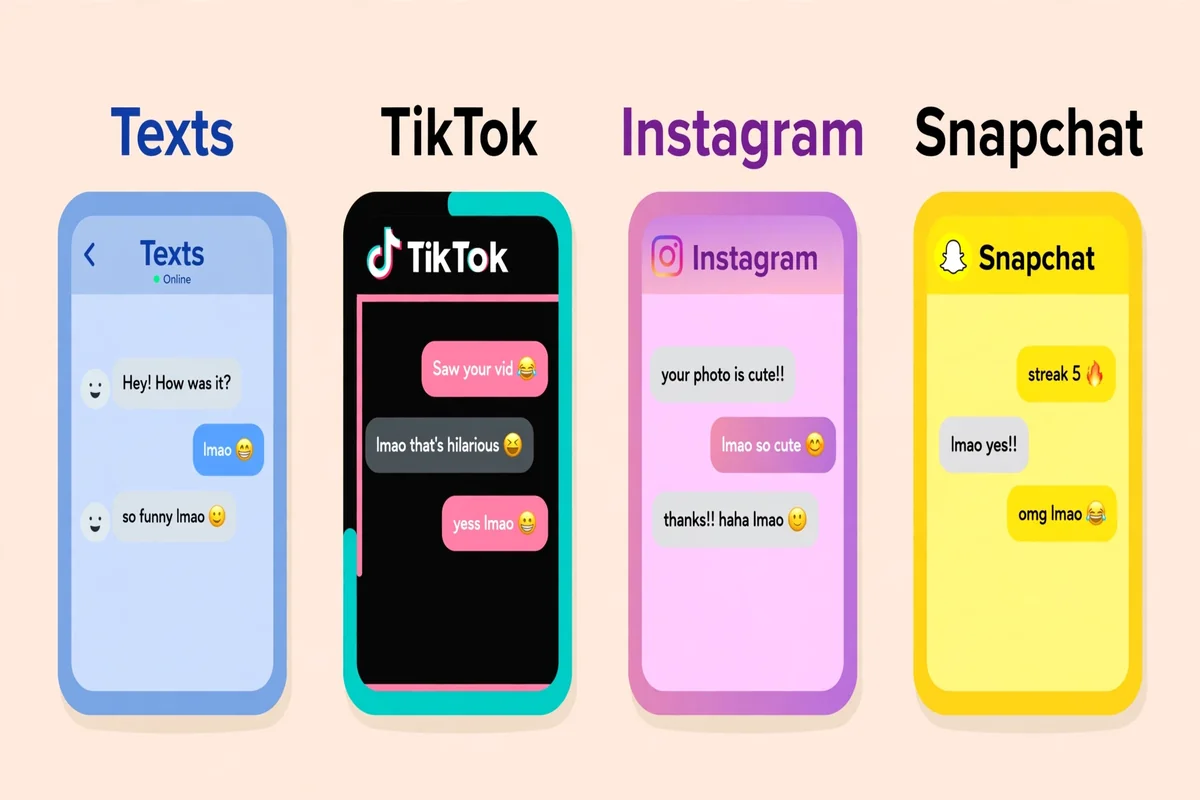
The core meaning of lmao does not change from one app to another. What changes is the room it arrives in, and the room changes how the same laugh signal feels. This section describes those shifts honestly, without inventing a separate meaning for each platform, because no source supports one.
In plain text messages, lmao is at its most personal. A one-to-one chat is where the softener reading lives: “lmao yeah, let’s do it” between friends is usually warmth, not hilarity. The stakes feel higher in texts precisely because there is no audience, just you and the laugh — which is why a sarcastic lmao in a text thread stings more than the same letters in a public comment.
On TikTok, lmao mostly shows up in comments, and comments are a public stage. A “lmao” under a funny video is applause the creator can count; a “lmao” under a bold or failed claim is often mockery, a public way of laughing at rather than with. TikTok is also where lmao travels furthest from literal laughter: dropped under something obviously true, it becomes an ironic joke in itself, which is why TikTok lmaos are the easiest to misread at face value.
On Instagram, lmao appears in comments and in direct messages, and the two spots differ. In a comment, it leans toward public reaction — quick, performative, often aimed at the post rather than at a person. In a DM, it behaves much more like a text message, a private laugh or softener between two people who know each other. Ask which room it arrived in before you decide what it means, and remember that a DM lmao from someone you barely know is usually just friendliness.
On Snapchat, lmao is casual and fast, a reaction inside a conversation that is already moving quickly. Because snaps disappear and chats feel light, a lmao there rarely carries the weight it can carry in a text thread. Snapchat’s speed makes its lmaos the least informative: a laugh signal there is just part of the rhythm. A short pause there is normal, and the guide to brb meaning in text explains why quick exits and quick reactions belong to the same fast-chat etiquette.
Who Sent It Changes the Read
A lmao is not a property of the letters; it is a property of the relationship, and the same four letters change their job with the sender. From a close friend, lmao is almost always safe to take at face value: friends use it as applause, softener, and filler interchangeably, and the Second-Line Test will usually confirm whichever one it was within a message or two. If a friend’s lmao confuses you, the friendship itself is the safety net — just ask.
From a crush, lmao carries a little extra weight. A crush’s “lmao” after your joke is usually encouragement — laughter is attention, and attention is the currency of early interest — but a crush’s flat “lmao” after something you said seriously can read as deflection, a laugh used to dodge a real answer. Do not treat either reading as proof of anything. Read the second line, watch the pattern over days rather than one message, and let the follow-up tell you more than the laugh ever will.
From a partner, lmao is usually shorthand for a shared sense of humor, and it is the least risky room of all — partners have a history that disambiguates the signal. The exception is an argument, where a lmao reads as dismissal — the one reading that escalates.
From a coworker, a stranger, or anyone in a semi-formal setting, lmao is a small risk even when the intent is friendly, because the masked word rides along with the laugh. A coworker’s lmao in a casual team chat is understood and low-risk; the same letters to a client or a manager are not. When the relationship is thin, the safest assumption is that the sender meant friendliness — and the safest reply is to match the friendliness without mirroring the vulgarity.
When LMAO Is the Wrong Reply
LMAO is a joy in its habitat and a misfire outside it. Skip it when the conversation is serious: bad news, grief, an apology, or a conflict are all moments where a laugh signal reads as disrespect, even when the sender meant “I am uncomfortable and do not know what to say.” Discomfort is real, but lmao is the wrong tool for it — a plain, kind sentence is better, and the guide to dw meaning in text shows what comfort sounds like when it is done properly.
Skip it in formal settings for the same reason the mask exists: work email, applications, messages to teachers or clients, and anything that could be screenshotted and forwarded. The vulgarity is mild, but mild vulgarity in a formal setting is still a choice you made on purpose, and readers will judge it that way. When the setting is formal, write the laugh out or skip it: “That’s hilarious” carries the same warmth with none of the risk.
Skip it when the laugh would be aimed at a person rather than with them. A lmao under someone’s embarrassing story, failed attempt, or vulnerable confession is mockery wearing a laugh’s clothes, and it lands the way mockery always lands. The difference between laughing with and laughing at is not in the letters; it is in whether the other person is laughing too. And skip the pile-on: a third or fourth “lmao” in a row stops being a reaction and starts being noise. The cold cousin of this mistake is indifference dressed as reaction, and the guide to idc meaning in text shows how a flat dismissal differs from a laugh that missed.
How to Reply to LMAO
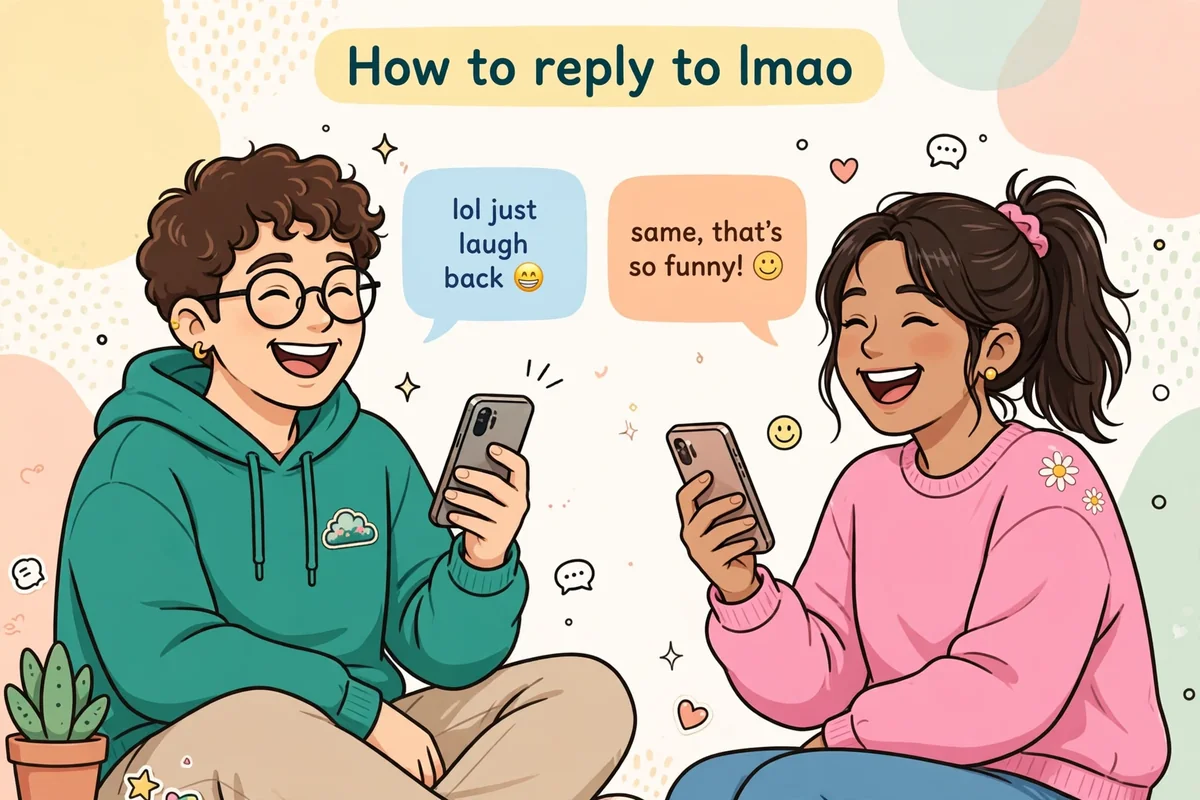
Replying to a lmao is mostly about matching the verdict of the Second-Line Test, not the letters. If the test said real laughter, keep the joke going: a laughing reply, an escalation (“I know, I watched it three times”), or a new detail that earns a second laugh.
If the test said softener, do not over-perform the laugh. The sender was being friendly, not applauding, so a simple warm continuation works best: answer the actual sentence, keep the tone light, and move on. Replying to a softener with a huge laugh of your own creates a mismatch — you are applauding a joke nobody told — and mismatches are where chats start feeling awkward for reasons nobody can name.
If the test said sarcasm, do not mirror the sarcasm back unless the friendship can carry it. The useful replies are a calm question (“Ha — which part?”), a graceful exit from the joke, or a plain statement that resets the tone. And when someone’s lmao was really a deflection after something serious you said, the honest move is to name it gently, the way the guide to tbh meaning in text models: a short, straight sentence beats a clever one.
Two practical habits cover the rest. First, when you receive a bare lmao with no second line and the stakes matter, ask for the second line instead of guessing: “Haha — did you like it, or are you making fun of me?” is a question that costs nothing and saves a misunderstanding. Second, when you are the one leaving a conversation after a laugh, do not let the lmao do the exiting for you — a clean sign-off works better, and the guide to ttyl meaning in text explains why a pause with a door left open beats a laugh that just stops. If a reply needs a decision or an update rather than a laugh, ask for it directly, as the guide to lmk meaning in text shows.
Quick Answers
What does lmao mean in text?
LMAO stands for “Laughing My A** Off” (masked here because the expansion contains a mild swear word). In text it signals great amusement, usually exaggerated — but in everyday use it often works as a friendly softener or filler rather than a report of real laughter. Run the Second-Line Test in this article: the line after the lmao tells you which job it was doing.
Is lmao stronger than lol?
As a tendency, yes — lmao claims a bigger laugh than lol, which sits at the lighter end of the ladder. But the difference is not a measured scale, and lowercase “lmao” is often used for mild amusement, so a lmao is not automatically a roar of laughter. When in doubt, step down the ladder: lol is always the safer send.
Does lowercase “lmao” mean something different from “LMAO”?
It tends to. Uppercase “LMAO” reads as a bigger, more uproarious laugh, while lowercase “lmao” reads as a chuckle, a small laugh, or a friendly filler word. Case changes the volume, not the definition — and the second line still decides the final reading.
Is lmao rude or offensive?
Not inherently, but it carries mild vulgarity, so it can offend in formal settings or when aimed at a person rather than shared with them. Between close friends it is harmless. In work messages, messages to strangers, or serious conversations, skip it and write the laugh out instead.
What does lmao mean from a crush?
Usually encouragement — laughter is attention, and attention matters early on. But a flat “lmao” after something serious can be deflection rather than delight. Read the second line, watch the pattern over days rather than one message, and do not treat a single lmao as proof of interest or disinterest.
How should I reply to lmao?
Match the Second-Line Test verdict: keep the joke going for real laughter, answer the actual sentence warmly for a softener, and stay calm or ask a clarifying question for sarcasm. For a bare lmao with no second line, ask what they meant — one honest question beats a confident misreading.
Final Thoughts
LMAO is four letters pretending to be simple. It is a laugh, a softener, a filler, and occasionally a weapon, and the letters themselves will not tell you which one arrived. The Second-Line Test is the whole method in one line: read what comes after the laugh, and let the follow-up decide. Do that, and most lmaos stop being mysteries and start being information.
Two habits will carry you further than any ladder. First, default to the generous reading — a friendly softener — until the second line tells you otherwise, because most lmaos really are just warmth. Second, when the second line does point to sarcasm or mockery, answer it plainly instead of mirroring it. A laugh is only a problem when you refuse to read past it. Read the second line, reply once, and let the conversation breathe.
