
“Are you coming Saturday?” The reply comes back: “Not sure yet. I’ll lyk tonight.” You know what the letters say, but what did your friend actually promise — an answer tonight, or just a shrug in three letters?
That is the whole puzzle of lyk meaning in text. Most of the time, LYK means “let you know”: the sender is promising you an update later. But the same three letters can also be the word “like,” spelled the way it sounds in a fast, casual message. Same spelling, two completely different jobs. This guide shows you how to tell them apart, and what to say back.
The Two Jobs of Three Letters
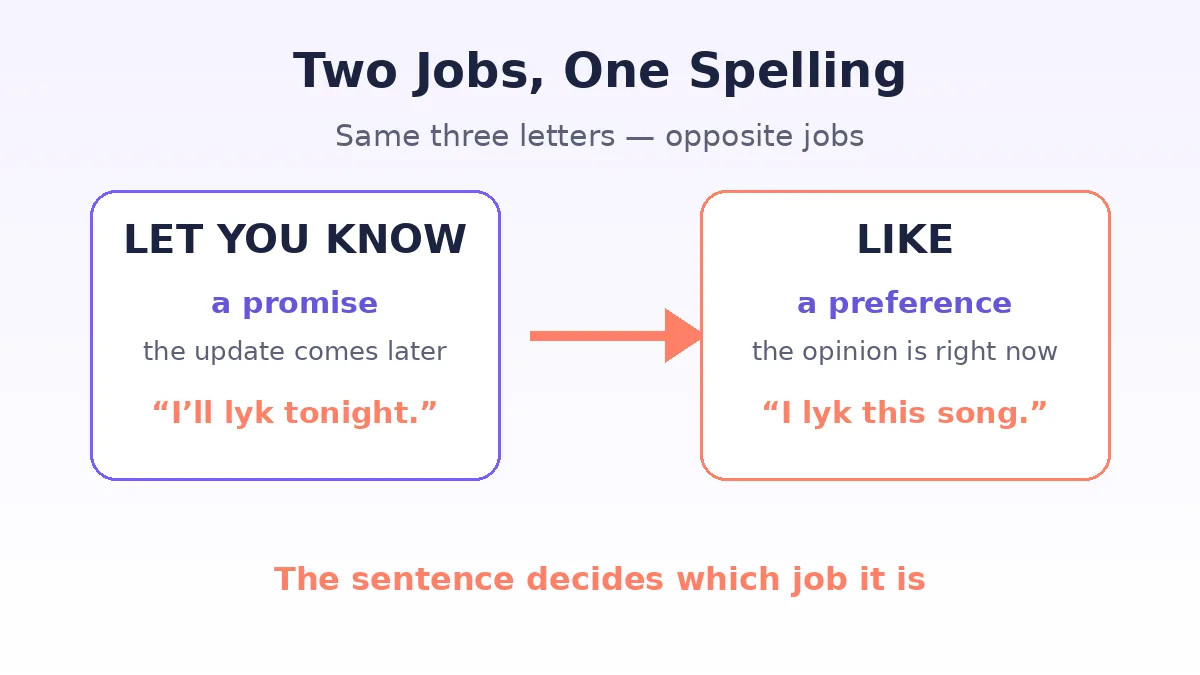
LYK does not have one meaning with a few shades. It has two meanings that work differently, and the sentence around it decides which one you are looking at.
| Reading | What it means | What it does | Example |
|---|---|---|---|
| Let you know | I will give you information or an answer later | Makes a promise about the future | “I’ll lyk tonight.” |
| Like | The word “like,” spelled casually | States a preference, a comparison, or fills a pause | “I lyk this song.” |
The first reading is the default. Wiktionary lists “lyk” as an initialism of “let you know,” and nearly every guide that ranks for this term agrees it is the meaning to try first. The second reading is real too, usually lowercase, where “like” would sit naturally. One ranking guide gets this backwards and calls “like” the main meaning — which is why so many people misread “I’ll lyk” as a shrug instead of a promise.
The Follow-Up Test: Three Questions That Settle Any LYK
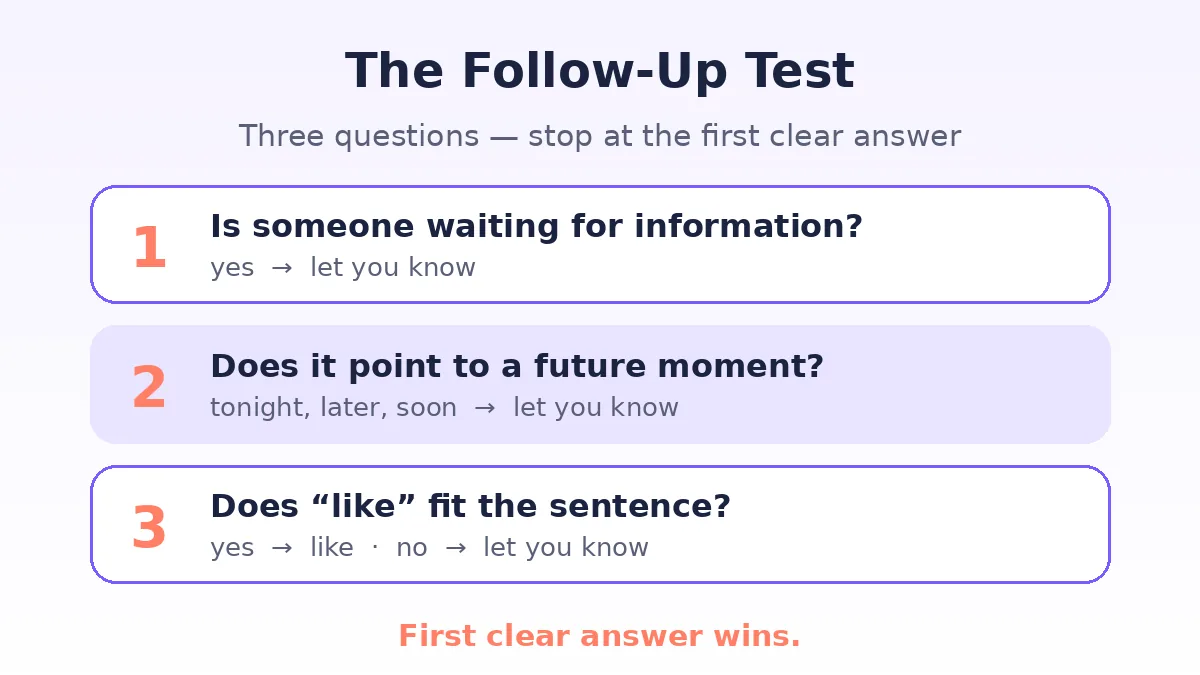
Here is the differentiator for this article: a test you can run on any LYK message in about five seconds. Ask these three questions in order, and stop at the first one that gives you a clear answer.
1. Is someone waiting for information that does not exist yet? If the conversation is about plans, a decision, or an answer nobody has right now, LYK means “let you know” — the answer is coming, just not in this message.
2. Does the sentence point at a future moment? Words like tonight, tomorrow, later, and soon are the fingerprints of the “let you know” reading. “Lyk tomorrow” and “I’ll lyk when I get home” both point forward.
3. Would swapping in “like” make the sentence sound natural? “I lyk this song” becomes “I like this song” — perfect. “I’ll lyk tonight” becomes “I’ll like tonight” — nonsense. If the swap works, it is “like.” If it breaks the sentence, it is “let you know.”
Reading One: “Let You Know” — A Promise, Not an Answer
This is the LYK you will meet most often, and it has one job: to buy time without going silent. The sender does not have the answer yet, so instead of guessing or leaving you hanging, they promise the answer later. “I’ll lyk tonight” really means “I don’t know right now, but I will tell you tonight.”
It comes in a few patterns: “I’ll lyk” (“Are you free Friday?” “Not sure yet. I’ll lyk.”); “I’ll lyk + time” (“I’ll lyk after work”); and “Lyk + condition” (“I’ll lyk once I ask my mom”).
Notice what LYK does not do in any of these. It does not say yes. It does not say no. It does not mean “probably.” It means exactly one thing: an update is coming. Treating “I’ll lyk” as a soft yes is how people end up waiting for someone who never confirmed. The honest translation is “the answer is still to be decided.”
The promise also has a cost: if you say “lyk tonight” and tonight passes with no message, the other person notices. Three forgotten promises in a row is how people stop believing the next one.
Reading Two: “Like” — The Word, Spelled the Way It Sounds
The second reading is simpler: it behaves like the word “like” because it is the word “like,” typed the way it sounds when people talk fast. It shows up in three slots: as a preference (“I lyk this song”); as a comparison (“That filter is lyk perfect”); and as a filler (“It was lyk so cold today”) — the same job “like” does in spoken English.
Two details give this reading away. First, it is almost always lowercase: “lyk,” not “LYK.” Second, it never comes with a future-time word. Nobody writes “I lyk tomorrow” and means “I like tomorrow.” The grammar test from the last section is the fastest check: if “like” fits the slot, that is the reading.
This spelling is also where the tone lives. “I lyk this song” sounds relaxed and playful — which is why you will see it in comments more than in a message to a teacher.
The Bare “Lyk” Trap: When Three Letters Point the Wrong Way
Sometimes you will see LYK standing alone, with no “I’ll” in front of it: “Lyk when you get there.” “Lyk what you decide.”
Read literally, those say “let you know when you get there,” which makes no sense — the sender is asking you to report back, not promising to tell you something. What the writer almost certainly meant is what LMK means in text: “let me know.” The two abbreviations sound alike and sit in the same part of a sentence, so the letters get mixed up.
This is not a third meaning of LYK. The letters L-Y-K cannot expand to “let me know” — there is no M in them — and no dictionary supports it. It is sloppy usage. The honest way to read a bare “lyk” is to ask who is supposed to do the telling: if the sentence asks you to provide the update, the writer meant LMK; if it promises the writer will provide it, it is LYK. Remember: LYK points at you — I will tell you. LMK points at me — you tell me.
Where You Actually Meet LYK: Four Rooms, One Habit
LYK does not change its meaning from app to app. What changes is which reading you are likely to meet. Think of it as four rooms.
In one-to-one texting, the “let you know” reading rules. This is where plans get made and answers get delayed, and the conversation history usually makes the meaning obvious.
In group chats, the promise gets louder. “I’ll lyk about the venue” tells five people at once that an update is coming, and it puts the promise on record. That is why a forgotten group-chat “lyk” stings more: everybody saw the promise. Name what you will update on.
In TikTok comments and DMs, the “like” reading shows up more: “I lyk this trend” is a preference, while a creator replying “will lyk about part 2” is a promise. The mix is roughly even here — which is why the Follow-Up Test earns its keep.
On Snapchat and Instagram, speed is the whole point. Snaps disappear and DMs move fast, so both readings appear in their shortest form — a bare “lyk later” here, a lowercase “lyk this filter” there. If the answer matters, move it somewhere it will not vanish.
Same Promise, Different Stakes: Who’s Sending It
LYK means the same thing no matter who sends it. What changes is what is at stake when the promise lands — or when it does not.
From a friend, “I’ll lyk” is low-stakes and friendly. It usually means they are still figuring something out. A friend who says “I’ll lyk” is not dodging you.
From a crush or someone you are dating, the same three letters feel heavier, because the thing being decided is often the date itself. “I’ll lyk if I can make it” after you asked someone out is not a yes and not a no — it is a decision that has not been made yet. The letters carry no romantic meaning on their own. When “lyk” means “like” from a crush — “I lyk your smile” — that one is personal, because the sentence is a compliment.
From a coworker, “I’ll lyk” is a small professional placeholder. In a casual team chat it reads as normal; in a formal email it reads as careless, because the reader may not know the shorthand. If the reader expects professional writing, spell it out — “I’ll let you know by 3 PM” also gives a deadline, which is what a coworker actually needs.
LYK Next to LMK, FYI, and IDK: The Update Family
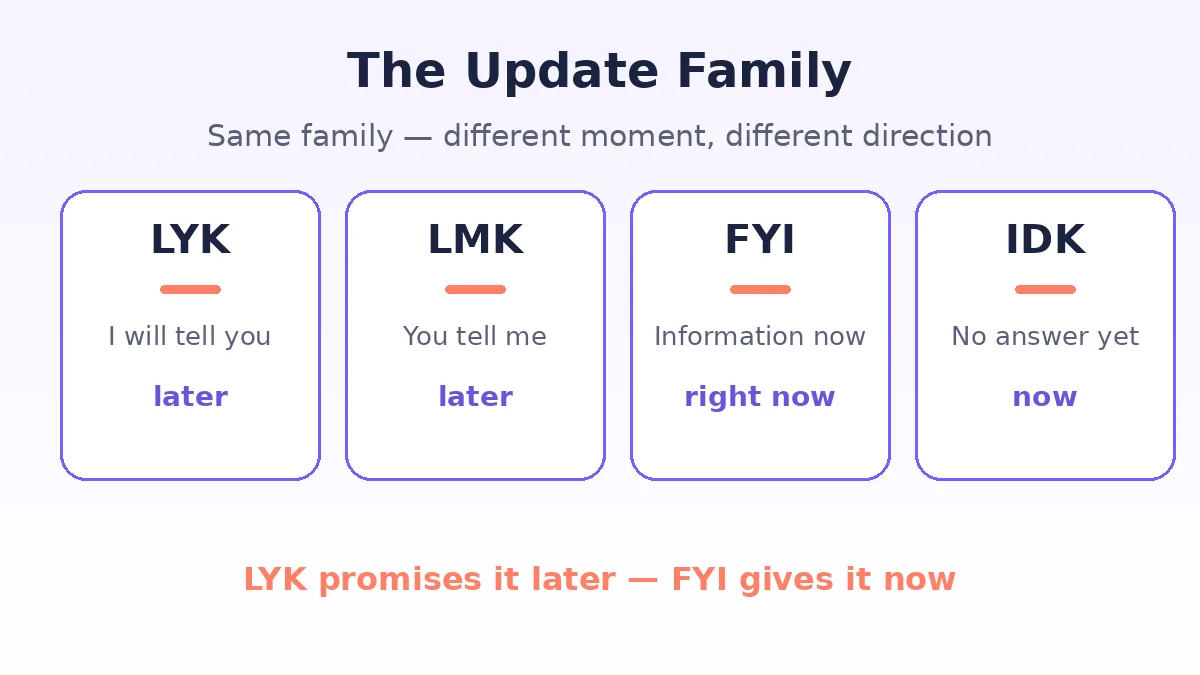
LYK belongs to a small family of abbreviations that all handle information — but each one handles a different moment in the same conversation.
| Abbreviation | Meaning | Who acts? | When? |
|---|---|---|---|
| LYK | Let you know | The sender will update you | Later |
| LMK | Let me know | The receiver should update the sender | Later |
| FYI | For your information | The sender shares it | Right now |
| IDK | I don’t know | Nobody — there is no answer yet | Now |
LYK and LMK are mirror images: LYK is “I will tell you,” LMK is “you tell me.” Get the direction wrong and the conversation stalls.
FYI is the opposite of LYK in time: FYI hands you the information immediately (“FYI, the meeting moved to 3”), while LYK promises it later. One closes the loop, the other opens it. IDK is LYK’s starting point: “IDK” admits there is no answer; “I’ll lyk” admits there is no answer yet. That “yet” is the whole difference.
When the answer depends on a date nobody has set, the situation is TBD — “to be decided” — and LYK is usually the sentence that follows it. When the update you are waiting for is a time, ETA is the word for it. BRB is the odd one out: a person stepping away, not information.
Three Ways LYK Backfires
LYK is harmless in itself. It backfires when the promise behind it is mishandled. These are the three ways that happens most.
1. The forgotten promise. You write “I’ll lyk tonight,” the evening passes, and nothing arrives — leaving the other person wondering whether the answer is no. The fix is small: if the deadline slips, send a one-line update — “still waiting, will lyk tomorrow.”
2. The wrong direction. You write “Lyk when you arrive” meaning “tell me when you arrive,” and the other person reads it as a promise from you. The fix is to use the right letters: LMK asks, LYK promises. One letter, opposite directions, and a whole missed pickup if you get it wrong.
3. The formal-room slip. You drop “I’ll lyk” into an email to a client, a teacher, or a hiring manager, and the reader either does not know the shorthand or reads it as careless. The fix costs nothing: spell it out. “I’ll let you know by Thursday” is clearer, warmer, and it carries a deadline. The same applies to TBH and most texting shorthand.
What to Say Back: Replies for Each Reading
Your reply depends on which LYK you just read, so match it to the reading, not to the letters.
When it is a promise (“I’ll lyk tonight”): keep it light. “Sounds good.” “No rush.” “Cool, keep me posted.” If the answer matters to your plans, ask for a rough time: “Any idea when?”
When it is a request in disguise (“Lyk when you get there”): answer as if they wrote LMK, because that is what they meant. “Will do.” “I’ll text you when I arrive.” No need to correct them; just do the thing they asked for.
When it is “like” (“I lyk this song”): reply to the opinion, not the spelling. “Same, it’s been on repeat.” Matching their spelling back — “I lyk it too” — is fine with friends; with anyone else, just answer normally.
When you genuinely cannot tell: ask, and ask in a way that does not make it a big deal. “Lyk as in let you know?” takes two seconds and saves a misunderstanding. If someone keeps leaving you hanging with repeated “I’ll lyk” messages and no follow-up, say so: “Hey, I need an answer by tonight so I can plan.” If you want them to reach out rather than wait, HMU is the abbreviation that invites contact.
Quick Answers
What does LYK mean in text?
LYK most commonly means “let you know” — a promise to share information, an answer, or an update later, as in “I’ll lyk tonight.” In very casual writing, lowercase “lyk” can also be the word “like.”
Does LYK mean “like” or “let you know”?
It can mean either, and the sentence decides. If the message is about a future update — “I’ll lyk after I check” — it means “let you know.” If “lyk” sits where “like” would fit — “I lyk this song” — it means “like.”
What does “I’ll lyk” mean?
“I’ll lyk” means “I’ll let you know.” The sender does not have the answer yet and is promising to give it to you later. It is not a yes and not a no — it is a placeholder for an answer that is still coming.
Is LYK the same as LMK?
No, and the direction is the whole difference. LYK means “let you know” — the sender will tell you something. LMK means “let me know” — the sender is asking you to tell them something. Y is for you, M is for me.
What does LYK mean on Snapchat?
On Snapchat it usually means “let you know,” most often when friends are making plans — “Not sure yet, I’ll lyk.” You may also see lowercase “lyk” meaning “like” in a comment about a filter. The sentence still decides.
What does LYK mean from a crush?
The letters themselves carry no romantic meaning. “I’ll lyk” from a crush means the same as from anyone else: an answer is coming later. If they wrote “I lyk your smile,” that is the “like” reading, and the sentence is a compliment. Read the whole conversation.
Is LYK rude?
No. LYK is neutral and casual by itself. It can feel distant if the message around it is short or tense — “Whatever. I’ll lyk.” — but the attitude comes from the surrounding words, not the abbreviation. A missing promised update can also feel like a brush-off.
Can I use LYK at work?
In a casual team chat where everyone already uses texting shorthand, “I’ll lyk” is usually fine. In a formal email or a message to a client or manager, spell it out: “I’ll let you know by Thursday.”
One Last Check Before You Hit Send
LYK is three letters doing two jobs. “Let you know” is the default — a promise that an update is coming, usually with a time word nearby. “Like” is the casual spelling, usually lowercase, sitting exactly where the word “like” belongs. When a bare “lyk” asks you to report back, the writer meant LMK. Say “I’ll lyk” only when you mean it, and send the update when the time comes. The letters are free. Keeping the promise is what makes them mean something.
