
You send a plan — “Meet at 7, bring the charger” — and the reply comes back in two letters: “mk.” You feel fine. Then you send a long, honest message about a bad day, and the reply is the same two letters: “mk.” Suddenly you do not feel fine at all. The mk meaning in text is the same in both messages — a casual, hummed way of saying okay — but its weight changes completely with what came before it, who sent it, and what, if anything, came after it.
In short: MK stands for “mm-kay” or “mm, okay,” the sound of someone nodding while they say okay out loud. It acknowledges, it agrees, and it moves the conversation on — usually without adding enthusiasm. That flatness is the whole puzzle: MK is not rude by itself, and it is not warm by itself either. It is a mirror, reflecting the conversation around it, and the Baseline Test below shows you how to read that reflection instead of guessing at it.
What MK Means in Text
MK is not an initialism made from the first letters of a phrase. It is a spelling of a sound: say “mm-kay” out loud and you have it, a hum then a quick “kay.” Wiktionary’s entry for m’kay lists mk among its spellings and defines it as an informal okay — acknowledgment or affirmation, now sometimes used in an ironic or condescending sense. Dictionary.com’s slang entry for the longer form mmk calls it a half-humming way to say OK, noting the same double edge: mild disapproval and suspicion, or warm affirmation, and sometimes a patronizing or rude ring.
The spoken “mm-kay” is older than the text version. Dictionary.com traces the earliest written “mkay” to a 1998 online forum about South Park, where counselor Mr. Mackey ends sentences with a droning “mkay,” and the film Office Space gave the world a boss whose “mmkay” turned polite requests into irritating orders a year later — part of why the word still carries a faint teasing edge today. Texting then shortened the sound further — mkay to mmk to mk — until two letters did the whole job.
That job is acknowledgment first and agreement second: “MK” says “I heard you” before it says “I agree with you.” A bare “mk” after “Meet at 7?” is a yes; after a confession it stops short of a response. Same letters, different jobs.
The Baseline Test
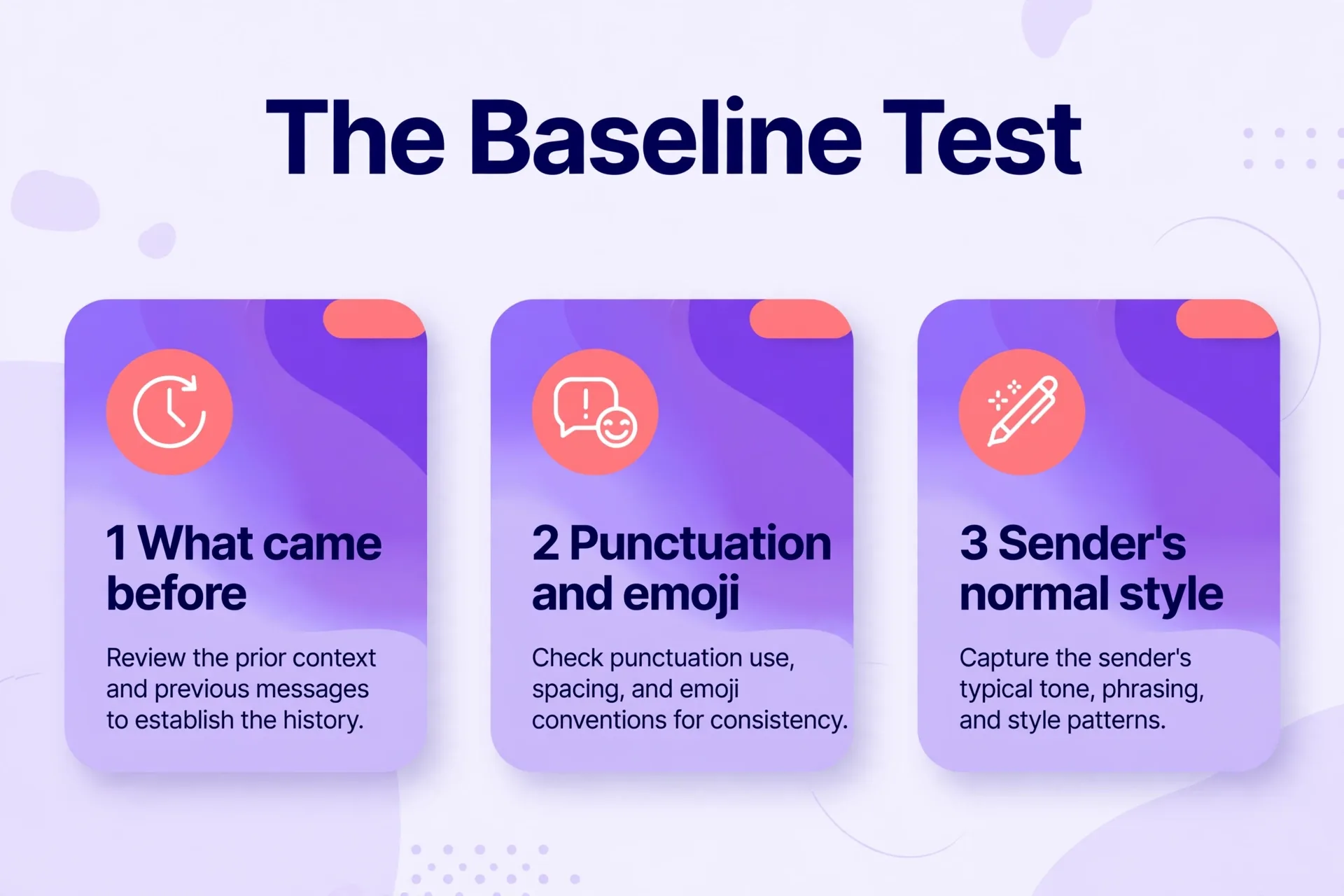
Here is this article’s named method, the Baseline Test: three clues, checked in order. It works because MK carries so little information on its own that the information has to come from around it.
Clue one: look back at what you just sent. A short, practical message — a time, a reminder, a piece of news — needs only a short reply, so “mk” fits it neatly. A long or emotional message needs a longer reply, so “mk” after it lands as a shrug.
Clue two: look at the MK itself. A bare “mk” is the flattest version. “mk!” is warmer, “mk 😊” friendlier still, and “mk, sounds good” is a real sentence with MK as its first word. “mk…” leans doubtful, a stretched “mmmkkk” leans playful, and “mk.” reads colder than bare “mk,” because a full stop after a one-word reply feels final.
Clue three: look at the sender’s baseline. Some people text in short bursts all day, and their “mk” is just how they talk — it means no more and no less than their “cool” or “got it.” Other people write full sentences, and a sudden “mk” from them is a real change of gear. If MK matches how they usually text, read it as neutral. If it is much shorter than usual, something is off — they are busy, distracted, annoyed, or done with the topic — and the honest move is to ask, not to assume which one.
The Five Shades of MK
After the Baseline Test, MK usually settles into one of five shades. Warm agreement is the friendliest: “mk, see you then!” after a plan, often with an emoji. Plain acknowledgment is the most common: “mk” after information — “I sent the file” — meaning “got it, noted.”
Hesitant agreement is the shade most guides warn about: “mk, I guess” after a suggestion the sender is not sold on. Skeptical MK is the doubting cousin: “mk, if you say so” after a tall claim, the texting version of a raised eyebrow.
Flat or dismissive MK is the one that stings: a bare “mk” after a message that deserved more. The sender may not mean to be cold — they may be busy or tired — but a two-letter reply to a heartfelt message reads as “I am not engaging with this.” Naming the shade before you reply keeps a flat MK from starting a fight that was never intended.
MK on TikTok, Snapchat, Instagram, and in Texting
MK means the same thing on every platform; what changes is the speed of the conversation around it. In plain texting, MK is at home: quick confirmations in one-to-one and group threads, such as a plan confirmed with “mk” plus a question about where everyone is — the kind of message our “wya” guide covers.
On Snapchat, MK gets even shorter and faster: a quick reply to a snap or story, where the photo already did half the talking. A snap of a new haircut plus “mk” is usually just acknowledgment, not a verdict on the haircut.
On Instagram, MK lives in comments, story replies, and DMs. In story replies it usually just acknowledges what was posted; in DMs it behaves like texting. One small trap: Instagram’s own short form is IG, not MK, so “mk” on a post is a reaction to the post, not a reference to the app.
On TikTok, MK and its longer cousin “mkay” show up in comments as a playful or sarcastic reaction, often aimed at an overconfident claim. A public comment is partly a performance for other readers, so the teasing shade is more common here than in a private text.
Tone and Sender Context: Who Is Saying MK, and Why It Lands Differently
MK carries almost no tone of its own, so tone comes from the sender and the relationship. From a close friend who texts in shorthand all day, “mk” is usually nothing at all. From a crush or partner, the same letters feel heavier, because a short reply from someone whose opinion matters reads as distance, even when it is only distraction.
From family, MK often reads as a teenager’s default setting: parents who get “mk” to every message are usually getting a style, not a verdict — check whether the teenager answers everyone that way. From a stranger, MK is usually just efficient.
One honest limit: you cannot reliably tell busy from annoyed from indifferent on two letters alone. The Baseline Test narrows the field, but it does not read minds — if the shade still feels wrong, ask briefly.
How to Reply to MK, and When to Spell It Out
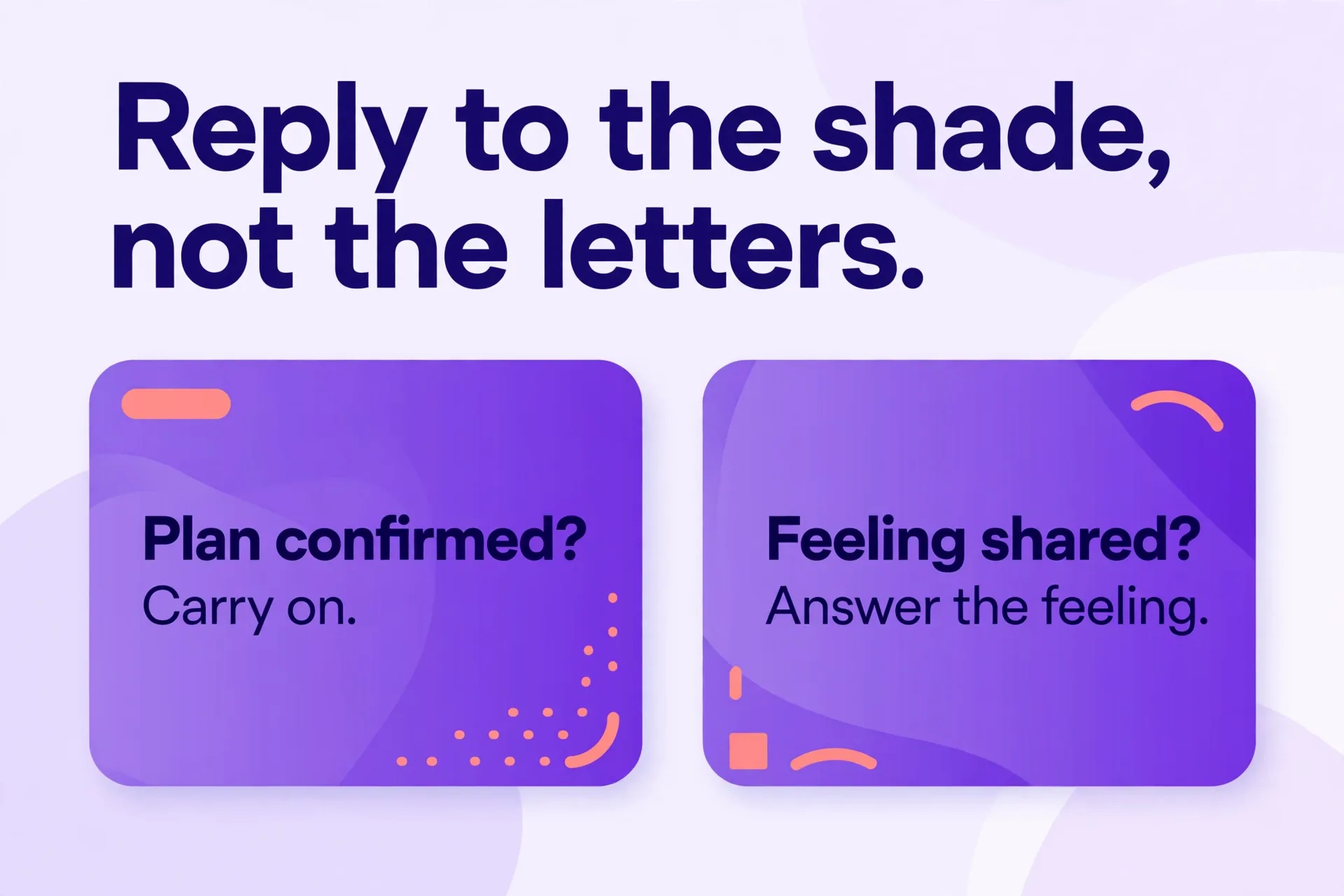
Reply to the shade, not the letters. If a plan was confirmed, carry on. If it was plain acknowledgment, move to the next topic. If it was hesitant — “mk, I guess” — answer the hesitation: “we can do something else if you’d rather” costs one sentence and saves a resentful evening.
If it was flat or dismissive after something that mattered to you, say so plainly: “that was kind of a big deal for me, can we talk about it?” is fair, while “why did you only send mk?” starts a fight about texting style instead of the real subject. If you are unsure which shade you got, a light check-in — “all good with that?” — settles it in seconds. And if you add a side note to your reply, remember the BTW guide on this site: put the real reply first and the aside second.
If you are sending MK, match your reply to the message you received. A two-letter reply fits a two-line message, not a heartfelt one or a serious apology. Spell it out — “okay, sounds good” or “got it, thanks” — when the reader needs warmth, the setting is professional, or the conversation is tense. MK is a fine nod; it is a poor hug.
MK vs Related Terms
MK sits in a family of short acknowledgments; the differences are mostly differences in warmth.
| Term | Full form | How it differs from MK |
|---|---|---|
| MK | Mm-kay / mm, okay | A hummed okay. Neutral by default, flat without help from punctuation or emoji. |
| K | Okay | The bluntest version. Colder than MK, because it drops even the hum. |
| KK | Okay, okay | Friendlier and bouncier than MK. A double tap where MK is a single nod. |
| OK / Okay | Okay | The clearest and most neutral. No shade, no hum, no guesswork. |
| TBH | To be honest | Frames an opinion as the speaker’s real view. TBH adds honesty; MK adds acknowledgment. |
| ID | Identification / I’d / I don’t | A different family entirely: documents, usernames, or a dropped apostrophe. Never an acknowledgment. |
| OTW | On the way | Announces movement toward you. MK never announces movement; it acknowledges a message. |
Debunked: What MK Does NOT Mean
Short letters collect false meanings. MK does not mean “my king” in ordinary texting: some fan communities use it that way, but in an everyday chat “mk” means okay. MK does not mean “Mortal Kombat” in a chat thread either — a gaming meaning, real in gaming chats, irrelevant when someone replies “mk” to dinner plans.
MK does not have a fixed meaning per platform: the same shades appear everywhere, and the sentence, the sender, and the Baseline Test decide — not the app. MK is also not always passive-aggressive, despite its reputation. Most of the time it is just a quick yes from someone who texts briefly.
Two claims, graded honestly. One list claims MK can stand for “mistake” — “that was an mk on my part” — but it appears in a single casual source with no dictionary backing, so this article grades it Weak: possible wordplay, not a live texting meaning. And no popularity ranking is printed here: no frequency study behind Gen Z or “most common” claims was found, so this article prints no percentages or age rankings — only that MK is widely understood by frequent texters.
When Not to Use MK
Skip it when formal: work emails, client messages, and messages to a teacher or manager are not the place for a hummed okay — “understood” or “sounds good” carries the same agreement without sounding indifferent. Skip it when the answer matters more than the acknowledgment: a serious apology, bad news, or someone telling you they are upset deserves real words, and MK there reads as not caring even when you do.
Skip it when you are the one who is annoyed: a cool, clipped “mk” does not hide the feeling, it advertises it, while giving the other person nothing to answer. And skip it when the other person has told you short replies feel cold to them — spelling out “okay, sounds good” costs about two seconds.
Quick Answers
What does MK mean in text?
MK means “mm-kay” or “mm, okay” — a casual, hummed way of saying okay. It usually signals acknowledgment or agreement, with the tone decided by context.
How can I tell what kind of MK I just received?
Run the Baseline Test: look back at what you sent, look at the MK itself (bare, punctuated, emoji, or extended), and compare it with how that person normally texts.
Is MK rude or passive-aggressive?
Not by itself. It can sound flat or dismissive, especially as a bare reply to a long or emotional message, but most of the time it is just a quick, neutral yes.
What is the difference between MK and K?
Both mean okay, but a single K is usually read as colder and more abrupt. MK keeps a hum of casualness that softens it slightly.
What does MK mean on Snapchat?
On Snapchat it means okay, the same as in regular texts — usually a quick acknowledgment of a snap or story, where the picture already carries half the meaning.
What does MK mean on TikTok?
In TikTok comments, MK and the longer “mkay” often appear as a playful or sarcastic reaction, especially to an overconfident claim.
Does MK mean Mortal Kombat?
Only in gaming chats. In an ordinary text conversation, assume it means okay.
Can I use MK at work?
Better not. At work, write “okay,” “sounds good,” or “understood” instead. MK reads as too casual and too easy to misread.
Final Thoughts
MK is the smallest possible unit of agreement: two letters, one hum, and a whole conversation’s worth of guesswork riding on them. The letters never change; everything around them does — the message they answer, the punctuation they carry, and the person who typed them. Check those three things before you react, and a reply that looked cold may turn out to be nothing at all.
