
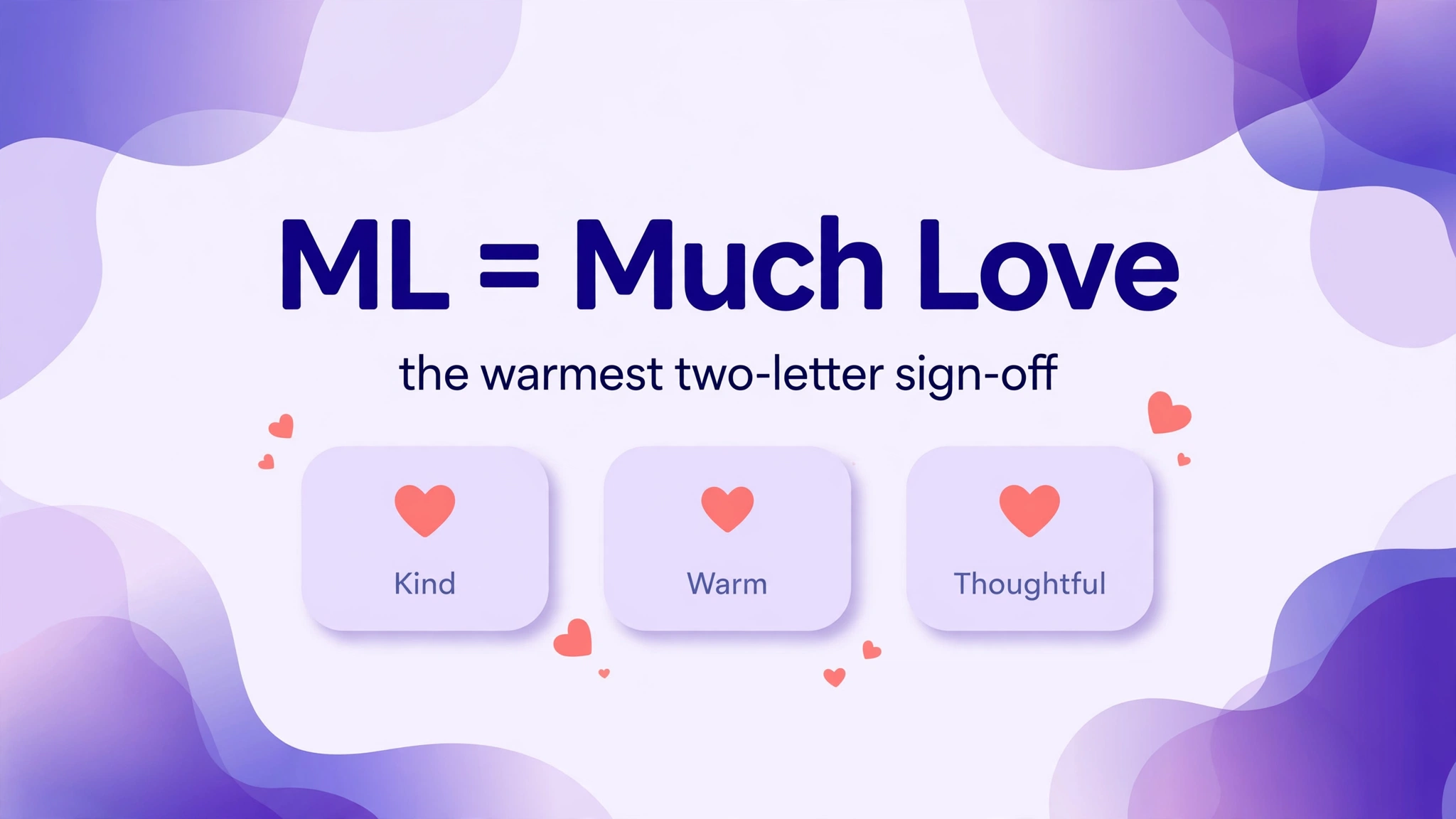
Two letters that sign off a message with warmth: “ml.” You’ve seen it at the end of texts — “night, ml,” “take care ml,” “thanks ml ❤️.” If you’re looking up the ml meaning in text, the answer is affectionate, but which kind of affection depends on who’s sending it.
ML most commonly means “much love” or “my love” — a warm, affectionate sign-off in texts and on social media. This guide covers the two readings and how to tell them apart, how ML works as a sign-off, what it signals about the relationship, and the unrelated meanings that share the same two letters.
The Short Answer
| Question | Answer |
|---|---|
| What it means | “Much love” or “my love” — an affectionate sign-off |
| What it does | Ends a message warmly; signals care, appreciation, or closeness |
| The two readings | “Much love” = friendly warmth; “my love” = more intimate |
| Where it sits | At the end of a message, usually after a comma or as a standalone |
| Register | Casual and warm — friends, family, partners, kind communities |
| Formal alternative | “Take care,” “best wishes,” or “with love” spelled out |
“Much Love” vs. “My Love”: The Two Readings
Here’s the key thing about ML: it has two affectionate readings, and they sit at different points on the intimacy scale.
“Much love” is the broader, safer reading. It’s friendly warmth without romantic weight — the texting equivalent of a warm hug from a friend. “Thanks for helping me move, ml!” “Good luck tomorrow, ml!” This is the ML you’ll see between friends, in group chats, in supportive comments, from people who care about you platonically.
“My love” is the more intimate reading — a term of endearment for couples and very close family. “Night, ml ❤️” from a partner lands differently than the same text from a coworker.
In practice, most ML you encounter is the “much love” kind. The “my love” reading usually announces itself through context: romantic relationship, heart emojis, goodnight texts. When in doubt, read the relationship, not the letters.
How ML Works as a Sign-Off
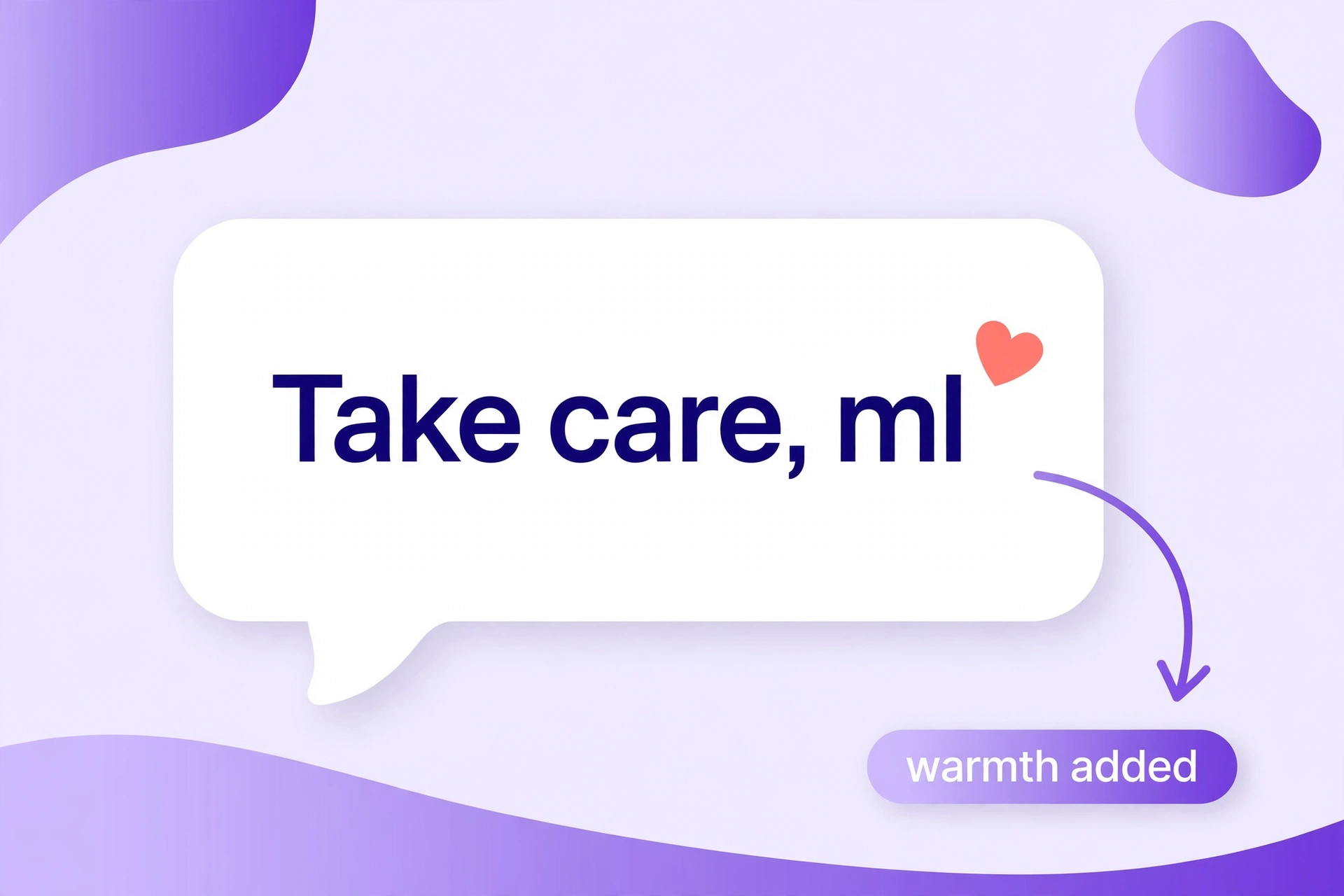
ML is almost always a closer, not an opener. It sits at the end of a message and colors everything before it with warmth — like a signature written in affection.
- “Take care, ml” — the ML turns a polite goodbye into a warm one
- “Thanks ml!” — gratitude plus a little extra heart
- “Night ml ❤️” — the classic goodnight, softened and sweetened
- “Proud of you, ml” — praise wrapped in affection
It also works standalone as a complete reply. Someone shares good news, and “ml!!” back says: I’m happy for you, no more words needed.
Lowercase “ml” is the texting default — quick and casual. Uppercase “ML” appears too, but in tech conversations it almost always means machine learning. Case is a clue, not a rule.
ML in Real Conversations
The exchanges below are illustrative examples, not real messages.
The supportive friend
- Emma: “thanks for checking on me, it’s been a rough week”
- Sara: “always here for you, ml ❤️”
The ML turns support into something warmer. Without it, the message is kind; with it, it’s a hug.
The check-in
- Jordan: “wya this weekend? haven’t seen you in ages”
- Casey: “around! coffee saturday? ml”
The ML at the end softens the whole exchange — it’s not just logistics anymore, it’s someone happy to see you.
The on-my-way
- Sam: “otw, see you in 10!”
- Riley: “perfect, drive safe ml!”
Reading the Intimacy Level
This is the part most guides skip, and it’s the most socially useful thing to know about ML. Because the two readings differ in intimacy, misreading the level causes the only real ML awkwardness.
Signals it means “much love” (friendly): group chats, new friendships, supportive comments on posts, coworkers you’re fond of, family group threads, any message where the overall tone is warm-but-casual. If the person signs off other messages with “take care” or “best,” their ML is in the same family.
Signals it means “my love” (intimate): romantic partners, goodnight texts, heart emojis, chats already full of endearments.
The awkward middle: someone you don’t know well drops an “ml” and you’re unsure. It almost never matters — both readings are positive. If it feels unexpectedly intimate, read it as friendliness and move on.
Sending it yourself: match the relationship. “Much love” ML is safe with anyone you’re warm with. The “my love” version — goodnight texts, heart emojis — reserve for where that intimacy exists.
ML and Its Neighbor Sign-Offs
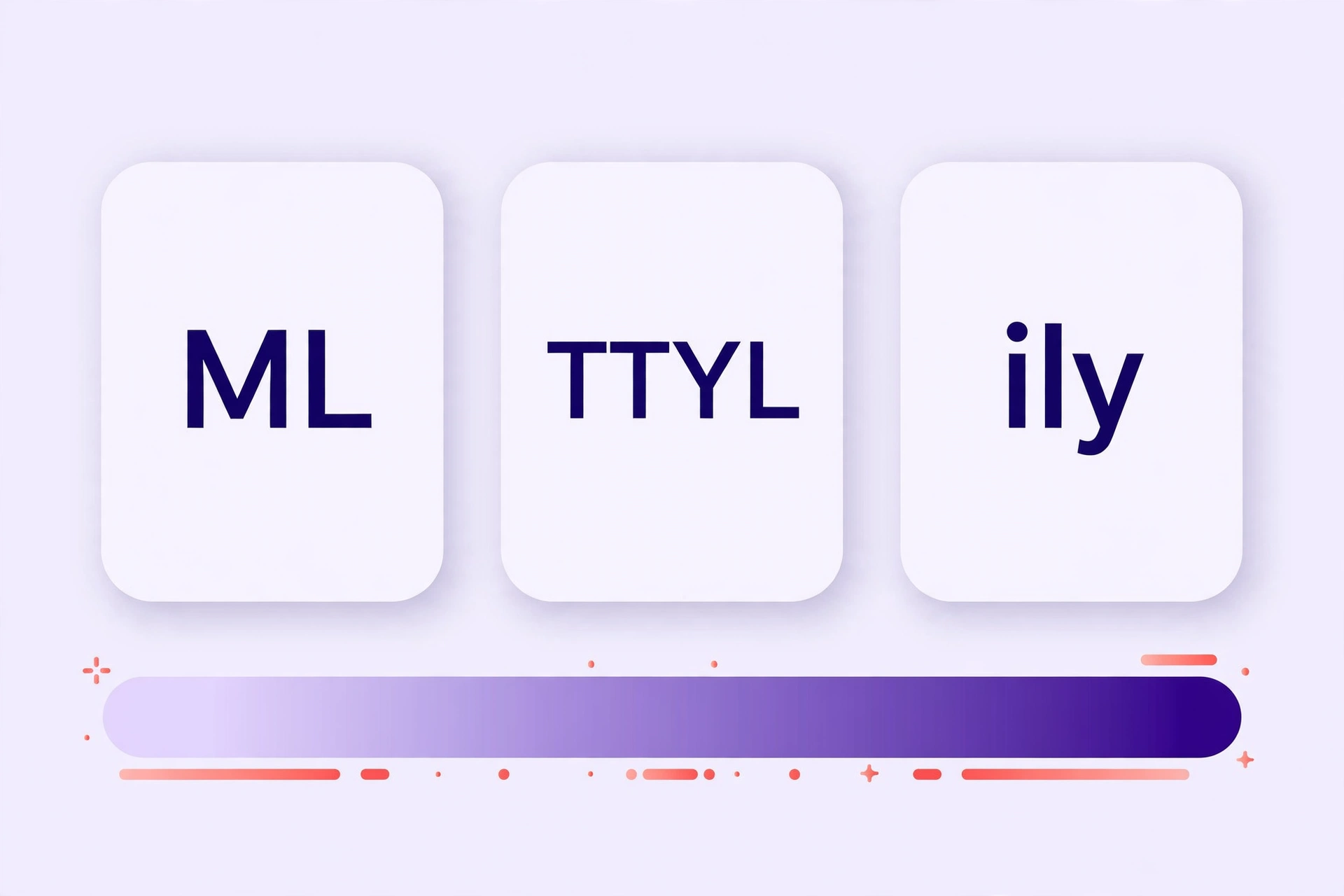
ML lives in a family of warm closers. Here’s how it relates to the ones it appears alongside:
ML + TTYL. The classic combo: “ttyl, ml!” TTYL handles leaving; ML handles the warmth. Together they’re the complete friendly exit.
ML + GTG. “Gtg, ml!” — the quick-exit version of the warm goodbye. GTG handles the departure; ML keeps it affectionate.
ML vs. “ily.” “Ily” (I love you) is a direct, heavier statement. ML is lighter: affection without the weight — for where “ily” would feel like too much.
ML vs. “xoxo.” Both are affectionate sign-offs, but “xoxo” is more performatively sweet, while ML is understated. ML fits a quick text; xoxo fits a birthday card.
The Other Meanings of ML
In personal chats, ML is affection essentially every time. But these two letters are busy elsewhere.
Machine learning. In tech, academic, or work conversations — especially uppercase — ML means machine learning, the AI field. “I’m studying ML this semester” is never affectionate. Topic and capitalization sort this instantly.
Milliliter. Written “mL,” it’s the metric unit of volume — recipes, medicine, science. “Add 250 mL of water” needs no emotional interpretation.
My life. A slang reading in relatable-content contexts — “ml 😭” under a painfully accurate meme, meaning “that’s so me.” Niche, but real.
Where ML Fits and Where It Doesn’t
Where it shines: texts with friends and family, romantic partners, supportive DMs, kind comment sections, group chats with people you like. Anywhere warmth is welcome.
Where it needs care: new professional relationships, formal messages. “Ml” to a new client isn’t warm — it’s puzzling. Spell it out: “take care” or “best wishes.”
The generational note: ML is casual digital-native shorthand. Older relatives or anyone outside texting culture may not recognize it — and “ml” from grandma’s perspective is just two mysterious letters. With them, write the words out.
One caution: because the “my love” reading exists, skip the heart emojis with people where that intimacy isn’t established. Match the decoration to the relationship.
How to Reply to ML
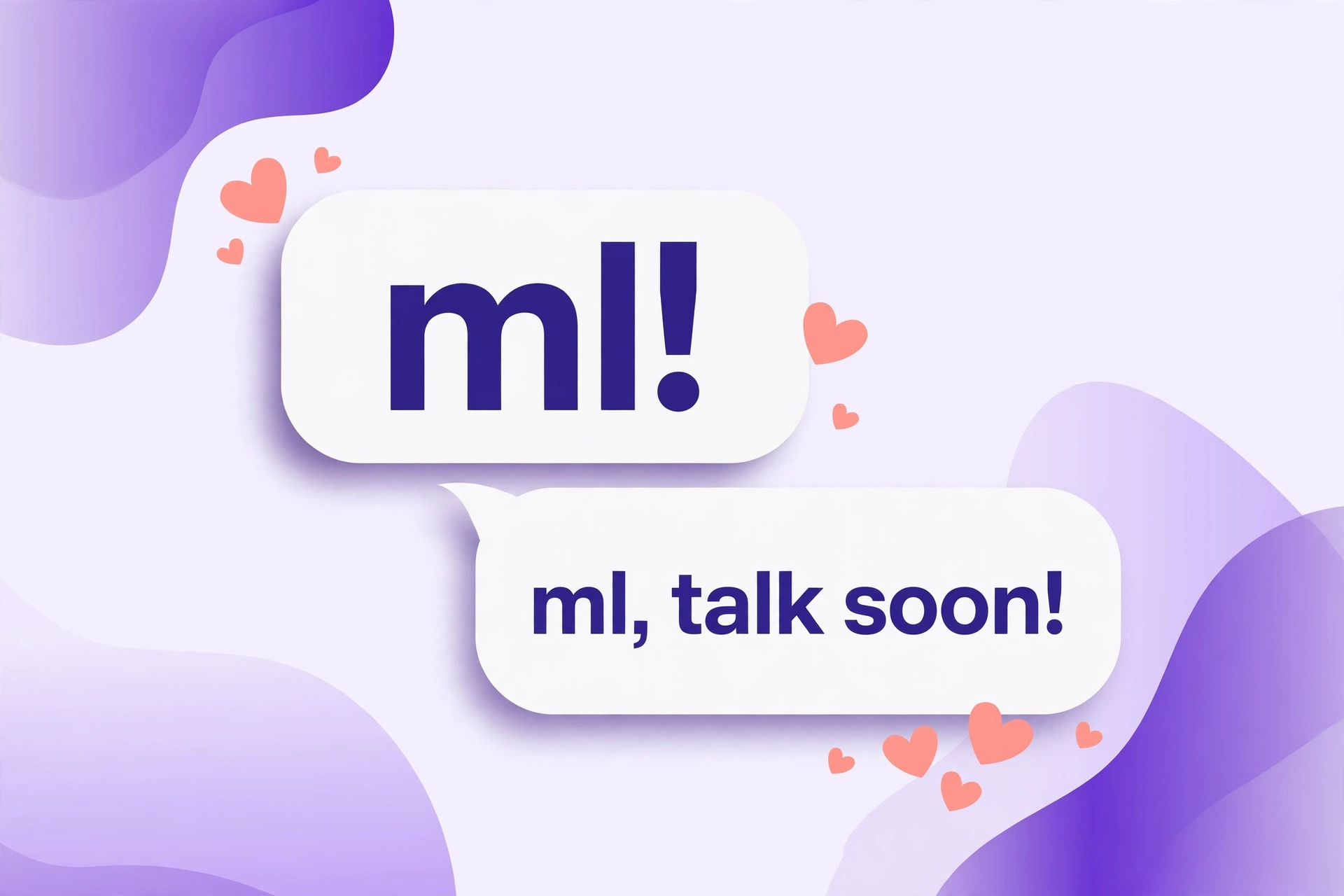
ML is a gift of warmth, not a question — so replies are about matching the energy, not answering anything.
- Mirror it: “ml!” right back — the simplest, most natural response between friends.
- Upgrade it: “ml, talk soon!” or “lmk when you’re free” — warmth plus a next step.
- The pause-and-return: “brb, ml!” — affection even in a quick exit.
- If it felt unexpectedly intimate: don’t make it weird. A warm “thanks, you too!” reads the friendly meaning and moves on gracefully.
- In a romantic context: match it honestly — “ml ❤️” back, or the words spelled out.
Quick Answers
What does ML mean in text?
“Much love” or “my love” — an affectionate sign-off. “Night, ml” is a warm goodnight; the exact shade depends on the relationship.
What’s the difference between “much love” and “my love”?
Intimacy. “Much love” is friendly warmth for friends and family; “my love” is a term of endearment, usually romantic. Context and relationship decide which one you’re reading.
Is ML flirty?
It can be — “ml ❤️” in a late-night chat carries romantic weight. But most ML is purely platonic warmth, so read the relationship, not the letters.
Does ML mean machine learning?
In tech contexts, yes — especially uppercase. In a personal chat, essentially never. Topic and capitalization sort it out.
What does “mL” mean?
Milliliter — the metric unit of volume. “Add 250 mL” is a measurement, not affection. The lowercase-m-uppercase-L styling is the tell.
Is ML the same as “ily”?
No — “ily” (I love you) is a direct, heavier statement. ML is lighter: affection without the weight. People use ML where “ily” would feel like too much.
Can I use ML at work?
With close colleagues you’re warm with, occasionally. In formal emails or with new professional contacts — no. Write “take care” or “best wishes.”
How do I reply to “ml”?
Mirror it (“ml!” back), or add a next step (“ml, talk soon!”). Even an emoji keeps the warmth reciprocated.
Is it weird to send ML to someone I just met?
A friendly “ml” is rarely weird. Just skip the heart emojis until the relationship earns them.
Why lowercase “ml”?
It’s the texting default — quick and casual. Uppercase “ML” leans toward the tech meaning (machine learning), which is why affectionate use stays lowercase.
The Short Version
ML is “much love” — two letters that sign off a message with warmth. A more intimate reading (“my love”) lives in romantic contexts, but most ML is friendly affection. Use it to close messages warmly, pair it with the classics (“ttyl, ml!”), and don’t overthink receiving it. In tech chats it means machine learning; everywhere else, it’s just love, abbreviated.
