
You got a one-word reply — “nty” — and now you are staring at it, wondering if the person is being polite or brushing you off. It looks cold on a screen, but it is usually neither an insult nor a compliment. NTY is shorthand for “no thank you,” and it is one of the most efficient little phrases in texting: a complete refusal in three letters.
What Does NTY Mean in Text?
NTY stands for “no thank you.” It is a short, casual way to decline an offer, an invitation, or a request without typing out the whole sentence. When someone writes “nty,” they are saying no — but with the manners left in.
It works the same way the full phrase does. If a friend texts, “Want the last slice?” and you are full, “nty” lands exactly like saying “no thank you” out loud. The abbreviation saves keystrokes; it does not change the meaning.
A few quick facts about the form itself:
- Lowercase “nty” and uppercase “NTY” mean the same thing. Lowercase feels softer and more casual; uppercase reads firmer or more emphatic.
- It is a decline, never an acceptance. The “thank you” inside it thanks the person for the offer — the “no” is doing the real work.
- Do not read it as “thank you.” That abbreviation is TY. NTY and TY are opposites, so do not mix them up.
How People Actually Use NTY
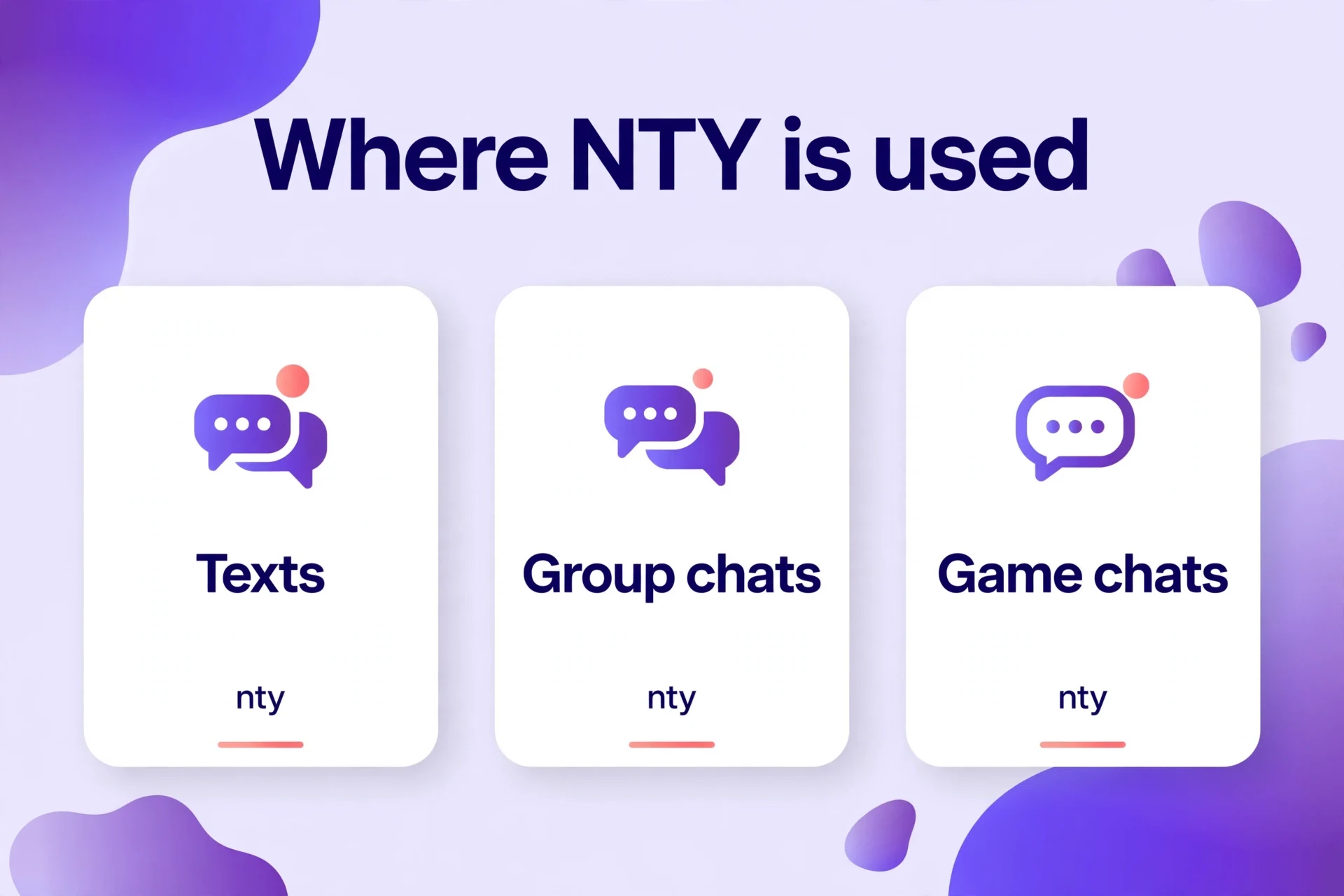
NTY shows up anywhere short replies are the norm: texts, DMs, group chats, comments, and gaming chats. Here is how it looks in real conversations.
Turning down plans
- Maya: “Movie night at mine on Friday?”
- You: “nty, I’ve got plans already 😊”
If you are the one leaving the conversation rather than declining an invite, GTG (got to go) is the abbreviation for that — a different kind of goodbye.
Declining an offer
- Dan: “Want a ride home?”
- You: “nty, I’m taking the bus. thanks tho”
Shutting down a lowball or a pushy seller
- Buyer: “Would you take $40 for it?”
- Seller: “nty”
Saying no in a group chat
- Group chat: “Who’s up for bowling tonight?”
- You: “Hard nty for me, saving money this week 😅”
Notice what most of these have in common: NTY rarely travels alone. People usually attach a short reason, an emoji, or a softener, because three bare letters can feel abrupt. “nty” plus context reads polite; “nty” alone reads blunt. (When friends ask what’s the move — WTM — to make plans, “nty” is the quick way out of the one you cannot make.)
The Tone Question: Is NTY Polite or Rude?
Honestly, it depends on how it is delivered. The phrase itself is polite — it literally contains “thank you” — but a bare three-letter refusal gives the reader almost nothing to work with, so they fill in the tone themselves. A few patterns:
- “nty” (lowercase) reads casual and soft. This is the everyday version.
- “NTY” (uppercase) reads firmer. On a trade offer or a repeat ask, it sounds like a door closing.
- “nty lol” / “nty tho” reads playful or warm. The extra word takes the edge off.
- “nty” with no emoji and no reason can read cold, especially from someone you are not close to.
If you want to keep it friendly, the formula is simple: NTY + a softener. An emoji, a reason, or a “thanks anyway” turns a flat refusal into a gracious one. A softener like to be honest (THB) works too — “nty, thb I’m just exhausted today” reads warmer than a bare “nty.”
NTY in Specific Places
Most of the time NTY behaves the same everywhere, but a few settings give it a slightly different flavor.
Dating apps. A polite “nty” after a meet-up suggestion is one of the cleaner ways to bow out. It is direct without being cruel, and it does not invite a debate. If you receive one here, do not reply with a counter-proposal — the conversation has ended.
Marketplace and resale chats. Sellers dealing with lowball offers use “nty” constantly. On platforms where messages fly fast, a one-word “nty” tells the buyer their offer was too low to negotiate against, without starting a fight. Buyers, for your part: getting an “nty” here means your number was nowhere close, not that the seller hates you.
Discord and Slack. In casual work or community chats, “nty” often answers quick polls and casual asks — “who wants to present first?” gets an “nty” from half the channel. It reads as banter, not rudeness, because everyone is speaking the same shorthand.
When Not to Use NTY
NTY is casual shorthand, and casual shorthand has limits. Spell out “no thank you” in any setting where professionalism matters: emails, job applications, messages to a manager, or any conversation where tone cannot afford to be misread. NTY also lands badly when the situation is emotional — turning down a wedding invitation or declining a serious request deserves a sentence, not three letters.
It is also worth avoiding NTY when you need to say yes to part of something. “nty” is a full stop. If you cannot come Friday but could come Saturday, say that instead — a bare “nty” closes the conversation before the alternative can surface.
NTY vs. Similar Abbreviations
Texting is full of three-letter abbreviations, and a few sit close enough to NTY to cause confusion. Here is how to keep them straight.
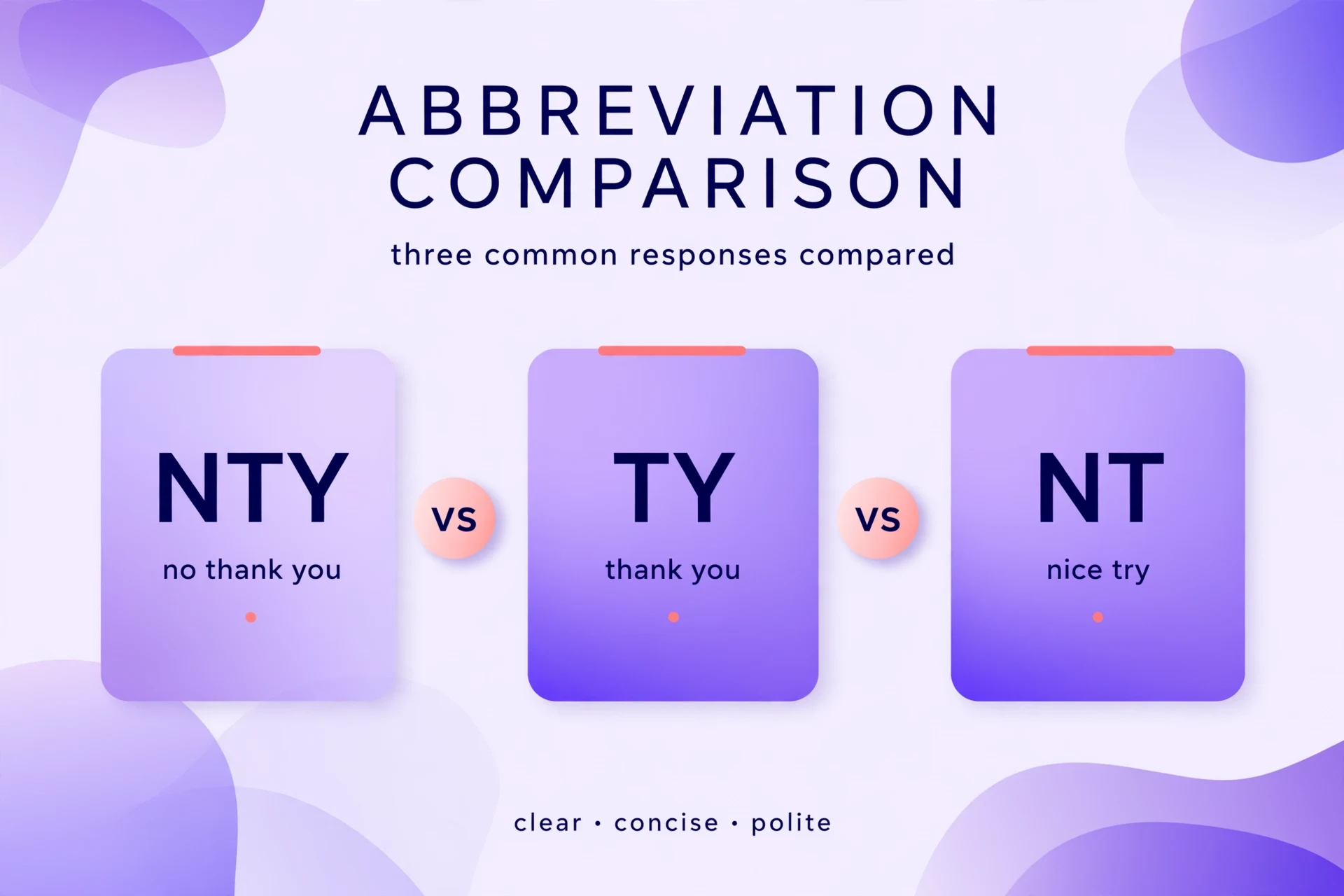
NTY vs. TY. TY means “thank you” — pure gratitude, no refusal. If someone offers you a lift and you accept, you reply “ty.” If you decline, you reply “nty.” They are opposites, so check before you send.
NTY vs. NT. In gaming chats, NT means “nice try” — encouragement after a teammate fails at something. NTY means “no thank you.” Type the wrong one in a game lobby and you will turn encouragement into rejection, which is one confused teammate you do not need.
NTY vs. IDC. IDC (I don’t care) means “I don’t care,” which is a much blunter instrument. If you want to see the full range from polite to blunt, compare the two: “nty” declines the offer gracefully, while “idc” tells the person their question was not worth answering. Use NTY when you care about staying on good terms.
NTY vs. NYT. This one is a typo, not a rival meaning — but it happens. NYT is The New York Times, and a mistyped “nty” can autocorrect into it. If someone’s reply looks like a newspaper reference, context will tell you which one they meant.
How to Reply When Someone Says NTY to You
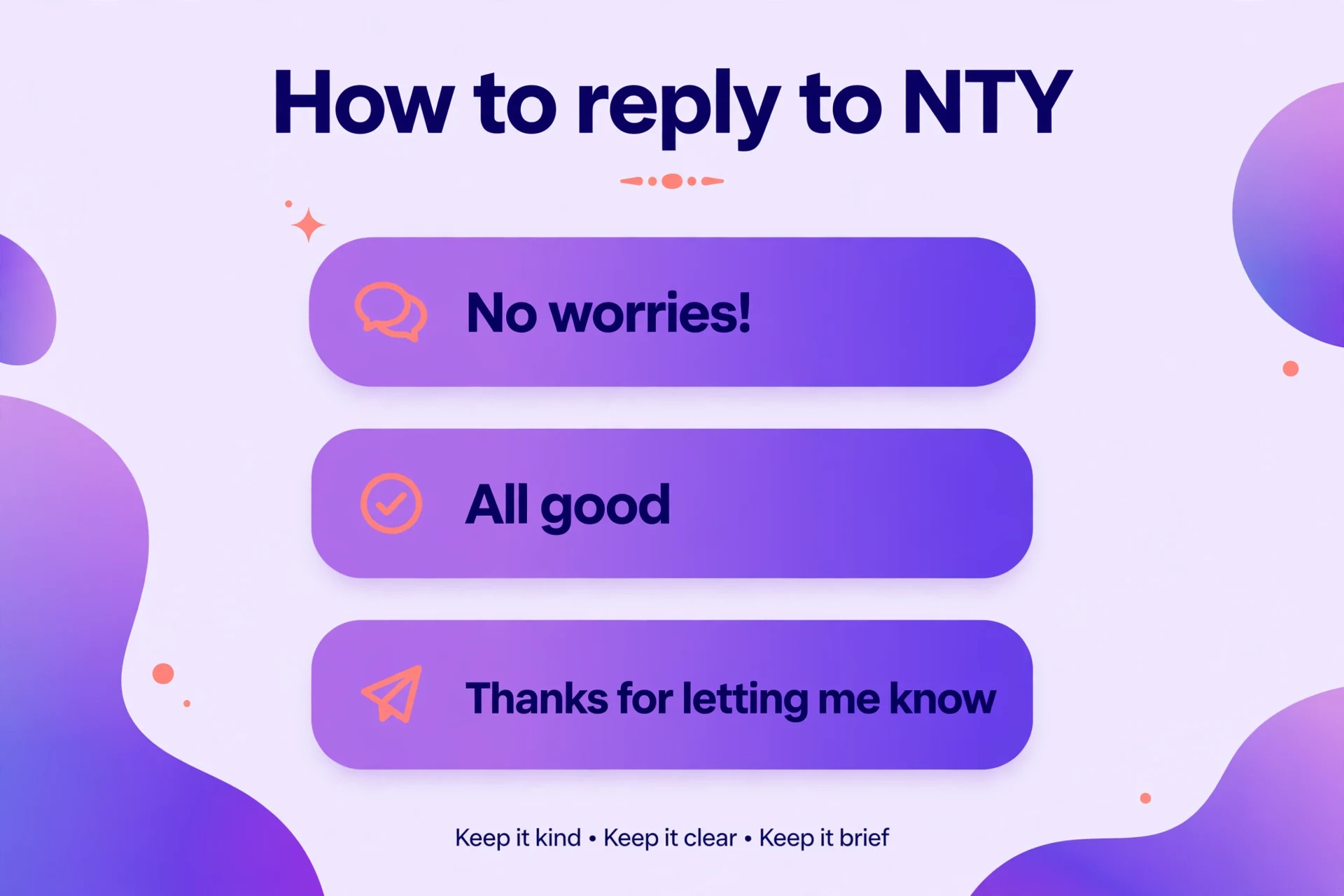
Being on the receiving end is simple: the person said no, politely. Take it at face value. Here are replies that keep things smooth:
- “No worries, thanks for letting me know!”
- “All good 👍”
- “Okay! Maybe another time — ttyl!”
What not to do: do not ask “why not?” unless the situation genuinely needs an answer, and do not send a follow-up pitch after a clear “nty.” Pushing past a polite refusal is what turns NTY into a block.
One more thing: if the “nty” came with no softener and stung a little, remember that brevity is the whole point of the abbreviation. Most people type “nty” because it is fast, not because they are angry.
Does NTY Mean Anything Else?
In texting and everyday chats, NTY almost always means “no thank you.” A couple of edge cases are worth a one-line mention so they do not confuse you:
- In gaming trade chats, some players use “nty” specifically to refuse a trade offer quickly — same core meaning, just a specific setting.
- Outside texting, NTY can be a technical abbreviation in fields like medicine or logistics (for example, “not tested yet” in lab documentation). Those meanings never cross into casual chat; if you are reading a text message, assume “no thank you.”
For more crowdsourced examples of the slang in the wild, see the NTY entry on Urban Dictionary.
NTY FAQs
Is NTY rude? Not by itself. It is a polite phrase in shortened form. It can feel abrupt without an emoji or softener, but the rudeness is in the delivery, not the abbreviation.
What does “nty lol” mean? Still “no thank you” — the “lol” just softens it into a lighthearted, playful refusal.
Can I use NTY at work? In relaxed team chats like Slack or Discord, occasionally, if the culture is informal. In emails or formal settings, type “no thank you” in full.
What is the difference between NTY and “nah”? They both decline, but “nah” is more casual and can sound dismissive. “nty” keeps a note of politeness, which makes it the safer choice with people you do not know well.
Does NTY mean “no thanks, you”? No. It means “no thank you” — the “you” is implied, not part of the abbreviation.
Is there an opposite of NTY? There is no single opposite, but IDM (I don’t mind) is close: it is the relaxed yes to NTY’s polite no. NTY declines an offer; IDM shrugs and accepts it.
The Short Version
NTY is “no thank you” in texting shorthand: a fast, polite way to decline an offer or invitation. It works across texts, DMs, comments, and game chats, and its tone is set by whatever travels with it — an emoji and a reason keep it warm; three bare letters keep it blunt. Save the full “no thank you” for formal settings, accept a received “nty” gracefully, and you will never have a problem with this one.