
You get a text that just says “wtm?” and now you have a small problem: is this person asking what the plan is tonight, or asking if you’re okay? If you’re looking up the wtm meaning in text, here is the honest answer — WTM can mean two genuinely different things, and which one you’re getting is decided by the conversation around it, not by the letters themselves.
The default reading is “What’s the move?” — plans, itinerary, what are we doing later. But WTM is also a documented concern check — “What’s the matter?” — the short text a friend sends when you’ve gone quiet. This guide gives you a two-second method for telling them apart, with real-chat examples and a reply for each.
WTM Meaning at a Glance
| Full form | What’s The Move? (also What’s The Matter? in concerned contexts) |
| Main job | Asking about plans — or quietly checking whether you’re okay |
| Rare third reading | “Whatever that means” — sarcastic, uncommon |
| Example | “wtm tonight?” → What’s the plan tonight? |
The Agenda Test: Which Question Are You Being Asked?
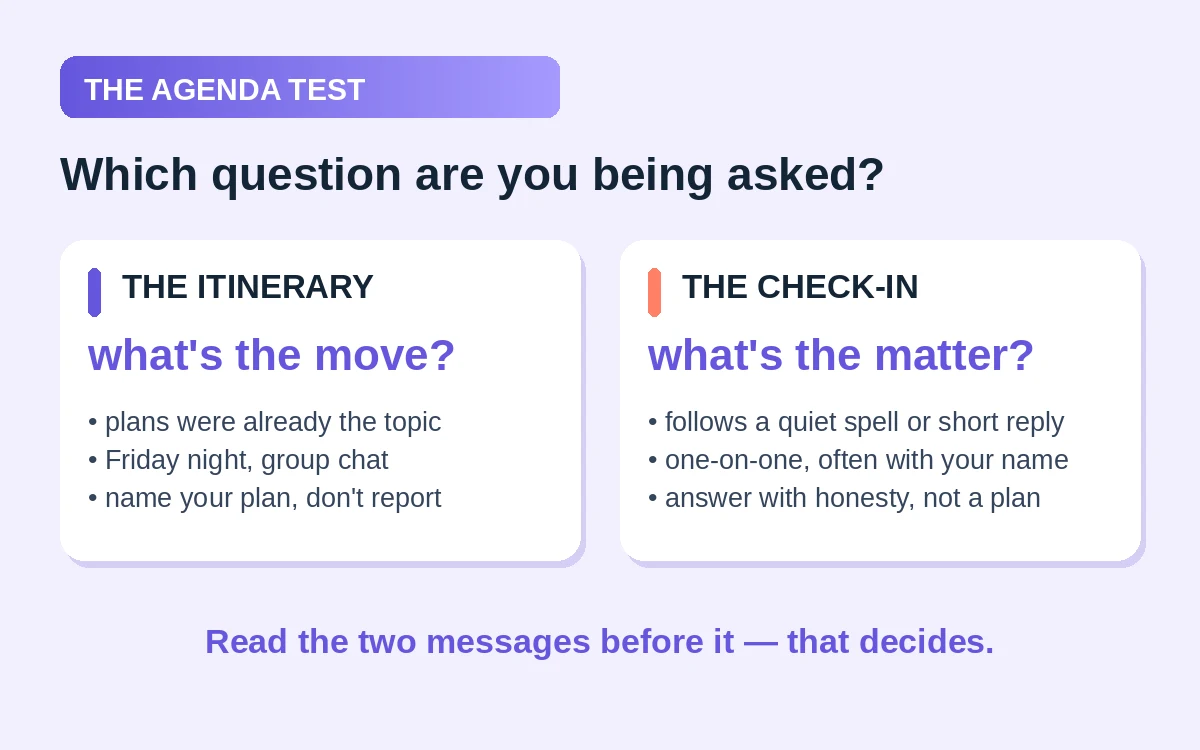
Every WTM carries an agenda — and it is always one of two. Either the sender wants an itinerary (“what are we doing?”) or a check-in (“are you okay?”). Run the Agenda Test: read the two messages right before the WTM and look for the setup.
- “anyone free later?” → “wtm?” — itinerary. The conversation was already about plans; the WTM is asking for the specifics.
- “yeah I’m fine” (after you said nothing for an hour) → “wtm?” — check-in. The conversation was about you; the WTM is asking what’s wrong.
- Friday night, group chat, nobody has suggested anything → “wtm tonight??” — itinerary, always. The double question marks are the universal symbol of an unsettled evening.
- One-on-one DM, your name attached: “hey. wtm?” — check-in. Plans questions rarely come with your name and a period.
That’s the whole test: itinerary or check-in — what was the last thing this conversation was about? Two seconds, and you never answer a worry with a party plan, or a party plan with your feelings.
Meaning One: “What’s the Move?” — The Plans Question
This is WTM’s home territory and its most common meaning by a wide margin. “What’s the move?” is plan-language — a way of asking what are we doing next without typing a whole sentence. And “the move” here doesn’t mean a chess move; it means the activity, the destination, the thing that’s about to happen.
It shows up where plans exist but are unsettled. Someone is free, the group is free, and nobody has committed to anything yet. That’s the exact gap WTM fills:
- “wtm tonight?” — What’s the plan for tonight? (the classic)
- “sooo wtm this weekend” — We have a free weekend; propose something.
- “off work. wtm?” — I’m available and bored; give me an itinerary.
- “wtm after the game?” — The game ends at some point; what happens next is open.
Notice the hidden assumption in all of these: the sender is available and looking for a suggestion. WTM is a low-effort way to ask if there’s any action happening without having to propose it. If you’re the friend who usually organises the group, you’ll see this constantly.
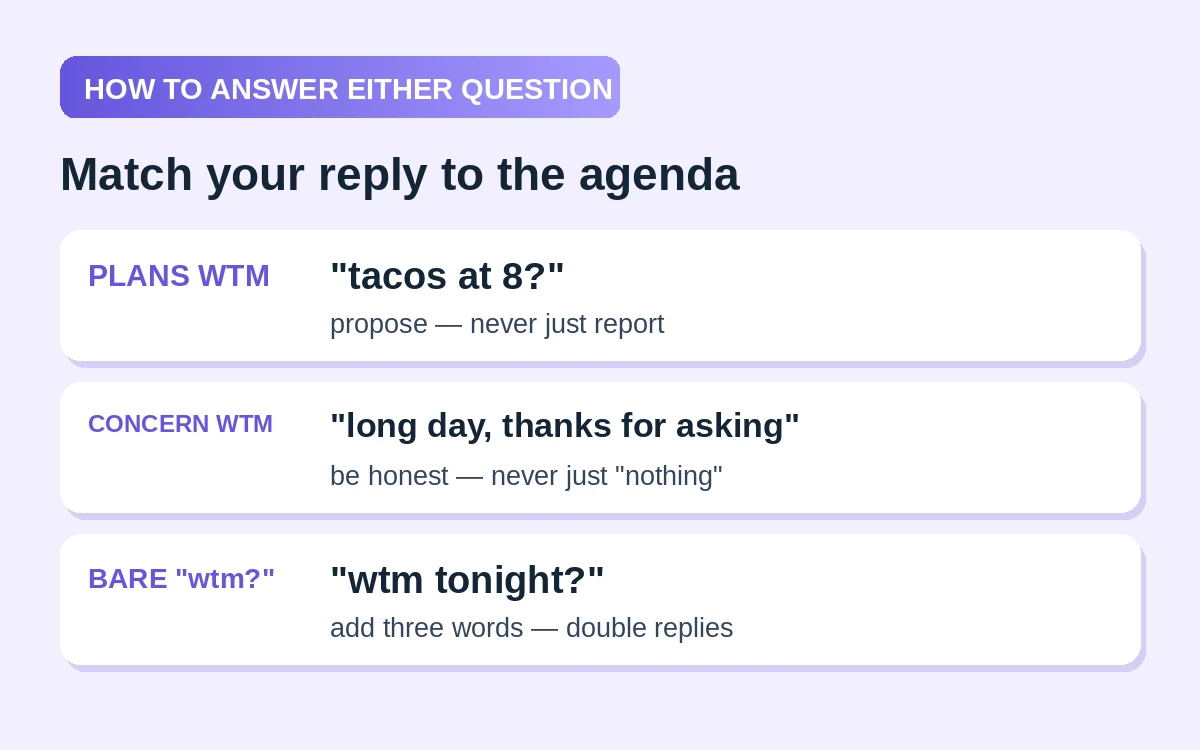
How to answer: answer with a proposal, not a status report. “WTM tonight?” → “tacos at 8?” beats “I’m just chilling.” A status report answers WYD — a different question for a different article. If you don’t know yet, say so and stay in the game: “no idea yet, lmk what you find.” And if you’re the one making the plan happen, WTM pairs naturally with its cousins: ask WYA for the location piece, and GTG is the natural last word when everyone’s actually heading out.
Meaning Two: “What’s the Matter?” — The Quiet Check-In
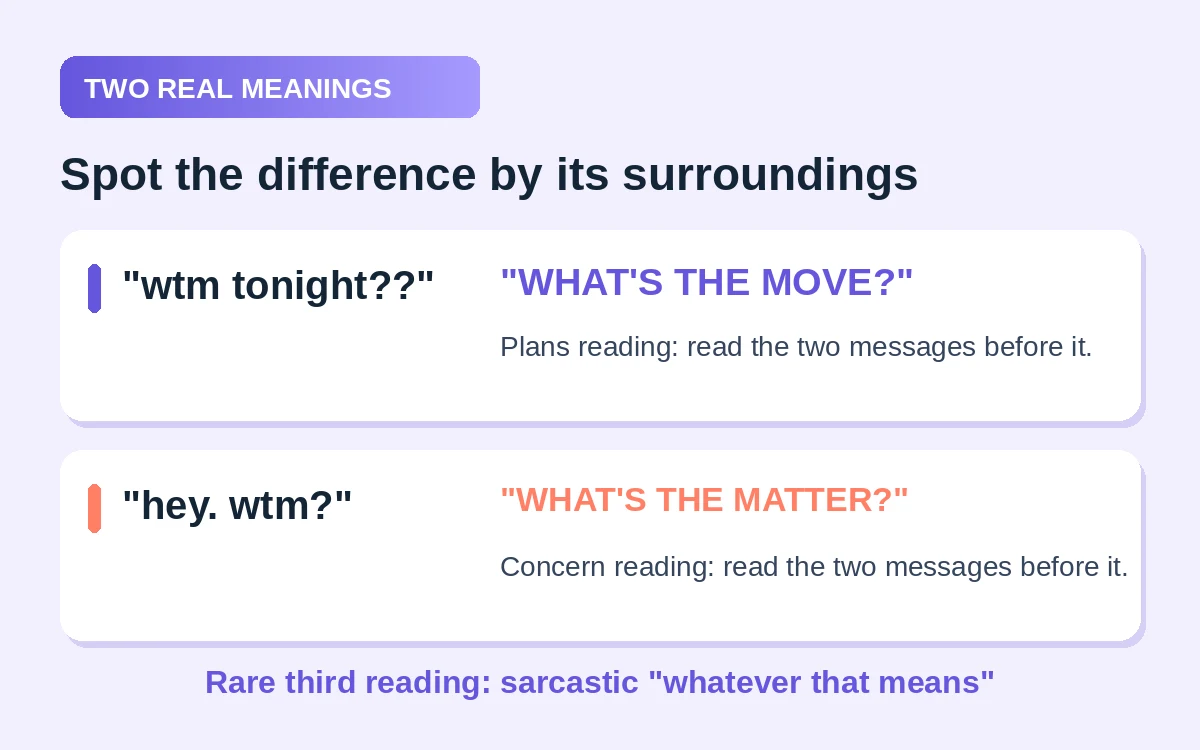
Here’s the meaning the old version of this article never mentioned, and it’s a real one. WTM can also mean “What’s the matter?” — a short, concerned text sent when someone seems off.
You recognise this WTM by its surroundings, not its letters. It arrives one-on-one, not in the group chat. It follows a quiet spell, a short reply, a cancelled plan, or a message that sounded flat. It often carries your name, or a period, or both — punctuation doing emotional work:
- “you’ve been quiet today… wtm?” — I’ve noticed, and I’m asking.
- “hey. wtm? you seemed off earlier” — Checking in after something felt wrong.
- “seriously, wtm?” — The concern is real; this isn’t small talk.
This is a care message wearing a slang costume. Treat it as one. You don’t owe anyone a full confession, but a flat deflection (“nothing”) usually earns a follow-up. The honest range is wide: “just tired, long day — thanks for asking” closes it warmly; “rough week honestly” opens it if you want to talk; “I’m good, just been busy” reassures if that’s true. A sincere “thanks for checking in” costs you four words and means more than you think.
And if you’re the one sending a concern-WTM, one tip: “wtm?” alone can feel abrupt. “hey, you seem a bit off — wtm?” gives the person something to hold onto. You’re TBH-adjacent here: honesty and gentleness in the same message.
The Occasional Third Reading: “Whatever That Means”
Rarely, WTM shows up as a sarcastic shrug — “whatever that means.” As in: “he said the meeting is ‘mandatory but optional’ wtm.” It comes after a confusing statement, never opens a conversation, and often travels with a “lol” or an eye-roll emoji. No need to answer it — it’s commentary, not a question.
WTM in Real Conversations
The exchanges below are illustrative examples, not real messages.
The Friday-night itinerary — and how to answer it
- Priya: “wtm tonight??”
- Sam: “thinking tacos at 8, then otw to the rooftop thing after”
- Priya: “in. text me when you head out”
The quiet check-in — handled warmly
- Jess: “hey. wtm? you’ve been quiet”
- Marco: “just a long day honestly. thanks for asking though”
- Jess: “of course. wdym ‘long day’ — work or something else?”
The misread — and the graceful recovery
- Alex: “wtm?”
- Dana: “movie at 9? I’m free”
- Alex: “oh — no, I meant you seemed upset earlier. wtm?”
- Dana: “ahh got you. yeah, rough morning. coffee tomorrow?”
Dana’s recovery is the whole lesson in four words: “ahh got you.” Nobody minds a misread; they mind being made to feel weird about it.
Who Sent It Changes Which Reading to Expect
The letters are the same from everyone; the odds shift with the sender.
From a close friend, it’s genuinely either — run the Agenda Test on the last two messages. Friends use both WTMs freely, sometimes in the same week. This is the sender you’ll misread most often, which is why the test exists.
From a crush or someone you’re dating, the itinerary reading is the strong favourite. “wtm this weekend?” from this person is almost always a bid — they’re asking whether you’ll see them. Answer the plan, not the subtext: say yes or no to the thing, and the rest sorts itself out.
From a group chat, it’s the itinerary, full stop. Nobody checks on your feelings in front of eight people. Reply like a planner: propose, vote, or bow out.
From a parent, an older relative, or a worried friend checking in, the concern reading is near-certain. If your mum texts “wtm?” she is not asking about your Friday-night itinerary. Reassure her like you mean it.
WTM vs. Its Near-Neighbors
WTM travels with a family of short question-slang, and they are not interchangeable:
| Abbreviation | Full form | What it asks | The boundary |
|---|---|---|---|
| WTM | What’s the move? | The plan — what happens next | Future, undecided |
| WYD | What are you doing? | Your current activity | Present, right now |
| WYA | Where you at? | Your location | Place, not plan |
| HMU | Hit me up | Contact me | An invitation, not a question |
| WTW | What’s the word? | What’s happening / any news | The update, not the itinerary |
The practical rule: WTM points forward. If the answer is a proposal (“tacos at 8”), it’s WTM. If the answer is a status (“watching TV”), it’s WYD. If the answer is a pin drop, it’s WYA. If you get a WTW (“what’s the word?”), the sender wants news and updates — answer that, and save the planning for WTM. Mixing them up is the most common small error in this whole family — “wtm?” answered with “nothing much” leaves the sender’s actual question hanging.
What WTM Doesn’t Mean (The Honest Part)
Some slang guides pad their WTM articles with long “alternate meanings” lists — “want to meet?”, “what’s the mood?”, “word to mother,” “what’s the motivation?” None of these has any dictionary or attested-texting support; they’re filler dressed as information. In real texting, WTM has exactly two meanings and one rare sarcastic reading, and that’s it. Anything else on a rival list is someone guessing in public.
Mistakes People Make With WTM
- Answering the wrong question. The classic error: replying to a concern-WTM with plans, or a plans-WTM with your feelings. Run the Agenda Test before you type — it takes two seconds and prevents the “ahh got you” moment.
- The bare “wtm?” with zero context. In a dead chat with no recent messages, a lone “wtm?” forces the other person to guess your agenda. Add three words: “wtm tonight?” costs nothing and doubles your reply rate.
- Using it where it doesn’t belong. WTM is casual-only — group chats, DMs, friends. A professor, a client, or a job interview is not the audience. In those rooms, type the actual sentence.
- Reading the sarcastic one as a real question. “whatever that means” never opens a conversation and never expects an answer. If a WTM follows a confusing statement, it’s commentary — don’t reply with your Friday plans.
Quick Answers
What does WTM mean in text?
WTM most commonly means “What’s the move?” — a casual way of asking what the plan is. It can also mean “What’s the matter?” when sent as a concern check, and rarely “Whatever that means” as a sarcastic aside.
How do I know which meaning of WTM someone intends?
Run the Agenda Test: read the two messages before the WTM. If the conversation was about plans, a free evening, or a group chat on a Friday night, it’s “what’s the move.” If it was one-on-one after a quiet spell, a short reply, or a cancelled plan, it’s “what’s the matter.”
What’s the difference between WTM and WYD?
WTM asks about the future — the plan, what happens next (“tacos at 8?”). WYD asks about the present — what you’re doing right now (“watching TV”). They overlap in casual chat but they are not interchangeable.
How should I reply to “wtm tonight?”
Propose something. “Tacos at 8?” beats “I’m just chilling.” If you don’t have a plan yet, stay in the game: “no idea yet, what are you thinking?” keeps the conversation moving toward an actual decision.
How should I reply when WTM means “what’s the matter?”
Match the tone of the question — it’s a care message, not small talk. “Just tired, long day — thanks for asking” closes it warmly; “rough week honestly” opens it up if you want to talk. You don’t owe a full confession, but a flat “nothing” usually invites a follow-up.
Is WTM formal or informal?
Informal, always. It belongs in texts, DMs, and group chats with people you know. Use full sentences in professional or formal communication.
The Short Version
WTM is three letters asking one of two questions: “What’s the move?” — the plans question, the default, the Friday-night text — or “What’s the matter?” — the quiet check-in from someone who noticed you went silent. The Agenda Test tells them apart in two seconds: read the two messages before it, and ask whether this conversation was about plans or about you. Answer proposals with proposals, answer concern with honesty, and never send a bare “wtm?” into a dead chat and expect the other person to do your agenda-reading for you.
