
Someone comments “PTSO” under a photo, or a friend drops it into a chat, and the moment passes before you can ask what it means. Was that a compliment? A joke? Something you’re supposed to respond to?
In nearly every texting context, PTSO is a compliment — short for “put that stuff on.” It’s shorthand for “you look great, own it.” Think of it as the digital version of pointing at someone’s outfit and giving them a look that says everything’s working.
The full phrase behind it is coarser — “put that [expletive] on” — which is why most people type the letters instead of spelling it out. The acronym keeps things fast and casual; the raw phrase would hit too hard for a comment section.
This guide covers what PTSO means in texts, where the phrase comes from, how people actually use it, and the rare cases where it means something else entirely.
The Short Answer
- PTSO means “put that stuff on” — a hype compliment for someone’s outfit, style, or confidence.
- It’s almost always positive. It’s not an insult, a callout, or a secret code.
- You’ll see it most in comments and group chats, less often in one-to-one texts.
- In school or office emails, the same letters usually mean a Parent Teacher Student Organization — a completely different, formal use.
What PTSO Actually Means
At its core, PTSO says: “Whatever you’re wearing — or whatever energy you’re bringing — it’s working.” The magic of the phrase is that it works as both a command and a compliment at the same time. It’s telling someone to show up boldly, and telling them they’re already doing it.
There are two shades of it, and the context tells you which one you’re looking at.
“You look amazing” — the outfit compliment
This is the main job. Someone posts a photo, an outfit video, or a “get ready with me” clip, and PTSO lands in the comments. It’s the commenter’s way of saying the look is undeniable.
- “Okay the jacket alone?? PTSO 🔥”
- “She PTSO every single time, no misses”
- “Whole fit is immaculate. PTSO.”
Nothing about these is subtle. They’re open, warm, and designed to be seen — half of the point is that everyone else reading the comments sees the hype too.
“Go for it” — the encouragement
The second shade shows up before the outfit is even out. A friend is choosing between two options, hesitating, or talking themselves out of wearing something bold — and “PTSO” is a shove.
- A: “I don’t know, is this too much for dinner?”
- B: “Are you kidding? PTSO. Wear it.”
Here it reads as encouragement, not judgment. It’s closer to “go for it” than to any commentary on the clothes themselves.
Where the Phrase Comes From
“Put that stuff on” — or, in its original spoken form, the coarser version — comes out of hip-hop and Black American vernacular speech, where fashion and presence have always been part of the language of self-expression. Rappers and street culture have been using the full phrase for years as a way of saying someone dressed well or showed up confidently.
The shortened “PTSO” is much newer. It followed the usual path for slang like this: people started typing the letters in comment sections and chats because it was faster than the whole phrase and sounded more casual than spelling it out. Social media fashion content — outfit videos, fit checks, styling clips — gave it a steady home.
A word of honesty: the exact breakout moment is murky. Different sources credit different songs and moments from the early 2020s, and none of the competing origin stories are solid enough to repeat as fact. What you can rely on is the meaning, which has stayed consistent everywhere it’s used.
How People Actually Use It
The exchanges below are illustrative examples, not real messages.
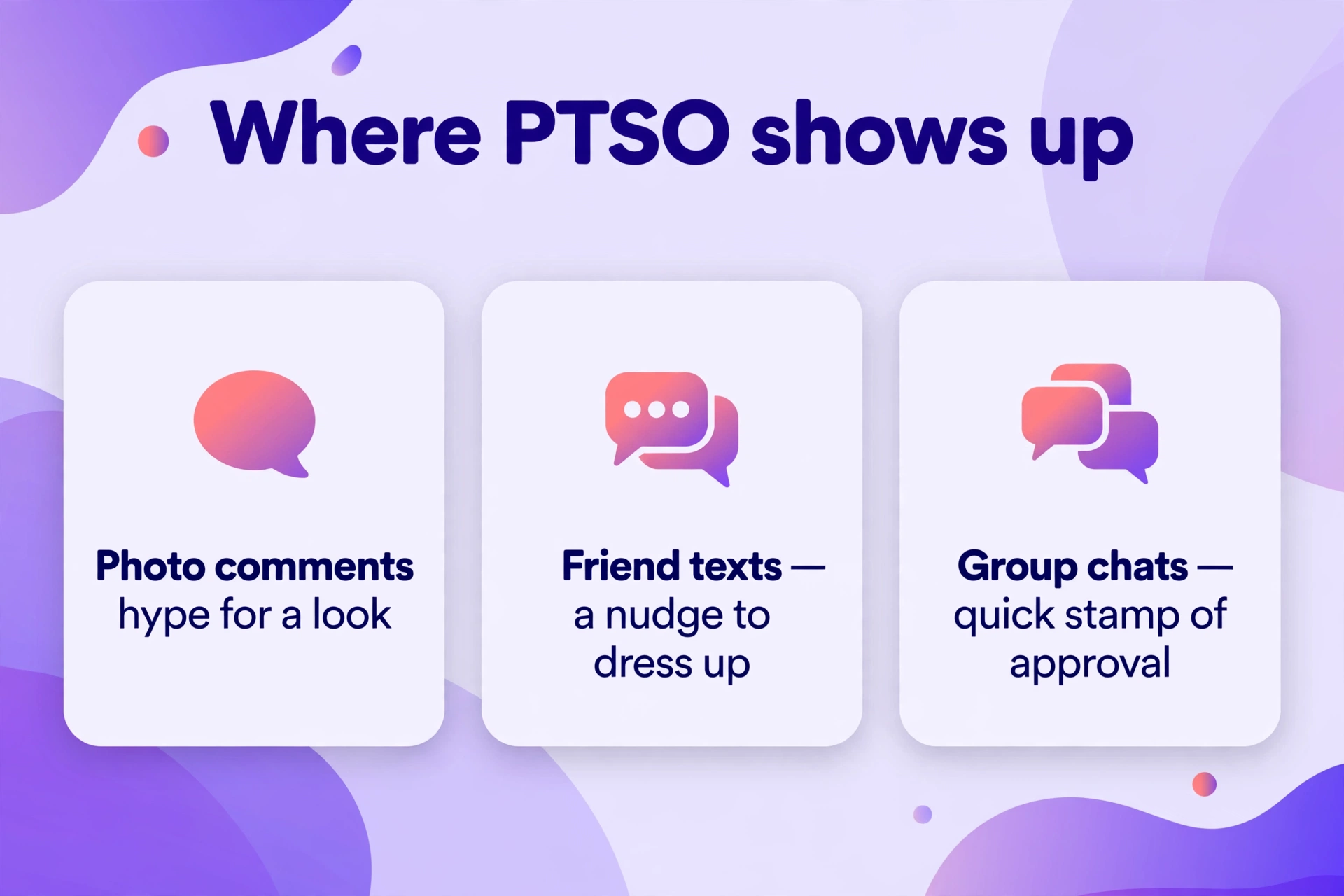
The comment-section hype
- A: posts a mirror selfie in a new coat
- B: “PTSO 🔥 the whole fit is working”
This is where PTSO lives most comfortably. Short, public, and enthusiastic — it’s built for the comments under a look.
The pre-game nudge
- A: “Do I wear the boots or the sneakers??”
- B: “Boots. PTSO.”
PTSO here is advice disguised as hype. B isn’t analyzing the outfit; they’re just saying “trust me, go bold.”
The group chat stamp of approval
- A: sends a photo of their outfit before heading out
- B: “Okay?? PTSO.”
- C: “RIGHT”
In a group chat, PTSO works like a stamp — quick, decisive, and usually followed by someone else piling on. It rarely starts a long conversation; its job is done in four letters.
What to Send Back
Being on the receiving end of PTSO is easy: it’s a compliment, so take it like one. A short, confident reply is all you need.
- “You know it 😌”
- “Had to put it on today!”
- “Appreciate it 🔥”
- “Always PTSO energy”
If you’re the one sending it, a little context helps it land. A bare “PTSO” under a photo works fine, but pairing it with something specific — the jacket, the colors, the confidence — reads as more genuine: “PTSO, the colors on you?? Unreal.”
A couple of adjacent phrases come in handy around here. If their look gave you a genuine reaction, a sincere follow-up lands well (“fr this is your best fit yet”). If you’re coordinating plans around the outfit, let me know where you’re wearing it (“ptso tonight, lmk if you need a ride”).

PTSO vs. Other Slang
Slang abbreviations cluster together in comment sections, so it helps to know which neighbors mean what.
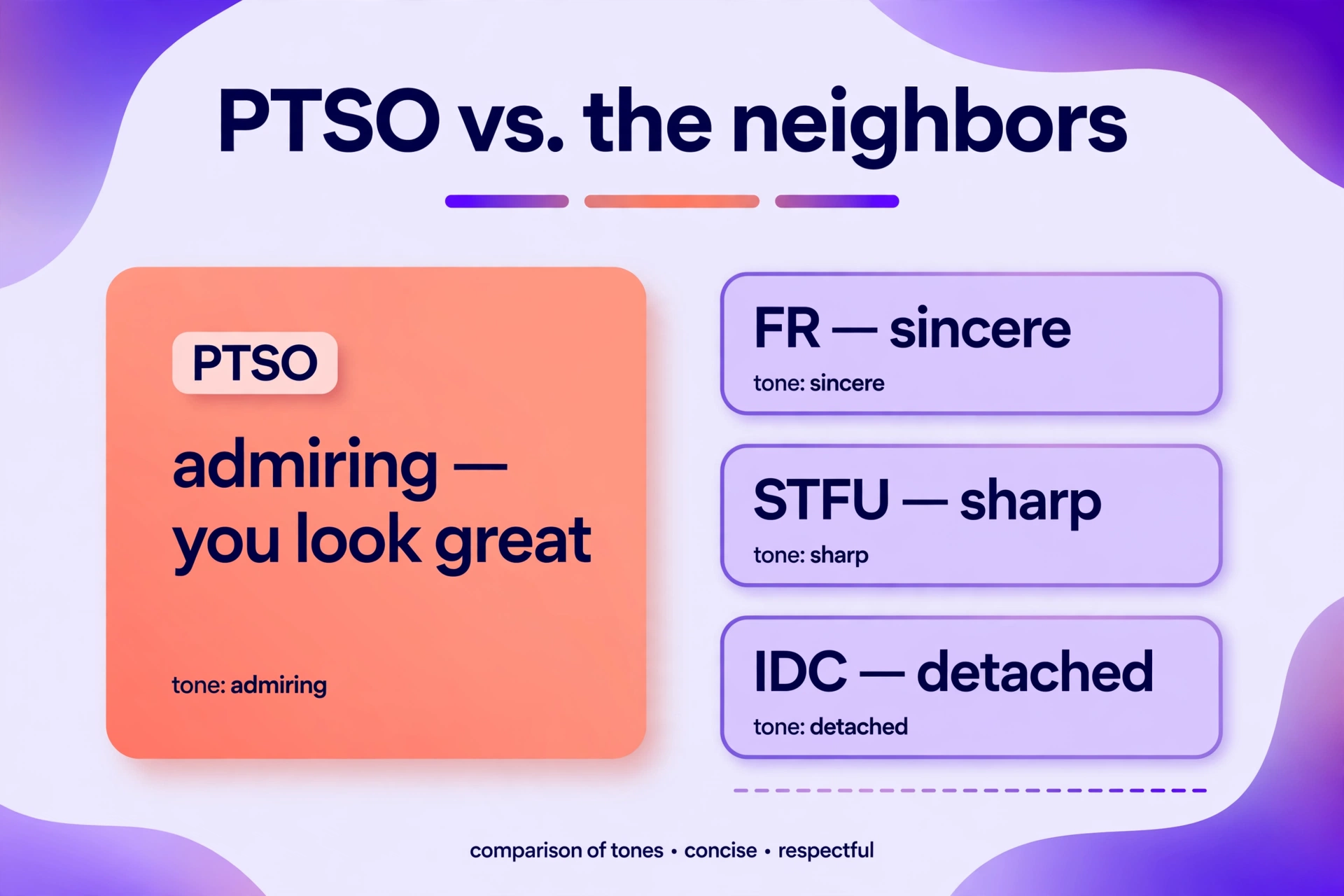
- PTSO vs. FR: FR means “for real” — it’s sincerity or agreement. PTSO is hype. “FR, PTSO” under a photo means “for real, you dressed” — they stack, but they do different jobs.
- PTSO vs. BFFR: these are near-opposites in tone. PTSO lifts someone up; BFFR (“be f—ing for real”) calls someone out. Confusing them would be a disaster — check the tone of the whole comment before you reply.
- PTSO vs. STFU: both are blunt and informal, but STFU is aggressive (“shut up”) while PTSO is admiring. One ends conversations; the other starts a compliment thread.
- PTSO vs. GNG: both are casual chat abbreviations you’ll see in the same circles. GNG is a greeting-adjacent slang (“gang”), PTSO is a reaction. They share a vibe, not a meaning.
- PTSO vs. IDC: IDC (“I don’t care”) is detached; PTSO is engaged. If someone says IDC, they’re opting out of the topic. If they say PTSO, they’ve opted all the way in.
The through-line: PTSO is one of the warmest abbreviations in the comment section. Its neighbors range from sincere (FR) to blunt (STFU) to detached (IDC) — PTSO is the one that’s pure admiration. Independent slang guides such as socialcrm.org document the same hype-compliment reading.
What PTSO Is Not
It’s not an insult.
If PTSO lands under your photo, nobody is being mean. The “command” in it — “put that on” — points at the clothes, not at you.
It’s not a secret code.
There’s nothing hidden in the letters. It’s a compressed compliment, and it means what it says.
It’s not always about clothes.
As the phrase stretched beyond outfit content, PTSO started showing up for anything someone owned — a performance, a presentation, a strong moment. The outfit reading is still the default, but “PTSO” on a video of someone’s speech means “you carried that,” not “nice jacket.”
And in one very different setting, it’s not slang at all.
In school newsletters, parent emails, and workplace documents, PTSO can stand for Parent Teacher Student Organization — the formal group version of a PTA. If you see it in an email from your kid’s school, nobody is complimenting your outfit. The formal meaning is well documented and consistent; the slang meaning lives in texts and comments.
A few joke-dictionary entries float other expansions for the letters, but they have no real usage behind them — they’re one-off gags. If a meaning only exists on one joke page, treat it as noise.
Frequently Asked Questions
What does PTSO mean in a text?
Usually “put that stuff on” — a compliment meaning “you look great, own it.” It’s hype for someone’s outfit or confidence.
Is PTSO a compliment?
Yes. It’s one of the warmest abbreviations you’ll see in a comment section. Nobody uses it to be mean.
Where does PTSO come from?
The full phrase comes from hip-hop and Black American vernacular speech, where it’s been used for years to praise someone’s style or presence. The “PTSO” abbreviation is a newer internet shortening.
Can I use PTSO in a formal message?
No — it’s pure casual slang. In a formal context, the same letters mean something else entirely (usually an organization), so keep it to chats and comments.
What does PTSO mean on TikTok and Instagram?
The same as in texts: a quick hype comment under outfit videos, fit checks, and stylish photos. It’s one of the most common compliments in fashion comment sections.
Is PTSO sarcastic?
Almost never. Unlike some slang that flips between sincere and cutting, PTSO has stayed overwhelmingly positive. If the rest of the message is warm, the PTSO is warm too.
What’s the clean version of PTSO?
“Put that stuff on.” That’s the version you can say out loud anywhere; the unabbreviated phrase behind the letters is coarser.
How do you respond to PTSO?
Like any compliment: “thank you,” “you know it,” or “appreciate it.” Keep it short and confident.
Is PTSO the same as a fit check?
Not quite. A fit check is the act of showing your outfit; PTSO is the audience’s reaction to it. They’re two halves of the same moment.
The Short Version
PTSO is the comment section’s way of saying “put that stuff on” — you look great, own it. It grew out of hip-hop slang for praising style and presence, got shortened for speed, and now lives wherever people hype each other’s looks. Just remember the one exception: in a school email, it’s an organization, not a compliment. Everywhere else, take it as one.