
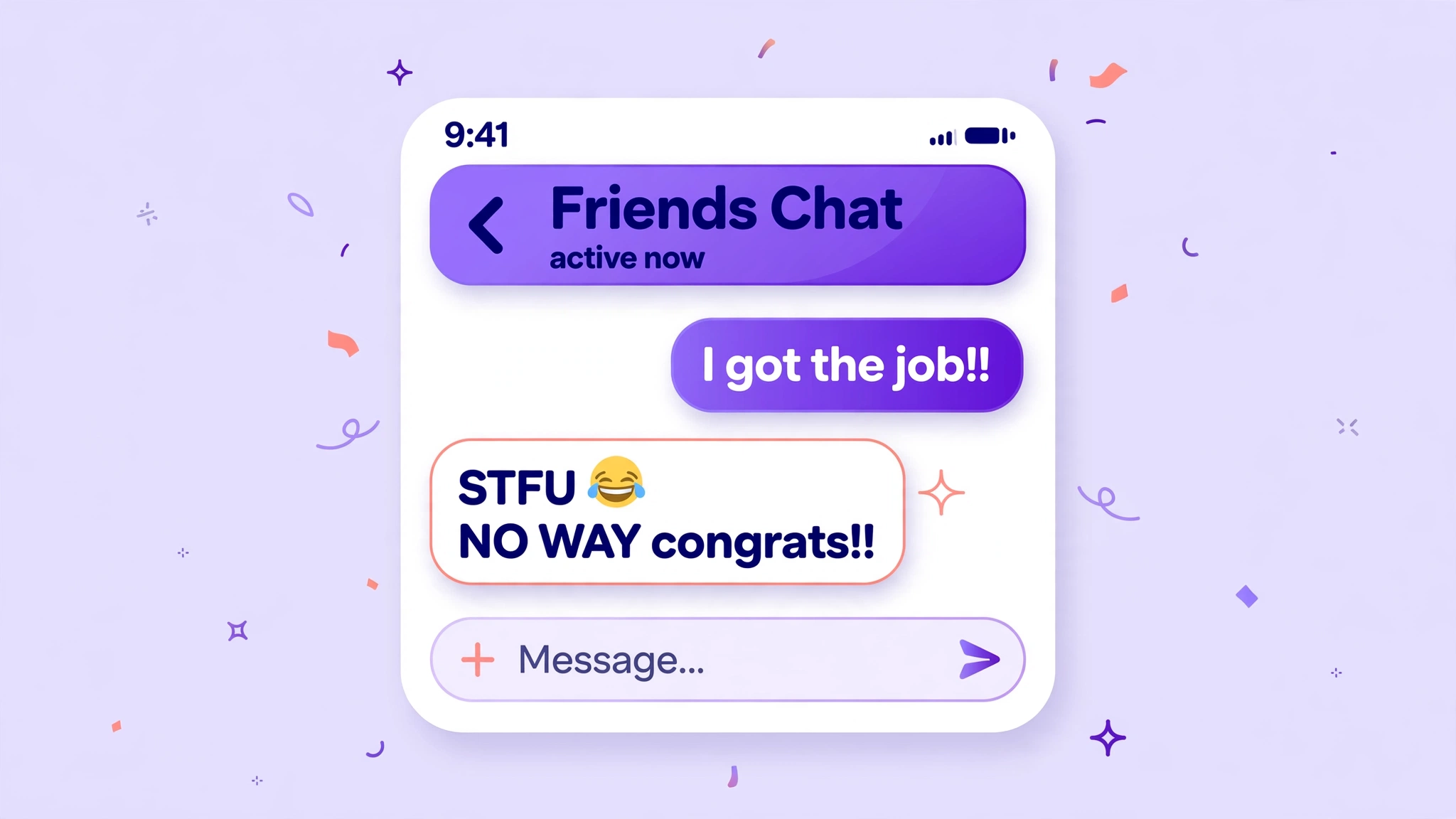
Four letters that can be the funniest thing in your group chat or the rudest thing in your inbox — sometimes in the same day. “STFU NO WAY” under good news is pure joy. “STFU.” with a period from someone you’re arguing with is a door slamming.
If you’re looking up the stfu meaning in text, here’s the honest frame: the letters stand for “shut the f*** up,” but the meaning depends entirely on tone, emoji, and relationship. This guide doesn’t just define it — it teaches you to read which version you got, how to reply to each one, and where the line sits between funny and hostile.
The Short Answer
| Question | Answer |
|---|---|
| What it stands for | “Shut the f*** up” — masked here, as it should be in polite company |
| What it does | A strong reaction: playful shock, genuine anger, or meme-style disbelief |
| The three readings | Playful (“STFU no way!”) / angry (“STFU right now.”) / meme (“STFU I’m crying”) |
| What decides | Emoji, punctuation, capitalization, and your relationship with the sender |
| Tone | Anywhere from affectionate to hostile — the delivery is everything |
| Register | Casual only — never work, school, or first conversations |
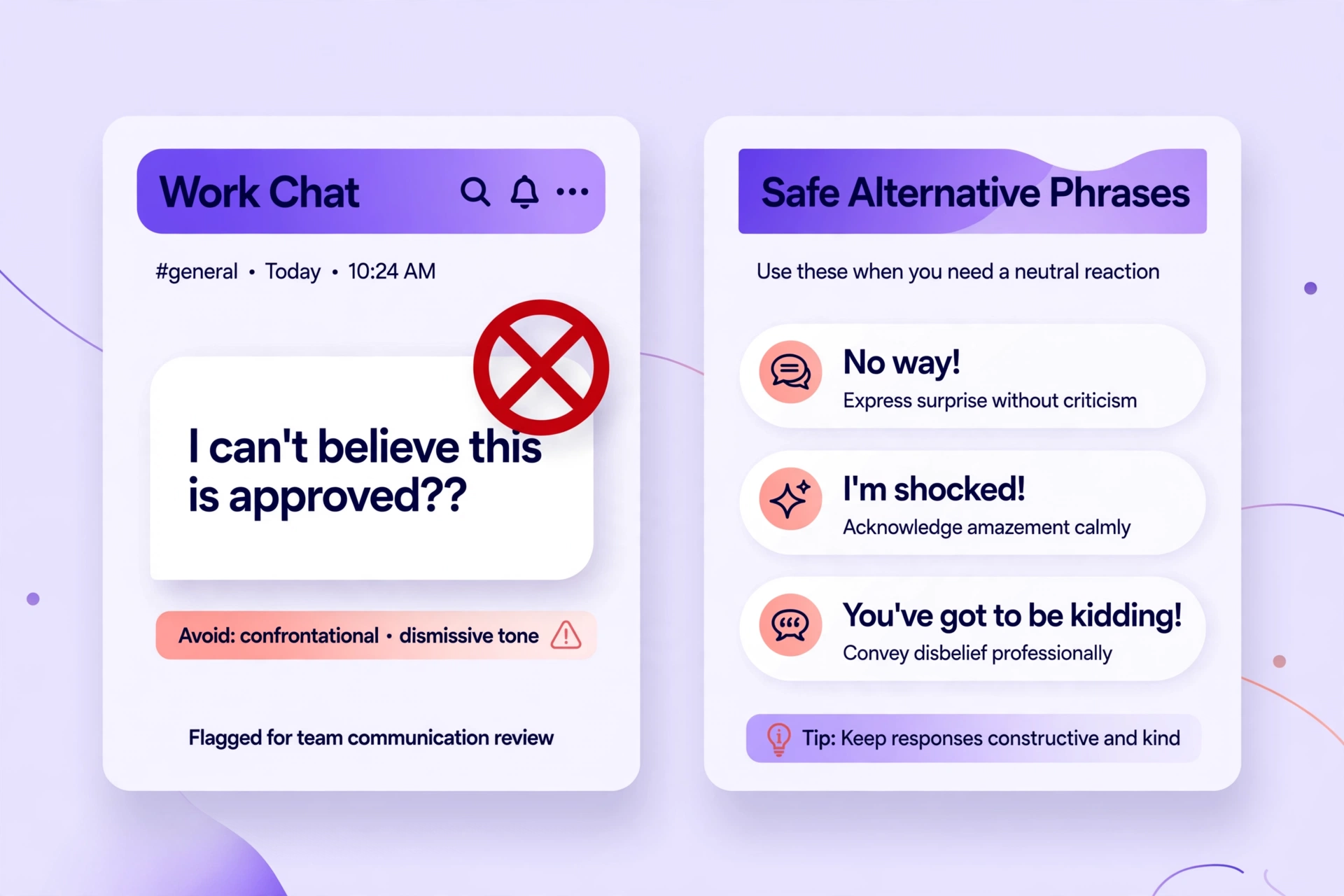
| Formal alternative | “No way!” / “I’m shocked!” / “You’ve got to be kidding!” |
The Three Readings
Forget the dictionary — STFU has three distinct personalities, and misreading which one you got is where all the trouble starts.
- Playful shock. “STFU NO WAY congrats!!” This is the dominant friendly use: disbelief as delight. It functions as an intensifier, not a command — nobody is actually being told to be quiet. The laughing emoji is the license; it converts profanity into celebration. It’s closer to “oml” (oh my lord) with profanity — pure overwhelmed delight. Between close friends, this is often affectionate — the stronger the reaction, the happier they are for you.
- Angry command. “STFU right now.” No emoji, period at the end, maybe caps. This is the literal meaning deployed at full force: genuine hostility, a conversation-ender. The period does heavy work here — “STFU” without one is ambiguous; “STFU.” is a wall. If you receive this version, the reply section below is for you.
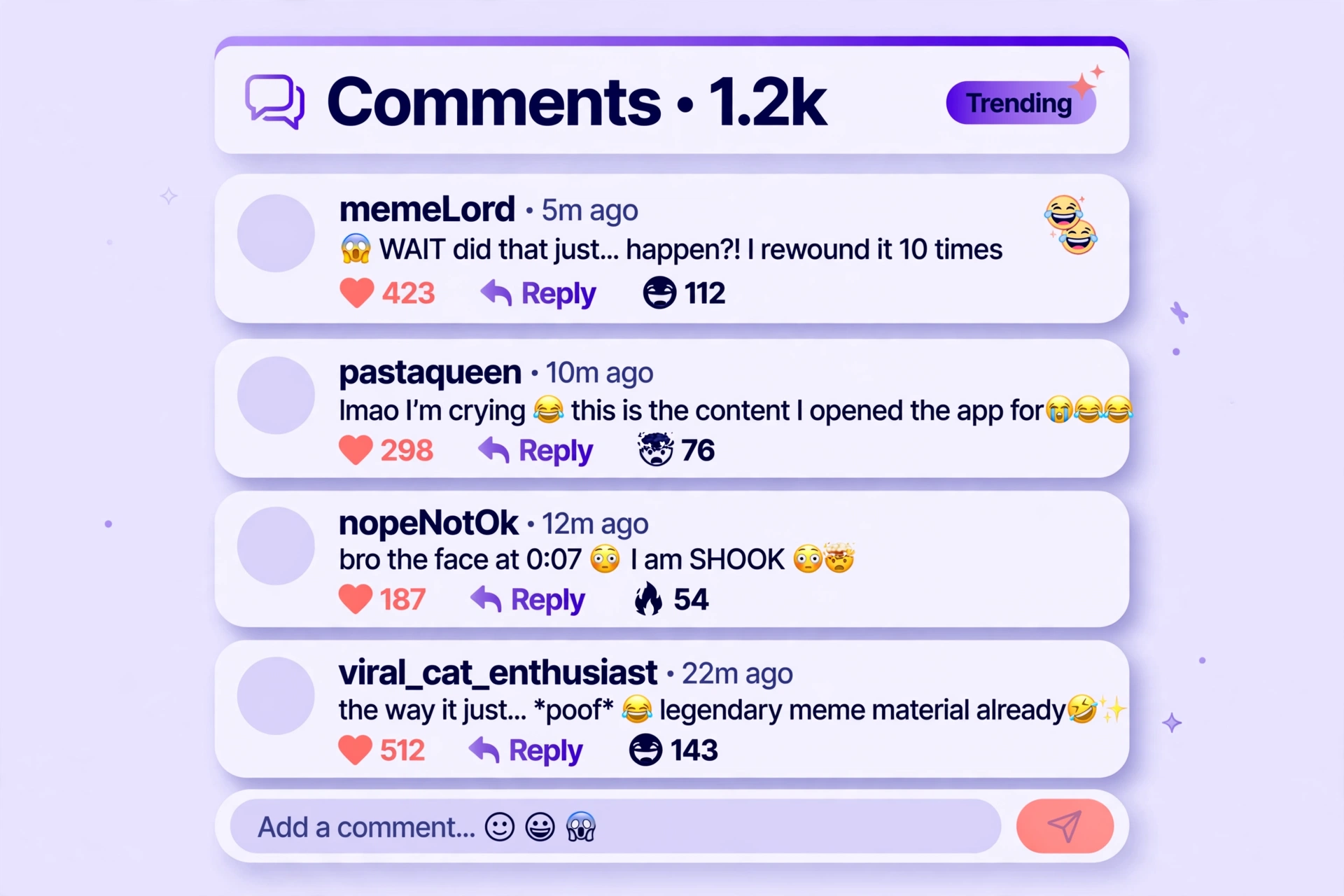
- Meme reaction. “STFU I can’t stop laughing” under a viral video. Performative, communal, low-stakes — the commenter isn’t talking to anyone in particular, they’re performing disbelief for the crowd. This is STFU as audience participation: the stronger the reaction, the funnier the video must be.
The same four letters, three different speech acts. Everything that follows is about telling them apart in under a second.
Tone Forensics: The Punctuation/Emoji/Case Decoder
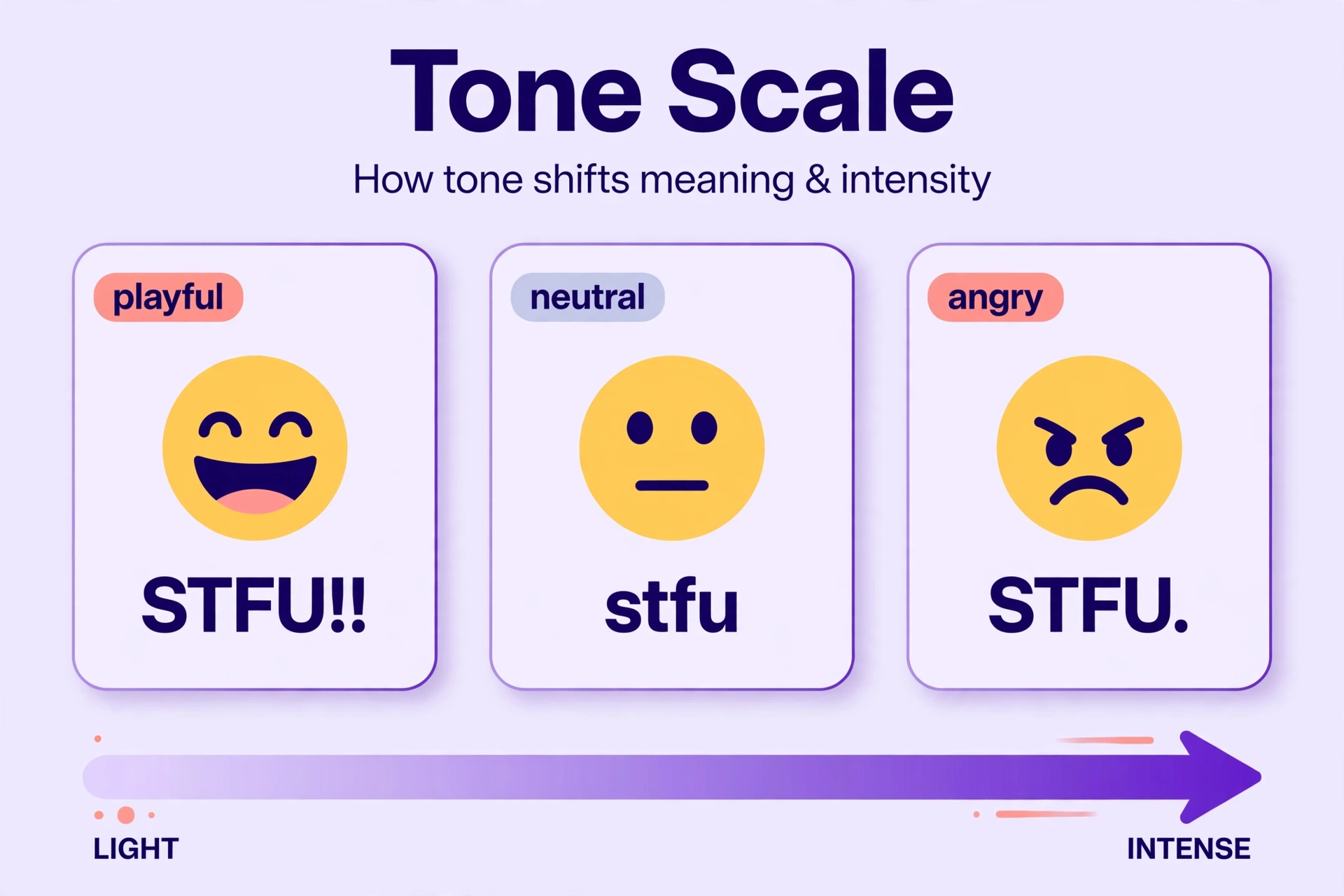
Here’s the practical skill: reading an STFU the way you’d read a face. Run through the checklist:
Case:
- Lowercase “stfu” softens everything. “stfu” is almost always playful — lowercase is the internet’s whisper, and whispers aren’t angry.
- Uppercase “STFU” amplifies. It can still be playful (“STFU”), but the volume is up.
- Uppercase + period (“STFU.”) hardens. This is the angriest common form — the period lands like a gavel.
Emoji (matters more than the letters):
- Laughing/crying-laughing — playful shock, guaranteed. Nobody pairs the crying-laughing emoji with genuine rage.
- Crying — overwhelmed (usually laughing too hard, occasionally real distress — check context).
- Skull — “I’m dead,” the meme register. Performative, not personal.
- Neutral/angry/none — the danger zone. No softener means no softening intended.
Punctuation:
- “STFU!!” — excited, usually positive. Exclamation marks are enthusiasm, even on profanity.
- “STFU.” — cold. The single most important distinction in this guide.
- “stfu lol” — the “lol” defuses it completely. This is banter, full stop. Same mechanics as “mb lol” after a typo — the laugh converts the edge into warmth.
The one-second read: emoji + exclamation = safe. No emoji + period = careful. That rule alone handles most cases.
The Reply Playbook
Knowing what it means is half the job. Knowing what to do is the other half — and the move depends on the reading:
Playful shock (“STFU NO WAY!”):
- Laugh along: “IKR” / “I KNOW RIGHT”
- Match the energy: “STFU YOURSELF” (between close friends, this is tennis, not fighting)
- Share the joy: they’re celebrating with you — let them
Angry command (“STFU right now.”):
- De-escalate, don’t mirror: “woah, what’s up?” — calm, short, no profanity back
- Don’t reply in kind. “STFU” back at an angry “STFU” is how group chats die. A silent “smh” to yourself is fine; a mirrored profanity is not
- If it’s a pattern, not a moment: that’s a relationship problem, not a slang problem. Address it directly or step back
- You are never obligated to accept being spoken to this way. Boundaries are allowed
Meme reaction (“STFU I’m crying”):
- Nothing is required. It’s a comment-section performance, not a message to you
- If it’s on your post: a like back is the complete social exchange
- Ignore-and-move-on is always fine here
When you’re not sure which one it is: default to the generous reading first, but trust a second signal. One ambiguous “stfu” is a coin flip; an ambiguous “stfu” followed by silence is telling you something. And when in doubt, the universal de-escalator works on all three: “haha what’s up?” — playful enough for the joke version, calm enough for the angry one.
The Relationship Test
The same STFU lands differently depending on who sent it. Run the test before you send one:
- Close friends: the full range is open. Playful STFU is often a love language here — the insult is in the delivery, and the delivery is fond. “Would I say this to their face while laughing?” If yes, send it.
- Acquaintances: risky. They don’t have enough data on you to know you’re joking, and text strips the grin off your voice. The playful reading needs a relationship to land in — without one, it defaults to rude.
- Strangers: hostile until proven otherwise. A “STFU” from someone you’ve never met reads as aggression wearing an emoji costume. Don’t send it; if you receive it, don’t engage.
- Group chats: know the room. What’s hilarious in your three-person inner circle can read as bullying with an audience of fifteen. The more people watching, the safer the joke needs to be.
The underlying rule: profanity is a trust exercise. Every strong word you send says I trust you to know I’m joking. Only send it where that trust exists.
A Short History
STFU is early-internet profanity — born in the IRC and forum era, when brevity was a technical constraint (slow typing, small screens) and profanity abbreviations were a minor rebellion. It mainstreamed through memes and reaction culture in the 2010s: the same decade that turned “lol” into punctuation turned “STFU” into a reaction GIF with letters. No single origin moment, no inventor — just the internet doing what it does to useful phrases: shortening them, then teaching them new tones. Keep this light; the history matters less than the handling.
The “Never” List (and What to Say Instead)
Some rooms never tolerate it, no matter the emoji. For each, the one-line upgrade:
- Work chats: never. Not even joking, not even with work friends — screenshots exist. → “No way!” / “I’m shocked!”
- Teachers, professors, parents: never. The generational gap turns playful into disrespectful instantly. → “You’ve got to be kidding!”
- Customer service: never. It’s abuse with extra steps. → “This is really frustrating, can you help?”
- First conversations: never. You haven’t earned the trust the joke requires. → “Wait, seriously?!”
- Arguments: never. It ends the conversation by detonating it — and you’ll still have the problem afterward. → “I need a minute” (then actually take one)
- Public posts from brands or professionals: never. The internet is forever and employers google.
The pattern: anywhere with a power gap, an audience, or a record — keep it out. The upgrade lines do the same emotional work without the profanity. They’re not weaker; they’re smarter.
STFD and STHU: The Relatives
Two related forms, one line each:
STFD (“shut the f*** down”) — more intense, much rarer. The nuclear option; you’ll see it in gaming trash-talk more than anywhere else. Mark it as low-frequency and high-risk.
STHU (“shut the hell up”) — the softer variant. “Hell” instead of the f-word takes it down a full grade — still rude, but the kind of rude a sitcom character can say. If you must use the family, this is the least explosive member. Must is doing heavy lifting in that sentence.
Overuse Dulls It
Worth saying plainly: STFU has a half-life. The fifth “STFU” in one conversation isn’t funny anymore — it’s filler. Profanity works as an intensifier because it’s rare; spend it on every message and it becomes punctuation. The old article gestured at this; here’s the sharp version: if everything is shocking, nothing is. Save it for the moments that deserve the volume.
STFU in Real Conversations
The exchanges below are illustrative examples, not real messages.
The good news
- Emma: “I GOT THE JOB!!!”
- Sara: “STFU NO WAY CONGRATS!!!”
Textbook playful shock. The caps are excitement, the emoji is the license, and “congrats” makes the affection explicit. This is STFU at its best.
The meme comment
- Video: a cat knocks a vase off a table in slow motion
- Comment: “stfu I’m crying”
Lowercase, skull emoji, public performance. Nobody’s angry; everybody’s laughing. No reply needed.
The argument
- Alex: “you never listen to me”
- Jordan: “STFU right now.”
No emoji, period, caps. This is the angry command — genuine hostility. The right move isn’t a clever reply; it’s “I hear you’re upset, let’s talk when we’re calm” or disengagement. (See the reply playbook.)
The lmk check
- Casey: “wait, did that actually happen??”
- Riley: “stfu lol yes”
“stfu lol” — the “lol” defuses it completely. This is banter: yes, and I can’t believe it either. The lol is doing the tonal work. (Casey’s opener had the right energy too — “wtw??” is disbelief, not accusation.)
Quick Answers
What does STFU mean in text? “Shut the f*** up” — but the meaning ranges from playful shock (“STFU no way!”) to genuine anger (“STFU right now.”) to meme reaction. Emoji, punctuation, and your relationship decide which one.
Is STFU rude? It can be — that’s the point of the tone forensics. With laughing emoji between friends, it’s affectionate. With a period from a stranger, it’s hostile. The letters don’t decide; the delivery does.
What’s the difference between “stfu” and “STFU”? Case changes the volume. Lowercase “stfu” is softer, almost always playful. Uppercase “STFU” is louder — still often joking, but with more edge. “STFU.” with a period is the coldest form.
How do I reply to STFU? Match the reading: laugh along with playful (“IKR”), de-escalate the angry (“woah, what’s up?”), ignore the meme. Never mirror an angry STFU with one of your own.
Can I use STFU at work? No. Not joking, not with work friends, not ever — screenshots exist. Use “No way!” or “I’m shocked!” instead.
What does STFU mean from a stranger? Assume hostile until proven otherwise. Don’t engage, don’t mirror it.
Is “stfu lol” friendly? Yes — the “lol” defuses it completely. “stfu lol” is banter, the textual equivalent of a playful shove.
What’s STHU? “Shut the hell up” — the softer variant. Still rude, but a full grade below STFU. The sitcom-safe member of the family.
The Short Version
STFU stands for “shut the f*** up” — but that’s the expansion, not the meaning. The meaning is three things: playful shock between friends, genuine anger with a period, and meme-reaction theater in the comments. Learn the forensics (emoji + exclamation = safe; no emoji + period = careful), run the relationship test before you send one, keep it out of work and arguments, and remember that overuse dulls the blade. Four letters, three personalities, one rule: the delivery is the message.
