
Someone just texted you “sm” and you paused for a second. Fair enough — the sm meaning in text changes with the sentence around it. In most personal chats, SM means “so much”: “I miss you sm” is simply “I miss you so much.” But those same two letters can mean “social media” in a work chat, or “send me” when someone wants a link. This guide gives you a quick test for telling them apart, with real examples and replies that fit each situation.
The Short Answer
| What you see | It usually means | Example |
|---|---|---|
| SM after a feeling or verb | So much | “I love this sm” |
| SM before a thing or file | Send me | “Sm the playlist” |
| SM as the subject of a sentence | Social media | “I’m taking a break from SM” |
| SM in a work or marketing chat | Social media | “Our SM posts need captions” |
If you only remember one thing, remember this: SM borrows its meaning from the words touching it. Read the whole sentence, not just the two letters.
The Position Test: Where SM Sits Tells You What It Means
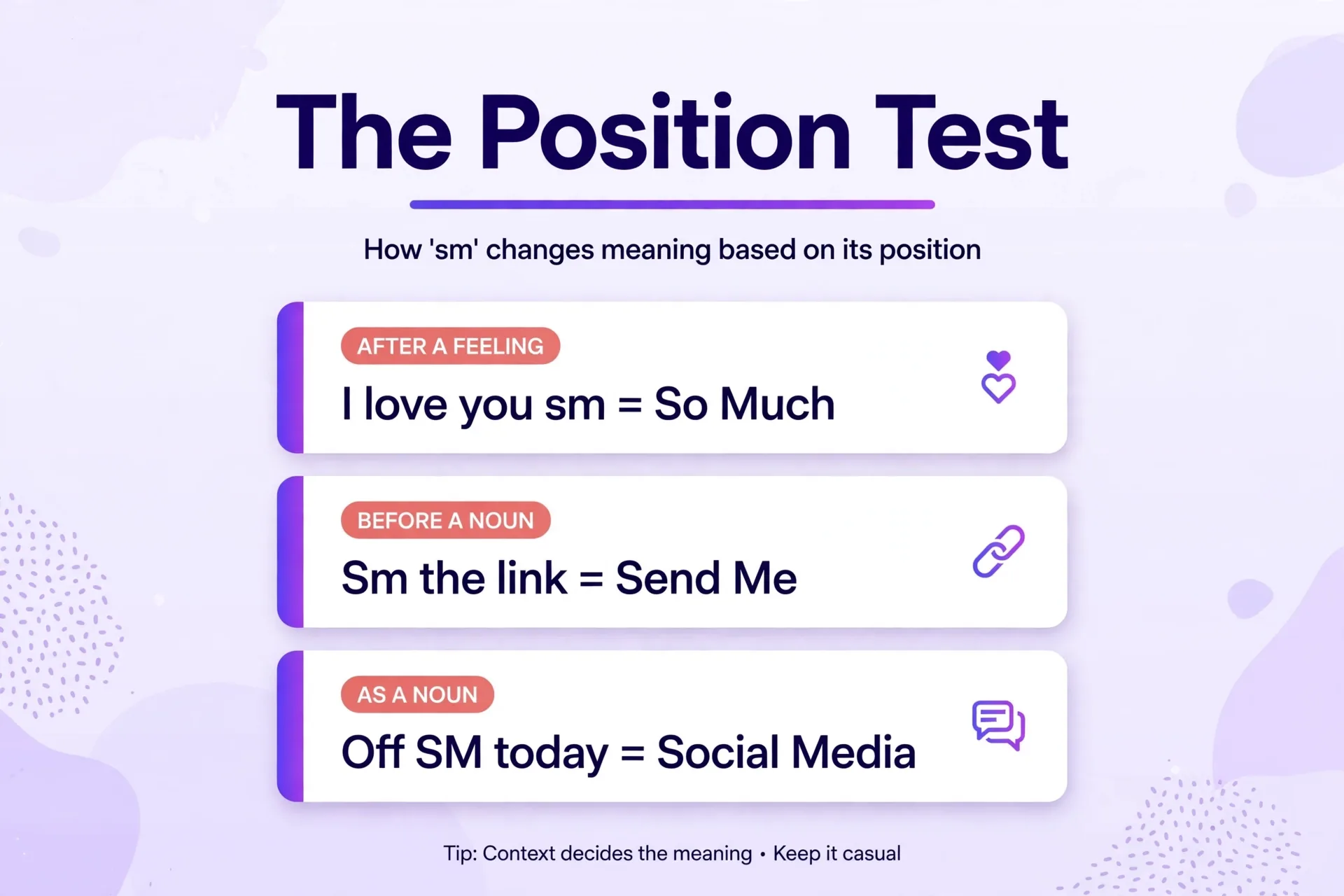
Here is the fastest way to decode SM: look at where it sits in the sentence.
After a feeling, it means “so much.” When SM follows a verb or an emotion word — love, miss, thank, hate, enjoy — it acts like a volume knob, turning the feeling up. “I appreciate you sm” means “I appreciate you so much.” “This annoys me sm” means the annoyance is strong, not mild. The feeling comes from the verb; SM only makes it bigger.
Before a noun, it usually means “send me.” When SM sits at the front of a short request and a thing follows it — a link, a photo, an address — the sender is asking you to share something. “Sm the notes when you can” means “Send me the notes when you can.”
As a noun itself, it means “social media.” When SM fills the slot where a noun belongs — the subject of a sentence, or the object of a preposition — it is talking about platforms, not feelings. “SM is exhausting lately” can only mean social media.
Try the Swap Test when you are still unsure. Replace SM with each candidate — “so much,” “social media,” “send me” — and keep the one that leaves a normal sentence behind. “Thank you sm for dinner” becomes “Thank you so much for dinner.” “Thank you social media for dinner” does not.
SM as “So Much”: The Meaning You Will See Most
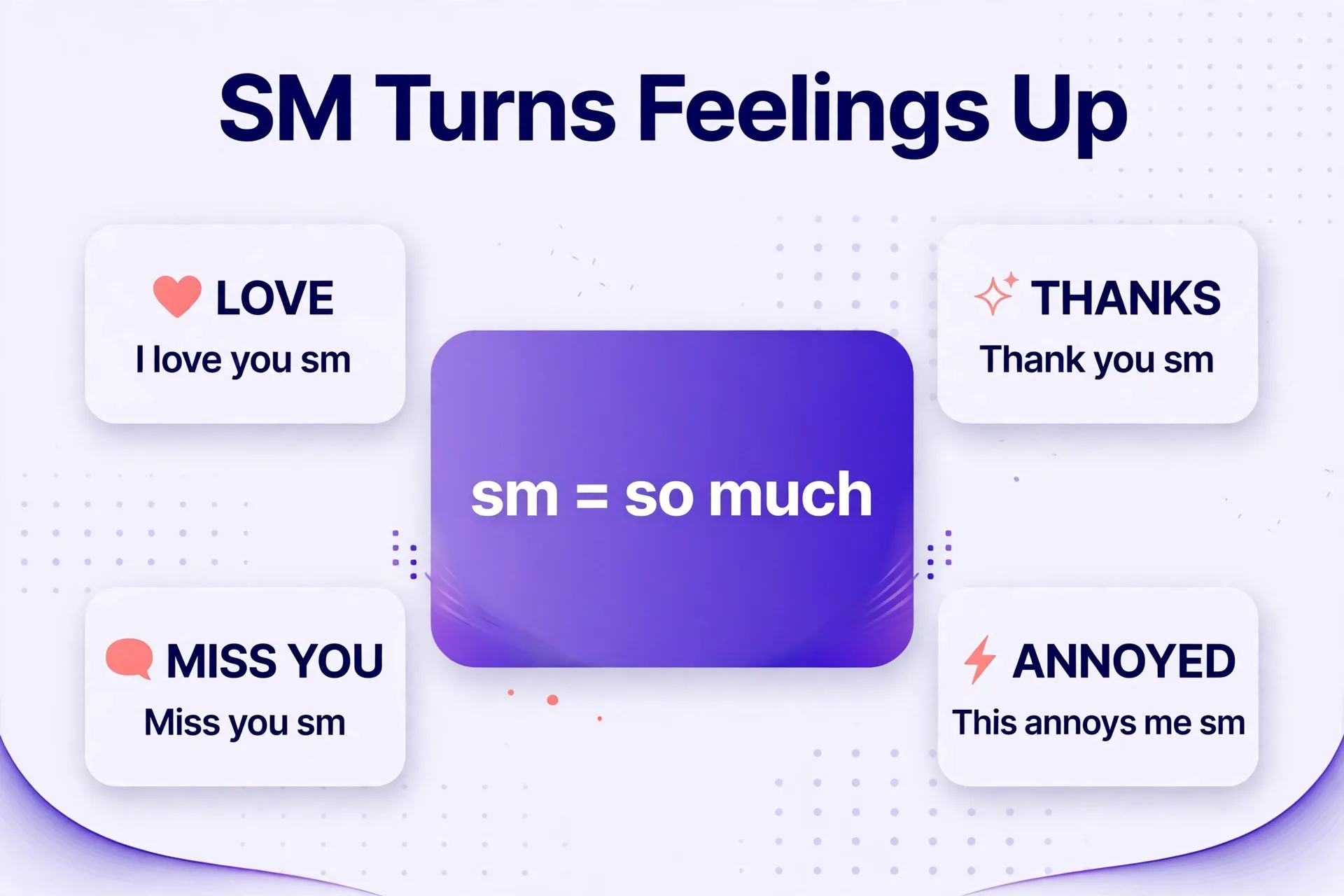
In everyday texting, SM almost always means “so much.” It compresses a familiar two-word intensifier into two letters, and it shows up wherever people express strong feelings quickly. Spelling does not change the meaning — “sm,” “SM,” and “Sm” are the same word; lowercase just reads a touch more casual.
The key thing to understand is that SM adds intensity, not emotion. It never tells you on its own whether the sender is happy, sad, grateful, or annoyed. The words before it do that work. “I love you sm” is warm because of “love.” “I hate waiting sm” is irritated because of “hate.”
That flexibility is why it fits so many moments:
- “I miss you sm.” — I miss you a lot, and I want you to know it.
- “Thank you sm for today.” — Deep, casual gratitude.
- “I’m tired sm.” — Not just tired. Really tired.
You will also see SM in longer slang chains, the way people actually type: “omg thank you sm” and “ily sm.” In “ily sm,” the two abbreviations stack into “I love you so much.”
When SM Means “Social Media”
Step out of personal texting and into a conversation about platforms, content, or marketing, and SM usually switches to “social media.” This is the established professional shorthand — Wiktionary lists it as an initialism of “social media” — and it turns up in creator chats, team messages, bios, and captions.
- “Our SM calendar is full this week.” — The social media posting calendar.
- “She runs SM for the shop.” — She handles the shop’s social media accounts.
- “I’m taking a break from SM.” — A break from social media, not from “so much.”
If the sentence is about platforms at all, “social media” is almost certainly the reading — though spelling it out is still clearer in anything formal.
When SM Means “Send Me”
The third reading is the most practical one. In quick chats, SM can be a request: “send me.” It appears at the start of a short instruction, followed by the thing being asked for.
- “Sm the link when you get it.” — Send me the link.
- “Sm that photo from last night.” — Send me that photo.
This use is less frequent than “so much,” and it only works when the sentence is clearly a request. If there is no thing being asked for, “send me” does not fit — which is exactly why the Position Test works: “send me” needs a noun after it, and “so much” needs a feeling before it.
SM on TikTok, Snapchat, and Instagram
The meaning of SM does not change from app to app — the conversation does. On all three platforms, the personal, emotional reading dominates in comments and captions. “Love this sm” and “thank you sm” appear under videos and photos the same way they appear in texts.
What changes is the mix of conversations you are likely to see. TikTok comments also carry fandom talk, where SM can refer to SM Entertainment, the K-pop company. Instagram bios and creator captions lean toward the “social media” reading when the topic is posting or accounts. Snapchat, being mostly private chats between people who know each other, leans hardest toward “so much.”
So do not memorise a meaning per app. Memorise the test: feeling before it, thing after it, or noun in its place.
Who Sent It Changes the Read
The same two letters land differently depending on who typed them. Before you settle on a meaning, weigh the sender.
A crush or partner almost always means “so much.” “I like you sm” or “miss you sm” from someone you are close to is affection turned up a notch.
A close friend is the same story with a wider range. Friends use SM for gratitude, excitement, complaints, and jokes.
A coworker or manager flips the odds. In a work chat, “Can you check the SM report?” means social media, and “talk to the SM about the budget” likely means the sales manager or senior manager. Treat any SM near words like strategy, accounts, or content as the professional reading.
A stranger or someone in a big group chat deserves a slower read. Without shared history, lean on the sentence itself. If the Swap Test gives you a clean answer, trust it. If it does not, ask.
Tone, Punctuation, and Emojis
SM has no tone of its own, so the rest of the message does the emotional work. Lowercase “sm” with no punctuation — “thanks sm” — reads relaxed and routine, the way people type when they are comfortable. Add an exclamation mark and it warms up: “love this sm!” sounds excited. Add an ellipsis and it cools down: “ok sm…” can read tired or flat, though only the wider conversation can confirm that.
Emojis sharpen the picture. A heart next to SM points to affection: “miss you sm 😭” is fond, not upset. An eye-roll emoji points the other way: “this traffic sm 🙄” is a complaint. When the words and the emoji agree, trust them together.
Other Meanings Worth Knowing
Most of the time, the three readings above cover everything you will see. A few more exist in narrower corners.
Service mark. In legal and branding writing, SM (usually written as the ℠ symbol) marks a service the way ™ marks a product.
Sales manager or senior manager. In some workplaces, SM is shorthand for a role. “The SM approved it” means a manager approved it — but only when the conversation is clearly about work.
SM Entertainment. In K-pop fan spaces, SM means the entertainment company behind groups like EXO and NCT. Outside fandom talk, this reading does not apply.
An adult-context meaning. In adult or sexuality-related discussions, SM is also used as a short form of a term for sado-mschism. This is a specialised, adult-only meaning, and it should never be assumed in ordinary conversation.
A rare “someone / something.” Very occasionally, in fast group chats, SM stands in for “someone” or “something” — “need sm to cover my shift.” Treat it as a last resort: only if neither “so much” nor “send me” fits the sentence.
SM vs. Similar Short Forms
SM is easy to confuse with lookalikes, because texting slang reuses the same letters in different combinations.
| Term | Means | How it differs from SM |
|---|---|---|
| SMH | Shaking my head | Disbelief or disappointment; SM never means this |
| TYSM | Thank you so much | Gratitude only; SM is the flexible intensifier inside it |
| TBH | To be honest | Introduces an honest opinion; SM intensifies a feeling |
| NGL | Not gonna lie | Flags honesty; SM flags intensity |
| ALR | Alright / already | Like SM, its meaning depends on position in the sentence |
| OTP | One true pairing | Fandom talk about a favourite couple; unrelated to SM |
| LOL | Laughing out loud | A reaction; SM is an intensifier, not a reaction |
How to Reply When Someone Texts You SM
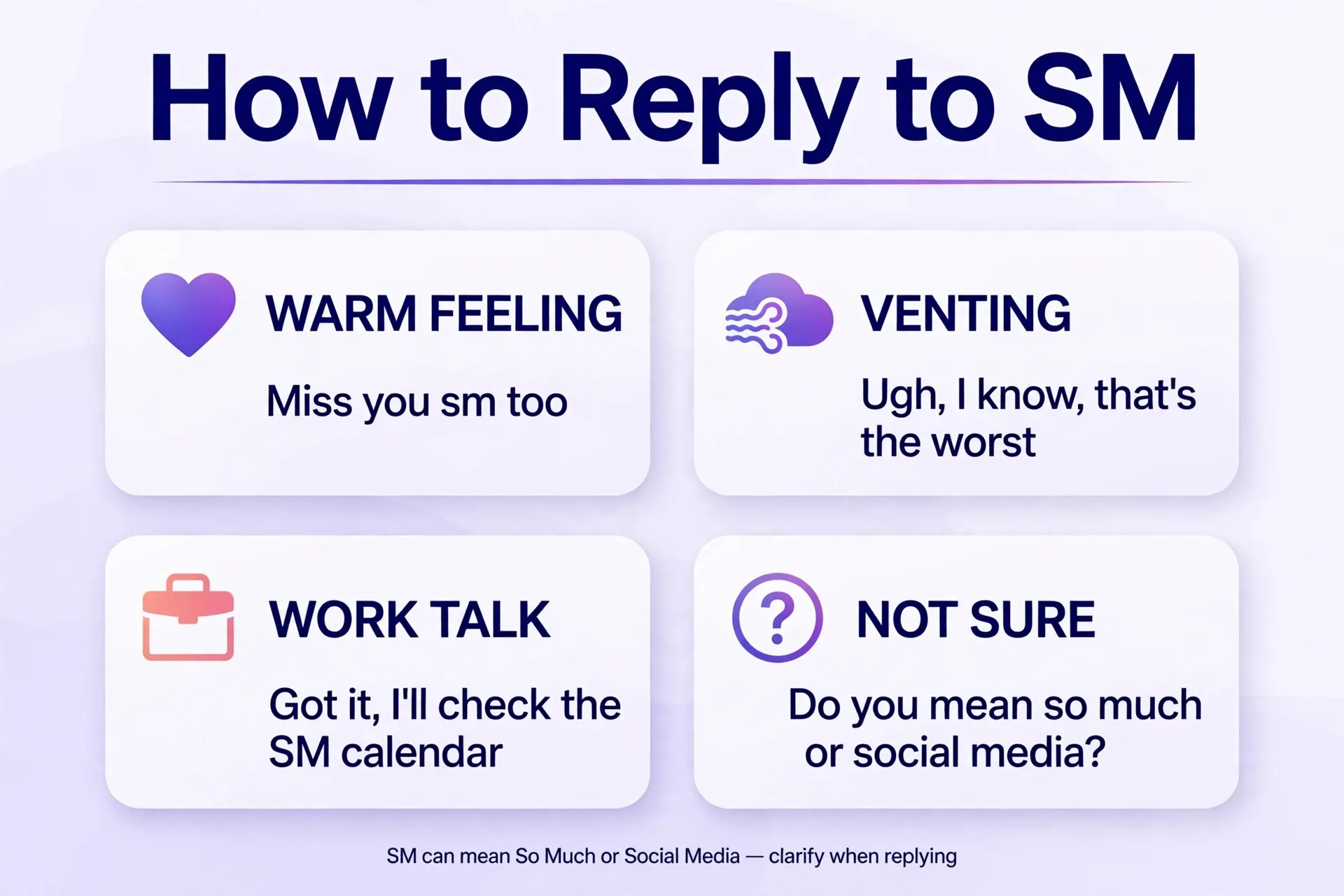
Match your reply to the meaning you just decoded, not to the letters.
They meant “so much” and the feeling is warm. Mirror it simply. “Miss you sm too,” “aww thank you sm,” or “same, love this sm” all work. Matching their energy is the whole job.
They meant “so much” and they are venting. Acknowledge the feeling before anything else. “Ugh, I know, that’s the worst” lands better than advice when someone writes “this day is dragging sm.”
They meant “social media.” Answer the actual question. “Got it, I’ll check the SM calendar” keeps the work moving.
They meant “send me.” Send the thing, or say when you will. “Sending now” or “I’ll send it after class” — short and done.
You genuinely cannot tell. Ask, plainly. “Do you mean so much or social media?” beats answering the wrong meaning. People would much rather clarify than be misunderstood.
When Not to Use SM
SM is a casual shortcut, and shortcuts have limits. Skip it in job applications, formal emails, school essays, and any message to someone who may not know texting slang. In those settings, write “so much” or “social media” in full.
Skip it, too, when the meaning could genuinely confuse the reader. If you are texting your manager “I love this project sm,” the warmth is real, but the abbreviation invites a misread. Spelling it out removes all doubt.
Quick Answers
What does SM mean in text?
In most personal chats, SM means “so much.” “I miss you sm” means “I miss you so much.” It can also mean “social media” in work or creator talk, or “send me” in a quick request — the sentence around it tells you which one applies.
What does “sm” mean on TikTok?
On TikTok it usually means “so much,” especially in comments and captions like “love this sm.” In K-pop fan discussions it can also refer to SM Entertainment, and in creator talk it can mean “social media.”
What does “sm” mean on Snapchat?
On Snapchat it almost always means “so much.” Snapchat chats are usually private messages between people who know each other, so the personal reading fits best.
What does “sm” mean on Instagram?
In Instagram comments and captions, SM usually means “so much,” as in “love this sm.” In bios or business talk about accounts and content, it more often means “social media.”
What does “ily sm” mean?
“Ily sm” means “I love you so much.” ILY is short for “I love you,” and SM adds the “so much” — the two stack into one warm, casual message used between close friends, partners, and family.
What does “thank you sm” mean?
“Thank you sm” means “thank you so much.” It is one of the most common uses of SM: warm, casual gratitude. You can reply with “of course” or “anytime.”
Is SM rude or offensive?
No, not in its usual meanings. “So much,” “social media,” and “send me” are all harmless. SM does have a separate adult-context meaning, but that reading only applies in adult discussions.
Is it okay to use SM at work?
Only when you mean “social media” or a job title like sales manager, and only in casual internal messages. The “so much” sense is informal, so in formal emails or reports, write the full words instead.
The Bottom Line
SM is small, but it does a lot of work. In a personal message it usually means “so much,” turning a feeling up a notch. In a work or creator chat it usually means “social media.” At the start of a request it can mean “send me.” The Position Test — feeling before it, thing after it, noun in its place — sorts them out in seconds, and the Swap Test settles the rest.
