
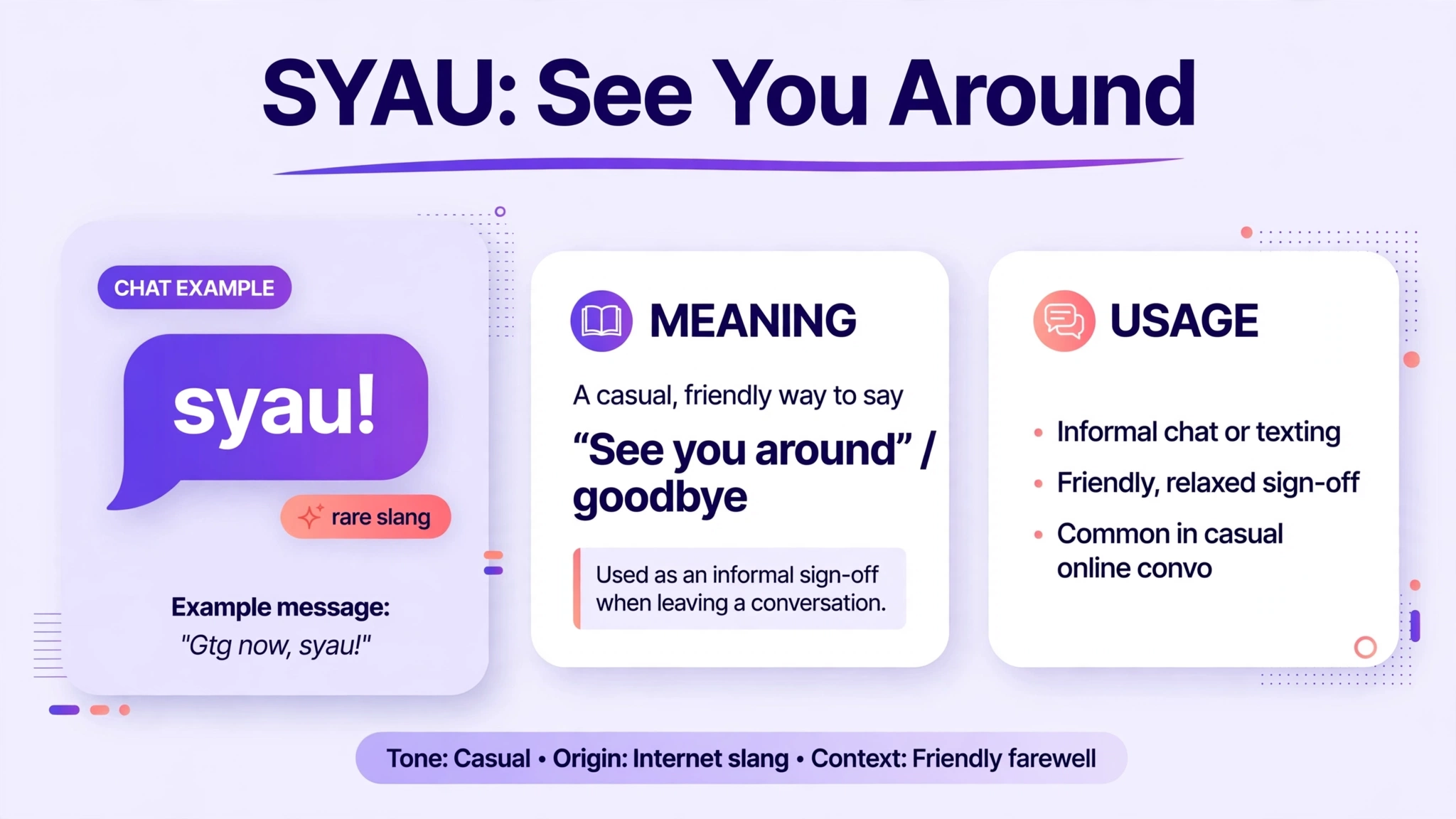
You’ve probably never received this text. Most people haven’t — and that’s the most interesting thing about it. SYAU means “see you around”: a casual, noncommittal goodbye. It’s real slang, but it’s rare slang, the kind that lives in small corners of Gen-Z texting rather than in everyone’s vocabulary.
If you’re looking up the syau meaning in text, you likely just joined a small club — someone sent you four letters you didn’t recognize, and now you’re here. This guide covers what SYAU means, why it’s rare, the “vibe” reading that separates it from a plain “cya,” the elongated “syauuu,” the myths worth busting, and where it sits in the goodbye vocabulary.
The Short Answer
| Question | Answer |
|---|---|
| What it means | “See you around” — a casual, open-ended goodbye |
| What it does | Ends a conversation warmly without scheduling the next one |
| Tone | Casual, breezy, slightly playful; the vibe matters more than the letters |
| Where it sits | End of a chat, usually standalone (“syau!”) |
| Register | Casual only — Gen-Z texting, TikTok/Instagram/Snapchat |
| Formal alternative | “See you later” or “talk soon” spelled out |
The Honest Truth: SYAU Is Rare
Let’s start where competitors won’t: SYAU is not mainstream slang. There’s no dictionary entry. Your parents haven’t heard of it. Most of your friends haven’t either. It lives in a niche — Gen-Z and Gen-Alpha texting, TikTok comments, Snapchat streaks — and even there, it’s uncommon.
Why so rare? Because it’s competing with goodbyes that are shorter, warmer, or both:
- “bye” — two fewer letters, universally understood.
- “cya” — same idea, one fewer letter, decades of history.
- ttyl — warmer, promises a next conversation.
- “peace” / “laterrr” — more personality per keystroke.
SYAU survives not by being efficient but by being flavored. It’s the goodbye with a vibe — and that vibe is the whole reason to learn it.
So if you got a “syau” text: you’re in a small club. The sender either runs in niche internet circles or likes the way it sounds. Either way, now you know something most people don’t.
The Vibe Reading: SYAU vs CYA
Here’s the genuinely useful distinction, and the one competitors only touch lightly. “Cya” (see ya) and “syau” (see you around) look like synonyms. They’re not — they carry different energy:
“Cya” is practical. It’s a wave: I’m leaving, bye. Short, clean, done. It works everywhere and promises nothing.
“Syau” is atmospheric. It doesn’t just end the conversation — it colors it. “See you around” implies the world is small and you’ll cross paths again, maybe at the next party, maybe in the comments, maybe nowhere specific. It’s the goodbye equivalent of a lingering smile versus a quick wave.
That difference is why the reply matters. “Cya” gets “cya!” back — symmetrical, done. “Syau” invites a warmer return: “syau too!”, “later 😎”, something with a little flavor of its own. Mirror the vibe, not just the letters.
“Syauuu”: The Elongation
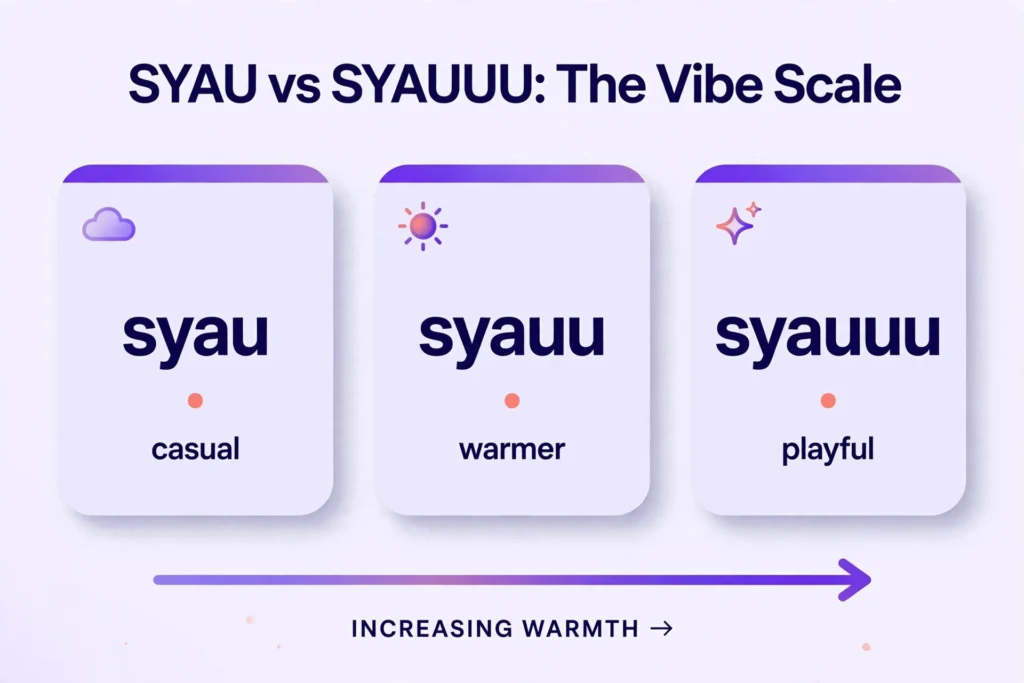
Like a lot of Gen-Z slang, SYAU stretches. “Syauuu” — with the extra vowels — is the affectionate/teasing version:
- “syau” — the standard. Casual, breezy.
- “syauu” — a little warmer. The extra letter is a small smile.
- “syauuu” — playful, teasing, sometimes flirty. The elongation does emotional work: I’m not just leaving, I’m leaving cutely.
This is the same mechanics as “heyyy” versus “hey” or “byeee” versus “bye” — vowel-stretching as tone control. If someone sends you “syauuu,” they’re not just saying goodbye; they’re performing the goodbye. Read it as warmth, and reply in kind (“syauuu 👋”).
Myth-Busting: What SYAU Is Not
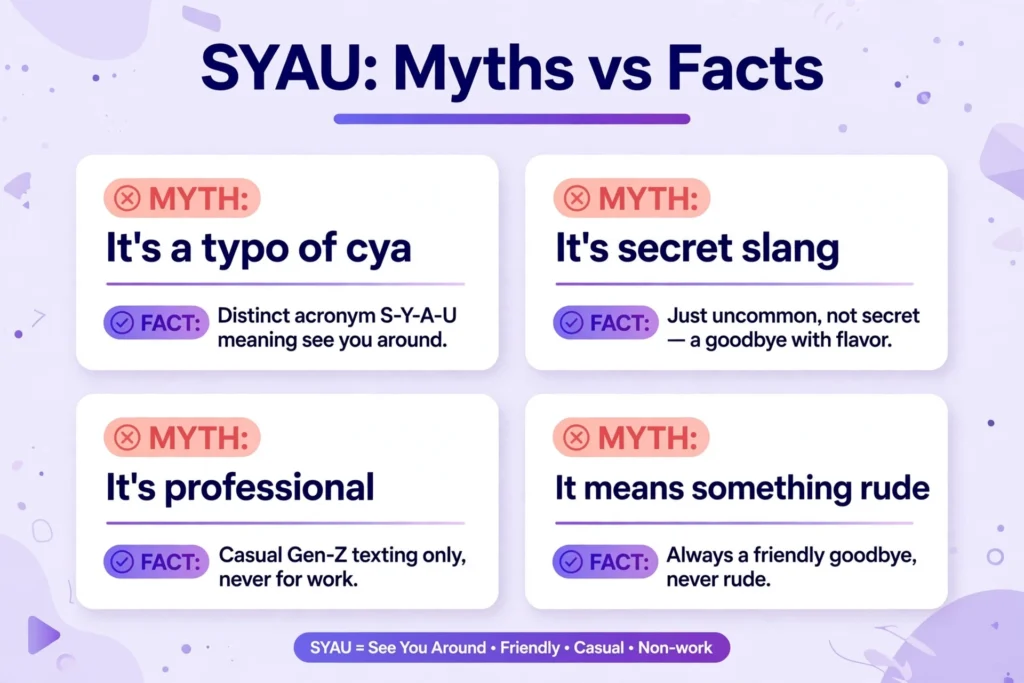
A short myth/fact block, because niche slang attracts bad information:
Myth: “It’s a typo of cya.”
Fact: It’s a distinct (if rare) acronym. The letters are deliberate — S-Y-A-U, “see you around.” Typos don’t get consistent four-letter spellings across platforms.
Myth: “It’s deep secret slang.”
Fact: It’s just uncommon, not secret. There’s no hidden meaning, no in-group test. It’s a goodbye with flavor, not a code.
Myth: “It’s professional.”
Fact: Never use it at work, in emails, or with anyone who didn’t text you first in slang. “See you later” exists for a reason.
Myth: “It means ‘shut you up’ or something rude.”
Fact: No. One junk source conflates it with SYBAU (a different, ruder acronym). SYAU is and has always been a goodbye. Don’t let a garbled source ruin a pleasant word. (For the record, oml — “oh my lord” — is the expressive reaction people reach for when they’re actually surprised; SYAU was never in that family.)
The Goodbye Ladder: Where SYAU Sits
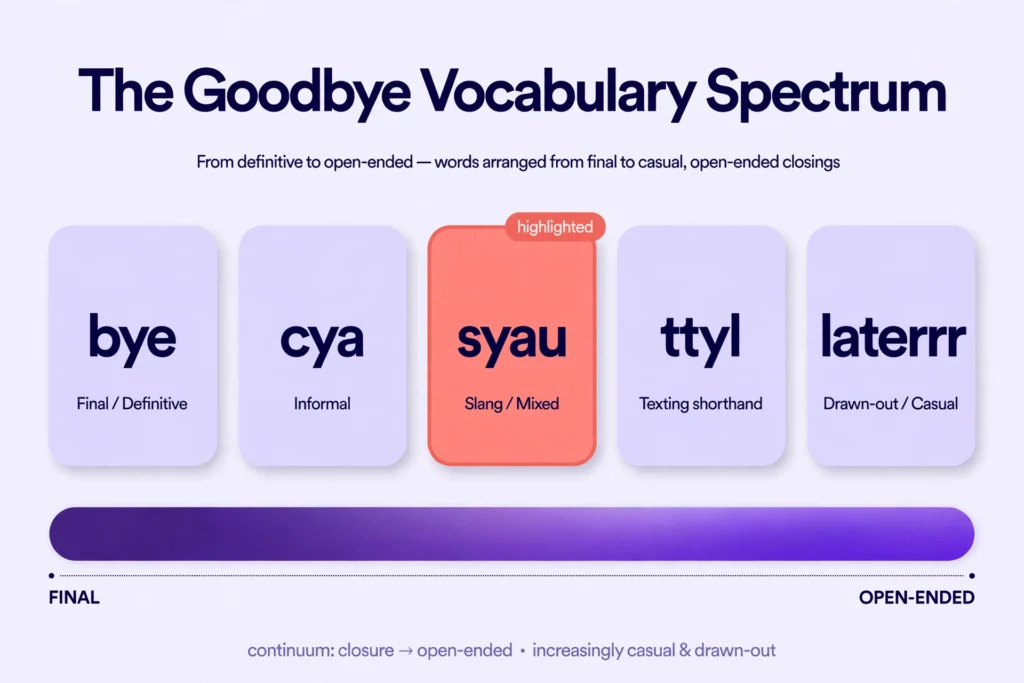
Every goodbye signals two things: how final is this? and how warm is this? Here’s where SYAU lands:
“bye” — final, neutral. The conversation is over. (Most final, least warm.)
“cya” — casual, neutral-warm. A wave, no promises.
“syau” — casual, warm-atmospheric. We’ll cross paths. Open-ended by design.
ttyl — warm, promissory. We will talk again. The most relationship-affirming of the bunch.
“laterrr” — playful, warm. The elongation is doing the same work as “syauuu.”
“peace” — cool, detached-warm. A nod rather than a wave.
SYAU’s niche is the open-ended warmth slot: warmer than “cya,” less committal than “ttyl.” It’s for conversations that might continue — at a party, in the comments, in the group chat — but nobody’s scheduling it.
Worth noting: the ladder isn’t just about the words, it’s about who you’re performing for. “Bye” works with anyone. “Syau” works best with people who’ll get it — fellow niche-slang users, Gen-Z friends, the group chat that trades rare acronyms like baseball cards. Using it with someone outside that circle doesn’t make you cool; it makes you confusing. The rarest slang is only fun when the audience is in on it. That’s the paradox of SYAU: its value comes from its obscurity, but its obscurity limits where you can use it.
The Casual-Distancing Use
One honest note from the competitor research (meanzspot): SYAU sometimes does quiet work as a soft distancing signal. “Syau” after a conversation that’s cooling — not a fight, just fading — can mean I’m not chasing this. It’s the goodbye version of leaving someone on read: polite, deniable, but noticeable.
This isn’t the primary meaning — most “syau” texts are just friendly goodbyes. But if the conversation was already thinning and the goodbye feels perfunctory, read the pattern, not just the letters. The acronym didn’t create the distance; it’s just narrating it.
SYAU in Real Conversations
The exchanges below are illustrative examples, not real messages.
The standard goodbye
- Mia: “this was fun, we should hang again soon”
- Zoe: “yes!! syau 👋”
Warm, open-ended, no specific plans. The “we should hang again” gets a vibe-match, not a calendar invite.
The elongated version
- Alex: “ok I’m heading out, syauuu”
- Riley: “syauuu, have fun!”
Both stretched, both playful. The conversation ends on a shared joke of a goodbye.
The comment-section use
- Post: group photo from the weekend
- Comment: “syauuu 😭”
Not really a goodbye — it’s a vibe comment. I was there in spirit. The elongation marks it as affectionate, not literal.
The distancing (read carefully)
- Sam: “hey, are we still on for Saturday?”
- Jordan: “not sure yet”
- Sam: “ok lmk”
- Jordan: “syau”
Short, flat, no emoji, no elongation. In context — the dodged plan, the “not sure yet” — the “syau” reads as a soft close. Not rude, but not warm either. (If Jordan had wanted to keep it warm: “syau! lmk about Saturday 👍”.)
The group-chat exit
- Alex: “alright, I’m out — syau everyone!”
- Group: “syau!” / “later!” / “byee”
In a group chat, “syau” works as a broadcast goodbye — one message, whole room. The replies scatter across the goodbye vocabulary, which tells you everything about how interchangeable these are in practice. (For the group-chat regular who always leaves first, brb is the more common move — “brb” promises a return; “syau” doesn’t.)
How to Reply to SYAU
- Standard: “syau!” or “syau too!” — mirror the vibe.
- Warmer: “later 😎” or “byeee 👋” — match the energy with your own flavor.
- To “syauuu”: elongate back. “syauuu 👋” keeps the playfulness alive.
- If it felt distant: don’t chase the acronym — address the conversation. “Sounds good!” is enough; if the pattern continues, that’s a relationship question, not a slang question.
- If they might have meant “see ya”: it doesn’t matter — the reply is the same. (And if you’re ever unsure where someone is when they text it, wya is the natural follow-up.)
- Never: reply with confusion (“what does that mean??”) — you’ve read this guide, you’re in the club now.
And if the goodbye felt abrupt rather than breezy — if “syau” landed more like a door closing than a wave — check whether the conversation needed a warmer exit. A quick mb (“my bad, gtg!”) on your own abrupt exit costs nothing and keeps things smooth.
Quick Answers
What does SYAU mean in text?
“See you around” — a casual, open-ended goodbye. It’s real but uncommon slang, mostly Gen-Z.
Is SYAU common?
No — and that’s the honest answer. It’s niche slang without a dictionary entry. If you received it, you’re in a small club.
What’s the difference between SYAU and CYA?
Vibe. “Cya” is a practical wave; “syau” is atmospheric — it implies you’ll cross paths again, with warmth. “Cya” ends things; “syau” leaves them open.
What does “syauuu” mean?
The elongated, playful version — warmer, sometimes teasing or flirty. Like “heyyy” versus “hey,” the extra vowels do emotional work.
Is SYAU a typo?
No. It’s a distinct (if rare) acronym: S-Y-A-U, “see you around.” Consistent spelling across platforms.
Can I use SYAU at work?
No. It’s casual Gen-Z slang. “See you later” is the professional version.
How do I reply to “syau”?
“Syau!” or “syau too!” — mirror the vibe. To “syauuu,” elongate back.
Does SYAU mean the conversation is over?
The immediate chat, yes — but “around” implies you might pick it up later. It’s less final than “bye.”
The Short Version
SYAU is “see you around” — a real but rare goodbye from niche Gen-Z texting. It’s not mainstream, and that’s the point: it’s the goodbye with a vibe, warmer and more open-ended than “cya,” less committal than “ttyl.” Learn the elongation (“syauuu” = playful), bust the myths (not a typo, not secret, not rude), and reply by mirroring the energy. Welcome to the small club.
