
Every Thursday, social media fills up with old photos, baby pictures, and grainy vacation shots — all tagged with three letters. If you've ever wondered what everyone's doing, here's the answer: the tbt meaning in text is "Throwback Thursday."
TBT stands for "Throwback Thursday." It's a weekly social media tradition where people share old photos, memories, or nostalgic content on Thursdays, usually with the #TBT hashtag. Think of it as the internet's designated nostalgia day.
What Does TBT Mean?
TBT means "Throwback Thursday." The formula is simple: old content + Thursday + the #TBT tag = a throwback post. Wiktionary lists TBT as an initialism of "Throwback Thursday," and it's one of the longest-running hashtag traditions on social media — the trend traces back to 2006, went mainstream on Instagram around 2011–2012, and never really left.
In action:
Maya's caption: "TBT to my college graduation — can't believe it's been 5 years 🎓 #TBT"
Dev's story: [photo of a 2015 road trip] "throwback to the best summer ever #tbt"
Group chat: [sends an old photo] "TBT lol, look at us"
Notice that TBT does two jobs at once: it labels the content as old ("throwback") and labels the day as Thursday ("Thursday"). That double meaning is the whole point — posting an old photo on a Thursday with #TBT says "I know this is old, and I'm sharing it because the memory still hits."
A note on the looser readings: you'll sometimes see TBT used to mean just "throwback" (no Thursday involved) or "throwback to" ("tbt to summer '19"). That's real usage — the Thursday requirement has eroded over the years — but the canonical meaning, and the one that ranks, is "Throwback Thursday." The adverb reading "truth be told" exists in dictionaries but has no real traction in texting; treat it as trivia, not a meaning.
The Nostalgia Filter: TBT's One Job
Here's the reader test — the Nostalgia Filter. TBT works when three conditions are all true:
- The content is old. A photo, memory, or clip from the past — not from this morning.
- It's Thursday (or close enough that nobody minds).
- The nostalgia is intentional. You're sharing it because it's old, not by accident.
Run any #TBT through the filter:
- Old graduation photo + posted Thursday + "can't believe it's been 5 years" → passes. Classic TBT.
- Photo from last weekend + posted Thursday + #TBT → fails condition 1. That's just a late post, not a throwback.
- Baby photo + posted Monday + #TBT → fails condition 2. The content qualifies; the day doesn't. (Save it for Thursday.)
- Old photo + posted Thursday + no nostalgic framing → fails condition 3. Without the "remember when" energy, it's just an old photo.
The filter explains why TBT posts feel different from regular posts: they're curated nostalgia. The poster dug through the archives on purpose. That intentionality is what the audience responds to — everyone loves a well-chosen time capsule.
The Thursday Rule (and When to Break It)
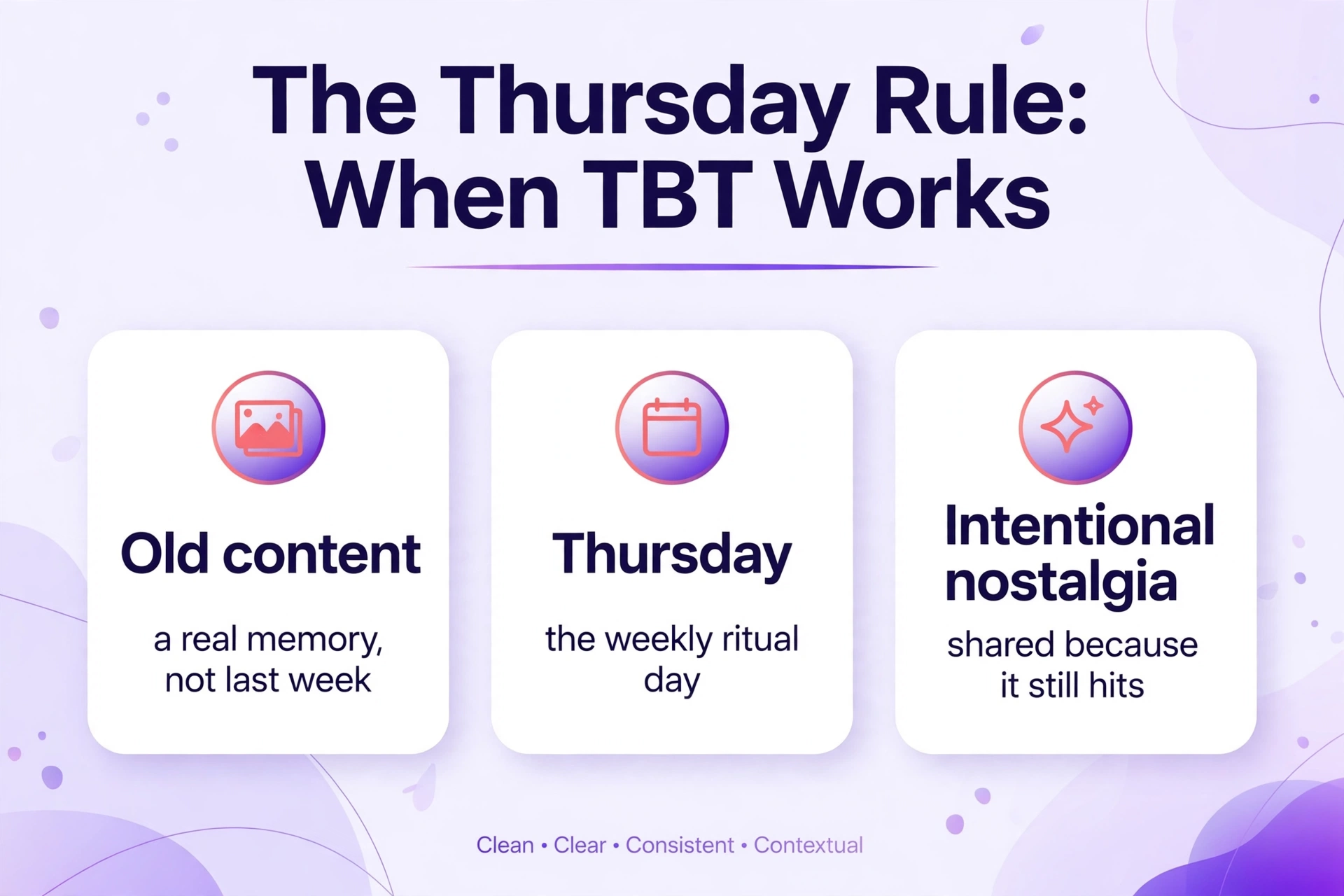
The Thursday in "Throwback Thursday" is doing real work — it's what makes TBT a tradition rather than just a label. Posting old content specifically on Thursdays created a weekly ritual: every Thursday, feeds fill with memories, and everyone knows why.
The rule: post throwbacks on Thursday, tagged #TBT (or #ThrowbackThursday).
The erosion: over the years, people started using TBT loosely — posting throwbacks on other days, or using "tbt" to mean just "throwback" regardless of the day. Related tags filled the gaps: #FlashbackFriday for Fridays, #WayBackWednesday for Wednesdays, #MondayMemories for Mondays.
When breaking the rule is fine: if the content is genuinely nostalgic and the framing is clear ("tbt to the best summer ever"), most audiences forgive a non-Thursday post. The nostalgia matters more than the calendar.
When it isn't: forcing TBT onto content that isn't really a throwback — a photo from yesterday tagged #TBT "for the aesthetic" — reads as try-hard. The Nostalgia Filter catches this: if condition 1 fails, no hashtag saves it. And brands take note: audiences can smell a manufactured #TBT from a mile away. Only post one if the memory is real.
Where You'll See TBT: Instagram, TikTok, Facebook, and Beyond
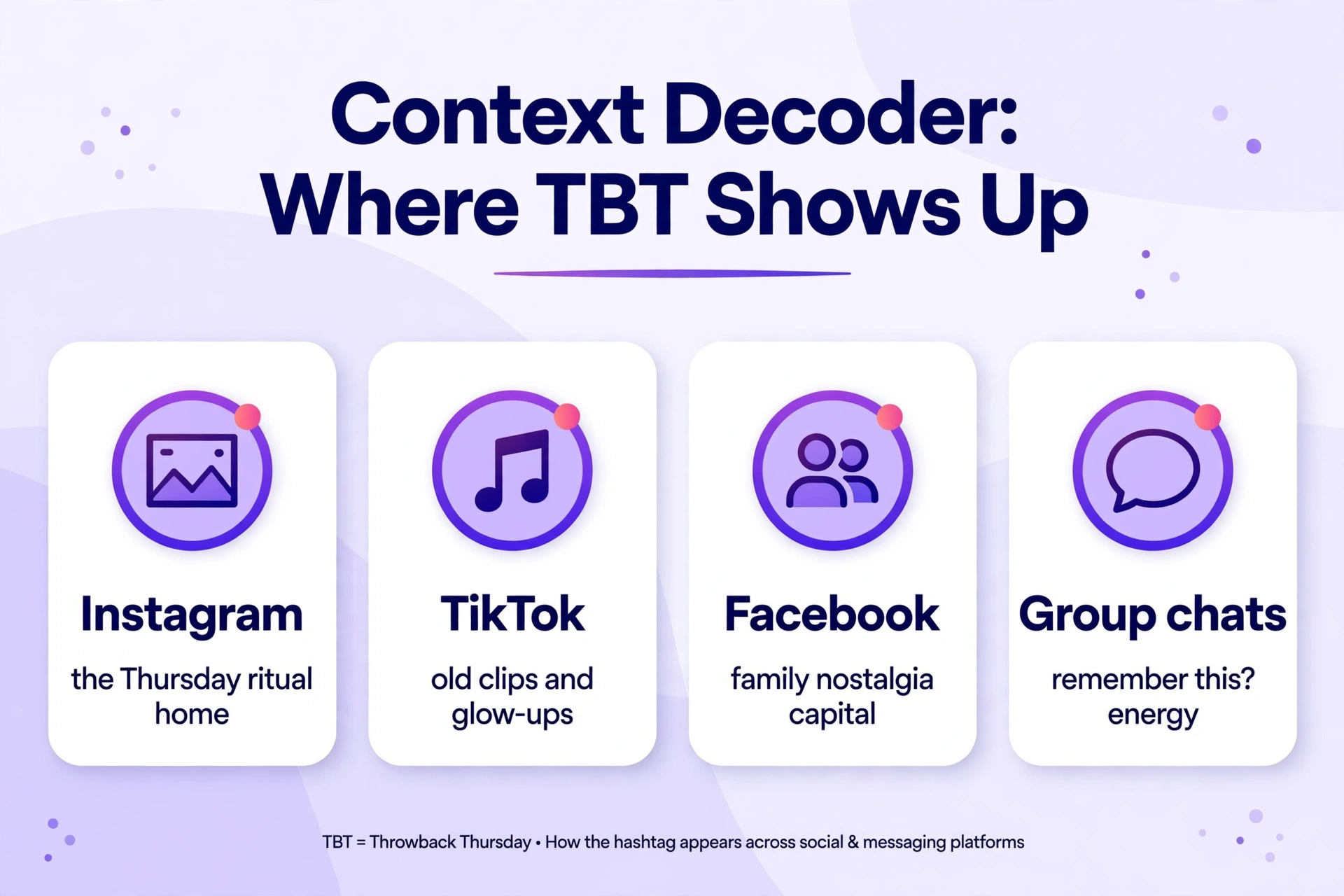
TBT is a social abbreviation — it lives in posts and captions far more than in private texts:
Instagram. TBT's home turf. Feed posts, stories, and reels all host throwbacks: old travel photos, childhood pics, glow-up comparisons. Instagram is where the Thursday ritual is strongest — the algorithm and the audience both expect it.
Facebook. The nostalgia capital. Facebook's "memories" feature basically manufactures TBT content daily, and users re-share old posts with #TBT tags. Family throwbacks and milestone anniversaries do especially well here.
TikTok. "POV: it's TBT and I'm posting the video that started it all." TikTok throwbacks skew toward old clips, trends, and glow-ups. The format is video-first, but the Nostalgia Filter still applies.
X (Twitter). "#TBT to when this was the biggest song in the world." X throwbacks are often cultural rather than personal — old memes, historic moments, anniversary posts.
Texting and group chats. TBT shows up here too, but informally: someone drops an old photo in the group chat with "TBT lol." No hashtag needed — the context does the work. In private chats, TBT is closer to "remember this?" than to the hashtag tradition.
Snapchat. Throwback snaps and story reposts: "tbt to this day 🥺." Snapchat's ephemeral nature makes throwbacks feel more special — a memory that vanishes twice.
TBT Tone: Warm, Playful, Sometimes Bittersweet
TBT's default tone is warm nostalgia — fondness for the past, shared openly. But nostalgia has shades:
Joyful TBT celebrates: "TBT to the best day ever 🎉" Graduations, weddings, trips, achievements. The past is a highlight reel, and everyone's invited to enjoy it.
Playful TBT roasts (lovingly): "TBT to when we thought this haircut was cool 😅" Self-aware, funny, endearing. The poster is in on the joke — that's what makes it charming instead of cringe.
Bittersweet TBT mourns gently: "TBT to grandma's kitchen 🤍" Old photos of people and places that are gone. These hit hard precisely because the nostalgia is real. Respond with care, not jokes.
Flex TBT humble-brags: "TBT to when I was in shape 💪" The nostalgia is real, but so is the subtext. Everyone sees through it; most people let it slide.
Cringe TBT misses: a forced throwback with no real memory behind it, or a #TBT on content from last week. The Nostalgia Filter exists to prevent exactly this.
The emoji grammar: 🎓✈️🎉 signal joyful; 😅🤣 signal playful; 🤍🕊️ signal bittersweet. Match your response to the tone the poster chose.
Sender Context: Who's Throwing Back
From a friend, a TBT is an invitation to reminisce: "TBT to our road trip!!" The correct response is a memory of your own, not just a like. "I still think about that diner 😭" beats "haha nice."
From a crush, a TBT can be strategic: posting a great old photo where they looked amazing is a time-honored move. "TBT 📸" with a fire photo isn't really about nostalgia — it's about being seen. A genuine compliment works; don't overthink it.
From family, TBTs are usually heartfelt: mom's "TBT to my babies 🥺" wants warmth back. "Love this!!" suffices — the bar is affection, not wit.
From a brand, TBT is marketing: "TBT to our first store opening!" It's fine when the history is real; it's noise when it's manufactured. Audiences reward authenticity and punish the opposite.
From an ex, a TBT is… complicated. "TBT to better days" aimed at an audience of one is a message disguised as a post. Read carefully, respond only if you want to re-open that door.
How to Post a Great TBT
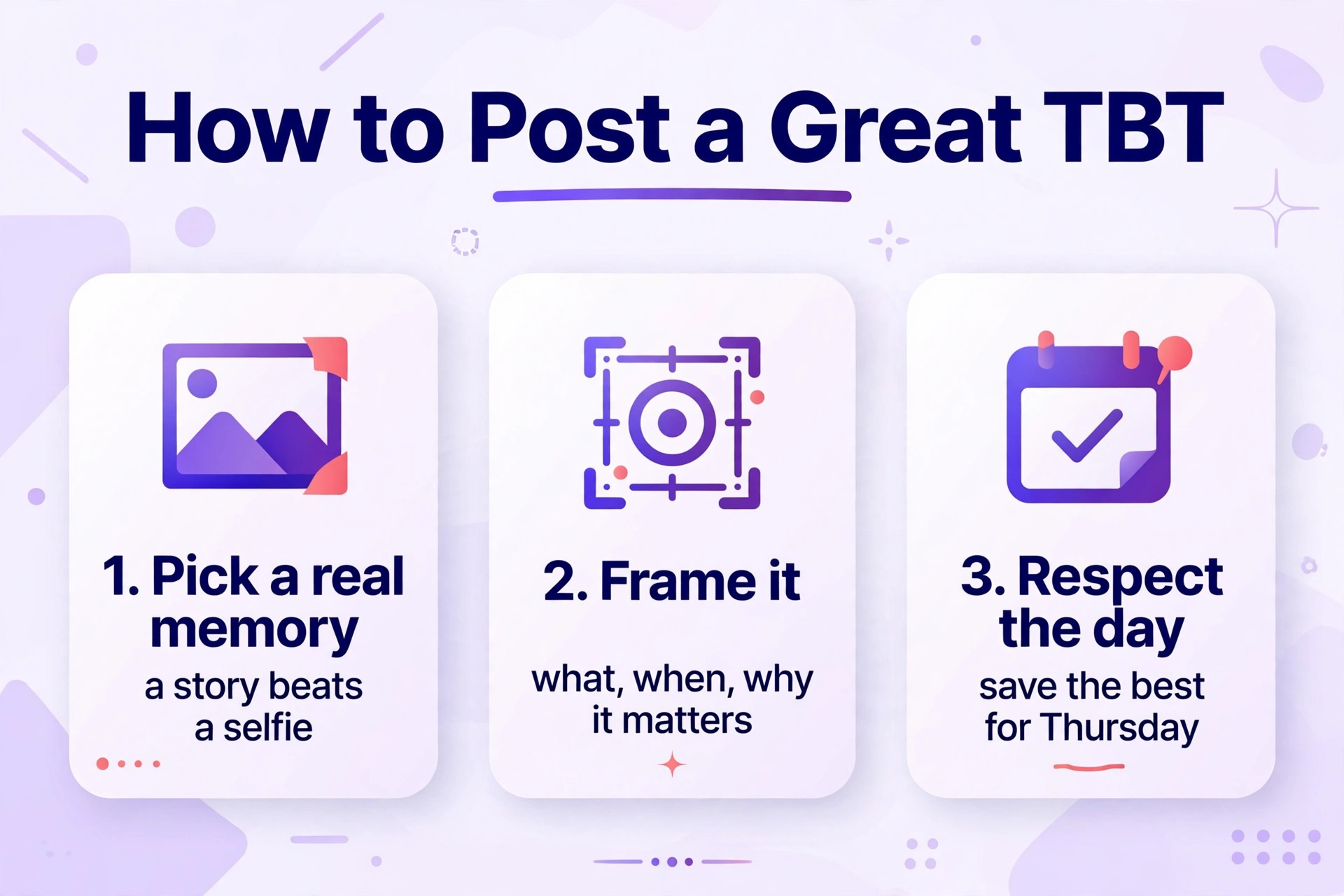
Want your throwback to land? Three rules:
1. Pick a real memory. The best TBTs have a story — even a small one. "TBT to the concert where it rained the whole time and we didn't care" beats a context-free old selfie. The Nostalgia Filter's condition 3 (intentional nostalgia) is what separates great TBTs from old photos.
2. Frame it. A caption does half the work: what it is, when it was, why it matters now. "TBT to summer '19 — the last normal summer 😭" gives the audience an emotional door to walk through. No caption, no context, no care.
3. Respect the day (mostly). Thursday is the tradition, and traditions are fun because they're shared. Posting on Thursday plugs you into a feed-wide moment. Off-day throwbacks work, but they lose the ritual energy — save your best material for Thursday.
And engaging with others' TBTs? Match the tone. Joyful → celebrate. Playful → laugh along. Bittersweet → be gentle. A "😂" on someone's memorial TBT is a mistake you only make once. When in doubt, a simple "love this" is never wrong — it's the FR-style sincerity that throwbacks deserve.
TBT vs Similar Slang
| Term | Meaning | How it differs from TBT |
|---|---|---|
| TB (throwback) | Old content, any day | The casual cousin — same nostalgia, no Thursday required |
| FBF | Flashback Friday | The Friday edition of the same ritual |
| #Latergram | Posted late | About timing, not nostalgia — a late post isn't a throwback |
| #OnThisDay | Anniversary posts | Calendar-driven, not Thursday-driven |
| LOL | Laugh out loud | The universal reaction; "TBT lol" is the classic combo |
| FOMO | Fear of missing out | What you feel watching other people's great TBTs |
| TBH | To be honest | "TBH this is my favorite TBT I've posted" — sincerity framing for the memory |
| SMH | Shaking my head | "TBT to this haircut smh" — the playful-roast reaction |
The most useful distinction is TBT vs TB. TB ("throwback") is TBT without the Thursday — the everyday version. "TB to the best summer 🌊" works any day of the week. TBT is the ritual version: Thursday, hashtag, tradition. Use TB for casual nostalgia; save TBT for Thursdays when you want the full ceremonial effect.
When Not to Post a TBT
- When the "memory" is from last week. The Nostalgia Filter's condition 1 exists for a reason. Recent content + #TBT reads as hashtag-stuffing.
- Sensitive anniversaries you don't own. Someone else's loss isn't your content. Bittersweet TBTs belong to the people who lived them.
- Every single Thursday. A weekly ritual is charming; a weekly obligation is content-mill behavior. Save TBTs for memories worth sharing.
- As a brand, faking history. "TBT to our founding in 2019" from a company founded in 2023 is a lie with a hashtag. Audiences notice.
- To get an ex's attention. We all see it. Everyone knows. Don't — and if you're the audience for someone else's bait-post, a quiet IDC (no reply, no like) is a complete answer.
Quick Answers
What does TBT mean in text?
TBT means "Throwback Thursday" — a social media tradition of sharing old photos, memories, or nostalgic content on Thursdays, usually with the #TBT hashtag.
Do I have to post TBT on Thursday?
Traditionally, yes — that's the whole point of the Thursday ritual. In practice, people bend the rule, and audiences forgive off-day throwbacks if the nostalgia is genuine. But your best material belongs on Thursday.
What's the difference between TBT and TB?
TB ("throwback") is the casual, any-day version — same nostalgia, no Thursday required. TBT is the ritual version: Thursday, hashtag, tradition.
Is TBT still a thing?
Yes. It's one of the longest-running hashtag traditions on social media, dating back to 2006 and mainstream since the early 2010s. The format evolved (photos → videos → stories), but the Thursday nostalgia ritual never left.
What should I comment on someone's TBT?
Match their tone: celebrate joyful ones, laugh along with playful ones, be gentle with bittersweet ones. "Love this" is never wrong.
Does TBT mean "truth be told"?
No — not in any real usage. Dictionaries list "truth be told" as a possible expansion, but it has no traction in texting or social media. TBT means "Throwback Thursday," full stop.
TBT is the internet's weekly permission slip to be nostalgic on purpose. Run the Nostalgia Filter — old content, Thursday, intentional framing — and your throwbacks will land exactly as intended: as time capsules, not just old photos.
