
Some messages need a paragraph to explain. “Aww” needs about a second.
It’s the written version of the soft sound people make when something melts them a little: a photo of a puppy asleep in a laundry basket, a friend’s sweet gesture, or news that tugs at them in a sad way. When someone sends you “aww,” the message is simple — they felt something warm, and they wanted you to know.
One thing to get out of the way early: “aww” is not an acronym. It doesn’t stand for anything. It’s an exclamation, typed out the way it sounds when said aloud.
This guide covers the three jobs “aww” actually does in texts, how the spelling stretches when the feeling gets bigger, what to send back, and which similar-looking claims you can safely ignore.
The Short Answer
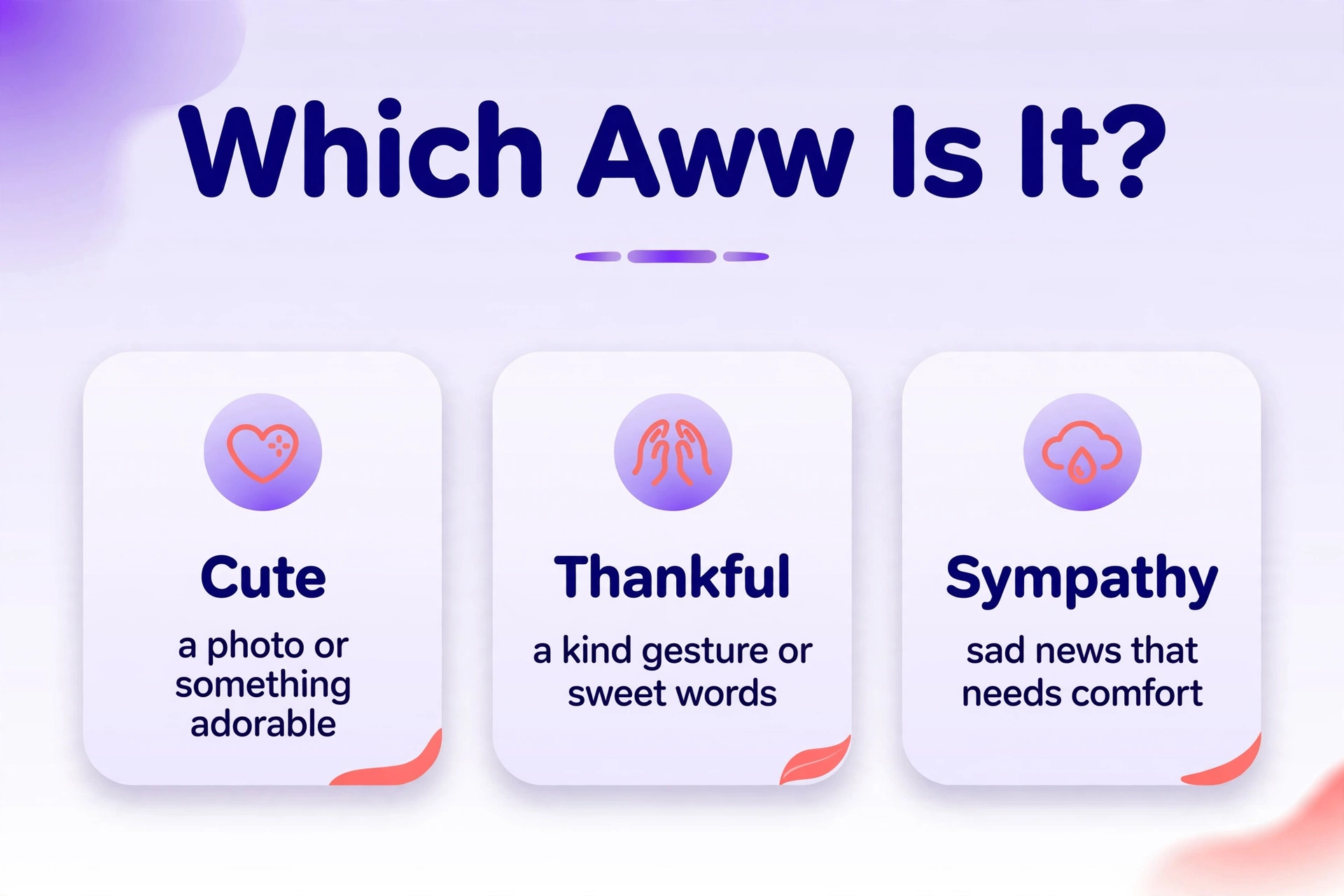
- “Aww” is an exclamation of warmth. It most often means “that’s so cute,” “that touched me,” or “I feel for you.”
- It is not an acronym. No phrase hides behind the letters.
- The feeling is always warm — the context around it tells you whether that warmth is delight, gratitude, or sympathy.
- Stretching the letters stretches the feeling. “Awww” lands harder than “aww.”
The Three Ways People Use Aww
1. “That’s so cute” — affection and delight
This is the reading most people meet first. Someone shares something adorable — a baby’s first steps, a kitten, a couple’s photo — and “aww” is the instant reaction. It’s the texting equivalent of a soft gasp and a hand on the chest.
- “Aww, look at his little face 😭”
- “Aww, you two are adorable together”
Here “aww” means the sender found something genuinely sweet. There’s no hidden layer to decode — the warmth is the point.
2. “That touched me” — appreciation and gratitude
The second job is a thank-you with feeling. When someone does something kind or says something heartfelt, “aww” says “that meant something to me” in two keystrokes.
- “Aww, you remembered my birthday!”
- “Aww, that’s the sweetest thing anyone’s said today”
In this reading the affection points at the sender, not at a photo. They’re reacting to what you did or said. It usually comes with a follow-up — “thank you,” “you’re the best” — that makes the gratitude explicit.
3. “I feel for you” — sympathy and comfort
The third job shows up when the news is sad instead of sweet. “Aww” becomes a small, gentle way to say “I’m sorry that’s happening” when the sender doesn’t have bigger words ready.
- “Aww, I’m sorry your trip got cancelled”
- “Aww, that sounds like a really rough day”
The tone here matters. A sympathy “aww” is quieter and usually comes with something concrete after it — an apology, a question, an offer. A bare “aww” on sad news can feel thin, so most people pair it with at least one more sentence.
Why People Stretch the Spelling
You’ve seen it: “aww,” “awww,” “awwwww.” The extra letters aren’t a typo — they’re volume.
As a general pattern, the longer the stretch, the bigger the feeling behind it. “Aw” (one w) is the mildest of the family and sometimes reads closer to “oh” — mild disappointment or softness. “Aww” is the standard warm reaction. “Awww” and beyond turn the feeling up: stronger affection, deeper sympathy, more overwhelming cuteness.
This isn’t a strict code with fixed tiers — nobody agreed on what exactly four w’s means versus five. Think of it as emphasis rather than a different word. The same instinct drives “soooo,” “yessss,” and “noooo.” More letters, more feeling.
One practical note: the stretched versions work best in casual chats with people who know your tone. In a shorter or more neutral conversation, a long “awwwww” can read as more intense than you intended.
Aww in Realistic Conversations
The exchanges below are illustrative examples, not real messages.
Delight — the cute photo
- A: sends photo of her dog asleep on her laptop
- B: “Awwww look at him 😭 he’s using your keyboard as a pillow”
- B found the photo adorable. The stretched spelling and the detail about the pillow both say “this genuinely delighted me.”
Gratitude — the kind gesture
- A: “Left your favorite snacks on your desk for the big day. You’ve got this.”
- B: “Aww, thank you! You’re the best”
- B is touched by the gesture. The “thank you” makes the appreciation explicit.
Sympathy — the bad news
- A: “My flight got cancelled and I’m stuck at the airport till morning”
- B: “Aww no, that’s awful. Want me to look up hotels nearby?”
- B’s “aww” carries sympathy, and the offer of help keeps it from feeling empty.
The affectionate check-in
- A: “Made it home safe. Today was perfect.”
- B: “Aww, I’m so glad. Sleep well 💛”
- Warm, fond, and low-key — the “aww” equivalent of a hug goodnight.
Where You’ll See It
- One-to-one texts and DMs: the home turf of “aww.” It lands best in conversations where both people already know each other.
- Group chats: usually as a reaction to shared photos or news — quick, warm, and easy to scroll past.
- Comments and replies: under cute or touching posts, “aww” is one of the most common single-word reactions you’ll find.
- Not for formal messages: “aww” is pure casual tone. It doesn’t belong in work emails, applications, or anything where you’d want to sound composed.
What to Send Back
The reply depends on which “aww” you received — but you rarely need to overthink it. Match the warmth and keep it short.
They found something cute:
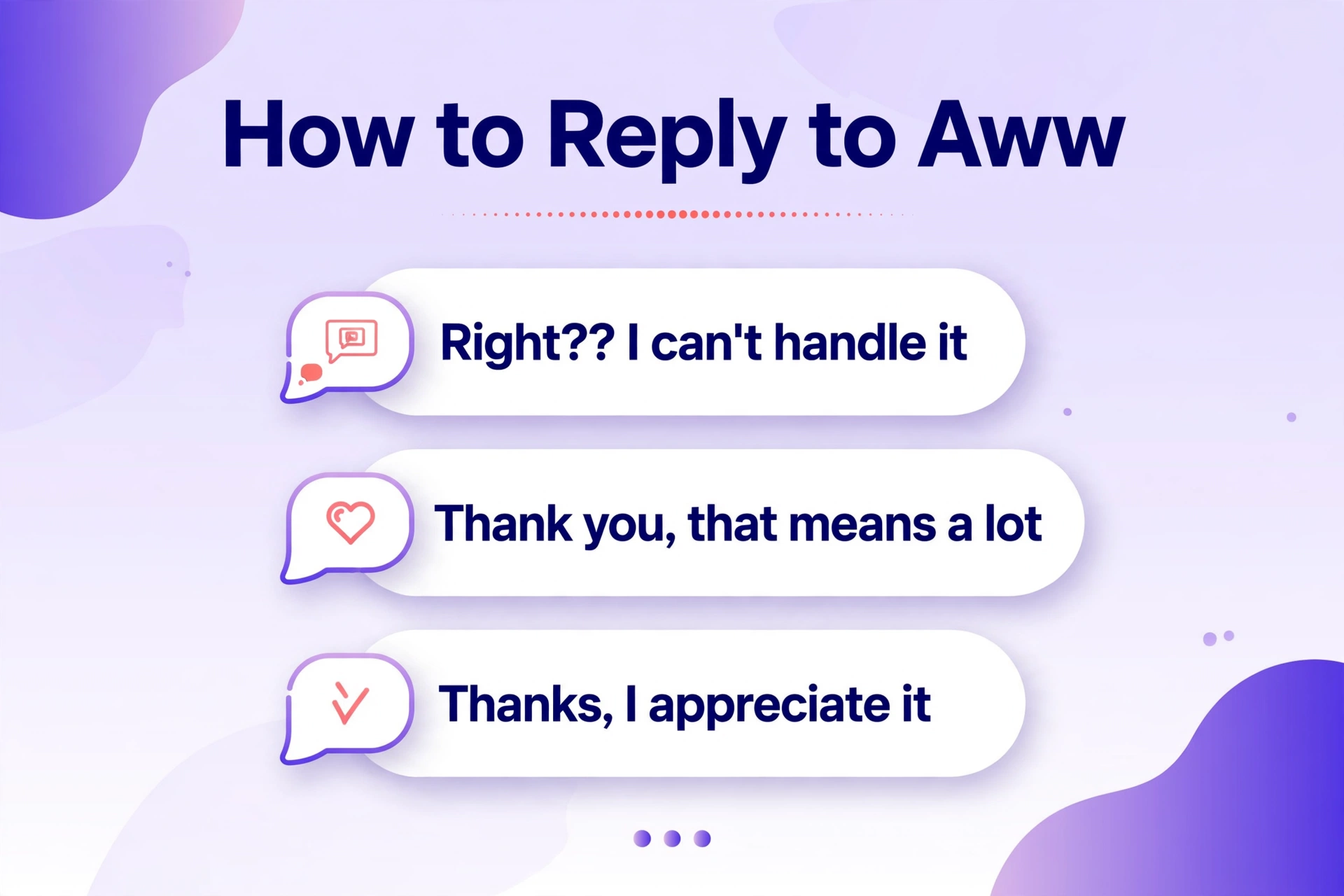
- “Right?? I can’t handle it 😭”
- “I know, I’m obsessed”
They’re thanking you:
- “Of course 💛”
- “Anytime — you deserve it”
They’re sympathizing with you:
- “Thanks, I appreciate it”
- “It’s okay, I’ll survive 😅”
They’re being affectionate:
- A little warmth back goes a long way: “🥰” or “you’re too sweet”
A few useful phrases for these moments: a sincere follow-up when you want to show you mean it, let me know when their sympathy deserves a real conversation later (“thanks — let me know if you’re free to talk tomorrow?”), a short alr to acknowledge gently, and ttyl when the exchange is winding down on a warm note.
Aww vs. Other Reaction Words
Texts are full of one-word reactions, and they don’t all do the same job.
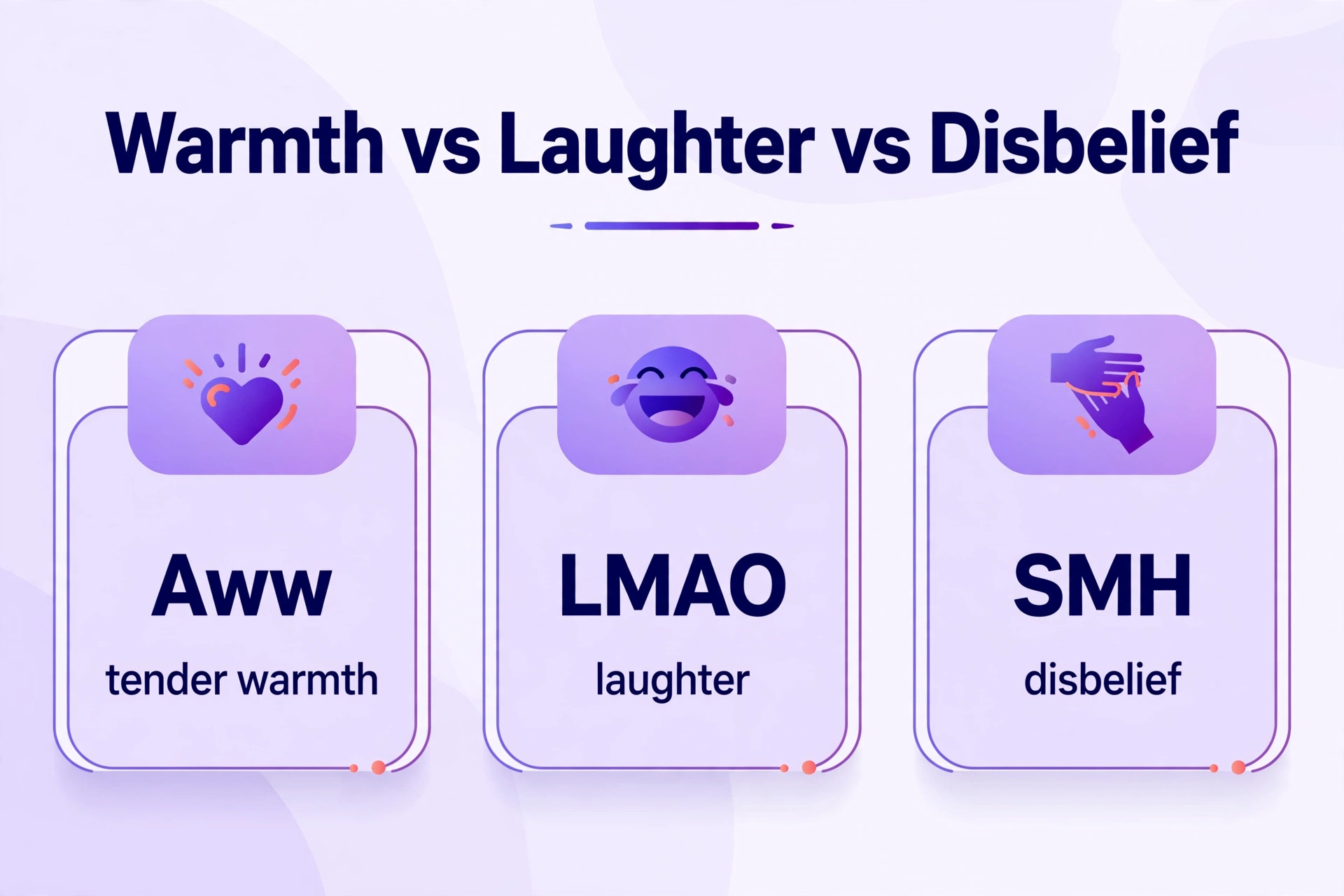
- Aww vs. LMAO: “aww” is warmth; LMAO is laughter. A cute photo gets “aww.” A funny video gets LMAO. Some moments earn both — “awww that’s hilarious 😭” — but the feelings are different.
- Aww vs. SMH: these are near-opposites. “Aww” leans in with warmth; SMH (shaking my head) leans back with disappointment or disbelief. “Aww” says “I feel with you”; SMH says “I can’t believe this.”
- Aww vs. “aw”: “aw” is the milder sibling — sometimes affectionate, sometimes closer to “oh well.” If someone writes “aw, that’s too bad,” the feeling is softer and thinner than “aww, that’s awful.” When in doubt, the two-w version is the warmer one.
The through-line: “aww” is the reaction word you reach for when the feeling is tender. Laughter, shock, and disappointment all have their own words. Usage examples on Urban Dictionary document the warmth readings.
What Aww Is Not
It’s not an acronym.
A few joke dictionary entries claim “AWW” stands for things like “Away Without Warning” or “Any Which Way.” These are one-off gags with no real usage behind them — nobody texts “aww” expecting to be understood as “away without warning.” Treat them as noise, not meanings.
It’s not always flirting.
“Aww” is affectionate, and affection can be romantic — but most of the time it’s just warm. Friends, family members, and coworkers in friendly chats all use it platonically. The relationship and the context decide whether there’s anything flirty about it, not the word itself.
It’s not sarcasm-proof.
Like any warm word, “aww” can be used sarcastically — “aww, did your plan fall apart?” lands very differently from “aww, I’m sorry.” Tone and context tell you which one you’re looking at. When the rest of the message is sharp, the “aww” is sharp too.
Frequently Asked Questions
What does “aww” mean in a text?
It’s an exclamation of warmth — usually “that’s so cute,” “that touched me,” or “I feel for you.” The context decides which one.
Is “aww” flirting?
Not by itself. It’s affectionate but most often platonic. Whether it’s flirty depends on who sent it and the rest of the conversation.
What’s the difference between “aw” and “aww”?
“Aw” is milder and can read as simple softness or mild disappointment. “Aww” is the warmer, fuller version — more affection, more feeling.
What does “awww” with extra w’s mean?
More of the same feeling. Stretching the letters is emphasis, not a different word — like writing “soooo” instead of “so.”
Does “AWW” in all caps mean something different?
No — same word, more volume. All caps reads as a stronger reaction, the way caps always do.
Can “aww” be sarcastic?
Yes. “Aww, poor thing” can comfort or mock depending on tone and context. Read the rest of the message before deciding.
How do you respond to “aww”?
Match the warmth: “thanks 💛,” “right??,” or “I know!” for cute things; “thank you, that means a lot” for kind gestures; “thanks, I appreciate it” for sympathy.
Can I use “aww” at work?
In formal messages, no — it’s too casual. In a friendly team chat where people already joke around, an occasional “aww” is fine.
Is “aww” an acronym?
No. It doesn’t stand for anything — it’s a written-out sound of affection.
What does “aww” mean on Instagram?
The same as anywhere else: a warm reaction. In comments it usually means the commenter found the post cute, sweet, or touching.
The Short Version
“Aww” is the sound of warmth in text form — affection for something cute, gratitude for something kind, or sympathy for something sad. It isn’t an acronym, it isn’t flirting on its own, and stretching the letters just turns the feeling up. When someone sends it, they’ve felt something tender. A little warmth back is usually all the reply it needs.
