
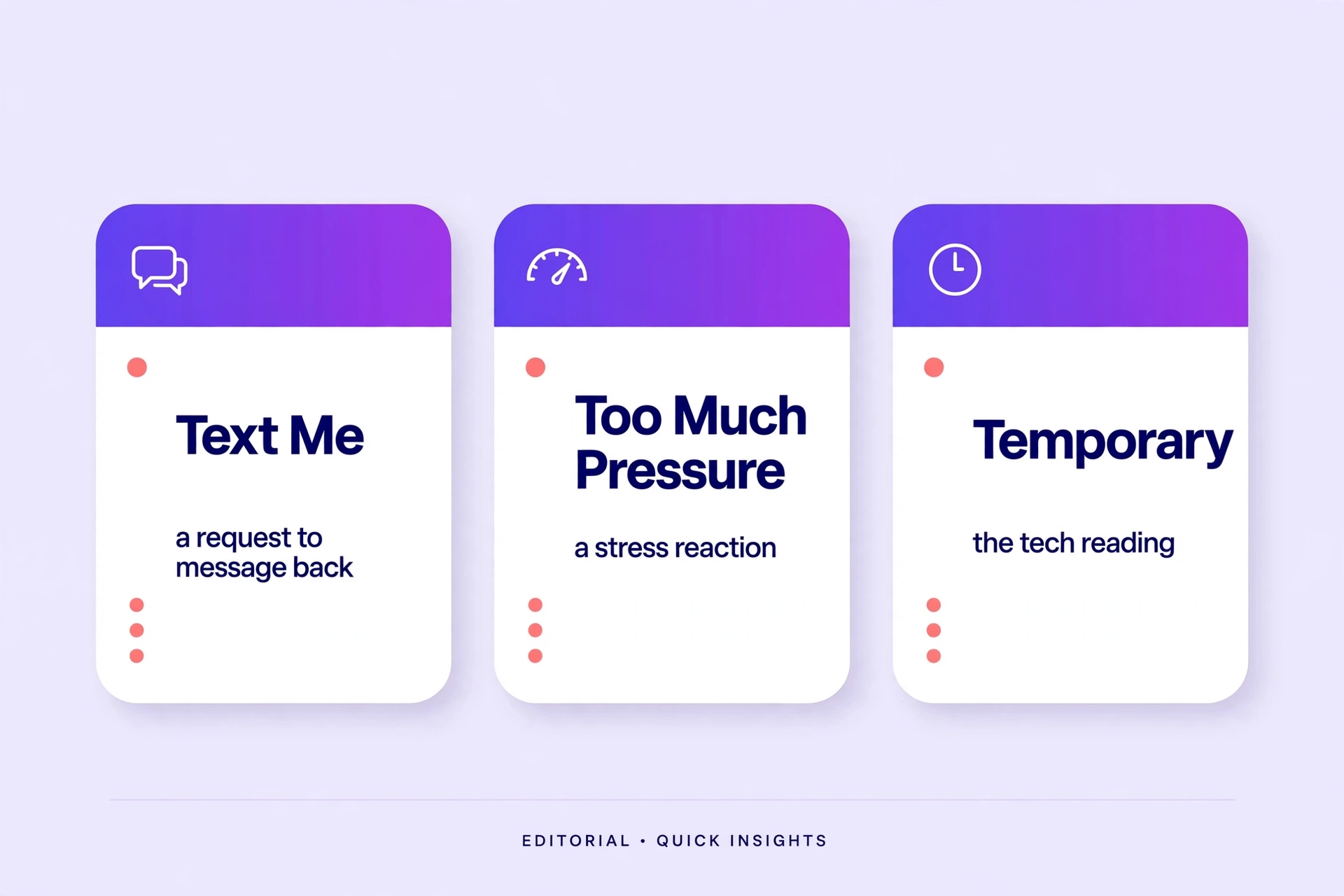
“tmp” is one of those abbreviations that can go in a few directions. In most texts and DMs, though, it’s a request: text me please. When someone writes “tmp later?” they’re really saying “message me when you get a chance.” But context matters — the same three letters can mean “too much pressure” when someone’s stressed, or “temporary” in a technical chat. This guide breaks down all three readings, shows how to tell them apart, and what to send back.
The Short Answer
- In most texts, “tmp” means “text me please” or “text my phone” — a casual way to ask someone to message you.
- In some chats it means “text me privately” — a request to move the conversation somewhere less public.
- When someone’s stressed, “tmp” can mean “too much pressure.”
- In tech and computing contexts, “tmp” usually means “temporary” — the same word behind “.tmp” files.
- The words around the abbreviation almost always tell you which reading is right.
The Three Ways People Use TMP
1. “Text me” — the request
This is the reading you’ll meet most often. Someone wants you to message them — usually soon, and usually because they need something from you or want to keep talking.
- “Hey, tmp when you get a chance 😄”
- “tmp later?” / “tmp when you’re free”
It’s friendly and low-pressure. Think of it as a small nudge rather than a demand — the person is opening the door, not banging on it.
2. “Text me privately” — the quieter follow-up
A close cousin of the first reading shows up in group chats and comments. Someone sees something they want to discuss, but not in front of everyone, so they write “tmp” as shorthand for “let’s talk about this in private.”
- (in a group chat) “saw your post, tmp about it”
- “check this out, tmp!”
Here the meaning is less “message me at some point” and more “message me somewhere quieter.” If you got “tmp” in a comment thread or group chat, this is almost certainly the reading.
3. “Too much pressure” — the stress reading
When the topic is stress — exams, deadlines, overwhelming plans — “tmp” flips to “too much pressure.”
- “This homework is tmp 😩”
- “Exams are tmp, I can’t keep up”
This reading is easy to spot: the conversation is about being overwhelmed, and “tmp” is describing a feeling rather than asking for anything. It never shows up alone as a request — nobody writes “tmp!” and means “too much pressure” as a standalone command.
The technical one: “temporary”
In work, gaming, and computing conversations, “tmp” usually means “temporary” — the same sense behind the “.tmp” temporary files your computer creates.
- “We’re using a tmp password for testing”
- “It’s just a tmp fix until the update”
This is the one reading that’s rarely ambiguous: if the chat is about files, passwords, accounts, or setups, “tmp” means temporary.
How to Tell Which Reading It Is
Most of the time you won’t need to think about this — the context hands you the answer. But when it feels unclear, run through these quick checks:
- Does it read like a request? If “tmp” is addressed to you and asks for contact (“tmp later,” “just tmp”), it’s “text me.”
- Did it arrive in a group chat or comment thread? It likely means “text me privately.”
- Is the topic stress, exams, or being overwhelmed? It’s “too much pressure.”
- Is the topic technical — files, passwords, gaming setups? It’s “temporary.”
- When in doubt, assume “text me.” That’s the default in one-to-one chats, and if you’re wrong, asking “what did you mean?” is completely fine.
TMP in Realistic Conversations
The exchanges below are illustrative examples, not real messages.
The friendly nudge
- A: “I found those concert tickets — they’re selling out fast”
- B: “tmp tonight so we can sort it out!”
- B just wants A to message back with details. Simple, warm, no urgency panic.
The private follow-up
- A: (in the group chat) “guys I have news about Saturday 👀”
- B: “tmp about it, I wanna hear everything”
- B is steering the conversation out of the group chat and into DMs.
The stress reaction
- A: “three assignments due tomorrow and a quiz on Friday”
- B: “that’s tmp honestly 😭”
- B is sympathizing — “that sounds like too much pressure” — not asking A to message them.
The temporary setup
- A: “can you set up a login for the new intern?”
- B: “sure, I’ll give them a tmp password to start”
- Nothing slang-y about this one — just a short-term password.
Where You’ll See It
- One-to-one texts and DMs: the home turf of “tmp.” This is where the “text me” reading lives.
- Group chats and comments: where “text me privately” shows up — a quick way to move things somewhere quieter.
- Social media comments: creators or followers asking for details without typing a full sentence.
- Gaming and tech chats: the land of “temporary” — passwords, files, accounts, setups.
- Not for formal messages: like most abbreviations, “tmp” is casual. In work emails or messages to teachers, write the full phrase.
What to Send Back
The reply depends on which “tmp” you got — but it doesn’t need to be complicated. Match the tone and keep it short.
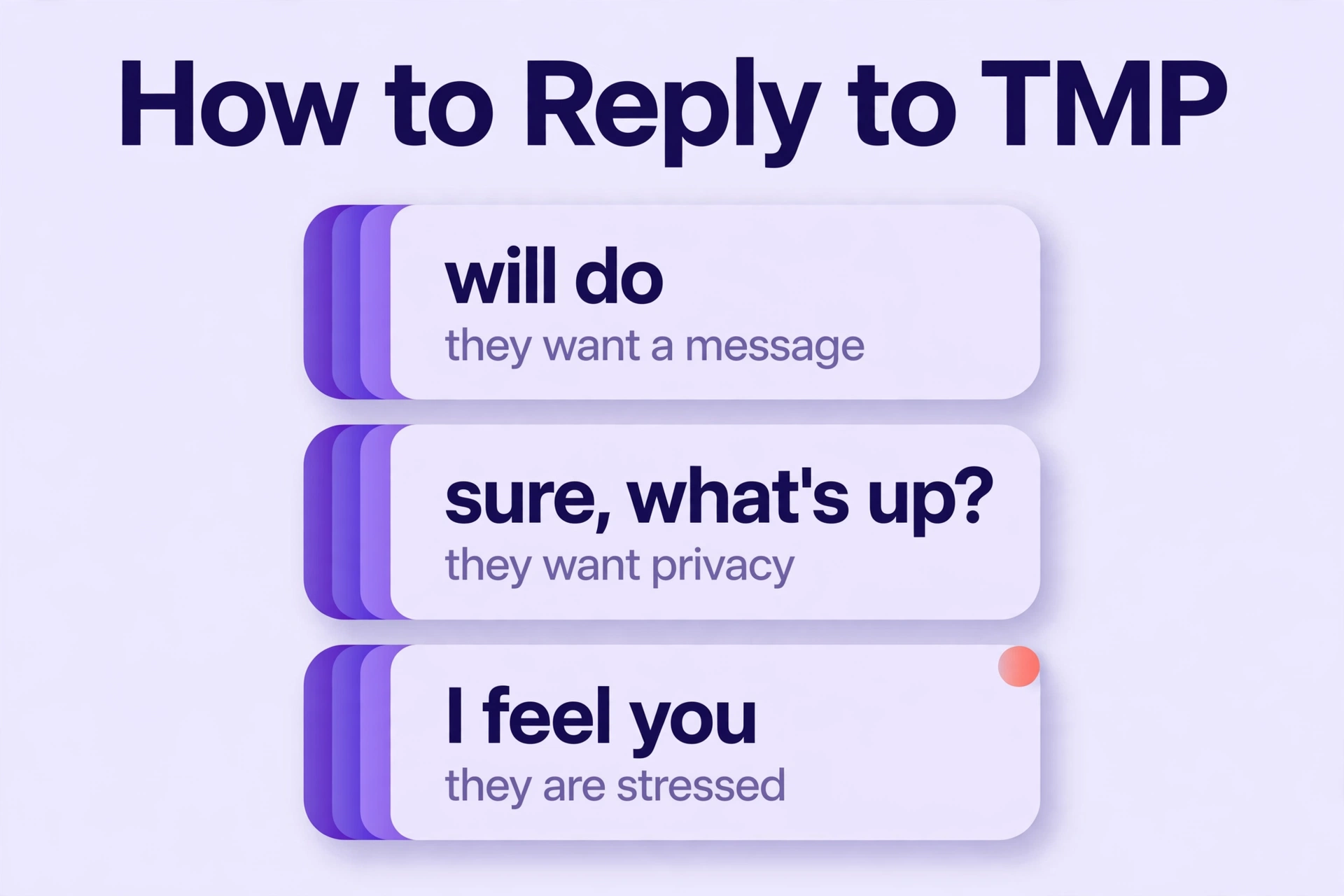
They want you to message them:
- “will do 👍”
- “on it”
- “okay, I’ll tmp you after class” (yes, it works both ways)
They want to talk privately:
- Just move to DMs and say hey — that’s the whole point of the message.
- “sure, what’s up?” once you’re there.
They’re stressed (“too much pressure”):
- “I feel you 😩”
- “that sounds rough, take it one thing at a time”
Some useful phrases for these moments: a quick alr to acknowledge their message, FR when you genuinely mean your reply, and let me know when you want them to follow up with details (“alr, lmk what time works”).
TMP vs. Other Reaction Words
“Tmp” gets mixed up with a few other abbreviations. Here’s how they differ.
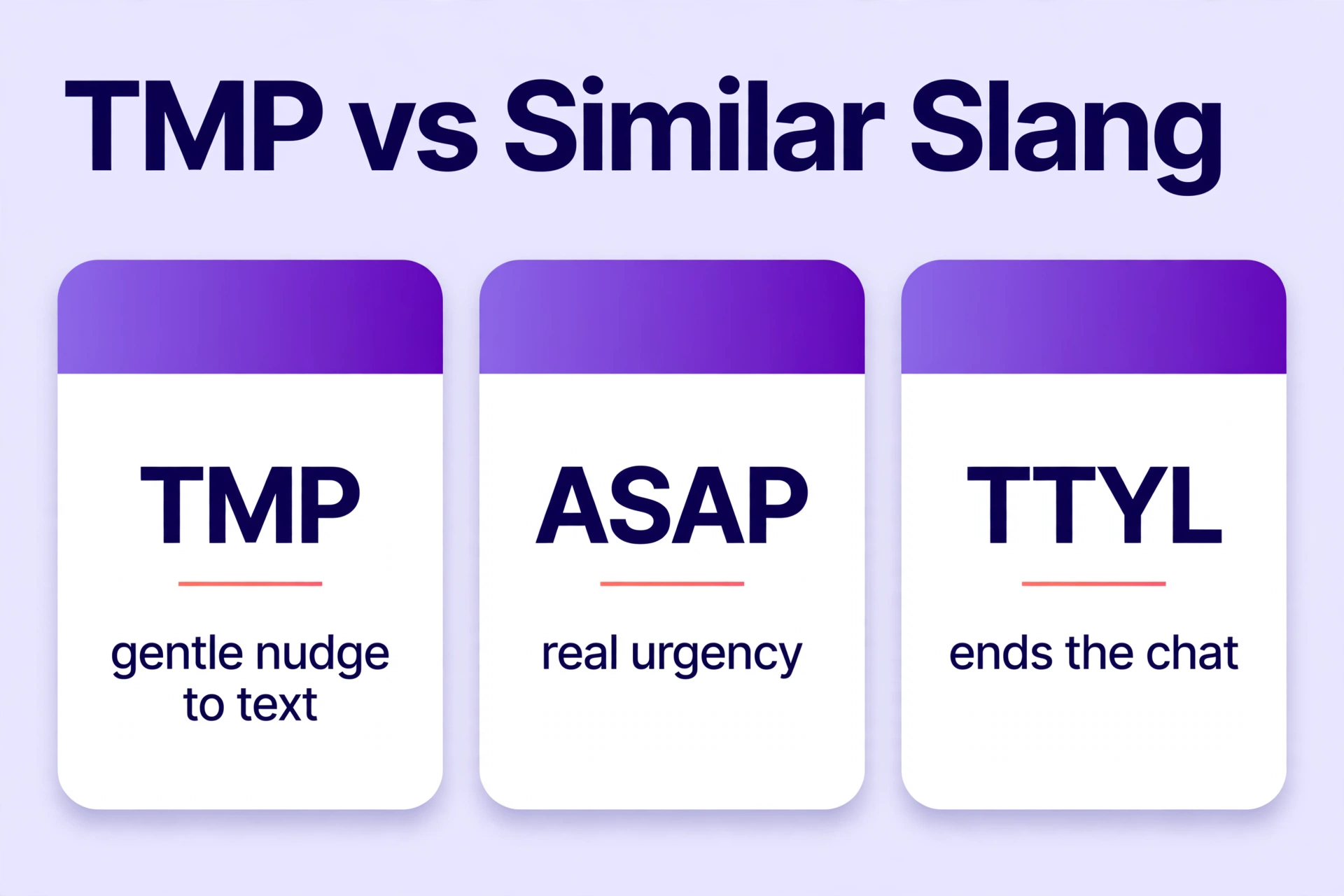
- TMP vs. ASAP: both ask for action, but “tmp” is a gentle nudge while ASAP carries real urgency. “Tmp when you can” is relaxed; “need this ASAP” is not.
- TMP vs. TTYL: these point in opposite directions. “Tmp” asks someone to contact you; TTYL ends the conversation for now. One opens a door, the other closes it politely.
- TMP vs. SMH: no real overlap, but they can appear in the same stressed-out chats. “Tmp” (too much pressure) describes the feeling; SMH (shaking my head) reacts to what caused it.
- TMP vs. TMI: “tmp” usually means “text me please”; TMI means “too much information.” Easy to confuse at a glance — read the letters carefully.
Usage guides on Slang Sense document the same three core readings — the “text me” request, the pressure reaction, and the temporary sense.
What TMP Is Not
It’s not a typo for “temp.” Well — sometimes it is. In a technical sentence like “this is just tmp,” the writer may simply be abbreviating “temporary” on purpose. But in a text like “tmp later?” it’s the slang request, not a misspelling. Context decides.
It’s not always urgent. A bare “tmp” reads like a nudge, not an emergency. If someone needed you urgently, they’d usually say so — or use something with more weight, like ASAP.
It’s not one single fixed meaning. Some abbreviations have one job. “Tmp” has three. That’s normal for texting slang — the words around it do the heavy lifting. Don’t memorize the letters; read the sentence.
The niche expansions aren’t real texting meanings. A few slang glossaries list creative readings like “totally my pleasure” or “the most popular.” These are one-off guesses with no real usage behind them — nobody texts “tmp” expecting to be understood that way. Treat them as noise.
Frequently Asked Questions
What does “tmp” mean in a text?
In most texts it means “text me please” or “text my phone” — a casual request for someone to message you. Context can shift it to “text me privately,” “too much pressure,” or “temporary.”
Is “tmp” rude?
Not usually. It’s a casual nudge, not a demand. But tone matters — a bare “tmp” with no context can read as slightly pushy, so most people soften it with “when you can” or an emoji.
Can “tmp” mean “text me privately”?
Yes — especially in group chats and comment threads, where it signals “let’s move this conversation somewhere quieter.”
What’s the difference between “tmp” and “hmu”?
They’re close. “Tmp” is specifically about messaging (“text me”); “hmu” (hit me up) is broader — it can mean text, call, or just reach out however.
Does “tmp” mean “too much pressure”?
It can, when the conversation is about stress or being overwhelmed. That’s the second most useful reading to know.
What does “tmp” mean in gaming?
Usually “temporary” — a tmp password, account, or file. Same as in computing, where “.tmp” marks temporary files.
Can I use “tmp” at work?
In casual team chats, occasionally. In emails or messages where clarity matters, write the full phrase — “please text me” or “temporary.”
How do you respond to “tmp”?
Match the reading: “will do 👍” for the request, a DM for the private follow-up, and sympathy (“that sounds rough”) for the stress reading.
Is “tmp” an acronym people actually use, or just internet slang?
It’s real texting slang with consistent usage across chats and social platforms — but it’s informal, and not everyone knows it. When in doubt, spell it out.
Does “tmp” in all caps mean something different?
No — same meanings, more volume. All caps reads as more urgent, the way caps always do.
The Short Version
“Tmp” is usually a request: text me please. In group chats it often means “text me privately,” when someone’s stressed it can mean “too much pressure,” and in tech contexts it’s “temporary.” Read the sentence around it and you’ll almost always land on the right one. When you get one, a quick reply or a DM is all it takes.
