
"Send this ASAP." It lands at 11 p.m., with no time, no reason, and no room to argue. If you have ever stared at those four letters and wondered whether you were late already, you have felt the exact confusion this article exists to clear up. In short, the asap meaning in text is "as soon as possible": a request for fast action, not a deadline, not an emergency, and not an order with a clock attached.
That missing clock is the whole story. ASAP sounds like it comes with a time attached, but it never names one. Learn to find the time hiding inside it — or notice when there is none — and the letters stop being stressful.
What Does ASAP Mean in Text?
ASAP is an initialism for "as soon as possible." Wiktionary lists it exactly that way, and every major explainer agrees: when someone writes ASAP, they want something done quickly, without unnecessary delay. It is not slang in the playful sense, like a joke word that only one group uses. It is a plain abbreviation that crossed from offices and the military into everyday texting because it is short and everyone already knows it.
Two details about the letters: most people say them one by one, "A-S-A-P," but "AY-SAP" is equally accepted, and the older dotted form "A.S.A.P." means exactly the same thing — the dots are a style choice, not a different meaning.
The most important detail is what ASAP does not mean. It does not mean "immediately" or "instantly." It means as soon as realistically possible — as fast as the person can manage. "Send the file ASAP" is not "send the file this second." It is "make this your next thing, and do not let it drift." That gap between "fast" and "instant" is where almost every ASAP misunderstanding lives.
Real-world ASAP, done right:
- "Can you send the location ASAP? The event is starting." — A real time pressure, with the reason visible.
- "I will do it asap." — A promise of priority, not a timestamp.
- "Text me ASAP when you get home." — A request for a quick check-in, not a demand for speed itself.
Notice what none of these contain: a clock. No "by 3," no "within the hour." That absence is the feature that makes ASAP both useful and maddening, and it is why you need a test for it.
The Hidden-Deadline Test
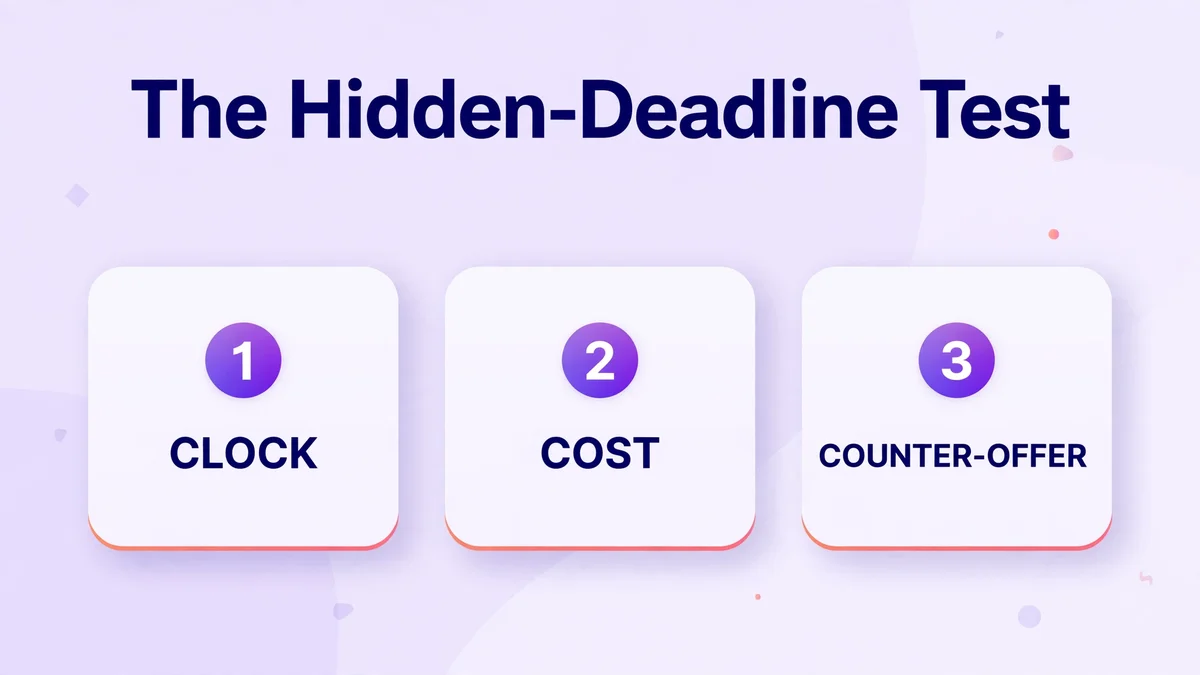
Here is this article's named method. Call it the Hidden-Deadline Test: three checks, run in order, on any ASAP you receive or are about to send.
Check 1: Clock. Does the message carry a time, or a time nearby? Look in the message and in the messages around it. "Need this ASAP, by 3 PM" has a clock, and the clock is the real deadline — ASAP is just the underline. "Need this ASAP" alone has no clock at all. Most ASAPs fail this check, and that failure is information.
Check 2: Cost. What actually breaks if you are late? A missed event start, a client waiting, a server down — those are real costs, and they tell you how fast "fast" really is. No visible cost means the urgency is borrowed: the sender feels rushed, or wants to feel in charge, but nothing specific is at stake. "Reply ASAP" on a casual question has no cost. "Fix this ASAP, the site is down" has a large one.
Check 3: Counter-offer. Can you answer with a real time instead of obeying? This is the check that turns the test into a tool. If there is no clock and no cost, you are free to set the time yourself: "I can send it by 4 — does that work?" If the sender accepts, the vague pressure becomes a real plan. If they push back with a reason, you have just learned the clock and the cost that were missing.
Run all three on two examples. Your boss writes "report ASAP" at 9 a.m. Clock: none. Cost: unknown — but bosses rarely write ASAP about nothing. Counter-offer: "I will have it by 11 — is that okay?" If she says yes, you have a deadline. If she says "the client meeting is at 10," you have just found both the clock and the cost. Now the opposite: a friend writes "send pics ASAP!!" after a party. Clock: none. Cost: none — nobody loses anything if the photos arrive tomorrow. Counter-offer: "I will send them tonight" ends the pressure completely. Same letters, two entirely different demands.
ASAP Is Not a Deadline
This is the distinction the old article never drew, and it is the most useful sentence in this guide: ASAP expresses urgency; a deadline expresses a time. They are different tools, and confusing them causes most of the damage ASAP does.
A deadline says "by Friday, 5 p.m." Everyone can plan around it and knows when it is missed. ASAP says "soon," and "soon" means something different to every reader: ten minutes to the sender, today to the receiver. When those two "soons" collide, both people feel wronged, and neither can point to a broken promise — because none was ever made.
That is why the best ASAP advice is also the simplest: whenever the timing actually matters, add a time. "ASAP, by 3 PM" is clearer than "ASAP" alone, and "please send this by 5 PM" is clearer still. The letters are not the problem; the missing clock is. Senders: if you know the time, say it. Receivers: if the time is missing, ask for it — that is the Hidden-Deadline Test's third check.
There is a second discipline hiding here: if everything is marked ASAP, nothing feels urgent anymore. A manager who marks every task ASAP trains their team to ignore the letters entirely, and then has no signal left for the one task that genuinely is urgent. Save ASAP for real urgency, and it keeps its power. A TTYL-style pause is honest about not being urgent; an ASAP on a non-urgent task is dishonest about being urgent, and readers can tell the difference even when they cannot name it.
ASAP on Texting, Snapchat, Instagram, TikTok, Email, and at Work

ASAP means the same thing on every platform: as soon as possible. No app gives it a special definition, and no app changes the letters. What changes is the room you are standing in — and the room changes how the urgency lands.
Texting (SMS, WhatsApp, iMessage). This is ASAP's home ground, and its most personal form. One-to-one chats, usually with someone you know: "text me ASAP when you get home" is a check-in with speed attached, not a command. The urgency here is almost always soft, because the relationship carries the context. A bare "ASAP" from a friend at midnight is rarely an emergency; it is usually excitement or worry wearing urgent clothes.
Snapchat and TikTok comments. In public, fast-moving rooms, ASAP shows up as coordination pressure: "reply ASAP so we can finalize" in a group story, or "send ASAP" under a comment thread. The public setting makes it feel louder than a private text, because an audience is watching — but the meaning has not changed, only the volume. The Hidden-Deadline Test still applies, and it still usually finds no clock and no cost.
Instagram. Direct messages behave like texting: personal, soft, context-rich. Captions and stories behave like announcements: "details ASAP" under a post is a broadcast request, closer to a sign than a message. Either way, the letters are the same; the audience is what differs.
Email and work chats (Slack, Teams). This is where ASAP is most at home and most dangerous. "Please send the report ASAP" in a work channel is standard. "ASAP" on every ticket in a project tool is a management failure, not a productivity system: a queue in which everything is urgent has no order at all. The professional move: pair ASAP with a deadline, a reason, or both — "ASAP, needed for client review" or "ASAP, by 3 PM."
Customer support. "We will get back to you ASAP" is a promise of speed from a company to a customer. Here the direction flips: the company is reassuring, not demanding. But the same missing-clock problem applies, which is why good support desks follow it with a timestamp or a tracking reference. An ASAP with no follow-through is worse than no ASAP at all, because it spends trust.
ASAP Tone: Pressure, Politeness, or Panic?
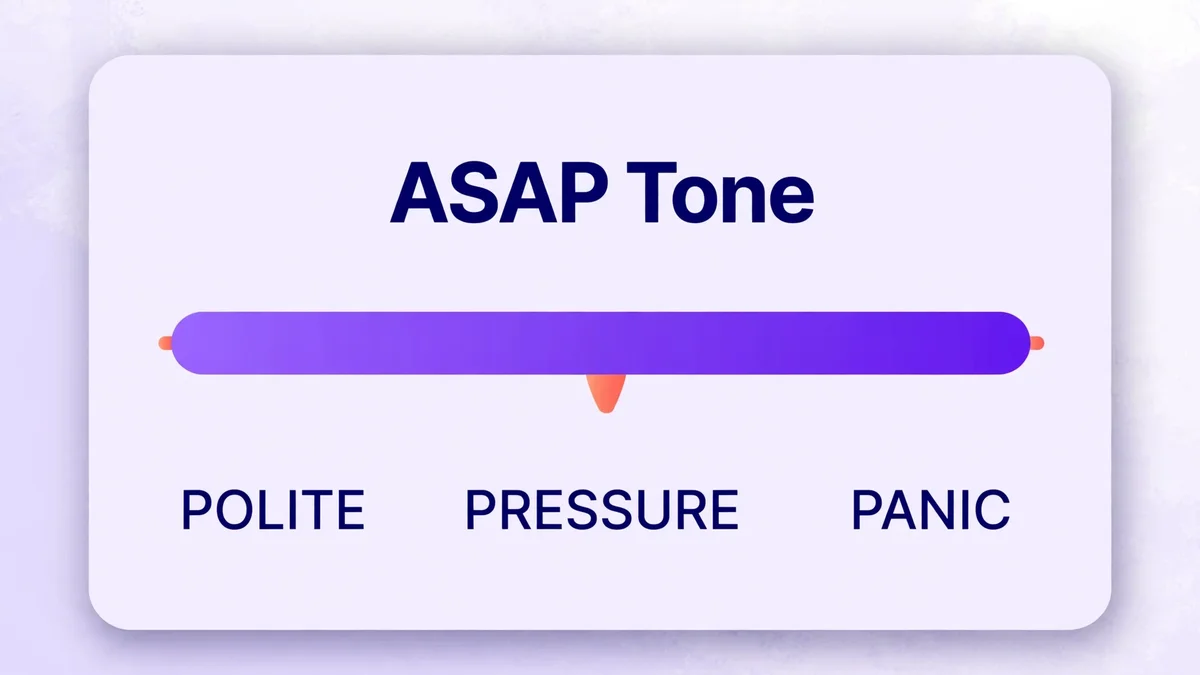
ASAP's default tone is urgent and direct. But like every pressure signal, it has a dose problem and a power problem, and both are about who is sending it.
The power rule. The same "ASAP" lands differently depending on who holds the power. From a boss, it is an instruction with a soft edge — you will treat it as a priority whether or not a clock exists. From a friend, it is a request you can negotiate. From a stranger, it is a presumption: someone you do not know is claiming your time, and that is why a bare "ASAP" from a stranger feels rude in a way the same message from a friend never does. From customer support, it is reassurance, not pressure at all. The letters do not carry the tone. The relationship does.
The please-and-time formula. Three small additions change everything about how ASAP sounds. "Please" softens it: "please send this ASAP" is a request, while "send this ASAP" is closer to an order. A reason justifies it: "ASAP, the client is waiting" gives the reader something to care about. A time replaces it: "by 3 PM" turns pressure into a plan. A message with all three barely needs the letters at all, which is rather the point. A BTW-style aside has the same softening effect without the pressure: "btw, whenever you get a chance today" is the opposite end of the urgency scale.
The dose problem. One ASAP signals urgency. Every message marked ASAP signals that the sender cannot prioritize. Teams, friends, and inboxes all learn the same lesson: if everything is urgent, ignore the label and guess instead. That guessing is where real deadlines get missed — not because anyone was lazy, but because the signal stopped meaning anything.
The panic trap. ASAP can also manufacture panic where none is warranted. A "reply ASAP" on a casual question makes the receiver's stomach drop for no reason, and a receiver who panics regularly stops trusting the sender's urgency signals entirely. If your message is not actually time-sensitive, do not borrow urgency you do not need — a DW-style "don't worry, no rush" beats an ASAP when there is nothing to rush. And if you receive an ASAP that makes you panic, run the Hidden-Deadline Test before you drop everything: no clock and no cost means you have time to breathe.
Sender context: from a boss, ask for the clock; from a friend, negotiate; from a stranger, feel free to ask "by when?"; from support, hold them to the follow-through.
How to Reply to ASAP
Your reply depends on what the Hidden-Deadline Test found. Match the reading, keep it short, and always try to replace the vague pressure with a real time.
If there is a real clock and a real cost: acknowledge and commit. "On it — sending by 3." That is the whole reply. No apology, no explanation, just the commitment. If you cannot make the clock, say so immediately with your own time: "I cannot make 3, but I can do 4:30 — does that work?" A missed ASAP with an early warning beats a silent miss every time.
If there is no clock and no cost: set the time yourself. "I will send it tonight" or "I will get to it tomorrow morning" ends the pressure and gives the sender something concrete. End with LMK-style clarity: "I will send it by 4, LMK if that slips" tells the sender exactly what to expect and when to worry. Most senders accept instantly, because what they actually wanted was not speed — it was certainty.
If the request is vague and it matters: ask for the one missing fact. "By when do you need it, and what is it for?" costs nine words and prevents the classic ASAP failure: two people working to two different "soons." Vagueness is not your problem to solve alone; it is a question to send back.
If you cannot do it at all: say so plainly and offer the alternative. "I cannot get to this today — I can do it Friday, or someone else can take it now." An honest no with an alternative respects the sender's urgency more than a silent yes that never delivers.
If the ASAP feels rude: do not escalate, and do not swallow it either. "Sure — by when, exactly?" is polite, firm, and forces the missing clock into the open. It works on bosses, strangers, and group chats alike, because it treats the message as a request for a plan rather than an order to obey. And if someone sends you a bare "ASAP!" with no context at all, you are allowed to treat it as incomplete: "ASAP for what, and by when?" is the only sensible reply to a message that forgot its own content.
One more rule, for senders: when someone answers your ASAP with a real time, accept it. If you wanted 3 PM, you should have said 3 PM.
ASAP vs RN, STAT, URGENT, and "At Your Earliest Convenience"
ASAP sits in a family of urgency words, and the cousins are easy to confuse because they all feel pressing. The difference is what each one actually demands.
| Term | What it actually demands | When it fits |
|---|---|---|
| ASAP | Fast, but no fixed time | "Send the file ASAP" — priority, not a clock |
| RN (right now) | This instant | Stronger than ASAP; leaves no room at all |
| STAT | Immediately, medical/emergency rooms | Hospitals and emergencies, not chats |
| URGENT | Importance + speed, stronger than ASAP | "URGENT" on a subject line outranks an ASAP inside it |
| At your earliest convenience | Soon, but on your schedule | The polite cousin: asks for less, pressures less |
| BRB | A pause of minutes | "BRB" steps away; ASAP pushes forward |
| GTG | An exit, for any reason | "GTG" ends the conversation; ASAP accelerates it |
| HMB | A reply, not the thing itself | "HMB" asks you to call back; ASAP asks you to deliver |
The useful pairs: ASAP versus a real deadline is the master distinction — one names urgency, the other names a time, and only the second can be planned around. ASAP versus "at your earliest convenience" is the politeness distinction — the first applies pressure, the second removes it. RN and STAT are both stronger than ASAP, and both belong in narrower rooms: RN in heated moments, STAT in medical and emergency settings where "immediately" is literal. BRB, GTG, and HMB are movement words, not urgency words — confusing them with ASAP produces nonsense replies.
Debunked: What ASAP Does NOT Mean
Short letters collect false meanings, and ASAP has collected a few — mostly by being old enough to gather barnacles.
- "One of the most commonly used abbreviations" — an unproven ranking. Every guide says it, no study supports it, and this article will not repeat it. ASAP is widespread; how widespread, exactly, nobody has measured. The old article's version of this claim is withdrawn.
- A Gen Z or youth-only word — false. ASAP predates texting by decades — acronym use back to at least the 1950s, the full phrase to 1838 — and is used by bosses, parents, support desks, and teenagers alike.
- An emergencies-only word — false. ASAP signals urgency, not emergency. A server outage or a client deadline is ASAP territory; a medical emergency uses STAT, "now," or "urgent," not a four-letter abbreviation in a chat.
- ASAP Rocky — a name, not a meaning. The rapper's name comes from the A$AP Mob collective, where A$AP stands for "Always Strive And Prosper." In a chat, nobody means the rapper unless they are talking about the rapper.
- "ASAP means now" — false. Now means this instant. ASAP means as soon as possible, which includes the time the task actually takes. Treating ASAP as "now" is how people burn out answering messages that could have waited an hour.
- "ASAP is always rude" — false. Rudeness lives in the power, the please, and the missing reason — not in the letters. "Please send this ASAP, the client is waiting" is polite. A bare "ASAP!" to a stranger is rude. Same letters, opposite manners.
- "ASAP is formal" — false, and so is "ASAP is slang." It sits in between: semi-formal. Fine in work chats and emails, out of place in formal outward-facing writing, where the full phrase "as soon as possible" belongs.
- A fixed meaning per app — false. No platform owns a special ASAP. The letters are constant; only the room, the audience, and the power change.
When Not to Use ASAP
ASAP is a joy in its habitat and a misfire outside it. Skip it when:
- The setting is formal. Letters, legal writing, and formal outward-facing documents want the full phrase, "as soon as possible," or a real deadline. ASAP reads as casual shorthand there.
- You know the time. If the deadline is 3 PM, write 3 PM. Using ASAP when you know the time hides information your reader needs.
- The task is not urgent. Marking a routine task ASAP spends a signal you will need later, and teaches your readers to ignore you. A normal deadline does the job better.
- The conversation is serious or sensitive. Bad news, apologies, and delicate negotiations do not want borrowed urgency. Pressure on top of sensitivity reads as bullying, even when it is not meant that way.
- You are sending a bare "ASAP!" with no context. A message that contains only the letters is not a request; it is a fire alarm with no fire named. Add the thing, the reason, or the time — ideally all three.
- You mean it as a weapon. ASAP after an argument or as a power move works once and costs you trust every time after.
Quick Answers
What does ASAP mean in text?
ASAP means "as soon as possible": a request for fast action, not a deadline and not an emergency. It asks for priority, not instant action.
Does ASAP mean immediately?
No. It means as soon as realistically possible — as fast as the person can manage. "Immediately" and "right now" are stronger and leave no room at all.
Is ASAP rude?
Not by itself. It can sound demanding, especially as a bare "ASAP!" to a stranger or without a please, a reason, or a time. With those three, it is polite and professional.
Can I use ASAP at work?
Yes — it is normal in work chats and emails. Pair it with a deadline or a reason ("ASAP, by 3 PM" or "ASAP, needed for client review"), and never mark everything ASAP, or the signal dies.
What is the difference between ASAP and a real deadline?
A deadline names a time ("by Friday, 5 p.m.") and can be planned around and missed. ASAP names urgency without a time, so two people can hold two different "soons" and both feel wronged.
Is ASAP the same as "at your earliest convenience"?
No. "At your earliest convenience" asks for less and pressures less — it leaves the timing on the reader's schedule. ASAP applies pressure. Choose based on how much pressure you actually mean.
ASAP is four letters doing the work of a raised eyebrow and a tapping foot. Run the Hidden-Deadline Test before you obey it and before you send it: find the clock, find the cost, and if neither exists, answer with a real time of your own. If you liked this guide, you may also enjoy the FT guide, which tackles another abbreviation whose meaning flips completely with context.
