
You did someone a favor, and their reply comes back as three letters: “tyy.” It’s obviously a thank-you — but what’s with the extra y? Is it the same as “ty,” or does it mean something more?
At its core, TYY is “thank you” with the warmth turned up. It’s the elongated, friendlier cousin of TY — the digital equivalent of saying “thank youuu” out loud. The extra y doesn’t change the meaning; it changes the feeling. This guide covers what TYY means, why the spelling stretches, when to use it, what to send back, and which readings you can safely ignore.
The Short Answer
- TYY is a warmer, more emphatic way of saying “thank you” in texts — like stretching the word out for extra feeling.
- It grew out of TY (thank you) the same way “soooo” grows out of “so”: more letters, more warmth.
- Lowercase “tyy” reads soft and casual; uppercase “TYY” reads more excited and emphatic.
- It’s informal. In work emails or formal messages, write “thank you” in full.
- Context decides everything, but in most chats TYY is pure gratitude.
Why the Extra Y Matters
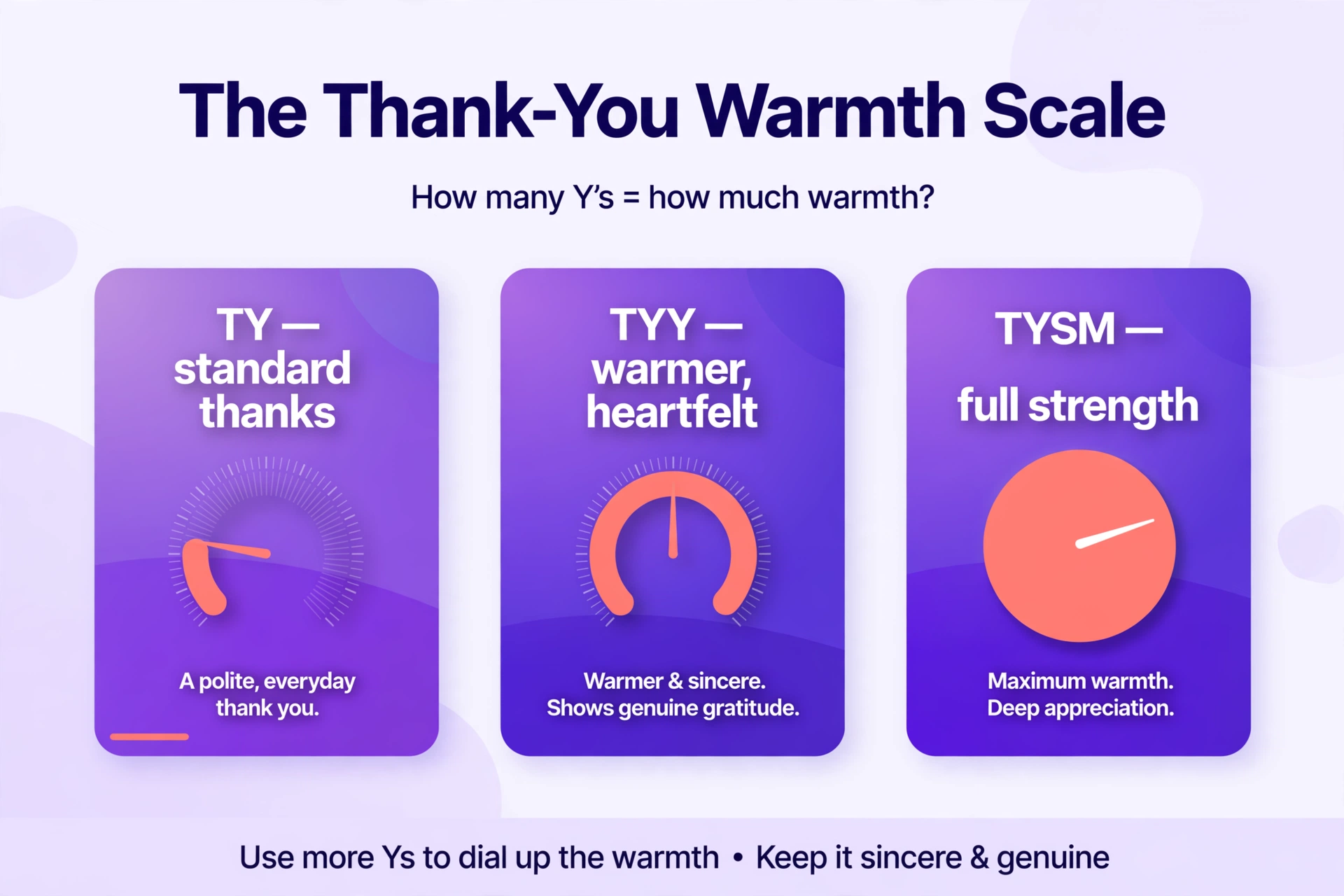
TYY belongs to a family of gratitude abbreviations that differ mostly in warmth. Think of it as a dial:
- TY — the standard “thank you.” Neutral, quick, works everywhere casual.
- TYY — one notch warmer. “Thank you, and I really mean it.”
- TYSM — “thank you so much.” The full-strength version.
The extra y works the same way stretched spellings always work in texting — “yesss,” “noooo,” “soooo.” More letters signal more feeling. So when someone types “tyy” instead of “ty,” they’re telling you the thanks came with genuine warmth, not just politeness.
Some glossaries spell this reading out as “thank you, yeah” or “thank you, yes” — the idea being that the sender is both grateful and in agreement with whatever just happened. That’s one way to interpret the extra warmth, but it isn’t a separate meaning. The core job is the same: a thank-you that lands softer and warmer than a plain TY.
TYY in Realistic Conversations
The exchanges below are illustrative examples, not real messages.
The favor
- A: “I covered your shift on Saturday, don’t worry about it”
- B: “tyy!! you’re actually the best 🥹”
The helpful send
- A: “Here are the notes from today’s class, all yours”
- B: “tyy, you saved my life”
The compliment
- A: “Your presentation was amazing today, seriously”
- B: “tyy, that means a lot coming from you”
The small kindness
- A: “Got you a coffee on my way in ☕”
- B: “tyy!!”
Notice the pattern: TYY shows up right after someone did something kind. It almost always travels with warmth — exclamation marks, emoji, a follow-up sentence about how much it meant. A bare “tyy” is rare; the whole point is the extra feeling.
Where You’ll See It
- One-to-one texts and DMs: the home turf of TYY — thanking friends, family, classmates.
- Group chats: a quick “tyy” when someone shares something useful with everyone.
- Comments and replies: under helpful posts or kind comments, a warm one-word reaction.
- Not for formal messages: work emails, school assignments, messages to teachers or managers. In those places, type the full “thank you.”
What to Send Back
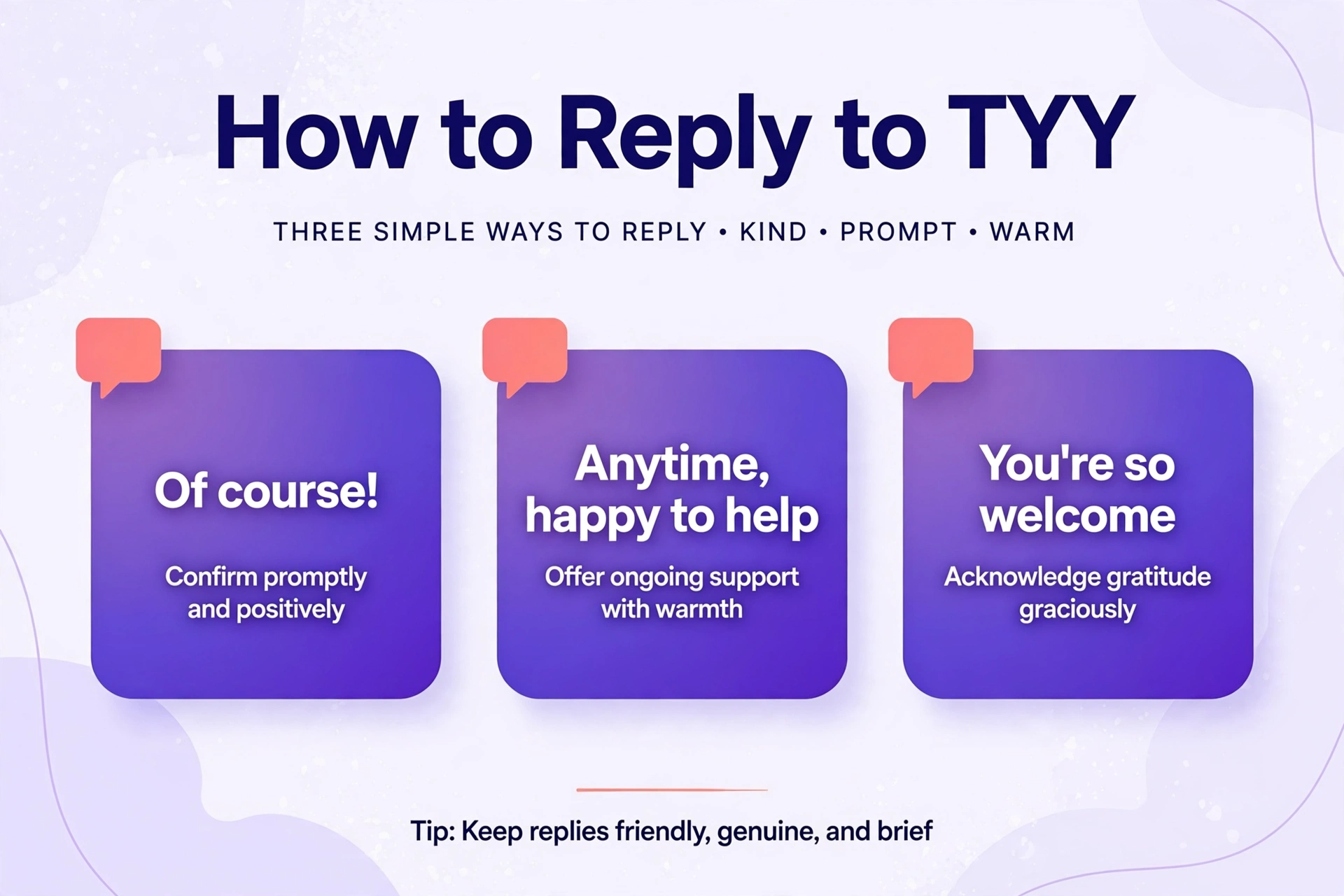
Getting a TYY is easy — someone just thanked you warmly. A short, warm acknowledgment is all it takes.
- “Of course! 💛”
- “Anytime, happy to help”
- “You’re so welcome!”
If the conversation is going somewhere, a couple of handy phrases keep it flowing. A quick alr acknowledges warmly (“alr, glad it helped!”). If they thanked you for information and there’s more to discuss, let me know where to take it next (“tyy for the heads-up” → “of course — lmk if you need anything else”). And when someone’s gratitude feels genuinely heartfelt, a sincere follow-up (FR) matches their energy (“fr, anytime”).
TYY vs. Other Abbreviations
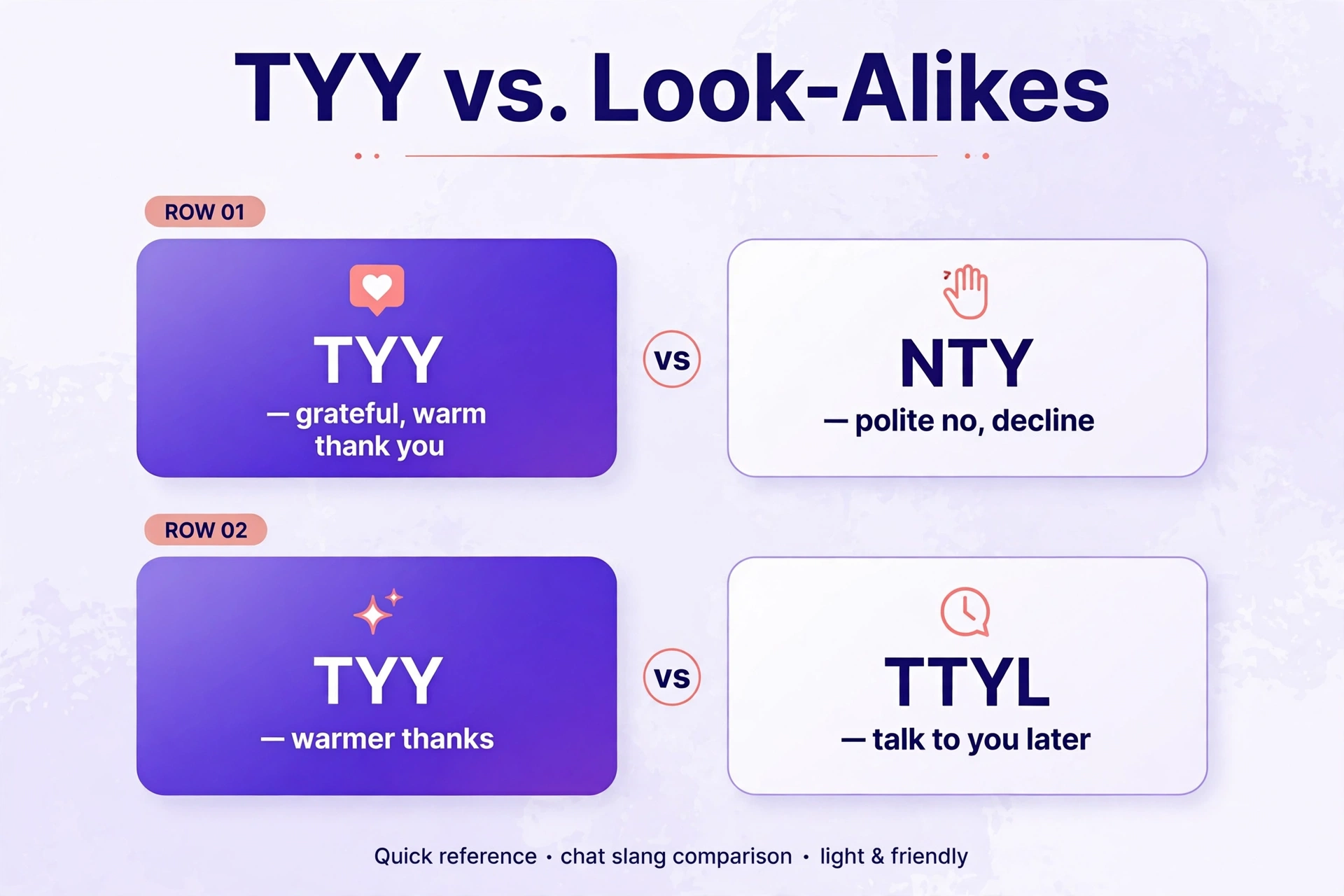
TYY vs. TY. These are siblings, not rivals. TY is the neutral, everyday “thank you”; TYY is the warmer version. Use TY for routine courtesies, TYY when you genuinely feel it. Nobody will misunderstand either — the difference is tone, not meaning.
TYY vs. NTY (no thank you). Easy to confuse at a glance, opposite in meaning. NTY (no thank you) declines an offer; TYY accepts it with gratitude. If someone offers you a ride and you say “tyy,” you’re coming. If you say “nty,” you’re not. Check the first letter before you send.
TYY vs. TTYL. These only collide if you meet the rare “talk to you” reading of TYY. In practice, the farewell job belongs to TTYL (talk to you later). If a conversation is clearly ending and someone writes “tyy,” they might mean “talk to you” — but the thank-you reading is far more established, so read the context carefully.
TYY vs. SMH. Near-opposites in feeling. TYY is warm gratitude; SMH (shaking my head) is disbelief or disappointment. One says “I appreciate you”; the other says “I can’t believe this.” You’d never swap them.
Usage entries on Urban Dictionary document the same core thank-you reading.
What TYY Is Not
It’s not formal. TYY lives in casual chats. In anything professional — emails, applications, messages to people you don’t know well — write “thank you” out in full. An abbreviation can’t carry the same weight.
It’s not universal. Not everyone knows this one. A plain “thanks” is understood by everyone; “tyy” might confuse someone who doesn’t live in texting shorthand. When in doubt, spell it out.
“Talk to you” is a stretch. One glossary suggests TYY can mean “talk to you” as a farewell, but the usage evidence for it is thin — it appears on a single source and clashes with the much better-attested thank-you reading. If a chat is obviously ending, you can allow for it, but assume gratitude first.
It’s not “thank you very much” spelled out. Some pages expand TYY as literally “thank you, yes,” as if it were a fixed phrase. It’s better understood as a stylistic stretch of “thank you” — the meaning is in the warmth, not in a hidden second word.
Frequently Asked Questions
What does TYY mean in a text?
A warmer, more emphatic “thank you” — the elongated, friendlier version of TY.
What’s the difference between TY and TYY?
TY is the standard, neutral “thank you.” TYY adds warmth and sincerity — like saying “thank youuu” out loud.
Is TYY the same as TYSM?
Close. TYSM (“thank you so much”) is the strongest of the family. TYY sits between TY and TYSM in warmth.
Can I use TYY at work?
In relaxed team chats, occasionally. In emails or formal messages, write “thank you” in full.
Is “tyy” different from “TYY”?
Same meaning, different volume. Lowercase reads softer and more casual; uppercase reads more excited.
What does “tyyy” with three y’s mean?
More of the same — even more warmth. Stretched spellings are emphasis, not different words.
How do you respond to TYY?
Warmly and briefly: “of course!,” “anytime,” or “you’re so welcome.”
Is TYY sarcastic?
It can be, like any warm word — “tyy for nothing 🙄” is clearly not grateful. Read the rest of the message.
Does TYY mean “talk to you”?
Almost never. One source lists it as a farewell reading, but the thank-you meaning is far better established. Assume gratitude unless the chat is clearly ending.
The Short Version
TYY is “thank you” with extra warmth — the texting equivalent of stretching the word out when you really mean it. It sits between a neutral TY and a full-strength TYSM, and its job is simple: make gratitude feel genuine. Save the full “thank you” for formal settings, and when someone sends you one, a warm “anytime” is all it takes.