
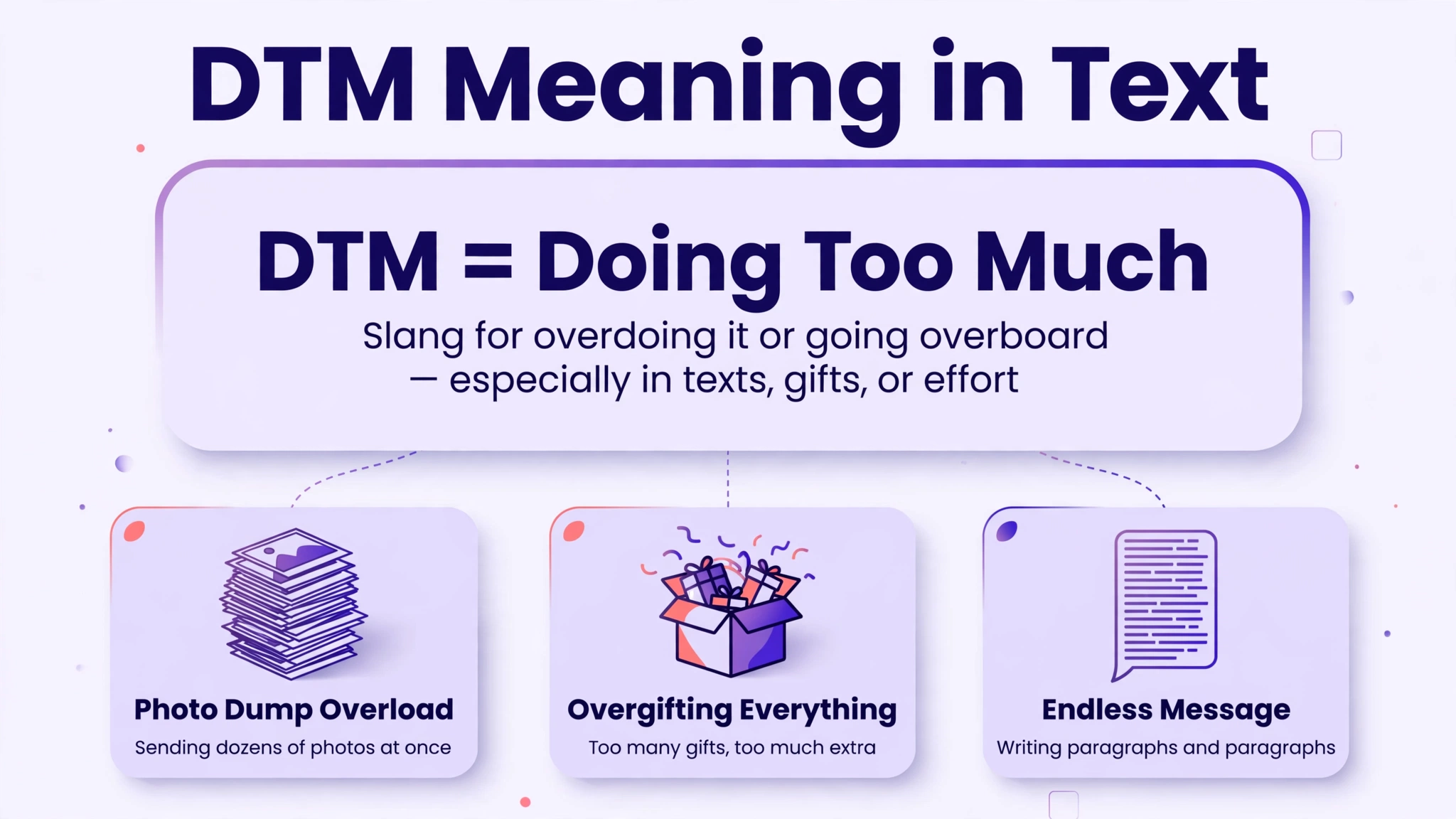
Three letters that work like a raised eyebrow: “you’re dtm.” If someone just sent you that, they’re telling you — playfully or pointedly — that you’re doing too much. If you’re looking up the dtm meaning in text, this guide covers the main meaning, the two other readings that show up in real chats, how to tell them apart, and how to reply without making it weird.
DTM most often stands for “doing too much”: a verdict on behavior that’s extra, over-the-top, or trying noticeably harder than the moment calls for. It’s the texting equivalent of a friend saying “relax” — sometimes affectionate, sometimes a genuine check. But DTM has other lives too, and context is the only reliable decoder.
The Short Answer
| Question | Answer |
|---|---|
| What it means | Most often “doing too much” — being extra, dramatic, or over-the-top |
| What it does | Calls out (or playfully teases) behavior that’s more than the situation needs |
| Other readings | “Down to meet” (up for hanging out) and “dead to me” (cutting someone off) |
| Tone | Playful teasing between friends; pointed or shady when the delivery is flat |
| Where it sits | Usually a reaction — mid-chat, after the behavior it describes |
| Register | Casual only — friends, group chats, comments, DMs |
| Formal alternative | “That’s a bit much” or “You don’t need to go that far” spelled out |
“Doing Too Much”: The Main Meaning
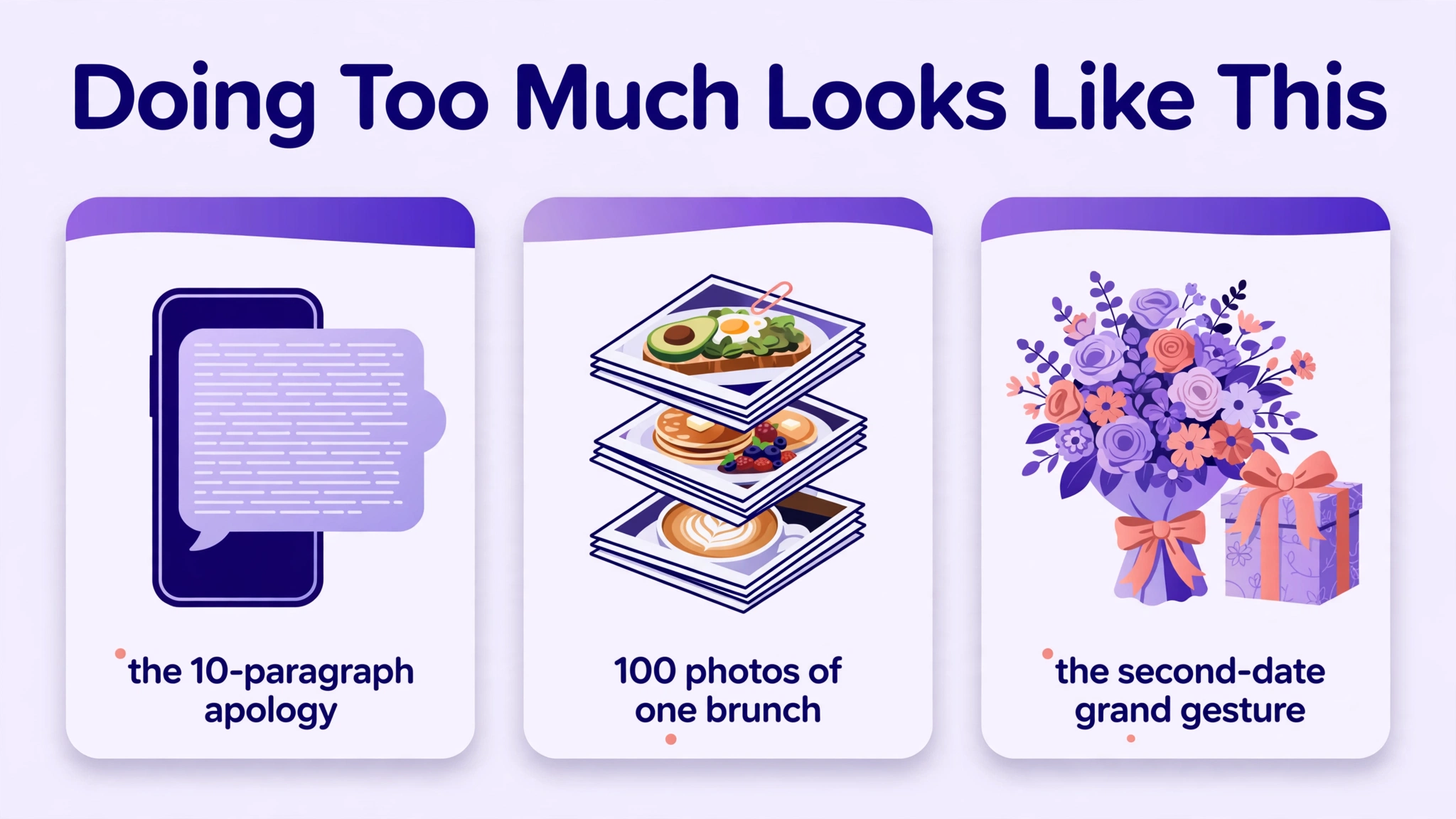
This is the DTM you’ll meet nine times out of ten. “Doing too much” describes effort or drama that overshoots the situation: the ten-paragraph apology for being five minutes late, the hundred photos of one brunch, the grand romantic gesture on a second date. The behavior isn’t bad — it’s just more than the moment asked for.
A few things make this meaning work:
It’s a calibration, not an insult. At its friendliest, “you’re dtm” means “I see the effort, and it’s more than this needs.” People even aim it at themselves — “I hate when I catch myself being dtm” is a real, self-aware use. Owning it is part of the slang’s charm.
It travels with “extra.” DTM and “extra” describe the same territory: over-the-top, theatrical, more than necessary. If you’d call the behavior extra, you could call it dtm.
The shade is adjustable. With a laughing emoji, it’s a roast between friends. Delivered flat — “ok you’re dtm.” — it shades into genuine criticism, close to calling someone dramatic. Same letters, different temperature, decided entirely by delivery and relationship.
The phrase “doing too much” has circulated in slang dictionaries since around 2017, and DTM rode the same wave as other three-letter verdicts like SMH — short enough to drop into a chat as a complete reaction.
The Other Two Readings: “Down to Meet” and “Dead to Me”
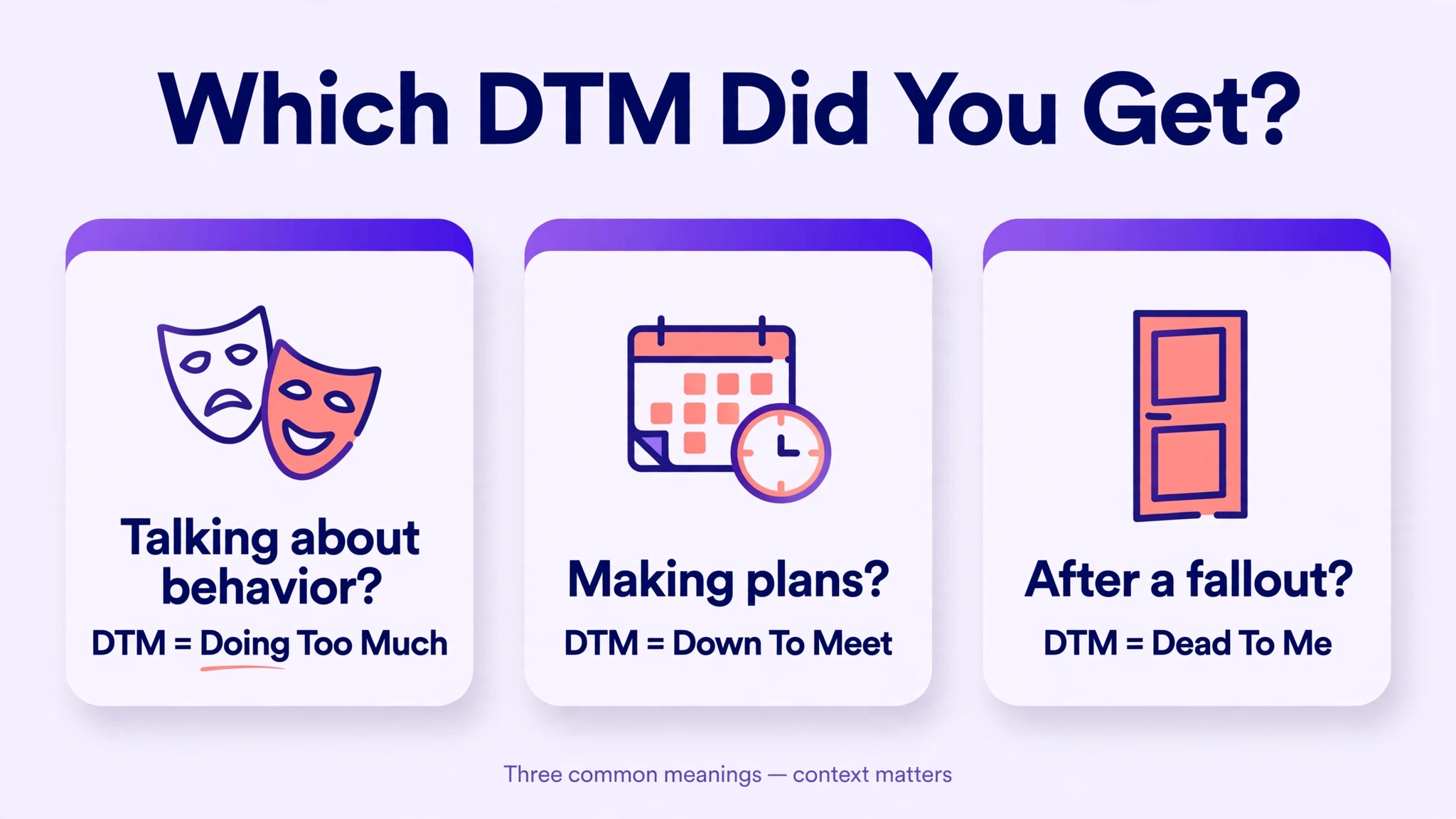
DTM’s letters got borrowed for two other phrases, and both appear in real chats:
“Down to meet” — the plans reading. “You dtm for lunch at 3?” Here DTM means up for meeting — a casual yes-in-waiting, the same family as WYA (“where you at?”) when friends are coordinating. It shows up around plan-making: times, places, “are you dtm Saturday?”
“Dead to me” — the cutoff reading. “After that, he’s dtm.” This one is heavier: the person is written off, done, no longer in your life. It appears after betrayals and fallouts, usually with “to me” or “for me” nearby (“she’s dtm for me”). It’s dramatic by design — most people who type it are venting, not filing paperwork.
A fourth reading, “don’t touch me,” surfaces occasionally as a playful boundary — “ew, your hands are freezing, dtm!” It’s joking, physical, and usually obvious from the moment. Treat it as a minor reading, not a main one.
How to Tell Which DTM You Got
The three main readings live in different kinds of conversation, which makes them easier to separate than they look:
- Talking about someone’s behavior? → “Doing too much.” (“She planned the whole wedding after one date — dtm.”)
- Making plans, with a time or place in play? → “Down to meet.” (“Dtm for Saturday?”)
- Talking about a fallout, a betrayal, a door closing? → “Dead to me.” (“He lied again. He’s dtm.”)
Grammar helps too. “You’re dtm” and “that’s dtm” judge behavior. “I’m dtm” before plans means willingness. “He’s dtm to me” names a cutoff.
If it’s still unclear, asking is cheap: “dtm as in doing too much or down to meet?” Nobody faults the clarification — the acronym genuinely carries both.
DTM in Real Conversations
The exchanges below are illustrative examples, not real messages.
The friendly roast
- Alex: (sends a 12-message breakdown of a two-line email from their boss)
- Sam: “bestie you’re dtm 😂 it said ‘ok thanks'”
Sam isn’t angry — the laugh carries it. Alex overshot, Sam calibrated, friendship intact.
The self-aware version
- Jordan: “I color-coded our trip spreadsheet and made a backup spreadsheet”
- Riley: “that’s… organized”
- Jordan: “I know, I’m dtm, I accept it”
Self-directed DTM is disarming. Naming your own excess before anyone else does turns a roast into a joke you’re in on.
The plan check
- Casey: “a few of us are getting food around 7, you dtm?”
- Morgan: “yeah I’m dtm, lmk where”
Here DTM means “down to meet” — the plan, the time, and the follow-up question all point the same way.
The cutoff
- Taylor: “found out he was talking about me behind my back the whole time”
- Jamie: “yeah he’s dtm after that. done.”
No laugh, no ambiguity. In fallout context, DTM is the door closing.
Being Called DTM: How to Take It (and Reply)
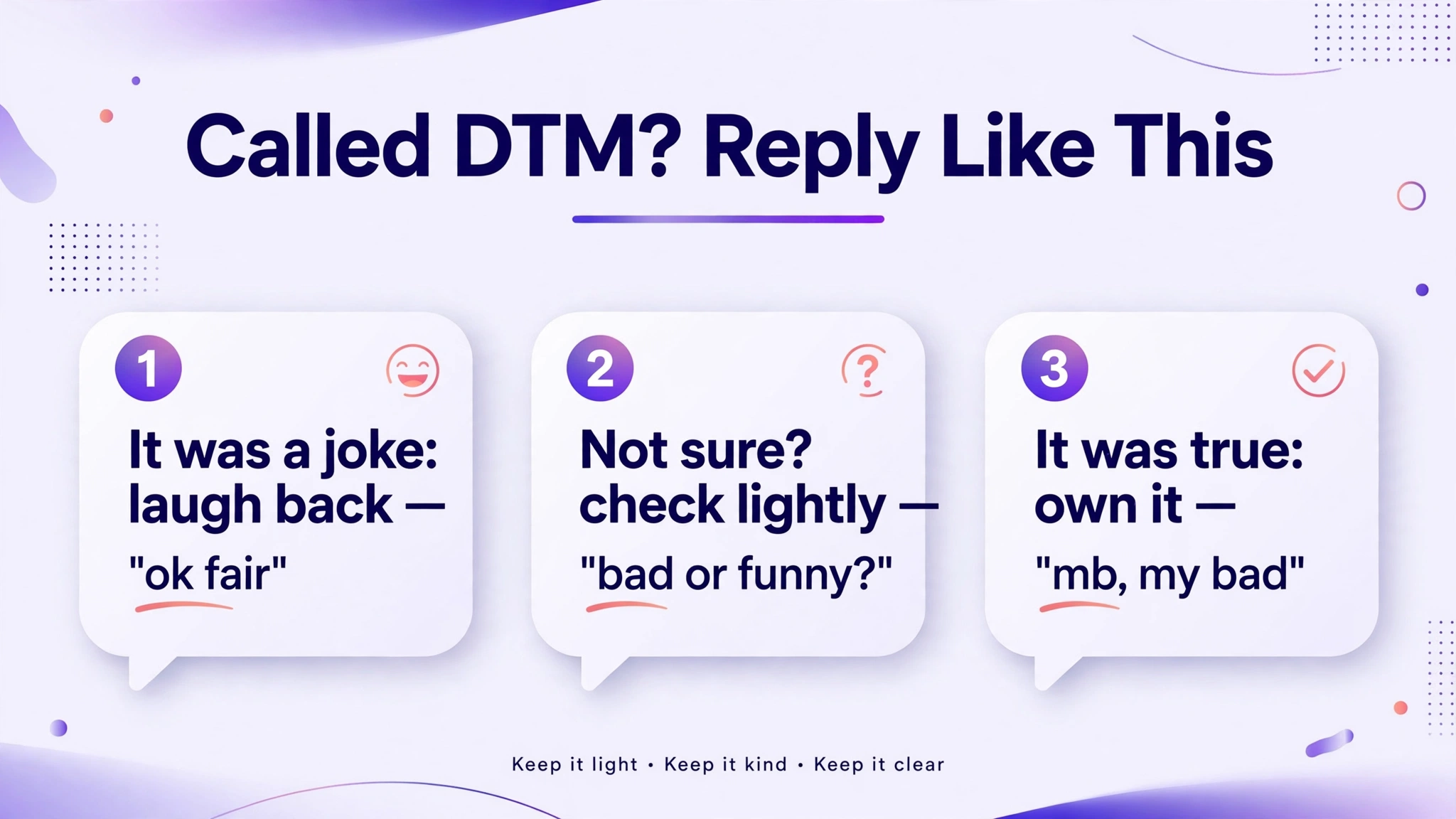
If it came with laughter, laugh back. “😭 ok fair” is the complete correct reply. The roast only lands if you get defensive; agreeing playfully ends it in one message.
If you’re not sure it was a joke, check lightly. “dtm bad or dtm funny?” gives them an easy out either way.
If it stung, say so plainly. “Hey, that actually bothered me” beats silently simmering — DTM is supposed to be small change. Most senders recalibrate instantly.
If you were doing too much, own it fast. A quick “mb 😅” (“my bad”) is the classic recovery: acknowledge, shrink the effort, move on. And if the conversation itself needs to end, GTG is the graceful exit — “gtg, talk later” — not a sulky silence.
What not to do: don’t escalate. Replying to “you’re dtm” with a furious paragraph is, definitionally, doing too much. The acronym wins every argument conducted at that length.
DTM vs. Its Neighbors
DTM vs. SMH. SMH (“shaking my head”) reacts to something foolish or disappointing; DTM judges something excessive. The keys locked in the car get an “smh.” The dramatic re-enactment of locking them in gets a “dtm.”
DTM vs. OML. OML (“oh my lord”) is pure reaction — surprise, exasperation, disbelief. DTM adds a verdict: not just “wow,” but “wow, that was more than needed.”
DTM vs. IDC. Opposite energies. “Idc” (“I don’t care”) signals too little investment; DTM accuses someone of too much. A chat can contain both: “you’re dtm about the seating chart and I genuinely idc.”
DTM vs. “extra.” Same meaning, different format. “Extra” is the adjective spelled out; DTM is its compressed, text-native form. If a WTW (“what’s the word?”) check-in gets a one-word reply of “dtm,” you know the conversation is heading toward a roast.
Where DTM Works and Where It Doesn’t
Where it works: close friends, group chats, comment sections, sibling dynamics — anywhere teasing is an established dialect and everyone knows the roast rules.
Where it fails: with a manager, a client, a teacher, or anyone whose effort you’re not positioned to judge. “You’re dtm” upward reads as disrespect, not banter. In professional settings, the letters also collide with real acronyms — in fashion and textiles, DTM means “dyed to match” — another reason to spell things out at work.
The gray zone: newer friendships and group chats you’re still reading. If you haven’t seen the group roast anyone yet, don’t be the first to try. DTM as a first impression can read as judgment from a stranger.
Quick Answers
What does DTM mean in text?
Most often “doing too much” — a playful or pointed way to say someone is being extra, dramatic, or over-the-top. It can also mean “down to meet” when making plans, or “dead to me” after a fallout.
Is DTM an insult?
Usually not a serious one. Between friends it’s teasing about effort or drama. Delivered flat in a tense conversation, it can land as real criticism — delivery decides.
What does “I’m DTM” mean?
Read the context. Around plans (“I’m dtm Saturday”), it means “I’m down to meet.” Aimed at yourself after overdoing something, it means “I’m doing too much” — the self-aware version.
What’s the difference between DTM and “dead to me”?
“Dead to me” is one of DTM’s readings — the cutoff one. If DTM follows talk of betrayal or a fallout (“he’s dtm to me now”), that’s the meaning. On its own after someone’s behavior, it’s “doing too much.”
How do I reply when someone calls me DTM?
Lightly. “😭 fair” or “mb 😅” closes it. If it genuinely stung, say so once, plainly — most people recalibrate immediately.
Can DTM mean “don’t touch me”?
Occasionally, as a playful, in-the-moment boundary (“ew, cold hands, dtm!”). It’s a minor reading — obvious from physical context when it appears.
Should I use DTM at work?
No. It’s casual slang, and the letters have professional meanings elsewhere (“dyed to match” in textiles). Spell out “happy to meet” or “that’s more than we need.”
Is DTM the same as “extra”?
Essentially, yes. “Extra” is the spelled-out adjective; DTM is the compressed texting form of “doing too much.”
The Short Version
DTM is “doing too much” — three letters that call out effort or drama that overshoots the moment, playfully between friends and pointedly when flat. Its letters also carry “down to meet” in plan-making and “dead to me” after a fallout, and context separates them cleanly: behavior talk, plan talk, or fallout talk. Take the roast lightly, own it fast if it’s true, and never answer “you’re dtm” with a ten-paragraph defense. That’s the one reply that proves it.
