
Three letters people type when “wow” and “seriously?” stop being strong enough: “jfc.” If you’ve seen it under a post, in a gaming chat, or from a friend having a day, you’ve met the internet’s heavy-duty exclamation. If you’re looking up the jfc meaning in text, this guide explains what it stands for, what it actually does in a conversation, where it sits on the reaction scale, and why it’s the one acronym in this family you should think twice about before using.
JFC stands for “Jesus f*cking Christ.” It’s an exclamation of frustration, disbelief, shock, or exasperation — the typed version of throwing your hands up. Almost nobody typing it is making a religious statement; it’s emotional punctuation, deployed when something is too ridiculous, too broken, or too much to respond to normally. But because it combines strong profanity with a religious name, it carries more weight — and more risk — than its milder cousins.
The Short Answer
| Question | Answer |
|---|---|
| What it means | “Jesus f*cking Christ” — a profane exclamation of frustration, shock, or disbelief |
| What it does | Works as emotional punctuation: marks a reaction too strong for “wow” or “seriously?” |
| Tone | Intense; venting, exasperated, sometimes sarcastic or exaggerated for comedy |
| Where it sits | Usually opens a message (“jfc, not again”) or stands alone as the whole reaction |
| Register | Very informal only — close friends, gaming, unfiltered online spaces |
| Formal alternative | “Unbelievable,” “Seriously?,” or “I can’t believe this” spelled out |
What JFC Actually Does in a Conversation
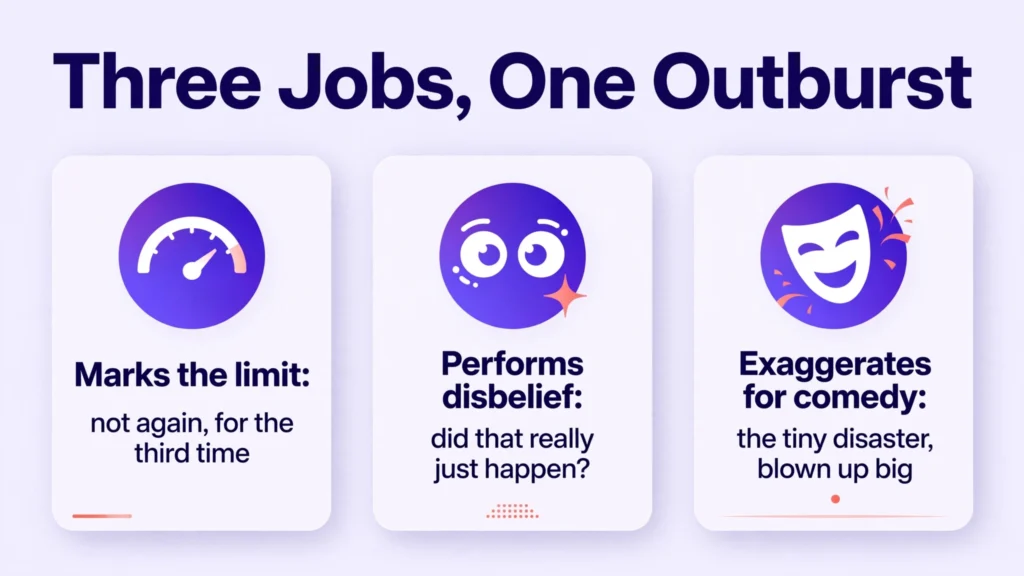
JFC isn’t information — it’s pressure release. Where most acronyms say something, JFC vents something. Understanding it means understanding the three jobs it performs:
It marks the limit. “Jfc, the server’s down again” doesn’t just report an outage; it reports that this outage arrived on top of the last four. JFC is cumulative — it usually appears when something has happened once too often, or all at once.
It performs disbelief. “Jfc, did he really say that in the meeting?” The thing being reacted to beggars belief, and the acronym registers that ordinary reactions (“wait, what?”) are insufficient.
It exaggerates for comedy. Used sarcastically, JFC blows a tiny inconvenience into a catastrophe: “jfc, my sandwich fell apart 😭.” The gap between the huge reaction and the small event is the joke. This melodramatic use is common in group chats, where everyone understands the scale is fake.
Notice what all three share: JFC is almost never aimed at the person you’re typing to as an attack. It’s aimed at a situation — a crash, a headline, a ridiculous turn of events — or at the sender themselves (“jfc, I can’t believe I just did that”). That target matters for how it lands.
Where JFC Sits: The Reaction Scale
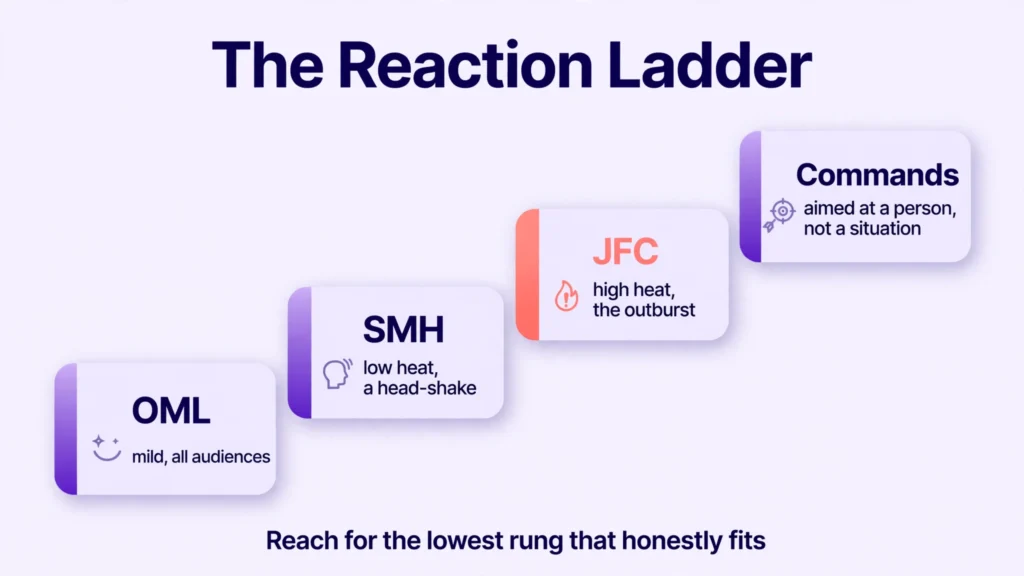
Reaction acronyms form a rough intensity ladder, and JFC sits near the top:
- OML — “oh my lord.” The mild, all-audiences cousin. Exasperation and surprise with no profanity at all — the one you can send your aunt.
- SMH — “shaking my head.” Low heat: disappointment and disbelief, expressed with a head-shake rather than an explosion.
- JFC. High heat. Profanity plus a religious name gives it a double charge neither of the above carries. It’s the reaction for when the milder rungs have been climbed and found wanting.
- STFU territory. The commanding end of strong slang — but STFU is an order to another person, while JFC is an outburst about a situation. Different weapons: one points at a person, the other at the world.
The practical lesson of the ladder: reach for the lowest rung that honestly fits. Most moments that feel JFC-sized in the instant are OML-sized by tomorrow. And when the moment passes and the acronym looks oversized, a quick MB (“my bad”) is the standard repair.
Why It Stays Abbreviated
The spoken exclamation JFC abbreviates has been around far longer than the internet — people have sworn this way for generations. The three-letter form is a creature of typing: it appeared in early chatrooms, forums, and instant messaging, where speed mattered and full profanity was both slower and more likely to be filtered or frowned on.
The abbreviation does real work:
- Speed. Three letters at the exact moment of frustration.
- A small layer of cover. The initials are one step removed from the words — still unmistakable to anyone who knows, but less confrontational on the screen than the full phrase spelled out.
- Tone control. Lowercase “jfc” reads weary and muttered; full-caps “JFC” reads shouted. The casing carries the volume.
Interestingly, when people expand the acronym out loud or in polite company, the middle word often gets swapped for the softer “freaking.” That tells you something about the original: even its own users treat the full-strength version as a lot.
JFC in Real Conversations
The exchanges below are illustrative examples, not real messages.
The limit reached
- Alex: “the update deleted everyone’s saved files”
- Sam: “jfc. third time this month.”
Aimed at the situation, cumulative frustration. Nobody in this exchange is being sworn at.
The self-own
- Jordan: “I just sent the meme to my boss instead of the group chat”
- Jordan: “jfc, I can’t believe I did that”
JFC turned inward. The sender is their own target — frustration mixed with disbelief at themselves.
The comedy exaggeration
- Casey: “my sock has a hole in it”
- Morgan: “jfc, tragic, cancel the day 😭”
The melodrama is the joke. The laughing-crying emoji and the absurd scale signal that nobody is actually upset.
The disbelief reaction
- Taylor: “he tried to pay for the car in coins. all of it.”
- Jamie: “JFC.”
Full caps, standalone, period implied. Sometimes JFC is the entire message — the situation left nothing else to say. (Compare a WTW — “what’s the word?” — which would ask for more story; JFC declares the story already too much.)
The Offense Question, Honestly
This is the section most guides rush. JFC combines two things that each bother some people — strong profanity, and a religious name used as a swear. For many Christians in particular, the second part registers as blasphemy, not just rudeness. That doesn’t change what the sender meant (usually nothing religious at all), but meaning travels with an audience attached.
Practical rules that follow from that:
- Know the room. In a group chat of close friends with established swearing norms, JFC is unremarkable. In a family chat, a mixed group, or anywhere faith is present and respected, it’s a genuine risk of real offense — not performative offense.
- Never at work, ever. Not in Slack, not in email, not in the “casual” channel. It’s the kind of thing that screenshots well and explains badly. (CBF — “can’t be f*cked” — lives in the same never-at-work family.)
- Public posts are forever-ish. Dropping JFC under a viral post is common, but it attaches to your name and your judgment in a way a private chat doesn’t.
- If you offended someone, repair simply. “Sorry — that was careless” beats a lecture about how it’s “just slang.” The MB reflex again: own it small, own it fast.
None of this makes JFC forbidden knowledge — it’s everywhere online, and recognizing it is a normal literacy skill. It just makes it a deliberate choice rather than a casual one.
Other JFCs You Might Meet
Outside texting, the initials have unrelated, perfectly neutral jobs:
- Java Foundation Classes — a term from software development (Java’s GUI framework history).
- Joint Force Commander — a military role.
- Junior Football Club — appears in sports contexts.
You will essentially never meet these in a chat, and nobody ends a frustrating day with “Joint Force Commander.” But if a search result or a work document confuses you, those are the alternate tenants of the initials. In a text message, the slang reading wins every time.
How to Reply When Someone Drops a JFC
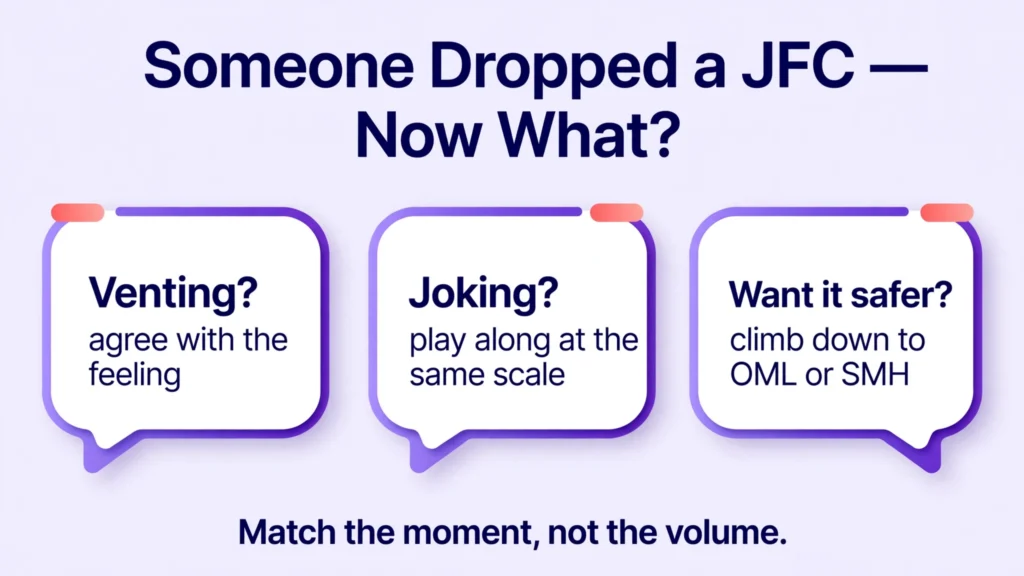
- They’re venting about a situation: agree with the feeling. “Right?? It’s ridiculous” validates without matching the profanity — usually what a vent actually wants.
- It’s the comedy version: play along at the same fake scale. “Thoughts and prayers for the sandwich” keeps the bit going.
- They’re swearing at their own mistake: reassure, don’t pile on. “Happens to everyone — did you fix it?” helps more than echoing the outburst.
- It was aimed at you (rare): don’t return fire in the moment. “Okay — what’s actually wrong?” moves from heat to information. If the chat is genuinely lost, a calm GTG exit beats a shouting match.
- It landed in the wrong room: a light redirect protects the sender too — reply on a different thread, change the subject, move on.
- You want the same feeling, safer: reach down the ladder — OML and SMH cover most JFC moments at a fraction of the risk.
Quick Answers
What does JFC mean in text?
“Jesus f*cking Christ” — a strong exclamation of frustration, shock, disbelief, or exasperation. It works as emotional punctuation, usually aimed at a situation, not a person.
Is JFC offensive?
It can be. It combines strong profanity with a religious name, which many people — especially religious people — experience as blasphemous. In close-friend chats it’s routine; in mixed, family, or work settings it can genuinely offend.
What does “JFC” mean when it’s about something small?
Melodrama. Used on tiny inconveniences (“jfc, my sandwich fell apart”), it’s deliberate exaggeration — the comedy is in the oversized reaction.
Is JFC stronger than OMG or OML?
Much stronger. OML (“oh my lord”) and OMG are mild, all-audience reactions. JFC sits near the top of the intensity scale, alongside the strongest reaction slang.
Can JFC mean something else?
In technical or formal contexts, yes: Java Foundation Classes, Joint Force Commander, or Junior Football Club. In a text message, it’s the exclamation, essentially every time.
How is JFC different from STFU?
Direction. JFC is an outburst about a situation (“jfc, not again”); STFU is a command aimed at a person. One vents, the other orders.
Should I use JFC at work?
No. Not in any channel, not even the casual one. Use “unbelievable,” “seriously?,” or OML instead.
Why do people type the initials instead of the words?
Speed, filtering, and a layer of distance. The abbreviation delivers the same vent at three letters, slightly softened by not being spelled out — though everyone who knows, knows.
The Short Version
JFC is “Jesus f*cking Christ” — the heavy-duty exclamation of texting, typed when frustration, disbelief, or sheer ridiculousness outgrows the mild reactions. It vents at situations (and sometimes at the sender), exaggerates for comedy in friendly chats, and sits near the top of the intensity ladder — above OML and SMH, in the neighborhood of the strongest slang there is. Use it deliberately: the right room hears emphasis; the wrong room hears blasphemy. When in doubt, climb down a rung — the feeling survives the trip, and so does everyone’s day.
