
WDYM always expands to the same four words — “what do you mean?” Wiktionary lists it as the initialism of that question, and Dictionary.com defines it as asking for clarification or asking someone to define what they said. The letters never change. What changes is the delivery, and delivery is where every misunderstanding lives.
A bare “wdym” in a homework chat is a genuine question. The same letters with your own words quoted back at you — “wdym you can’t come??” — are not a question at all; they’re a challenge. And “wdym 😭” under a compliment is neither: it’s an invitation to keep talking. The real wdym meaning in text lives in that delivery, so this guide decodes it — each common form of WDYM, what it most likely signals, and the reply that fits it.
The Delivery Decoder
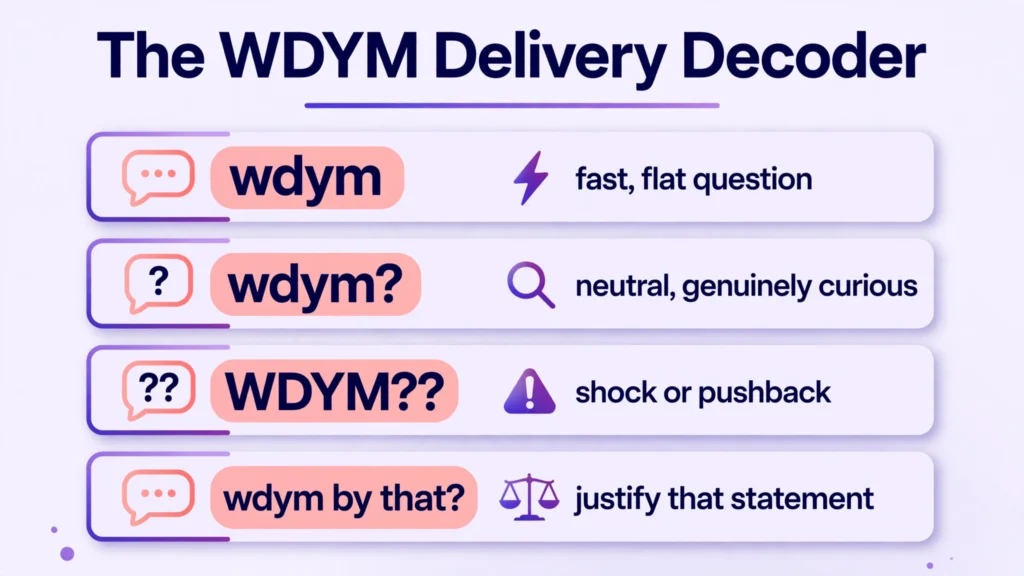
Because text strips out voice and facial expression, the furniture around WDYM — case, punctuation, emoji, extra words — carries the tone. Read it like this:
| The form you got | What it usually signals | Your best move |
|---|---|---|
| wdym (bare, lowercase) | A fast, flat clarification request; blunt only if the chat is already tense | Restate your point in simpler words |
| wdym? | The neutral default — genuinely curious, no edge | Answer plainly and add the context you skipped |
| WDYM?? | Shock, disbelief, or pushback — the strongest reaction form | Clarify your intent first, facts second |
| wdym by that? | The sharpest common form — “justify that statement” | Give the specific reasoning, calmly |
| wdym + your words quoted back | A challenge, not a question (“wdym I never call?”) | Address the complaint underneath, don’t just re-explain |
| wdym 😂 / 😭 / lol | Playful or dramatic — the emoji is doing the softening | Match the lightness; elaborate or play along |
Two things this table can’t show: the relationship (a bare wdym from your best friend and one from a near-stranger are different objects) and the sentence before it. Form first, context always.
The Three WDYM’s
Underneath the punctuation, almost every WDYM is doing one of three jobs.
1. The genuine question
The sender missed something — a fact, a reference, a step in your logic. This is the dictionary use, and it’s the most common one in help contexts: study groups, planning chats, tech support from a friend.
A: the 9:40 bus doesn’t run on sundays anymore
B: wdym
A: new schedule started this month. the 9:40 is weekdays only
Nothing is wrong here. B lacked a piece of information; A supplied it in different words than the first attempt. Notice A didn’t just repeat the original sentence louder — that’s the whole skill, and it gets its own section below.
2. The playful echo
Here the sender understood perfectly well — they want you to say more. It shows up after compliments, hints, and dramatic statements:
A: you looked nice today btw
B: wdym? 🙈
B isn’t confused. The wdym is a keep-talking signal — part modesty, part invitation. This is also where claims that “WDYM is flirty” come from, and they’re half right: in an already-flirty exchange, a playful wdym can absolutely function that way. But the flirting lives in the conversation and the emoji, not the letters. WDYM has no secret romantic meaning; Dictionary.com gives it a clarification job and a rhetorical one, and that’s the full list.
A close relative is the dramatic echo — “wdym he’s moving?? 😭” — where the sender heard you fine and is performing their shock. The reply they want is the story, not a re-explanation.
3. The challenge
The rhetorical use Dictionary.com names outright: WDYM deployed not to learn something but to dispute it. Its fingerprints are the quote-back (“wdym the test was easy, it was impossible”), the by-that form, and a chat that was already warm. How-To Geek describes this use as pointing out that what the other person said “makes no sense or is blatantly incorrect.”
The classic trigger is a loaded, dismissive statement — drop an IDC on someone mid-disagreement and “wdym?” is the sound of them picking it up. In challenge mode, WDYM means: defend that. Answering it with a flat factual restatement — as if they’d asked a homework question — reads as dismissive and pours fuel on it.
Help Question or Argument? The Split That Decides Your Reply
This is the distinction no definition site bothers to make, and it’s the one that actually prevents fights.
In a help context, wdym asks for a concept to be re-explained. The stakes are zero and nobody is accused of anything. The good reply re-teaches differently: a simpler analogy, the missing step, an example. Repeating the identical explanation is the one useless move.
In an argument context, wdym asks for a defense. The sender’s real message is “that claim about me / that decision isn’t fair.” The good reply addresses intent and the underlying complaint first (“I didn’t mean you’re lazy — I meant Saturday specifically”), and only then the facts.
Misread the contexts and both directions fail. Treat an argument-wdym as a homework question and you sound cold. Treat a homework-wdym as an attack and you’ve started an argument with a classmate who just wanted the bus schedule explained. When you genuinely can’t tell which one you received, the tiebreaker is the quote-back: confusion rarely quotes you; challenges almost always do.
Tone combinations muddy this further — a frustrated SMH paired with wdym (“wdym smh”) signals the challenge end of the scale, while adding FR (“wdym fr”) marks it as a serious, for-real request to explain yourself.
How to Answer a WDYM (Without Making It Worse)
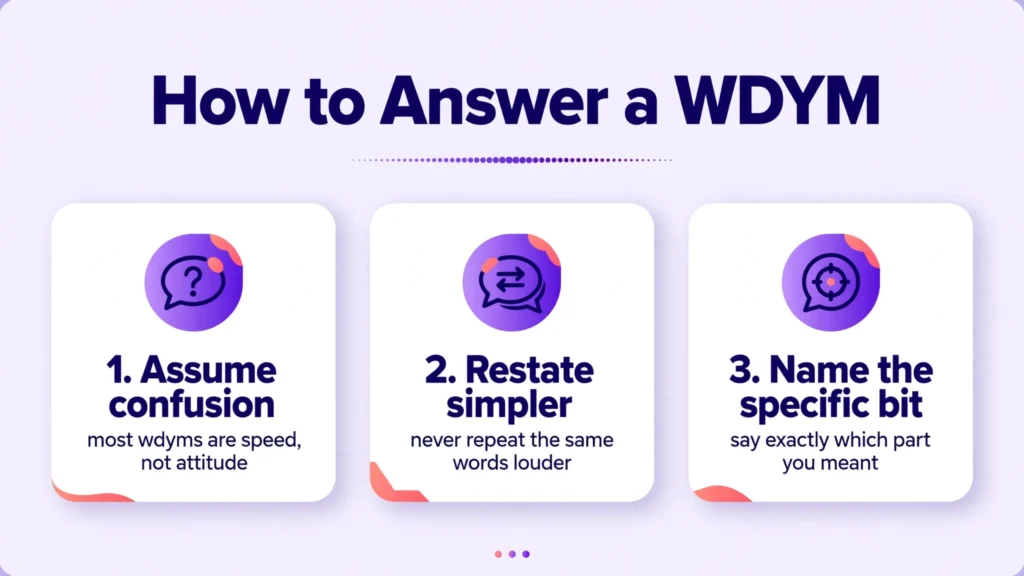
Someone sent you a wdym. Whatever its mode, this sequence works:
- Assume confusion before attitude. Most bare wdyms are speed, not hostility. Answering a real question defensively manufactures the argument you feared.
- Restate simpler — never repeat louder. The original wording is what failed. Swap in plainer words and the context you skipped: not “THE BUS DOESN’T RUN ON SUNDAYS” but “sorry, I should’ve said — the weekend schedule changed last month.”
- Name the specific bit. “I meant the deadline, not the quality” beats re-sending the whole message. Precision is what the question is asking for.
- If it was a joke, explain the joke briefly or let it die. A one-line “it’s from that video where—” works; a paragraph of lore doesn’t.
- Close the loop. After you’ve clarified, a light LMK (“lmk if that makes sense now”) hands the conversation back without hovering.
And if their wdym was the challenge kind? Add one step in front: lower the temperature first (“not coming at you — I meant…”), then clarify. Order matters; facts delivered into heat get heard as attacks.
Sending WDYM Without Starting Something
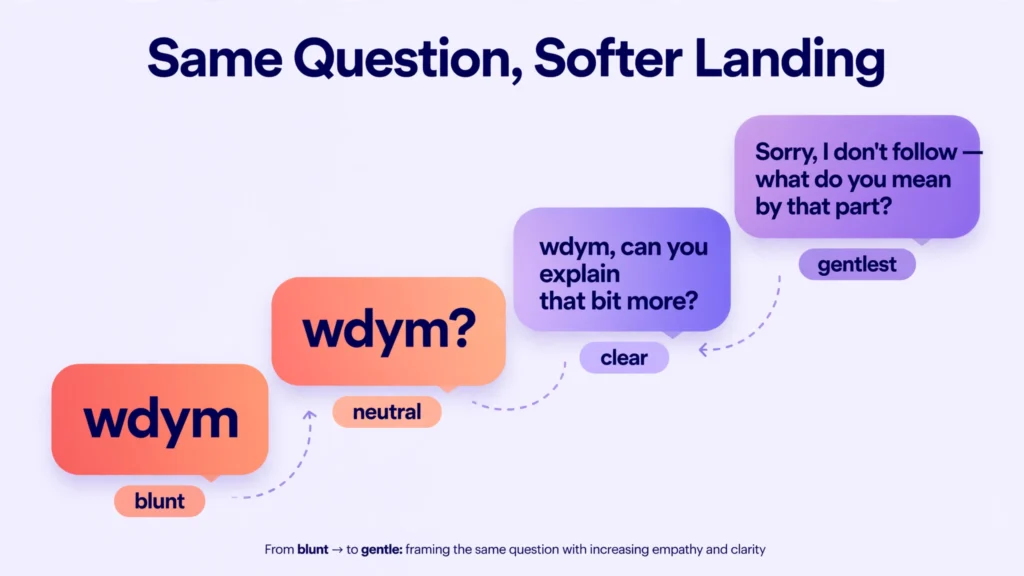
Sometimes you’re the one who’s confused. Bare “wdym” is efficient with friends and risky everywhere else, because the recipient can’t hear your tone either. Cheap insurance, in ascending order of softness:
- Add the question mark. “wdym?” is the neutral default; the bare form is the one that reads flat.
- Add the furniture. An emoji or a follow-up — “wdym 😅” or “wdym, can you explain that bit more?” — makes curiosity visible.
- Spell it out. “What do you mean by that?” in full words lands noticeably softer than the initialism, every time.
- Use the full softener when it matters: “Sorry, I don’t follow — what do you mean by that part?” Nobody has ever started a fight with that sentence.
At work or with anyone formal, skip the initialism entirely: “Could you clarify?” is the professional form of the same question, and it never needs decoding.
WDYM vs. WYM — and the Rest of the W-Family
WYM is WDYM with the “do” dropped: “what you mean.” Same question, same rhetorical use — references like ProWritingAid treat WDYM as simply the more complete form, and the shorter WYM can feel a touch sharper or more casual. One caution the similarity hides: WYM carries a second, unrelated sense — “watch your mouth,” said in reply to an insult. WDYM does not share that meaning, so never read it into the longer form.
And if plain WDYM is the polite end of this family, its profane cousin FYM is the other end — the same “what do you mean” demand with the aggression spelled in. If a message feels hostile, check which of the two you actually received before reacting.
The W-questions readers most often mix up:
- WTD — “what’s the deal / what to do”: asks about a situation or plan, not about your meaning.
- WTW — “what’s the word”: a greeting or “what’s happening,” the opposite direction from WDYM.
- WYA — “where you at”: asks about location, not meaning.
WDYM is the only one of the four that points backward at something already said.
Quick Answers
What does WDYM mean in text?
“What do you mean?” — an initialism used to ask for clarification, per Wiktionary and Dictionary.com. Dictionary.com adds that it’s also used rhetorically, to dispute what someone said.
Is WDYM rude?
Not by default. A bare wdym is a fast question; WDYM??, “wdym by that?”, or a quote-back in a tense chat is where it turns into a challenge. Delivery and relationship decide.
What does WDYM mean from a girl or a guy?
Exactly the same thing. Every reference that addresses the question says the meaning doesn’t change with the sender — read the conversation, not the sender.
What is WDYM on TikTok or Snapchat?
The same as everywhere else: “what do you mean?” No platform gives it a different definition — a point NapoleonCat’s social media dictionary makes explicitly. Context changes the tone, not the meaning.
WDYM vs. WYM — what’s the difference?
Completeness, mostly. WYM drops the “do” (“what you mean”). Same question; WYM reads slightly more casual, and it alone can also mean “watch your mouth.”
Is WDYM flirty?
The letters aren’t. In an already-flirty conversation, a playful “wdym? 🙈” after a compliment works as a keep-talking signal — but that’s the context flirting, not the abbreviation.
How old is WDYM?
Old enough to be boring: the first Urban Dictionary definition is dated 2007 and already reads “What Do You Mean?” Anyone claiming a recent coinage is selling you something.
Read the Delivery, Not Just the Letters
WDYM is the rare abbreviation whose dictionary entry is the easy part. “What do you mean” can be a student stuck on step two, a friend fishing for the rest of the story, or the first formal shot of an argument — and the four letters are identical in all three. Check the punctuation, check for the quote-back, check what kind of conversation you’re in. Then reply to the one you actually got.
