
Someone drops “FYM?” into a chat and the whole conversation freezes for a second. Is that person joking? Angry? Genuinely confused? The three letters carry a surprising amount of weight, and reading them wrong can turn a friendly chat into an argument in one message.
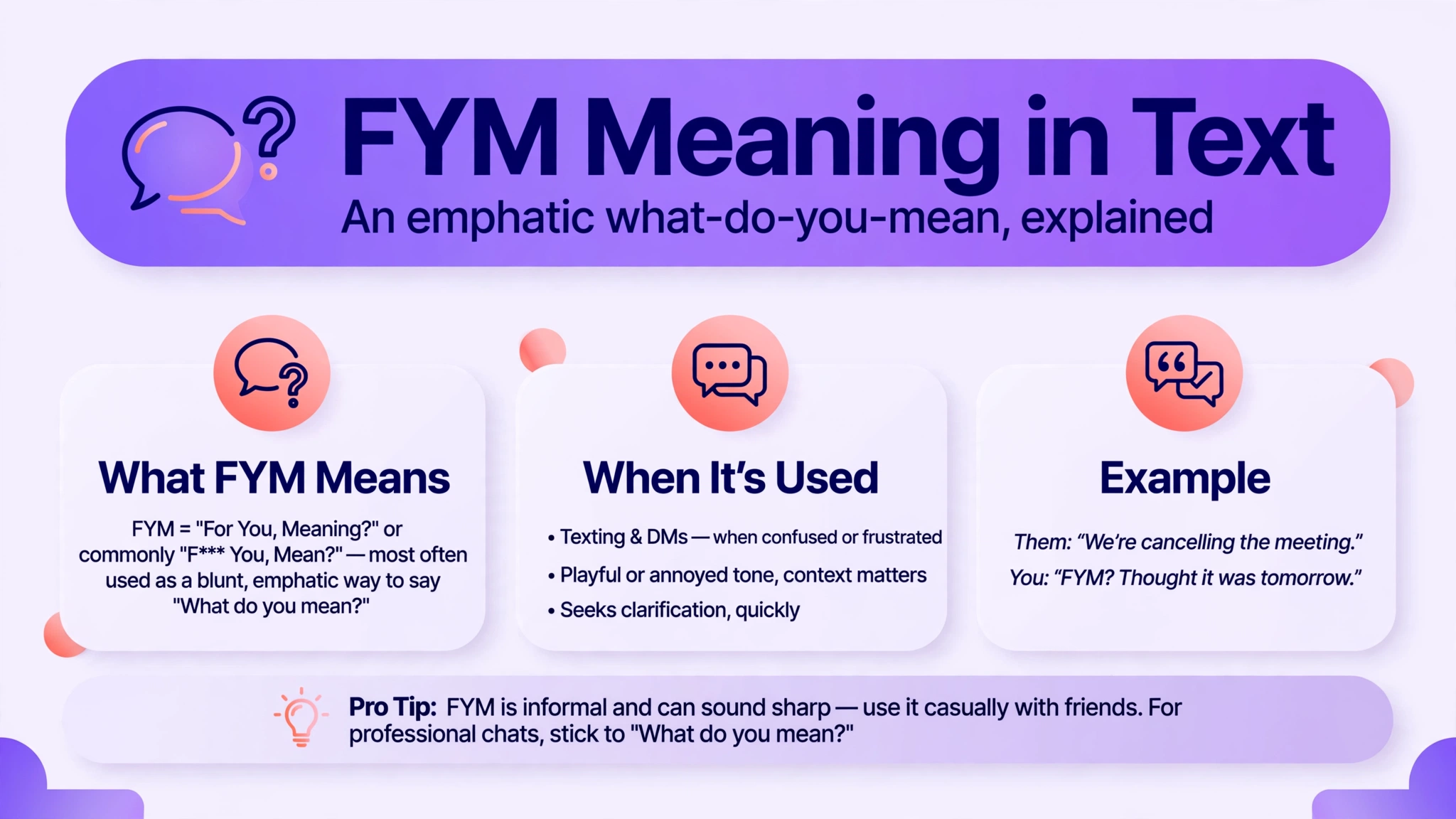
At its core, FYM is a punchier, more emotional version of “what do you mean?” It’s disbelief with attitude — part question, part raised eyebrow. But the same three letters can sound like teasing banter in one chat and a genuine challenge in another. This guide covers what FYM means in texts, how tone changes it, what to send back, and when to avoid it completely.
The Short Answer
- FYM is texting slang for an emphatic “what do you mean?” — a way to express surprise, disbelief, or challenge in a single reaction.
- It is informal and edgy by design. The tone comes from the sender and the context, not the letters alone.
- Among friends, it’s usually playful teasing — “wait, seriously?”
- In arguments or with strangers, it reads confrontational — a provocation, not a polite question.
- It is not for work, formal messages, or conversations where the tone can’t afford to be misread.
What FYM Actually Means
The letters spell out “f*** you mean” — a clipped, slangy version of “what do you mean?” with extra disbelief packed in. You’ll hear it glossed in one quick sentence whenever someone asks: it’s the phrase behind the abbreviation, and knowing it explains why the abbreviation hits so hard.
But understanding the letters is only half of it. FYM isn’t really about the expansion — it’s about the reaction. It’s what you type when someone says something so surprising, confusing, or ridiculous that a plain “what?” doesn’t feel like enough. The function is closer to a raised eyebrow or a dramatic “wait, say that again?” than to an actual question that needs answering.
A few things about the form:
- Lowercase “fym” reads more casual; uppercase “FYM” reads stronger and more confrontational. The same applies to most texting slang.
- “FYM?” with a question mark is the standard form — it’s asking for clarification, even if it’s asking rudely. A flat “FYM.” with a period reads like a shutdown, not a question.
- “FYM??” with double punctuation or emoji usually means incredulous but playful — the digital version of laughing in disbelief.
The Two Tones: Playful vs. Confrontational
FYM has a split personality, and the relationship between sender and reader decides which one shows up.
The playful reading
Among friends, FYM is a teasing jab — the texting equivalent of laughing and saying “there’s no way.” It shows up when someone says something surprising but not serious.
- “FYM you’ve never had pizza?? We’re fixing that this weekend”
- “FYM I was late — you were the one who set the time 😭”
- “FYM that’s not your favorite movie, it’s a classic”
Notice the signals around these: laughing emoji, caps for excitement, an exclamation mark. The whole message is warm even though the three letters are edgy.
The confrontational reading
In an argument, with a stranger, or after a statement that actually offended someone, FYM stops being playful. Here it’s a challenge — “explain yourself” with a sharp edge.
- “FYM I don’t understand your point”
- “FYM that’s not what happened”
- “FYM you can’t just say that”
Here the surrounding signals are different: no emoji, no laughter, short sentences. The message is a demand for an explanation, and replying with a joke would pour fuel on it.
How People Actually Use FYM
The exchanges below are illustrative examples, not real messages.
The friend-chat disbelief
- A: “I’m deleting all my social media for a month”
- B: “FYM?? You’ll last like two days 😂”
- B isn’t actually asking for clarification. The message is “there’s no way you’ll do that” — teasing, not challenging.
The group chat callout
- A: “I’ve never seen that show everyone keeps talking about”
- B: “FYM you’ve never seen it, it’s everywhere”
- B is performing disbelief for the whole group. This is one of FYM’s favorite settings: a public reaction shot where everyone watching gets the joke.
The argument escalation
- A: “You never listen to anything I say”
- B: “FYM I never listen, I literally just helped you yesterday”
- B is defensive here, and the FYM is part of the defense. In a heated chat, this reads as “prove that claim” — not a question that wants a calm answer.
The meme-caption reaction
- Caption: “FYM gas is $6 a gallon 💀”
- On social media, FYM shows up as a standalone reaction to absurd news — a way to say “you cannot be serious” without a whole paragraph.

Where You’ll See It
- One-to-one texts: usually the playful version, between people who know each other.
- Group chats: the performance version — reactions meant to land in front of an audience.
- Comments and replies: under surprising, funny, or outrageous posts. FYM is one of the go-to one-word reactions there.
- Gaming chats and Discord: disbelief at a play, a call, or a teammate’s claim.
- Not for formal messages: work emails, job applications, messages to teachers, or anything professional. FYM’s edge makes it inappropriate by default in these settings.
What to Send Back
The reply depends on which FYM you got — so read the tone before you type.
It was playful (friends, laughter, emoji):
- “I know, I know 😅 let me explain”
- “lol it’s true! swear”
- “😭 I’ll tell you the whole story later”
It was confrontational (argument, no emoji, sharp tone):
- “Here’s what I meant: [restate your point calmly]”
- “I didn’t mean it that way — let me explain”
- “Fair enough, my bad for how I said it”
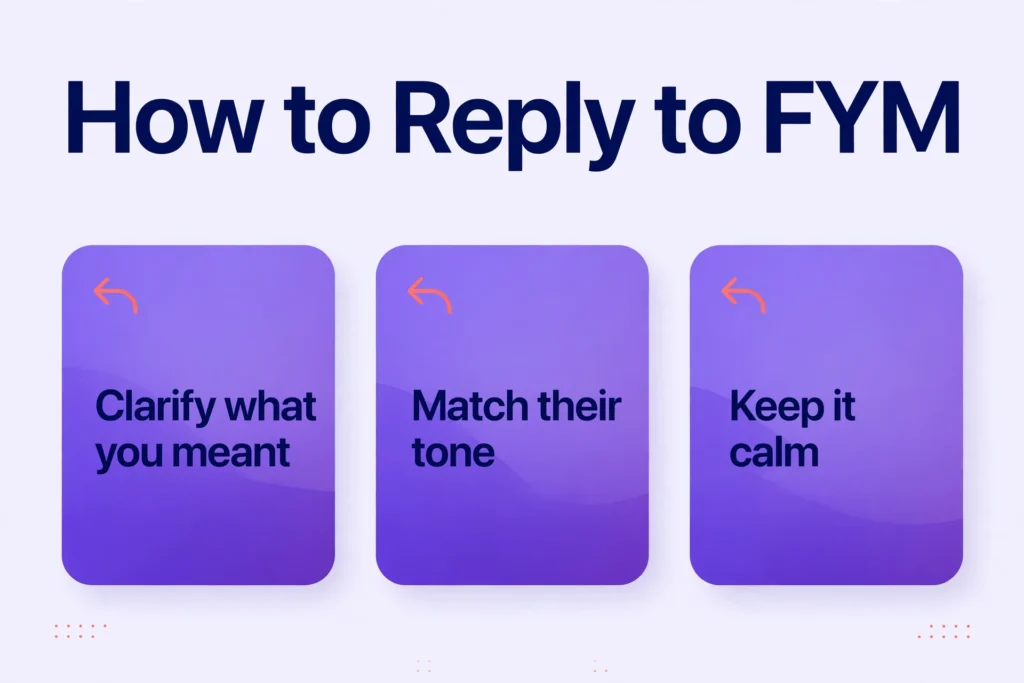
Whatever the tone, the smartest move is to answer the question underneath the edge: clarify what you meant. If their reaction came from genuine surprise, a sincere follow-up (FR) — “fr, here’s what happened” — usually resets things fast. And if the whole thing needs a longer conversation, telling them you’ll explain properly: let me know (LMK) when you’re free to talk is almost always better than arguing in the chat.
FYM vs. Other Reaction Words
Short, edgy reaction words cluster together in chats and comments. Here’s how FYM differs from its neighbors.
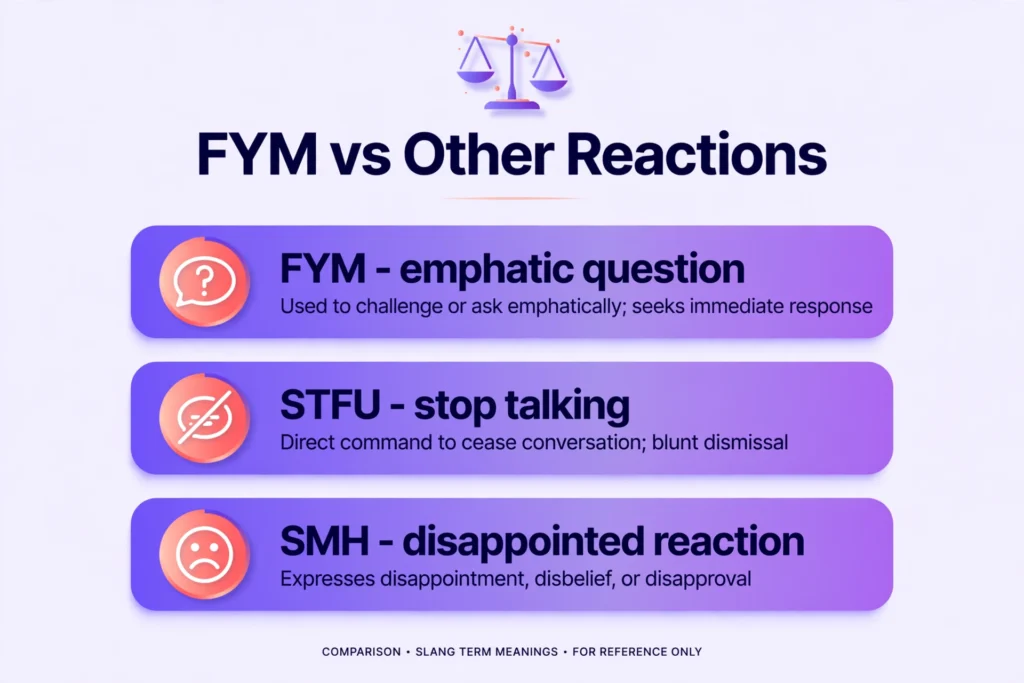
- FYM vs. STFU: both are blunt, but FYM asks something — it’s a challenge to explain. STFU is a command to stop talking. FYM keeps the conversation going (even if it’s going badly); STFU tries to end it.
- FYM vs. SMH: these are close cousins of disbelief. SMH (shaking my head) is a reaction — disappointed, judging, hands-off. FYM is a question — it demands an answer. You shake your head at a situation; you say FYM to a person.
- FYM vs. LMAO: FYM expresses disbelief; LMAO expresses laughter. They often arrive together — “FYM?? LMAO” is the classic “I can’t believe this” combo — but the feelings are different. One is surprise, the other is amusement.
- FYM vs. IDC: near-opposites in engagement. FYM leans in — it cares enough to challenge what you said. IDC (“I don’t care”) leans all the way out — it won’t even engage with the topic. FYM says “prove it”; IDC says “not interested.”
Usage guides on Urban Dictionary — where the term has been documented since the mid-2010s — record the same core disbelief-and-challenge reading across hundreds of entries.
When Not to Use FYM
FYM’s edge is the whole point of it — which means it fails anywhere the edge isn’t welcome. Skip it entirely in:
- Work chats and emails: managers and HR do not know your tone. An intern who meant “what do you mean?” has been misunderstood as swearing at a manager — don’t be that story.
- Messages to strangers: without a shared sense of humor, FYM reads as hostility, not banter.
- Serious or emotional conversations: when someone is upset or delivering bad news, an edgy reaction reads as mockery.
- First impressions: on dating apps or new group chats, nobody knows your humor yet. Start neutral.
If you need the function without the edge, the safer versions exist: “wdym,” “wait what,” or just “what do you mean?” They ask the same question with none of the confrontation.
What FYM Is Not
It’s not a polite question. If you need to ask for clarification neutrally, FYM is the wrong tool. The phrase behind it carries profanity, and even the abbreviation carries attitude.
It’s not always angry. The confrontational reading is real, but plenty of FYM usage is friendly teasing. The anger is in the context, not hard-coded into the letters — read the rest of the message before you decide.
It’s not “for your mother” or “free your mind.” A few joke-dictionary entries invent clean expansions for the letters — “for your mind,” “free your mind,” “for your misinformation.” These are one-off gags with no real texting usage behind them. If a meaning only exists on one joke page, treat it as noise.
It’s not universal. Not everyone knows this one, and the people who don’t will read it at face value — as profanity. If you’re texting someone who doesn’t live in slang, spell out what you actually mean.
Frequently Asked Questions
What does FYM mean in a text?
It’s texting slang for an emphatic “what do you mean?” — used to express surprise, disbelief, or challenge. Playful among friends, confrontational in arguments.
Is FYM rude?
It can be. The phrase behind it is profane, and the abbreviation carries attitude by default. Among friends it’s usually teasing; with strangers or in formal settings it reads as rude.
What’s the difference between FYM and WYM?
WYM (“what you mean”) asks the same question without the edge — it’s the safe, neutral version. FYM is WYM with attitude.
Can I use FYM at work?
No. Skip it in work chats, emails, and anything professional. Use “could you clarify?” instead.
How do you respond to FYM?
Answer the question underneath the edge: clarify what you meant. Playful FYM gets a playful explanation; confrontational FYM gets a calm restatement.
Is FYM always confrontational?
No. Friends use it as teasing banter all the time — “FYM you’ve never seen that??” The confrontation reading depends on context, not the letters.
Does FYM mean something different on TikTok or Instagram?
Same core meaning everywhere: surprised disbelief with attitude. In comments it functions as a quick public reaction — “FYM this actually happened 💀.”
Is FYM the same as “d’fuq”?
Close relatives. Both are profanity-edged reactions of disbelief; FYM asks “what do you mean?” while “d’fuq” is closer to “what the —.” Same family, different shade.
What should I use instead of FYM?
“Wdym,” “wait, what?,” or “what do you mean?” — same function, none of the edge. Use these with strangers, at work, or whenever tone might be misread.
The Short Version
FYM is “what do you mean?” with attitude — a quick, edgy reaction to something surprising, confusing, or ridiculous. With friends, it’s playful teasing; in arguments, it’s a genuine challenge; at work, it’s a mistake. The same three letters do all three jobs, and the context decides which one you’re looking at. When someone sends one your way, read the tone first, then answer the question underneath the edge.