
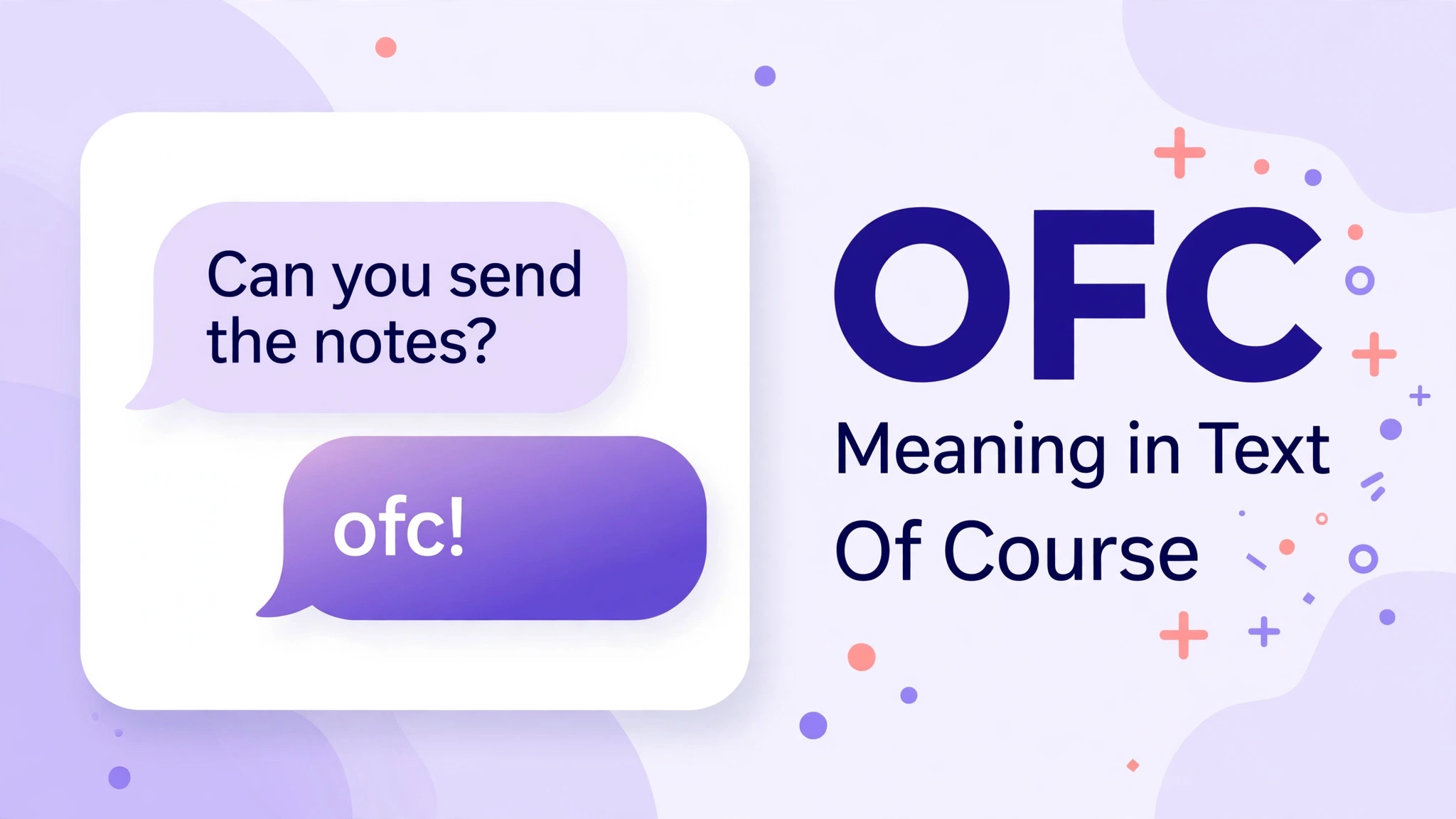
"Can you send me the notes?" — "ofc!" Warm, instant, no hesitation. Now try: "Are you coming tonight?" — "ofc." Same three letters, completely different temperature. If you've ever puzzled over the ofc meaning in text, here's the core: OFC stands for "of course." It's the fastest yes in texting — agreement, confirmation, or reassurance in three keystrokes. But those three letters are also tone chameleons, and this article is the first in its batch to give you a complete decoding system for them.
What Does OFC Mean?
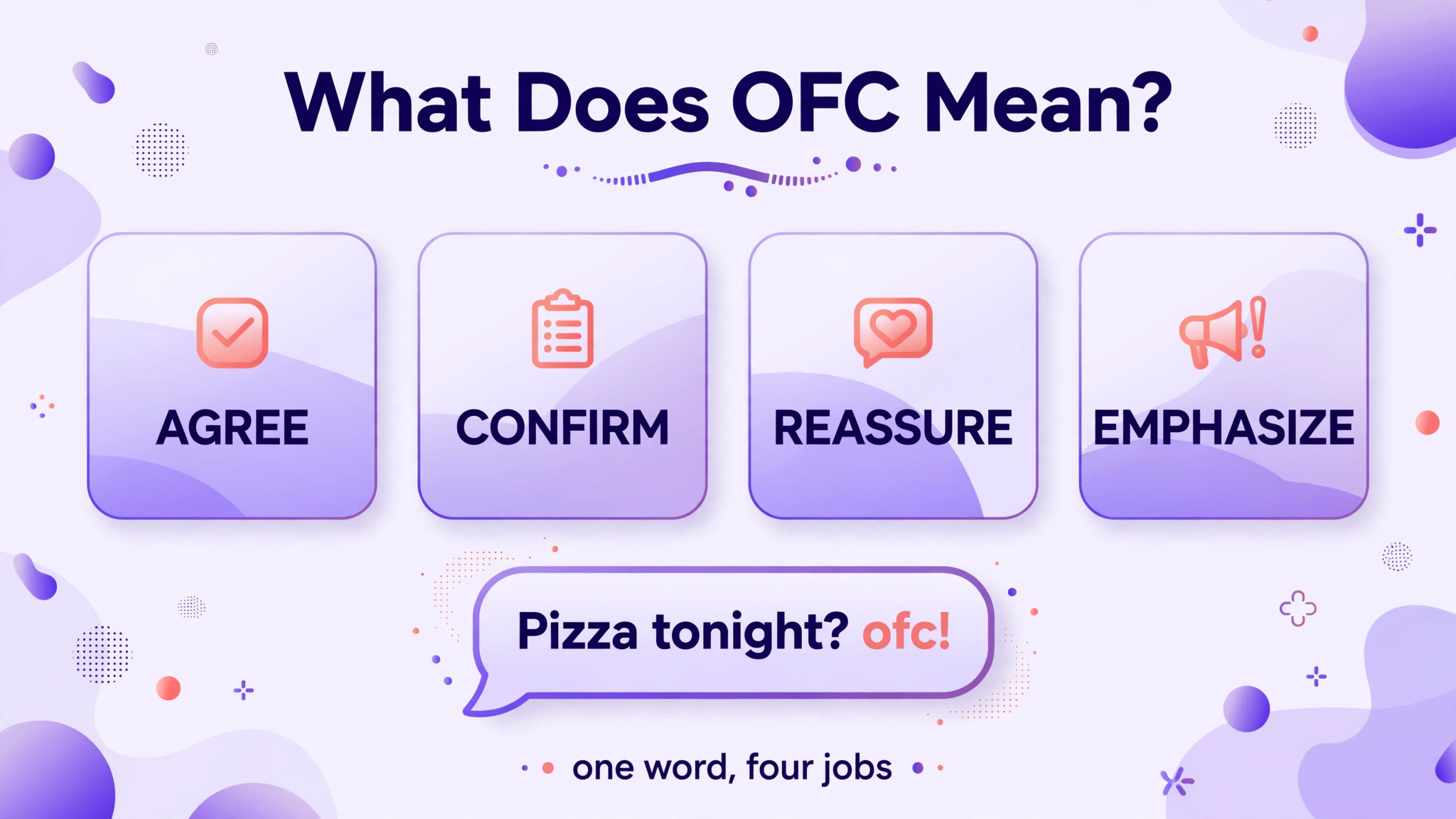
OFC means "of course" — Wiktionary lists it directly as internet-slang abbreviation of of course, with a published quotation to prove real-world use, and every credible source agrees. In a text, it's doing one of four closely-related jobs:
1. Agreement: "Pizza tonight?" — "ofc!" (Yes, obviously.)
2. Confirmation: "So we're meeting at 7?" — "ofc, see you there." (Yes, that's right.)
3. Reassurance: "Thanks so much for helping" — "ofc, anytime." (You're welcome; it was nothing.)
4. Emphasis: "That movie was amazing, right?" — "ofc!!" (Obviously! Strongly yes.)
Notice that all four are flavors of yes. OFC never means no, never means maybe — it's affirmation, period. The only question is what kind of yes you're getting, and that's a tone question. Before we decode the tone, one honest note on the word's edgier cousin.
The emphatic reading, handled plainly: there is a vulgar emphatic variant of this abbreviation in documented use — "of f***ing course" — the same yes with the volume cranked to eleven. It's uncommon, it's emphatic rather than insulting, and in practice the two readings are nearly identical. You'll recognize it by context (heated threads, venting, strong feeling), not by spelling. That's the full treatment it needs: one masked mention, so you can recognize it — never something to deploy yourself in polite company.
The Period Test: OFC's One-Second Tone Check
Here's the named trick — the Period Test — and it's the fastest tone decoder in this article. Take any OFC reply you received (or are about to send) and re-read it with a period instead of whatever punctuation it has:
- "ofc!" → "ofc." If the period version reads annoyed, curt, or flat — congratulations, you've just detected how fragile this yes is. The exclamation mark was doing all the warmth work.
- "ofc." stays friendly in your head? Then it's genuinely neutral-positive. Send it.
- "ofc." reads annoyed? Add a clause before sending: "ofc, happy to help." Three extra words, completely different message.
The Period Test works because OFC is one of the most punctuation-dependent abbreviations in texting. The letters carry the meaning (yes); the punctuation carries the feeling. Run the test every time the stakes matter — with a crush, a boss, or anyone you're not sure about — and you'll stop sending accidental attitude.
The OFC Tone Decoder: Friendly, Dry, or Sarcastic?
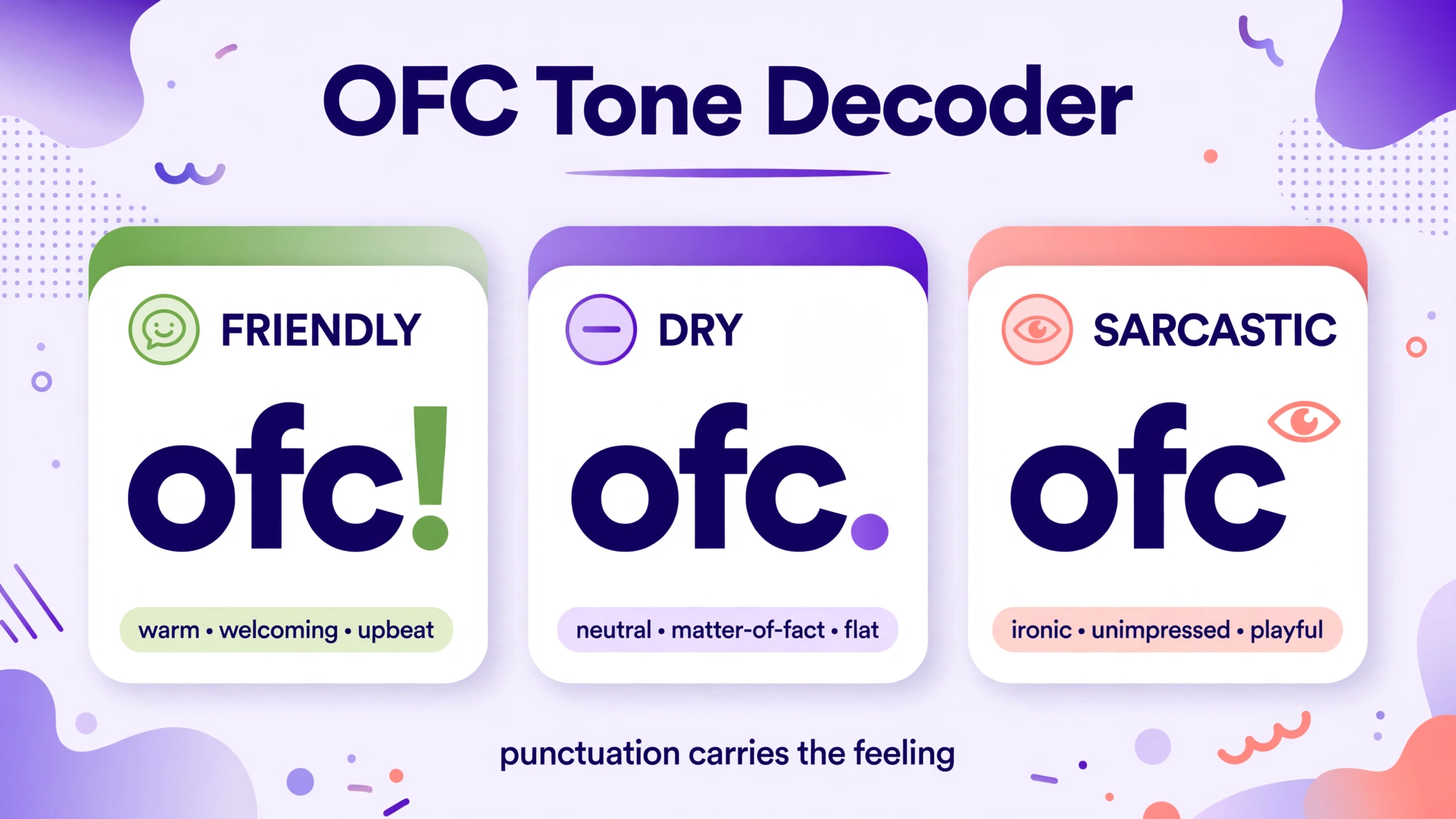
The Period Test is the quick version. Here's the full matrix — placement × punctuation × capitalization — the complete tone-decoding system no competitor assembles in one place:
Punctuation (the biggest lever):
- "ofc!" — enthusiastic, warm, genuine. The safest OFC there is.
- "ofc" (no punctuation) — casual, low-key, neutral-positive. Texting's default.
- "ofc." — neutral to dry. Can read blunt or slightly flat. (Run the Period Test — oh wait, this is the Period Test.)
- "ofc…" — annoyed, resigned, or trailing off. The ellipsis is doing emotional work.
- "OFC??" — surprised, defensive, or calling you out. "OFC?? why would you even ask."
- "ofccc" (stretched) — extra enthusiasm, playful. Letter-stretching is texting's volume knob; no new meaning.
Capitalization:
- Lowercase "ofc" — softer, more casual, and significantly more common in real texting. The friendly default.
- Uppercase "OFC" — louder and more declarative. Can read confident ("OFC!") or confrontational ("OFC.") depending on punctuation.
Position in the sentence:
- At the start ("ofc I'll be there") — reads positive and definite. The yes leads.
- At the end ("I'll be there, ofc") — reads drier, more casual, occasionally snarky. The yes trails off.
- Standalone ("ofc") — the tone is entirely in the punctuation. No punctuation, no signal — which is why the bare "ofc" is the most misread text in this family.
The sarcasm tell: "ofc" turns sarcastic the same way BSF does — through mismatch. "Oh great, another meeting, ofc 🙄" isn't agreement; it's the yes-word deployed as an eye-roll. If the sentence around the OFC is annoyed, the OFC is annoyed. The letters didn't change; the room did.
OFC vs FR vs TBH: The Affirmation Cluster
OFC doesn't live alone — it's the head of an affirmation family, and confusing the members is a daily texting error. Here's the cluster decoded:
OFC ("of course") is the agreeing yes — it confirms what someone said or asked. "Pizza tonight?" → "ofc!"
FR ("for real") is the emphasizing yes — it intensifies a statement rather than answering a question. "That test was brutal" → "fr." FR agrees with vibes; OFC agrees with proposals.
TBH ("to be honest") is the opinion signal — it frames what's coming as candid. "Tbh I didn't love it" isn't a yes at all; it's honesty with the safety off.
TBF ("to be fair") is the hedged yes — agreement with a caveat attached. "Tbf, he did warn us" concedes a point while softening it.
The one-line version: OFC confirms, FR amplifies, TBH confesses, TBF concedes. Four words, four jobs, zero interchangeability once you see it. This cluster comparison is the batch's first same-family mapping — no sibling article has done one.
OFC on TikTok, Snapchat, Instagram, and in Texts
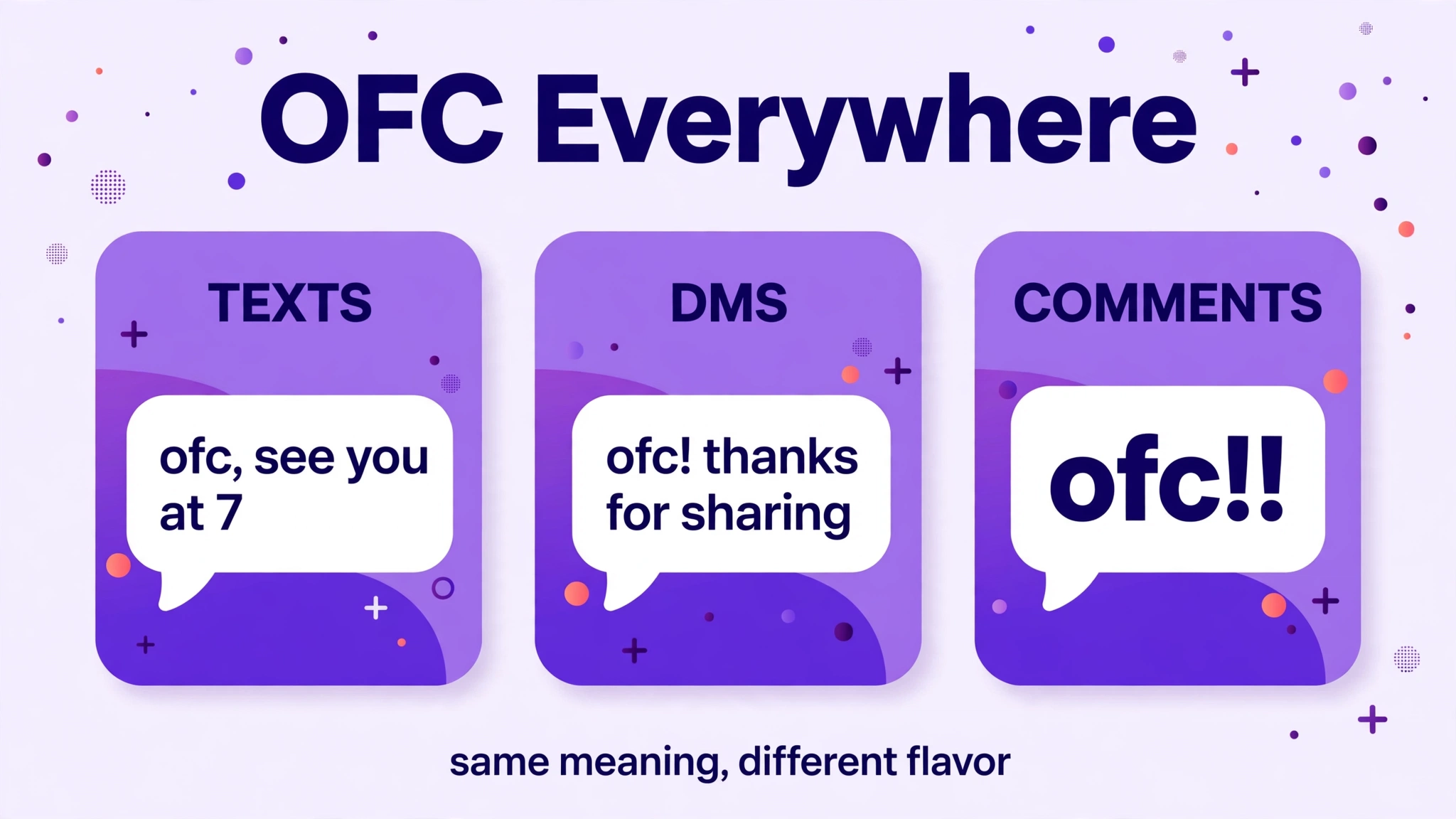
Same meaning everywhere; the flavor shifts by venue. Here's the documented context (never invented per-platform definitions):
Texting (SMS, WhatsApp, iMessage). OFC's home turf and its most sincere habitat. One-on-one texts carry the full tone range: the warm "ofc! 💜" to a friend, the dry "ofc." to a sibling, the reassuring "ofc, don't worry about it" that pairs naturally with comfort language. In group chats it's the quick consensus-builder: "everyone good with 7?" → "ofc."
Instagram. In DMs, OFC is friendly small-talk glue: "love your post!" → "ofc, thanks for sharing 🥺." In comments, it's punchier — the public OFC skews toward the enthusiastic "ofc!!" because comments are performances. Nobody comments "ofc." with a period unless they're making a point.
TikTok. TikTok comments are OFC's loudest venue: "ofc!!" under relatable videos, "OFC" as a standalone reaction to a hot take. The caps-lock OFC thrives here — TikTok rewards declarative energy. It's also where the sarcastic OFC gets the most workout, riding along with eye-roll content.
Snapchat. On Snap, OFC is fast and disposable: "ofc" between streaks, quick confirmations that vanish with the chat. Snapchat OFC rarely carries heavy tone — the platform moves too fast for punctuation analysis. If someone's being snarky on Snapchat, they'll use more words.
Sender Context: Who's Saying "Of Course"?
From a close friend, OFC is frictionless warmth: "ofc I'll help you move." The friendship supplies the exclamation mark even when it's absent.
From a crush, "ofc" is doing quiet work — it's eagerness wearing casual clothes. "Can you come?" → "ofc 👀" is not a neutral yes; it's a delighted yes with plausible deniability. The emoji is the tell.
From a partner, OFC is reassurance currency: "ofc, I love you" / "ofc I'll be there." In relationships, the bare "ofc." (with period) is worth noticing — it's the one context where punctuation drift can signal a real mood shift. Don't interrogate it; just notice.
From a coworker, "ofc" is professional friendliness in casual channels: "ofc, sending the deck now." In email, they'd write "of course" or "certainly" — the abbreviation stays in chat where it belongs.
From a parent, "ofc honey" is pure warmth with slightly formal diction — a parent using just enough slang to meet you halfway. Cherish it.
From someone annoyed with you, "ofc." is the whole argument in four characters. You've seen the matrix; you know what the period means. The correct response isn't another OFC — it's words: "hey, are we good?"
How to Use OFC Without Sounding Rude
The Period Test catches problems before you send. A few more rules:
1. Default to the exclamation mark. "Ofc!" is never misread. "Ofc." sometimes is. When in doubt, add the bang — it's free insurance.
2. Add a clause when it matters. "Ofc, happy to help" / "ofc, see you at 7" / "ofc, don't even worry about it." Three extra words convert a bare yes into warmth. This is the single highest-ROI texting habit in this article.
3. Never send a bare "ofc." to someone who's upset. They asked for reassurance; a period gives them flatness. If the moment is emotional, write the sentence: "Of course — I'm here, don't worry."
4. "OFC not" needs softening. "Of course not" is grammatically fine, but a bare "OFC not." reads blunt to the point of rudeness. Always attach the softener: "ofc not, you're totally fine."
5. Match the register. In a formal email, write "of course" or "certainly." In a job interview, say the words. OFC is for chats, comments, and DMs — it's sneakers, not dress shoes.
When You Get an Ambiguous "ofc"
Sometimes you receive an "ofc" and genuinely can't tell if it's warm or dry. Don't spiral — clarify like an adult:
- Light check: "haha was that an enthusiastic ofc or a dry ofc 😅" — works with friends.
- Direct check: "just making sure we're good?" — works everywhere.
- The WDYM move: when the ambiguity is real and the stakes are real, a quick "wdym by that?" beats three hours of re-reading a three-letter text.
And remember the HBU principle from this batch's sibling article: when a short reply starves the chat, the fix is a question back, not a shorter reply. "Ofc!" → "amazing, what time works?" keeps things moving.
When Not to Use OFC
- In formal writing. Emails, applications, professional documents: "of course," "certainly," "absolutely." OFC in a cover letter is an instant no.
- When the answer is actually no. "OFC not" is fine; a sarcastic "ofc 🙄" when you mean no is just conflict with extra steps.
- As a complete response to bad news. "I failed the exam" → "ofc you'll pass next time" is reassurance; a bare "ofc" is nothing. Match the moment's weight.
- When you're the one who's upset. Sending "ofc." as a weapon is transparent — everyone in this article's audience now knows what the period means. Use words instead.
- With people who don't text much. Grandparents, formal acquaintances: the full "of course" costs you nothing and confuses nobody.
Quick Answers
What does OFC mean in text?
OFC means "of course." It's a fast yes — agreement, confirmation, reassurance, or emphasis — used in texts, DMs, and comments. Example: "Can you send the notes?" → "ofc!"
Is OFC rude?
Not by default — it's friendly. But punctuation decides: "ofc!" is warm, "ofc." can read dry or curt, and "ofc…" reads annoyed. When in doubt, add an exclamation mark or a clause ("ofc, happy to help").
What's the difference between OFC and FR?
OFC ("of course") confirms or agrees with what someone said. FR ("for real") amplifies or emphasizes a statement. OFC answers; FR intensifies.
Can I use OFC at work?
In casual team chats, yes. In emails or formal messages, write "of course" or "certainly" instead.
What does "OFC not" mean?
"Of course not" — but a bare "OFC not." reads blunt. Soften it: "ofc not, you're totally fine."
Does OFC mean anything else?
In texting, it's "of course" (with a rare, emphatic vulgar variant you'd recognize by context, not spelling). In fanfiction communities the same letters mean "original female character" — but in a chat, it's "of course" every time.
OFC is the fastest yes in texting — and, as of this article, the best-decoded one. Run the Period Test before you send, read the matrix when you receive, and remember the cluster: OFC confirms, FR amplifies, TBH confesses, TBF concedes. Four words, four jobs — and now you'll never mix them up. Speaking of mixing things up: if someone's "of course" ever feels more like "I don't care," that's the IDC article's territory — and if you need to walk a heated "ofc 🙄" back, NVM ("nvm, we're good") is the reset button.
