
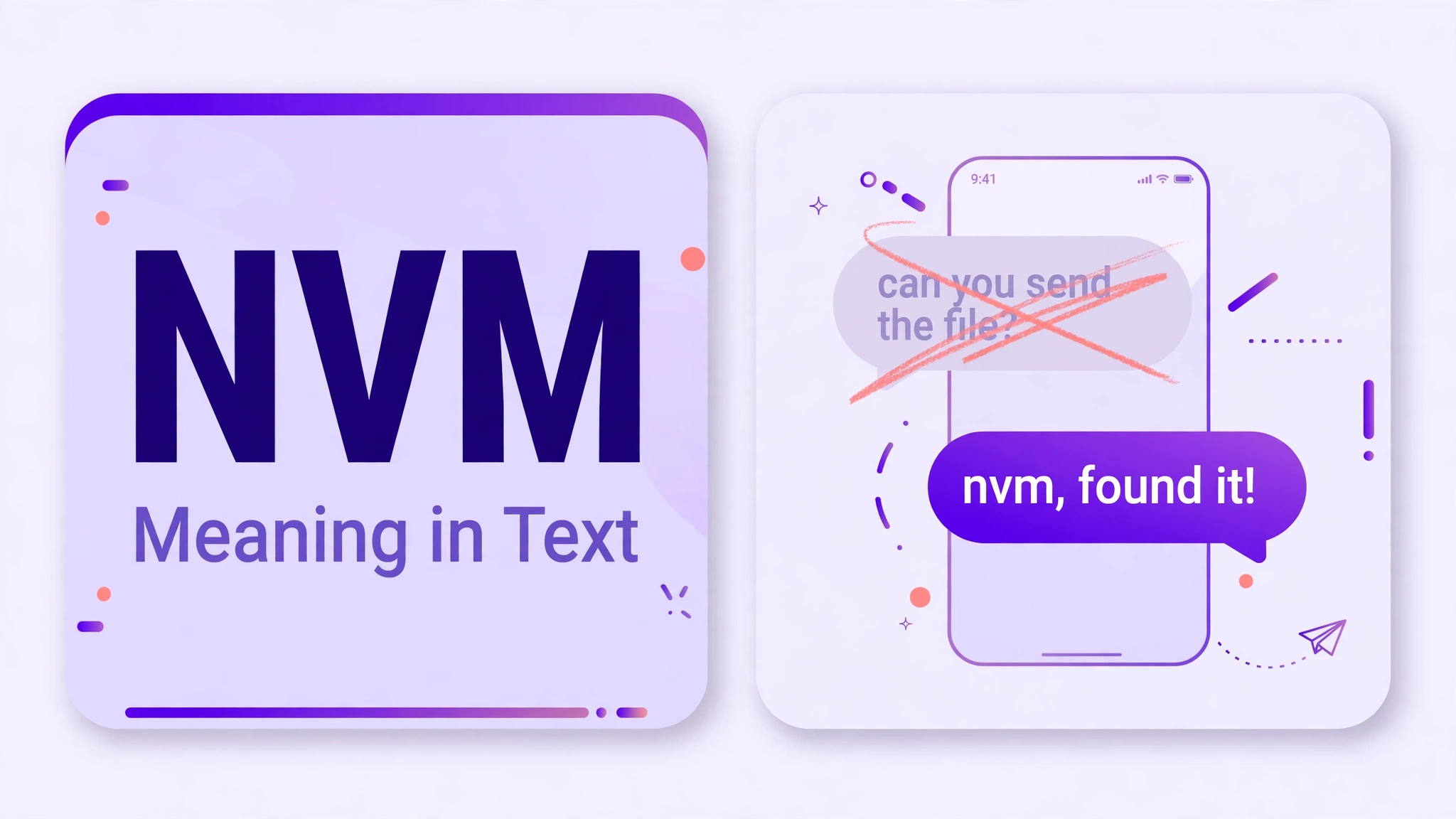
Most abbreviations add something to a conversation. NVM subtracts. It’s the message that cancels the message before it: disregard that, it’s handled, forget I asked. Merriam-Webster defines the phrase never mind as “used to say that something previously mentioned or asked can be disregarded” — and its own example is the exact texting pattern: “Do you know where my keys are? Oh, never mind. Here they are.”
That’s the core of the nvm meaning in text. But the same three letters can also be a small act of frustration — the thread-closing forget it sent after a question sat unanswered. Which one you received depends on the sequence around it, not the word itself. This guide reads that sequence: the anatomy of a retraction, the two silences that produce it, the reply rules, and the position test that separates NVM from its confusing twin, NM.
Anatomy of a Vanishing Request
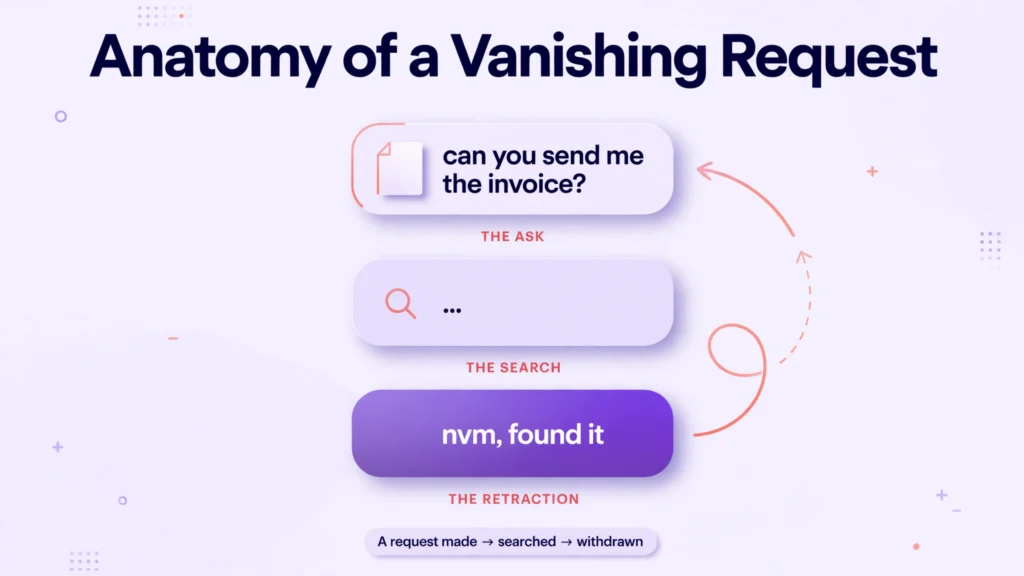
NVM almost never opens a conversation. It arrives as the second half of a pair, and the first half tells you which kind it is.
The self-answer (the classic). The sender asked, then solved it before you replied:
A: can you send me the invoice from march?
A: nvm, found it in my downloads
The cancelled request. Something changed — the item arrived, the plan moved, the need evaporated:
A: could you grab milk on your way home?
A: nvm, I ordered it
The wrong-chat rescue. The message was never meant for you:
A: tell mom the flight lands at 6
A: nvm, wrong chat 😂
The dropped explanation. The sender started something, judged it too long or too tangled to type, and withdrew it. Group chats collect these constantly — a polite retreat rather than a door slam.
NVM belongs to the same early-chat generation as BRB — built for the era of character limits and slow typing, when cancelling a request in three letters genuinely saved effort. Its first Urban Dictionary entry dates to 2003, and it has outlived most of its contemporaries because the job it does never went away.
One pairing worth knowing: “nvm, mb.” MB (“my bad”) owns the mistake; NVM cancels the message. Send both when the error was yours — NVM alone withdraws the request but skips the apology, and people notice the difference.
The Other Direction: “Don’t Worry About It”
Occasionally NVM points the other way — not retracting the sender’s message, but releasing you from yours. Merriam-Webster’s first sense of never mind is “used to tell someone not to be concerned,” and Cambridge gives the same: don’t worry about it, it’s not important.
A: so sorry, I completely forgot to bring the charger
B: nvm, I borrowed one
This direction is real but secondary in texting — the abbreviation overwhelmingly runs speaker-retracts-own-message, so don’t assume it. Its closest living relative is IDM (“I don’t mind”), which carries the same reassurance without the ambiguity. If you mean “no harm done,” IDM or a spelled-out “don’t worry about it” says it more clearly than NVM does.
When NVM Is Quietly Furious
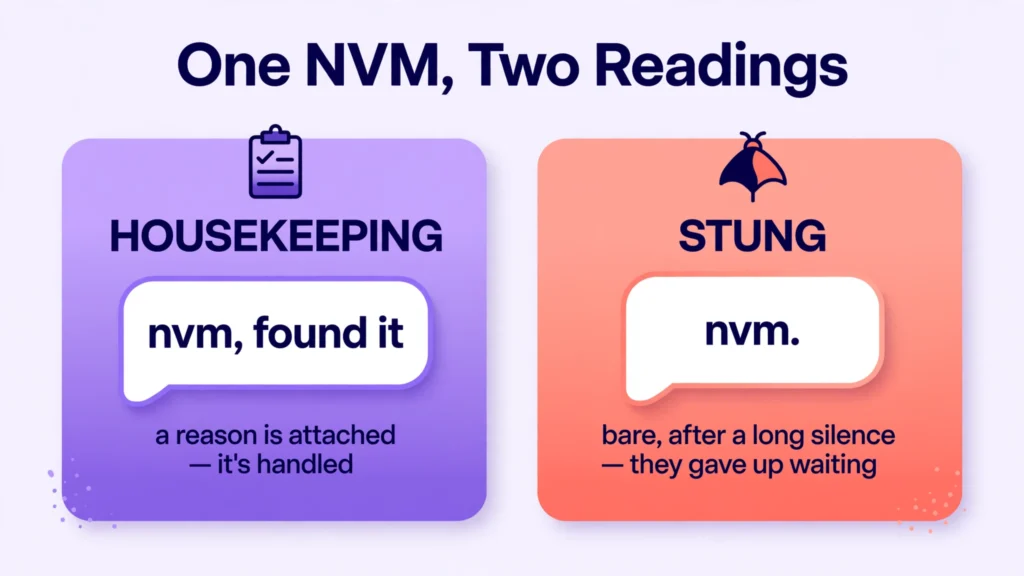
Now the reading everyone actually worries about. How-To Geek documents it plainly: NVM gets used “in a passive-aggressive or sarcastic way,” sent when someone isn’t opening your messages — “to get their attention or make them feel guilty for not responding.” Dictionaries back the underlying sense: never mind can express frustration or impatience when someone does not understand something.
There are two frustrated patterns, and both are built from sequence, not spelling:
The silence pattern. An urgent or heartfelt question, a long gap, maybe a “hello?” in between — then a lone “nvm.” The sender has given up waiting and is closing the thread with a note of reproach attached. The word is housekeeping; the silence before it is the message.
The failed-explanation pattern. You are replying, but it’s not landing — and “nvm” arrives as stop, I’ll do it myself. This one wounds the most, because it often lands on someone who was actively trying to help.
What does not determine the reading: capitalization. Claims that uppercase NVM is “angry” and lowercase is “soft” circulate widely, but the evidence doesn’t support a rule — references note lowercase is simply the common form and case doesn’t change the meaning. Nor is there any evidenced delay threshold (no honest source can tell you “after X minutes it’s annoyed”). A three-minute nvm in a fast back-and-forth is usually pure self-correction; a next-day nvm after an urgent ask almost always carries the sting. Read the thread, not a stopwatch.
The useful contrast is IDC. IDC dismisses your topic or you — it’s genuinely cold. NVM retracts the sender’s own message, which is why it’s normally neutral. And where IDC performs indifference, a frustrated NVM is closer to SMH spelled as a sentence: disbelief and exasperation, aimed at the situation as much as at you.
Should You Reply to an NVM?
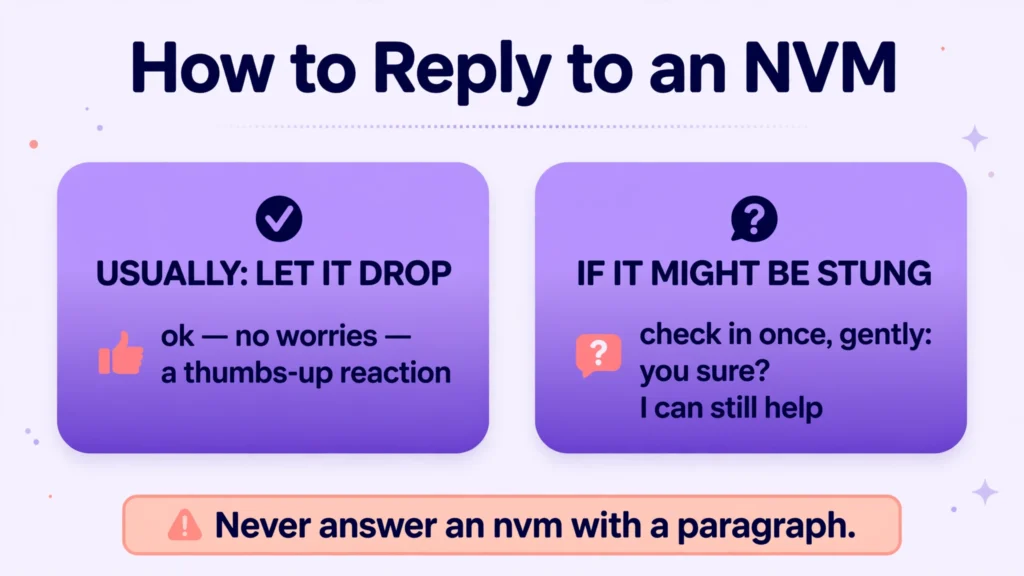
Usually, barely. NVM is a closure signal, and closure signals have their own etiquette:
Default: let it drop. A light acknowledgement — “ok,” “no worries,” a thumbs-up reaction — confirms you got the cancellation and asks nothing further. Interrogating a benign nvm (“what? tell me anyway”) reopens exactly what the sender closed, and it reads as needling.
Check in once, gently, when the stung reading is plausible. The tells: the original ask was urgent or emotional, the gap was long, or the nvm trailed a misunderstanding. One line is enough — “you sure? I can still help” — and then accept whatever answer comes, including a second closure. Pressing past that converts your concern into pressure.
Never answer an nvm with a paragraph. The entire function of the word is to save both of you the paragraph. Match its economy.
NVM vs. NM: The Position Test
The letters NM cause the confusion NVM exists to prevent, because NM does double duty: it’s “not much” and an older short form of “never mind.” Dictionary.com lays both out — nm for “not much” is “usually written in the lowercase,” answering greetings, while NM can also mean never mind in older chat usage.
You don’t need to memorize that. You need the position test:
| Where it appears | What it means |
|---|---|
| Answering “what’s up?” or “wyd” — “nm, just watching tv” | Not much — a status report |
| Following the sender’s own earlier message — “found the file, nm” | Never mind — a retraction |
| Anywhere NVM appears | Never mind — always; NVM has no “not much” sense |
Position, not spelling, settles it. And this is exactly why NVM became the standard retraction form: it says one thing only. If you’re the sender and the stakes of being misread are real, NVM is the clearer, safer choice.
NVM Is Not an Exit: GTG, TTYL, and the Alternatives
Readers mix NVM up with the conversation-closers, but the jobs differ. GTG ends the whole conversation — the person is leaving. TTYL is the friendly sign-off, a goodbye with a promise in it. NVM ends one thread inside a conversation that continues: you cancel the milk request, then keep chatting about dinner. A bare nvm misread as a goodbye has ended more chats than it needed to.
When NVM isn’t quite the word, the honest alternatives ladder by temperature:
- “Scratch that” / “disregard” — the same retraction, neutral and clear, safe anywhere.
- “Forget it” — warmer than it looks in speech, colder in text; this is the one that blurs into the frustrated reading.
- WTV (“whatever”) — a shrug that dismisses rather than retracts; noticeably more dismissive than NVM, and the wrong tool if you only meant “handled it.”
In fast gaming and Discord chats, by the way, NVM does its purest work: cancelling a callout before teammates act on it — “push B, nvm, they’re stacked there.” There’s no separate gaming definition; the meaning is identical, it’s just that a late retraction costs more there. At work it survives in internal chat with one professional softener attached — “nvm, found the file, thanks though.” In email or to a client, spell out “please disregard my previous message.”
The Other NVMs (You’ll Probably Never Text These)
Two technical meanings share the letters, both real and both strictly context-bound. In developer spaces, nvm is Node Version Manager — the command-line tool (from the nvm-sh project) for switching between Node.js versions. In computing writing, NVM is non-volatile memory: storage that keeps its data without power, the family that NVMe drives belong to. Neither will ever appear in a personal text thread meaning anything but “never mind” — if your group chat suddenly discusses non-volatile memory, you’ll know from everything around the word, which is rather the theme of this article.
Quick Answers
What does NVM mean in text?
“Never mind” — a retraction meaning disregard my last message. Merriam-Webster: something “previously mentioned or asked can be disregarded.”
Is NVM rude?
Not by default. It’s neutral housekeeping when it cancels a solved request. It turns sharp only in sequence — after a long silence or a failed explanation, where it reads as forget it, then. The letters are innocent; the timing accuses.
Someone sent “nvm” after I didn’t reply. Are they mad?
Possibly, but not provably. They may simply have solved it. The tells are urgency, follow-ups in between, and whether the nvm came with a reason (“nvm, found it”) or bare. If it might be the stung kind, one gentle “you sure? I can still help” covers both readings.
NVM vs. NM — what’s the difference?
NM is ambiguous: answering “what’s up?” it means “not much”; cancelling your own message it can mean “never mind.” NVM only ever means “never mind.” Position tells you which NM you got.
Does lowercase “nvm” mean something softer than “NVM”?
No evidenced rule says so. Lowercase is just the more common form. Bareness is what reads cold — “nvm.” alone versus “nvm, found it 😅” — not the case of the letters.
Is it “nevermind” or “never mind”?
Two words: never mind. The one-word nevermind is a regional noun meaning attention or business (“pay no nevermind”) — a different word entirely, and not what the abbreviation expands.
What does NVM mean in gaming?
The same “never mind” — used to retract a callout, plan, or request before teammates act on it. No gaming-specific definition exists, despite what some slang pages invent.
The Short Version
NVM is a self-cancelling message: that last one? Handled — disregard. Read it by its sequence and it will never confuse you: a reason attached means housekeeping, a silence attached may mean hurt, and if it answers “what’s up,” it isn’t NVM’s twin at all — it’s NM, saying “not much.”
