
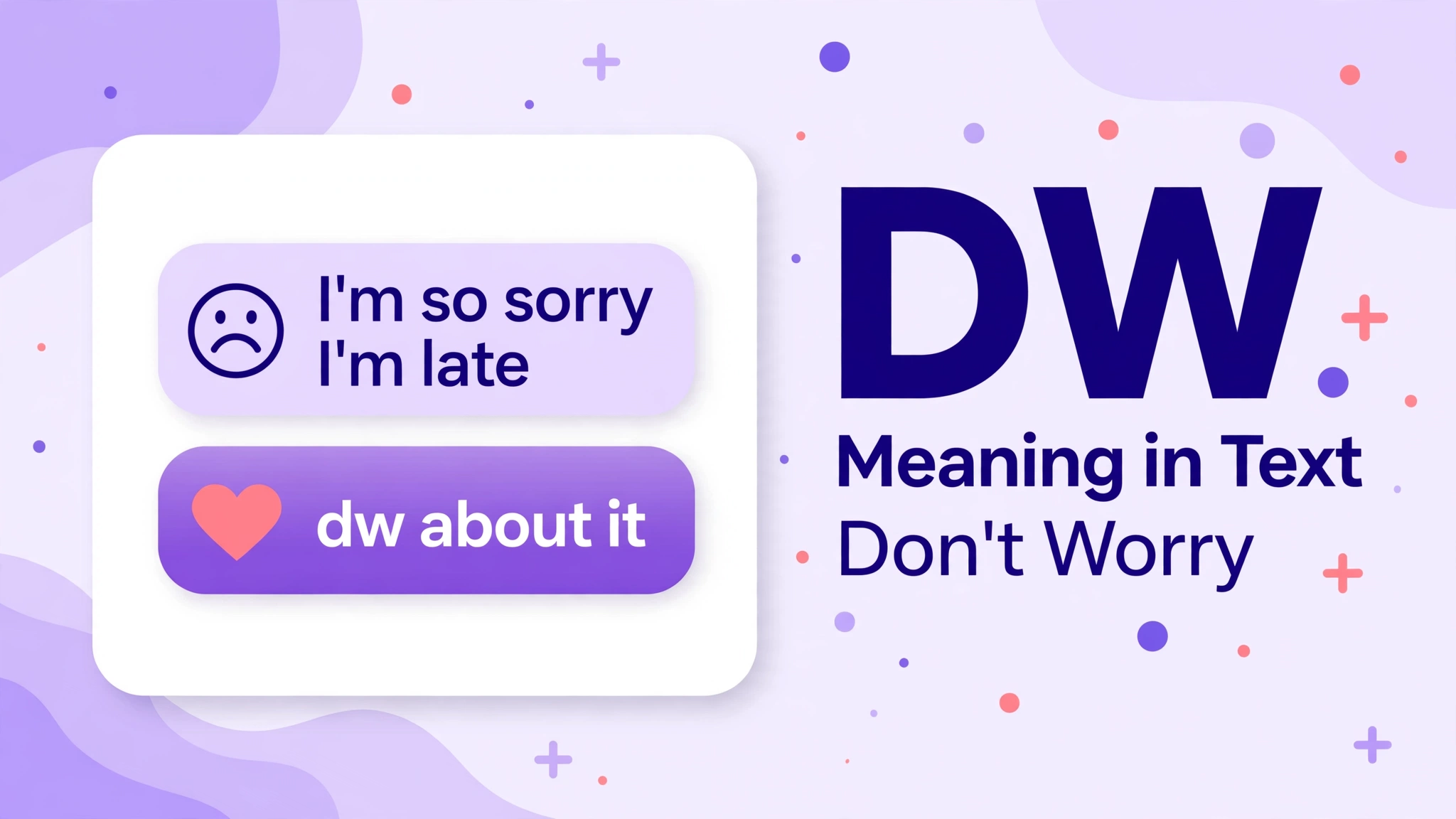
"I'm so sorry I'm late 😭" — "dw about it." Two letters, and the whole apology deflates into warmth. If you've ever received a "dw" and wondered about the dw meaning in text, here it is: DW stands for "don't worry." It's reassurance in its most compressed form — a tiny "it's all okay" for the moments that need exactly that, and nothing more.
What Does DW Mean?
DW means "don't worry" — Wiktionary lists it directly as internet-slang initialism of don't worry, and every credible source agrees. It's the verbal equivalent of a hand wave that says it's fine, really.
In action:
Maya: omg I'm so sorry I forgot to text back yesterday
You: dw about it! how was the trip?
Dev: I think I messed up the presentation slides
Priya: dw, we'll fix it together in the morning
Two flavors in those exchanges, and both are the same meaning: forgiveness ("dw about it" — the apology is accepted) and reassurance ("dw" — the problem is smaller than you think). The fuller phrase "dw about it" completes the thought and sounds a touch warmer than the bare "dw" — same meaning, softer landing.
One honest note on the disambiguation: in other corners of the internet, DW has other lives — "dear wife" in forums and mommy-blogs ("picking up DW then we'll be OTW!"), "Doctor Who" in fandom spaces. Neither is a texting meaning. In a chat, DW is "don't worry" every time; the other readings only exist where the context is already about spouses or sci-fi. Context decides, instantly.
The Warmth Check: DW's Three-Second Read
Here's the named trick — the Warmth Check — for reading any DW you receive. Before you decide how it felt, check three things:
1. The punctuation and caps. "dw" (lowercase, no punctuation) is the soft default — casual, warm, unbothered. "dw." with a period is flatter — not necessarily cold, but lower-energy. "DW" in caps is more abrupt — efficient rather than cozy. Punctuation is the thermostat.
2. What came with it. An emoji ("dw 😊"), a follow-up sentence ("dw, we'll figure it out"), or a name ("dw Maya") — all warmth signals. A bare "dw" standing alone after your long, emotional message? That's the one to read carefully (see below).
3. Who sent it, and how heavy was your message? A "dw" after "sorry I'm 5 minutes late" is pure kindness. A bare "dw" after you poured out something genuinely painful is a different animal — not comfort, but topic-closing. The same two letters; the weight of the moment decides which.
The rule: warm context + soft wrapping = accept the comfort. Heavy moment + bare "dw" = the sender is closing the topic, not comforting you. The Warmth Check takes three seconds and prevents ninety percent of DW misreadings.
DW Tone: Warm, Neutral, or Distant?
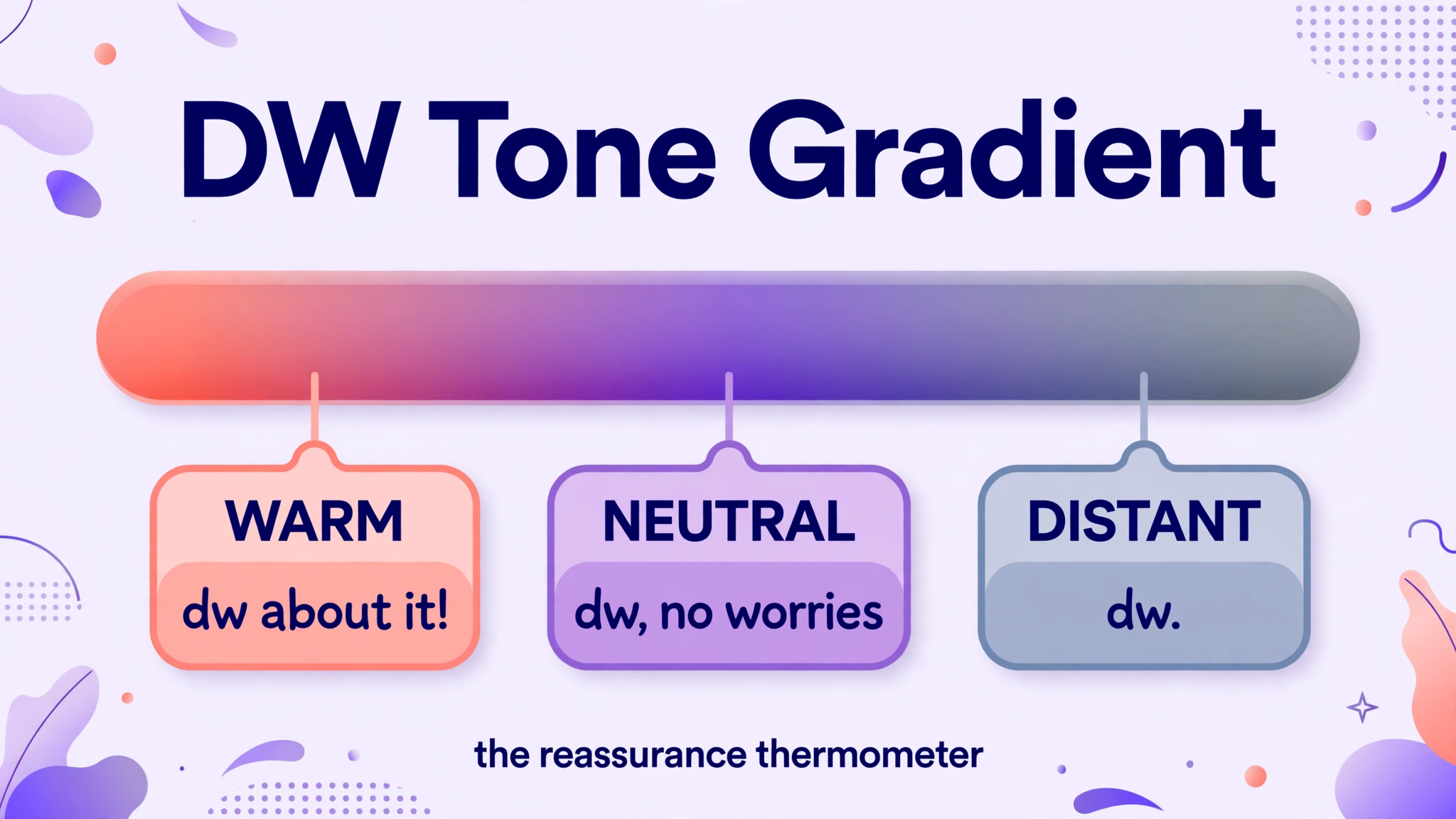
The Warmth Check is the quick version. Here's the full gradient — the "reassurance thermometer" this batch hasn't done before:
Warm DW is genuine comfort, with real effort around it: "dw about it!! 💜" / "dw, seriously, it's totally fine." Exclamation marks, emojis, the fuller "dw about it" phrasing, a follow-up sentence — all push toward warm. This is someone actually trying to make you feel better. Let them.
Neutral DW is the conversation-keeper — polite, functional, extremely common: "dw, no worries." (Yes, "don't worry, no worries" is redundant, and yes, everyone says it.) Most DW in daily texting lives here: light situations, light reassurance, nobody overthinking anything.
Distant DW is the low-effort one, and it's the only DW with a sting: a lone "dw" after you've poured out something real. It carries a whisper of IDC energy — not hostile, just not trying very hard. The tell is always the ratio: your paragraph of feelings, their two letters back. It can also read as mildly condescending toward someone who's genuinely stressed — "dw" to a person mid-panic can land as dismissal rather than comfort.
The lowercase convention: "dw" in lowercase is the documented default — softer and more common than "DW" in real texting. Capitalization doesn't change the meaning, but it nudges the temperature. When you want maximum softness, go lowercase, add an emoji, and write the fuller phrase.
Where You'll See DW: TikTok, Snapchat, Instagram, and Texting
The meaning is identical everywhere — every source agrees on this, so this section describes documented usage context, never invented per-platform definitions:
Texting (SMS, WhatsApp, iMessage). DW's home turf and its most sincere habitat. One-on-one texts carry the full gradient: the warm "dw about it 💜" after a friend's apology, the neutral "dw" in daily logistics ("dw, I'll grab it tomorrow"). This is where the Warmth Check matters most, because the emotional stakes are highest.
Snapchat. On Snap, DW is fast and light: "dw" between streaks, quick forgiveness for a missed snap, low-stakes reassurance that vanishes with the chat. Snapchat DW rarely goes deep — the platform's speed keeps everything in the warm-to-neutral band.
Instagram DMs. In DMs, DW does social smoothing: "dw about it!" after a delayed reply, "dw, happens to everyone" under a vulnerable story share. It's politeness infrastructure — the oil in the gears of online friendship. Story replies are a common delivery vehicle.
TikTok comments. In comments, DW is public reassurance: "dw, you're doing amazing" under a struggling creator's video, "dw about the hate" as community defense. Same two letters, performed for an audience — TikTok DW is reassurance as a public act, which makes it the warmest flavor on average.
One pattern across all four: DW always moves toward the worried person. It's a response to someone else's stress, apology, or mistake — never an opener. If you see DW starting a conversation, something unusual is happening.
Sender Context: Who's Telling You Not to Worry?
From a close friend, DW is pure comfort: "dw, I got you." Accept it. The friendship has earned the right to wave off your worries.
From a crush, "dw about it 🥺" is doing gentle work — it's care wearing casual clothes. "Don't worry" from someone who likes you is rarely just reassurance; it's also "I want you to feel okay around me." The emoji is the tell.
From a partner, DW is reassurance with history: "dw, we'll handle it." In relationships, DW usually comes with implicit backup — it's not just "don't worry," it's "don't worry because I'm here." But notice the distant-DW warning applies double here: a bare "dw" after a real fight isn't comfort, it's a door closing. Read it with the Warmth Check, not with hope.
From a coworker, "dw about the deadline, I'll cover it" is professional kindness in casual channels. In email they'd write "don't worry about it" in full — the abbreviation stays in chat.
From a parent, "dw honey, everything will be fine" is the most literal DW there is — parental reassurance in its native habitat. It's doing exactly what it says.
From someone you barely know, a quick "dw" is just politeness: "dw, no problem at all." Low investment, low meaning, perfectly fine. Don't read depth into it.
How to Reply to DW Without Overthinking It
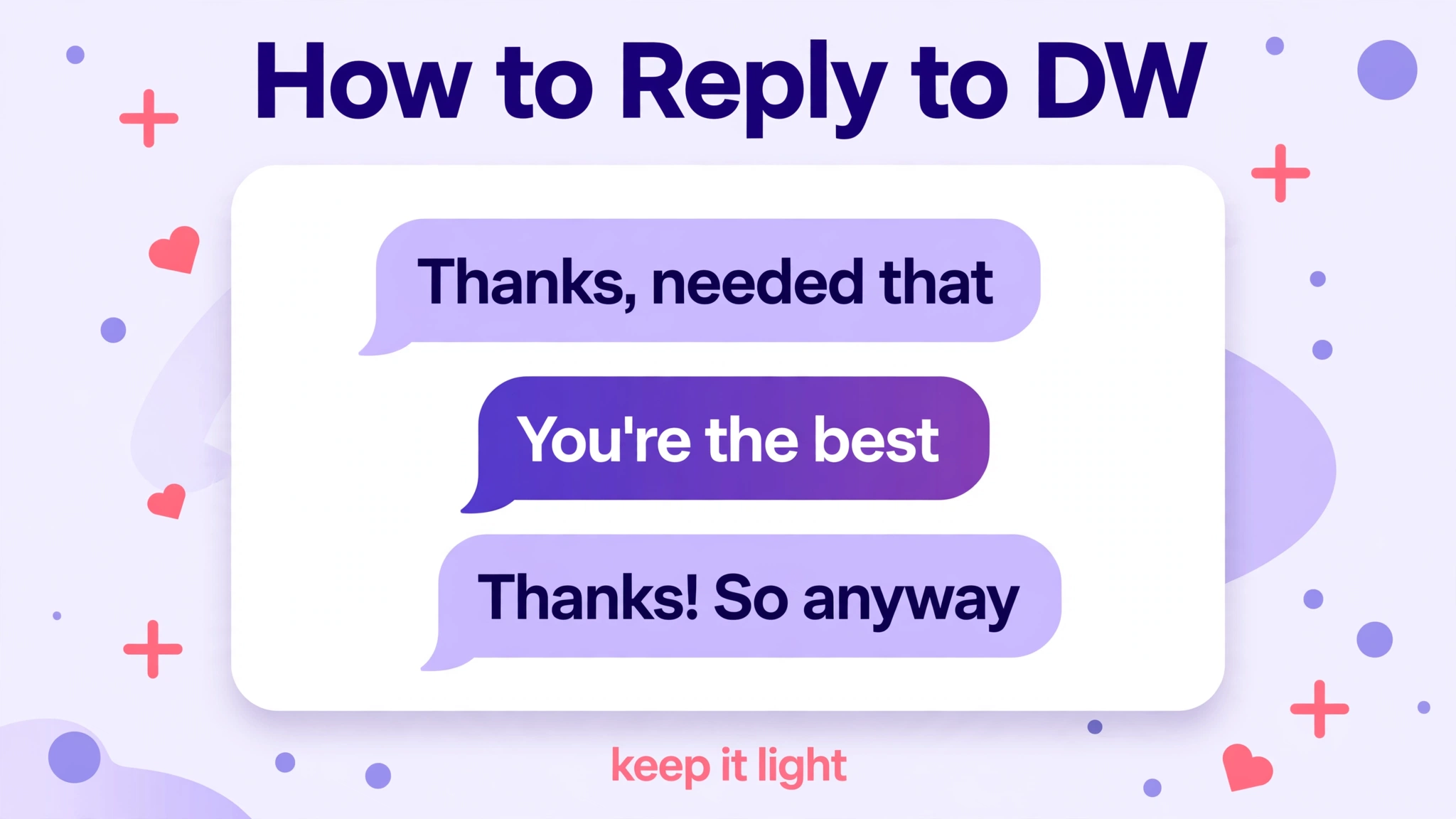
DW is a response to you, so your reply is the third beat in a rhythm: worry → reassurance → acknowledgment. Keep it light:
- Accept the comfort: "thanks 🥺" / "you're the best" / "okay, breathing again 😅"
- Return the warmth: "dw, you're fine too" is the mirror move — reassurance boomerangs nicely.
- Move the conversation forward: "thanks! so anyway —" and then the actual topic. DW did its job; let the chat continue.
- If it was distant-DW and it stung: don't perform okay-ness you don't feel. A TBH-style honest beat works: "tbh still a bit stressed about it, but thanks." Honesty beats a hollow "lol ok."
- The LMK pivot: when someone DWs your apology and you want to make it up: "thanks — lmk how I can make it up to you." Turns reassurance into action.
Reply scripts by sender:
- Friend: "aw thanks, needed that 💜"
- Crush: "🥺 you're sweet, thank you" (warmth back, door open)
- Partner: "thank you. love you." (match the weight)
- Coworker: "appreciate it, thanks!" (professional warmth)
DW vs Similar Slang: The Comfort Corner
DW lives in texting's comfort corner. Here's how it relates to its neighbors:
| Term | Meaning | The difference |
|---|---|---|
| DW | Don't worry | Reassurance toward you — comforts the worried person |
| NVM | Never mind | Cancels the speaker's own point — "forget I said anything" |
| IDC | I don't care | A shrug — indifference, not comfort; distant-DW's tonal cousin |
| TBH | To be honest | Frames candor, not comfort — different job entirely |
| WDYM | What do you mean | Asks for clarity — use it when a "dw" genuinely confuses you |
| OFC | Of course | Agreement/confirmation — "ofc, don't worry" is DW's natural partner phrase |
| HBU | How about you | Bounces the question back — the reply-etiquette sibling: after DW resolves the worry, HBU restarts the chat |
| WBU | What about you | Same family as HBU — chat-flow, not comfort |
The most useful pair: OFC + DW. "Ofc, dw about it" is the complete reassurance sentence — agreement plus comfort in four words. You'll see it everywhere once you notice it.
When DW Is the Wrong Reply
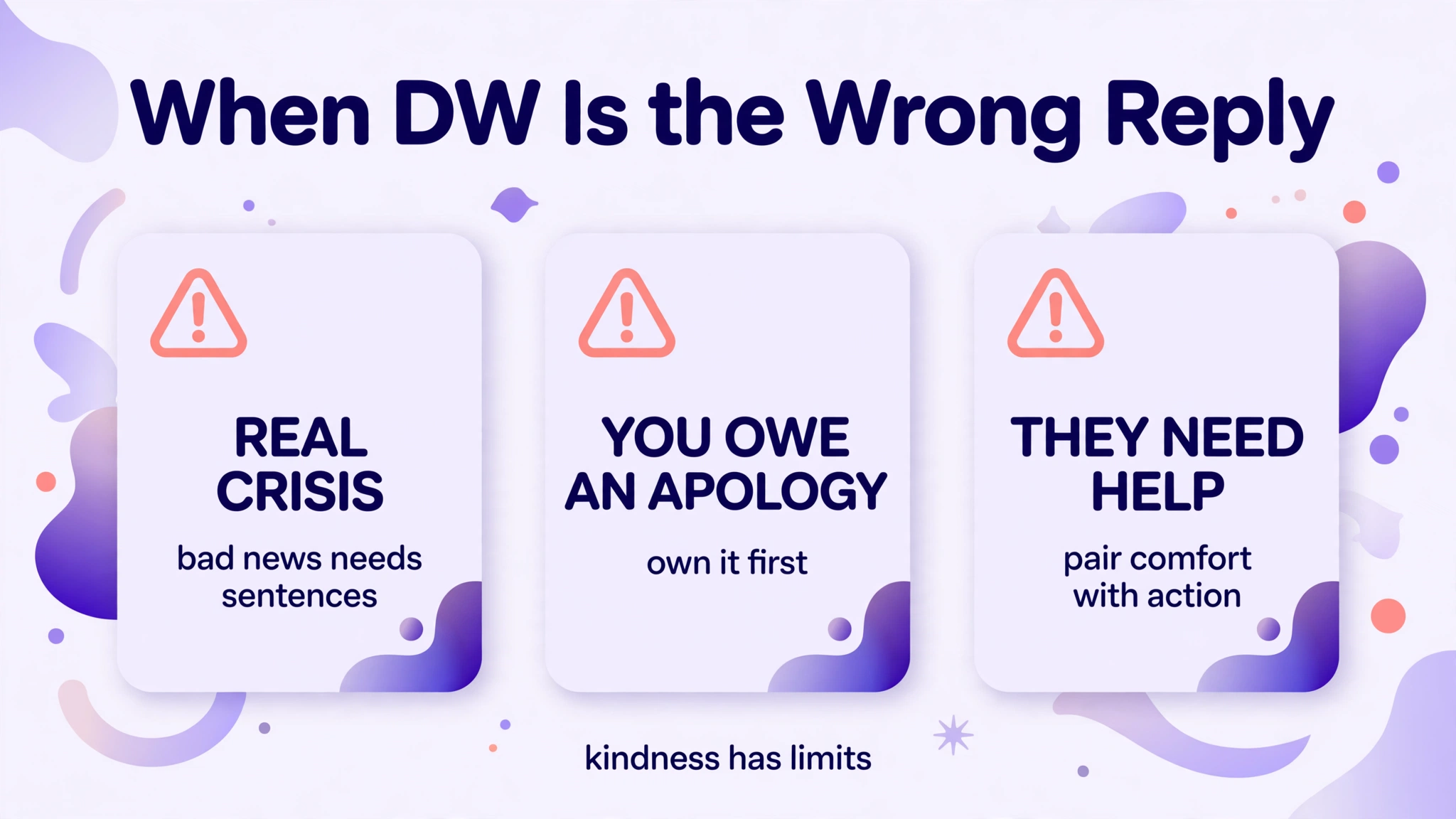
DW is kind, but it's not universal. It's the wrong move when:
- Someone is genuinely in crisis. "DW" after real bad news — a death, a breakup, a failure — reads as minimizing. The moment deserves sentences: "I'm so sorry. I'm here."
- You caused the problem and haven't owned it. "Sorry I ruined your birthday" → "dw" from the person who ruined it is self-absolution, not comfort. Own it first, then accept their DW.
- They need help, not reassurance. "I'm drowning in work" → "dw" is useless; "dw, I'll take the slides" is help. Pair the comfort with action or skip the comfort.
- You're the one who should be apologizing. DW forgives; it doesn't apologize. Don't DW someone you're supposed to be saying sorry to.
- It's your third "dw" in a row. Repeated bare DWs train people to stop bringing you their worries. Vary it, deepen it, or ask a real question instead.
Quick Answers
What does DW mean in text?
DW means "don't worry." It's short for reassurance or forgiveness — for example, "I'm sorry I'm late" → "dw about it!" (Don't worry about it.)
Is DW the same as "don't worry about it"?
Essentially. "DW about it" is the fuller, slightly warmer variant of bare "dw." Same meaning, softer landing.
Can DW sound rude?
It can read as dismissive — never rude exactly, but distant — when it's a bare "dw" after someone shared something heavy. The Warmth Check (punctuation + what came with it + the weight of the moment) tells you which DW you got.
What should I reply to DW?
Keep it light: "thanks 🥺," return the warmth, or move the conversation forward. If it stung, be honest instead of performing okay-ness.
Can I use DW at work?
In casual team chats, yes ("dw about the deadline"). In emails or formal messages, write "don't worry about it" in full.
Does DW mean anything else?
In texting, no — it's "don't worry" every time. Elsewhere, the same letters mean "dear wife" (forums) or "Doctor Who" (fandom), but those readings never appear in chats. Context decides.
DW is the smallest kindness in texting — two letters that say it's all okay so the conversation can breathe again. Run the Warmth Check on every DW you get, pair it with action when someone's really struggling, and remember its natural partner: "ofc, dw about it." Four words, complete reassurance. And if a "dw" ever leaves you unsure whether you were comforted or dismissed — that's what the WDYM move is for. Ask. The two seconds of awkwardness beat two days of wondering.
