
You apologise for replying late, and back comes a single word: "dwbi." No emoji, no explanation. Are you forgiven, or have you just been brushed off? If you have ever stared at those four letters wondering which one it was, you are not alone — and the dwbi meaning in text is simple to state and surprisingly easy to misread.
DWBI means "don't worry about it" — a casual way of saying something is fine, forgiven, or not worth stressing over. That is the whole definition. The useful part is telling the warm version from the cold one, and knowing when four letters are enough and when they are not.
What Does DWBI Mean in Text?
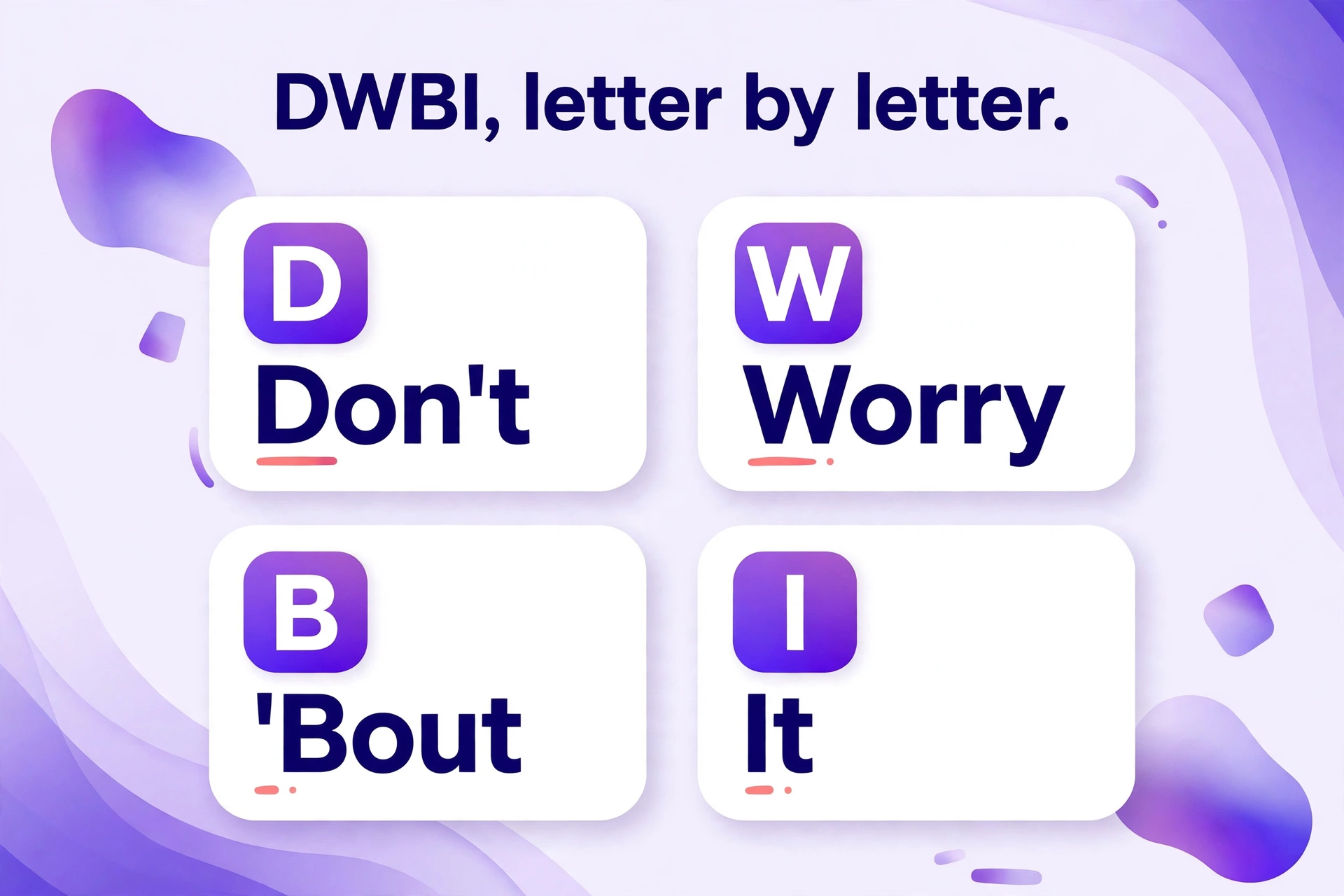
DWBI is an initialism, and its letters spell the phrase out: Don't Worry 'Bout It — "don't worry about it" in its relaxed, spoken form. People send it when someone else is worried, sorry, or making a fuss over something small, and the sender wants to wave that worry away.
It almost always arrives as a response. Someone apologises, frets, offers to fix something, or asks whether everything is okay — and DWBI answers: no harm done, nothing to fix, let's move on.
- "Sorry I forgot to text back!" — "dwbi, I was busy too."
- "Did I mess up your plans?" — "Not at all, dwbi."
- "Sorry I'm running five minutes late." — "DWBI, I just got here."
Notice what all three have in common: something small went wrong, or someone feared it had, and DWBI closes the gap. It is reassurance in shorthand — the texting equivalent of a hand wave that says "we're good."
One honest limit up front: DWBI has no dictionary headword yet. English Wiktionary does not carry an entry for it, and no established dictionary lists it. That does not make the meaning doubtful — every independent explainer agrees on it, and the letters transparently spell a common English phrase — but it does mean this article makes no claims about when DWBI was invented, how popular it is, or who uses it most. Those numbers do not exist, and any site printing them is guessing.
The Weight Test: Warm, Neutral, or a Door Closing?
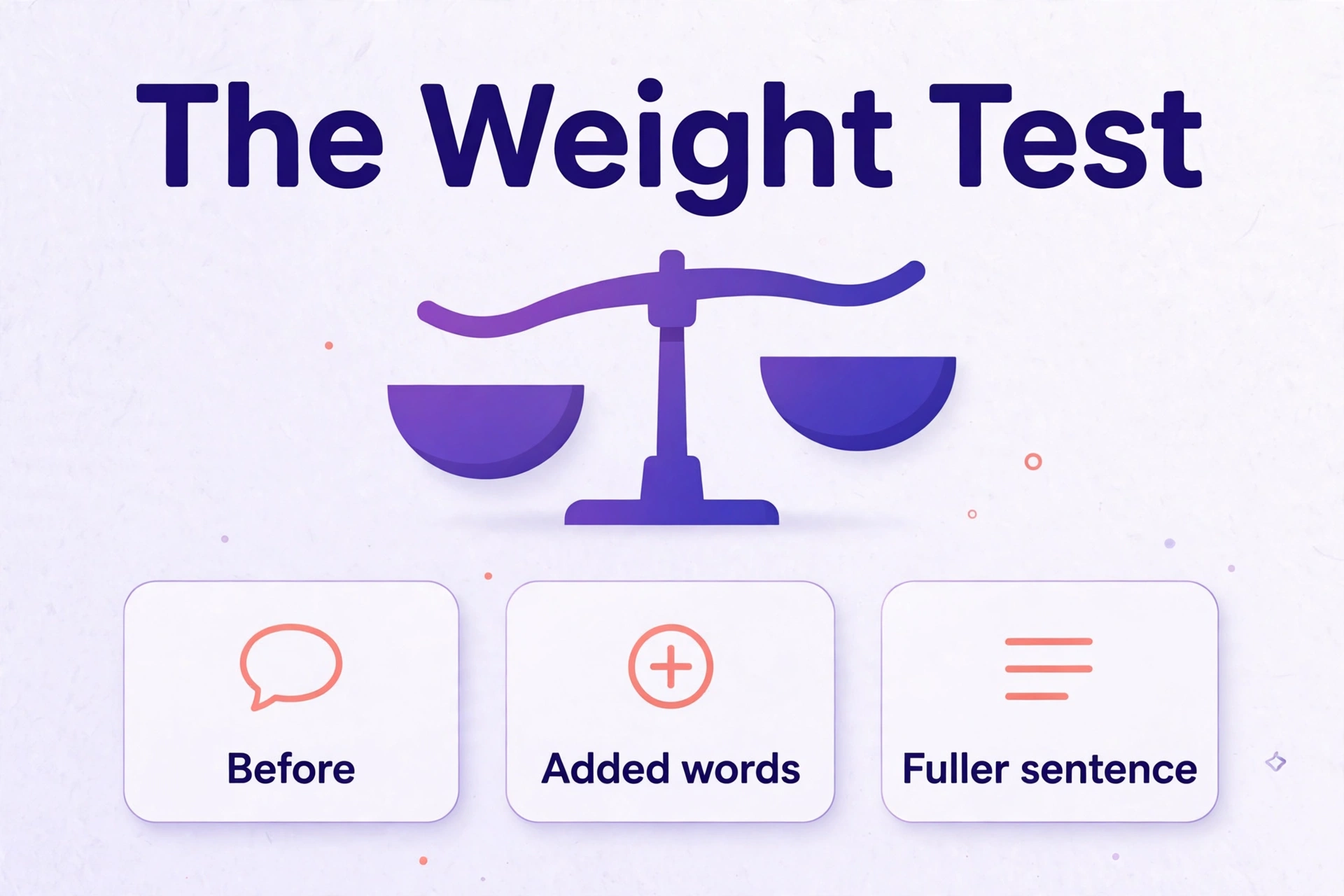
Here is this article's named method, and it settles nearly every DWBI confusion. Call it the Weight Test: weigh what the message is carrying, in three steps.
Step 1: What came before it? DWBI answers something. If what came before was a small apology — a late reply, a forgotten charger, a missed call — DWBI almost certainly means "forgiven, forget it." If what came before was a serious question — "Are you upset with me?" or "What happened earlier?" — a bare DWBI is doing different work: it is closing the subject, not answering it.
Step 2: What was added after it? Warmth travels in the extra words. "Dwbi 😊, it happens to everyone" is unmistakably kind. "Dwbi, I already fixed it" is practical and reassuring — the problem is handled. A bare "dwbi." with a full stop and nothing after it is the coldest form: it ends the exchange without offering anything back. The letters are the same; the luggage is not.
Step 3: Would a fuller sentence change anything? Try swapping DWBI for its full phrase. "Don't worry about it, I wasn't offended at all" feels generous. "Don't worry about it." said to someone who is genuinely upset feels like a dismissal. If the full sentence would still sting, the problem is not the abbreviation — it is that four letters were never enough for that moment.
Run all three and you will rarely misread a DWBI again. A TBH-style honest read applies here: the abbreviation itself is neutral; the weight comes from the conversation around it.
DWBI's Three Jobs
DWBI does three distinct jobs, and recognising which one you just received changes how you reply.
Job 1: Accepting an apology. This is the classic use. You said sorry for something small, and DWBI accepts it. "Sorry I couldn't make lunch" — "DWBI, we'll catch up another time!" The apology is received, the slate is wiped, and the conversation can carry on normally. A warm follow-up ("we'll catch up") is the tell that this is genuine forgiveness, not politeness.
Job 2: Reassuring someone who is worried. Sometimes nobody apologised — someone is just anxious. "I'm so nervous about tomorrow" — "dwbi, you're prepared." Here DWBI is not forgiveness; it is a hand on the shoulder. It says the worry is bigger than the problem. This is the use where a few extra words matter most: "dwbi, you've got this" comforts in a way that a bare "dwbi" never will. It also travels well with a BTW-style aside — "btw, you're more prepared than you think" — reassurance slipped in sideways.
Job 3: Closing or downplaying a topic. This is the sharp edge. "Should we talk about what happened?" — "DWBI." Nothing is forgiven here, because nothing was apologised for; the subject is being set down, and possibly shut. The same letters that forgive a late reply can also say "I don't want to discuss this." Context is the only way to tell them apart — which is exactly what the Weight Test is for.
Tone and Sender Context: Who Sent It Changes the Read
DWBI is not a tone; it is a tool. The tone comes from who is holding it and what has already happened between you.
From a friend, DWBI is almost always warmth in shorthand. Friends use it to keep small things small: the late reply, the cancelled plan, the forgotten errand. If a friend who normally writes in paragraphs suddenly sends a bare "dwbi.", though, notice the change — a sudden drop to one-word replies says more than the abbreviation does.
From a crush, DWBI is usually reassurance with a smile behind it. "Sorry I took so long to reply" — "dwbi 😊" means "I wasn't counting." But if you apologised for something real and got only "dwbi." back, read it with the Weight Test, not with hope: a crush who wants to keep talking adds words.
From a partner, DWBI is household shorthand — the small stuff, waved away daily. It only matters when it breaks pattern. A partner who always writes "dwbi, it's fine, love" and suddenly writes "dwbi." has changed something, and the change is the message.
From a stranger, DWBI is usually just efficient. In a comment thread or a marketplace chat, "dwbi" means "no problem" and nothing deeper. Do not mine it for feelings that are not there.
From a boss or coworker, DWBI is a yellow flag, not a green light. In a casual work chat it can be fine — "Sorry, sent the old version" — "DWBI, I found the new one." But it is vague in exactly the way work should not be: did they fix it, forgive it, or just not want to discuss it? If accountability matters, DWBI is the wrong reply to send and a risky one to accept without a follow-up. A FYI-style heads-up works better at work: "Thanks — all resolved on my end" says what DWBI only hints at.
DWBI on TikTok, Snapchat, Instagram, and in Texting
DWBI means the same thing on every platform: don't worry about it. No platform gives it a special definition — any site claiming a TikTok-only or Instagram-only meaning is inventing one. What changes is where you are most likely to meet it, and how it lands.
Texting (SMS, WhatsApp, iMessage). This is DWBI's home. It shows up in one-to-one chats and group chats alike, usually right after an apology or a worry. In a group chat it can also calm a worried member in front of everyone, which is part of its charm: the reassurance is public, so the embarrassment does not linger.
Snapchat. Chats here are fast and disposable, and DWBI fits that rhythm — a quick "dwbi 😂" after a missed snap or a late reply. The disappearing format makes it feel even lighter than in texting, which is fine for small things and risky for serious ones: a disappearing reassurance is easy to doubt later.
Instagram. In DMs and story replies, DWBI does the same job among friends: "Sorry I tagged the wrong account" — "DWBI! It happens." In a public comment, though, the audience changes the feel. A public "dwbi" under someone's apology can read as generous — the forgiveness is visible — or as performative, depending on who is watching.
TikTok. In comments and DMs, DWBI calms other users: "dwbi, you did great" under a nervous creator's video, or a quick reassurance in a comment thread. The meaning never changes; the stage just gets bigger, so a cold "dwbi." lands harder in public than it would in private.
The pattern across all four: the letters stay the same, but the room changes the temperature. Private rooms forgive; public rooms perform.
How to Reply to DWBI
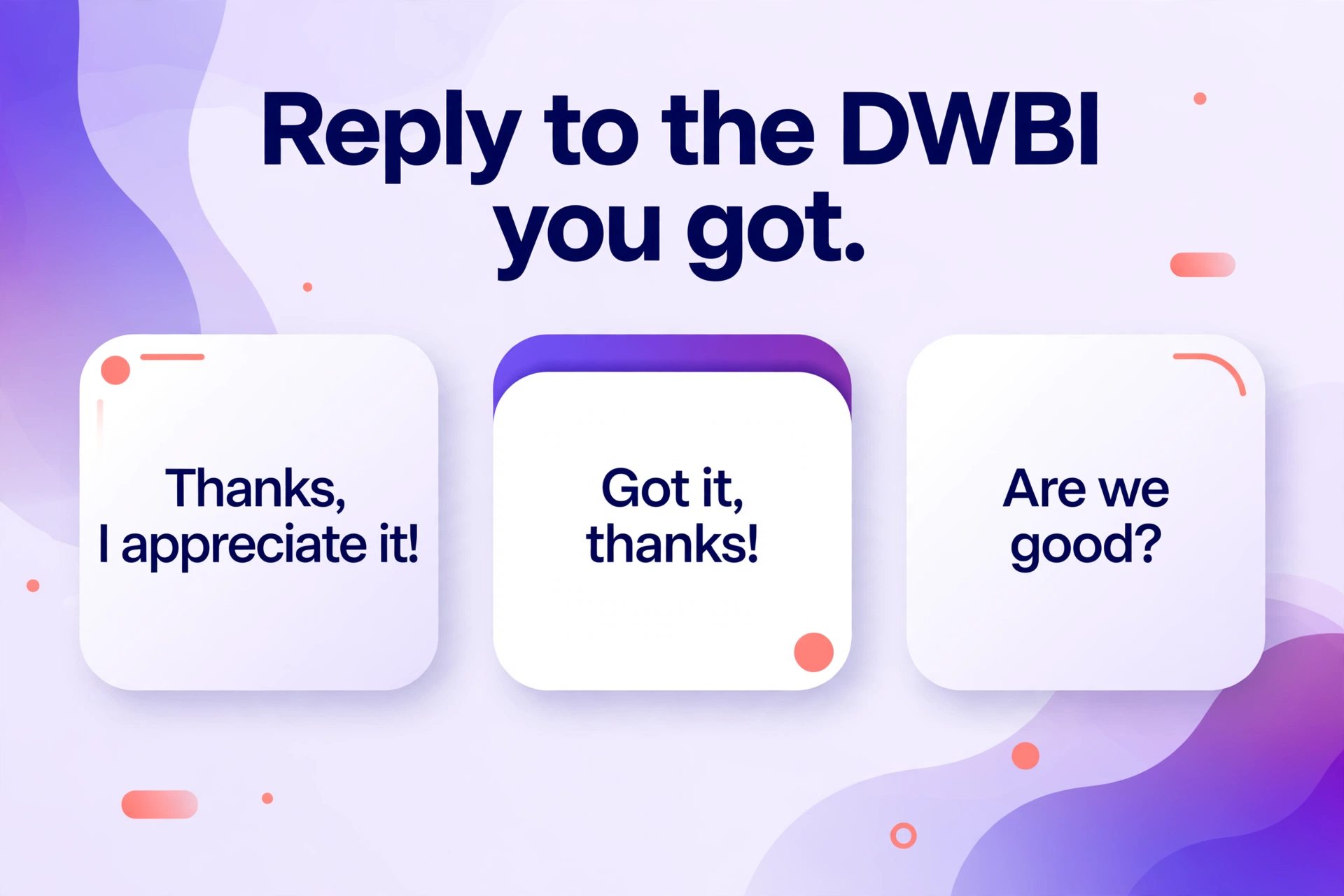
Your reply depends on which job the DWBI was doing. Run the Weight Test first, then match it.
If it was warm: accept it gracefully and stop apologising. "Thanks, I appreciate it!" or "Phew, thank you 😊" closes the loop. The one mistake here is apologising again — it drags the conversation back to the mistake the other person just tried to close.
If it was neutral: a simple acknowledgement is enough. "Okay, thanks for letting me know" or "Got it — let me know if you need anything." No drama, no over-reading. Some people just text short.
If it felt cold or like a door closing: do not guess, and do not chase. One calm check-in beats ten anxious ones: "I want to make sure we're good — is anything bothering you?" If the answer is another bare "dwbi," believe the pattern: they are not ready to talk, and pressing harder will not open the door.
When YOU send it: add the warmth yourself. DWBI is cheap to send and easy to misread, so spend the extra words when it matters: "dwbi, it happens to everyone" instead of "dwbi." And never send a bare DWBI to someone who is genuinely upset — that is the moment for a full sentence, not an abbreviation. A LMK-style soft close helps: "dwbi, honestly — lmk if you want to talk about it."
DWBI vs DW, NVM, NBD, and NP
DWBI sits in a family of reassurance shorthand, and the cousins are easy to confuse:
| Term | Full form | What it actually does |
|---|---|---|
| DWBI | Don't worry about it | Reassures about a specific concern, or closes it |
| DW | Don't worry | Quick comfort, usually before the reassurance lands ("DW, I'll be there on time") |
| NVM | Never mind | Withdraws a question or request — cancels something, rather than forgiving it |
| NBD | No big deal | Minimises the size of the problem, without directly telling anyone not to worry |
| NP | No problem | Says something was not a problem, usually after thanks or an apology |
The useful contrast is DWBI vs NVM. Both can end a topic, but they end it differently: NVM takes something back ("never mind, forget I asked"), while DWBI tells you not to worry about something that already happened. If a friend writes "nvm," they may feel unheard. If they write "dwbi," they are usually telling you it is fine — unless the Weight Test says otherwise.
DWBI's closest relative is DW itself: DW is the shorter, earlier shrug ("don't worry"), and DWBI is the fuller version that points at a specific it. DW comforts in advance; DWBI forgives or closes after the fact.
Debunked: What DWBI Does NOT Mean
Short letters collect false meanings, and DWBI has collected a few:
- "Don't Worry, Be Indian" — invented. One slang site prints this as DWBI's meaning, dressed up as a cultural spin on "Don't Worry, Be Happy." There is no attestation for it in real chats; it is a backronym someone made up to fill a page. In a real text, nobody means this.
- "Don't Worry, Be Inspired" — also invented. Same trick, different slogan. Motivational, memorable, and not what anyone types when they send "dwbi."
- A measured popularity claim — none exists. If a site tells you what percentage of users send DWBI, or that it is "mostly used by" some specific group, ask for the study. There is not one. DWBI is understood in casual texting, and that is as far as the evidence goes.
- A tech term in a texting conversation — wrong room. In data and analytics work, DWBI can stand for Data Warehousing and Business Intelligence — a real field with real job titles like DWBI Developer. That is a different world with the same letters. If you see DWBI in a job posting, it is the tech term. If you see it in a chat, it is "don't worry about it." Check the room, not just the letters.
- A formal phrase — no. DWBI is informal, full stop. It does not belong in emails to clients, job applications, or academic writing, and it is a poor substitute for an apology or an explanation when either is actually owed.
When NOT to Use DWBI
DWBI is a light tool, and light tools break under heavy loads. Skip it when:
- Someone is genuinely hurt, not mildly inconvenienced. A bare DWBI to a real apology reads as dismissal. Write the sentence: "I'm sorry that happened — are you okay?"
- Accountability is on the line. At work, "dwbi" after a mistake leaves it unclear whether anything was fixed. Say what happened and what you did about it.
- You are the one who should be apologising. Answering someone's hurt with "dwbi" flips the script: it tells them not to worry about something you did. That is not reassurance; that is avoidance.
- The relationship is new or formal. Strangers, elders, teachers, and clients have not agreed to your shorthand yet. The full phrase costs four more words and removes all doubt.
- You are not sure how it will land. The golden rule from this article: use DWBI only when the mood is light and mutual. If there is even a little doubt, choose a clearer phrase — "no need to worry about it" is DWBI with the warmth built in.
Quick Answers
What does DWBI mean in text?
DWBI means "don't worry about it" — a casual way of saying something is fine, forgiven, or not worth stressing over.
Is DWBI friendly or dismissive?
It can be either, and the Weight Test tells you which: what came before it, what was added after it, and whether a fuller sentence would change anything. Warm extras (emoji, "it happens") mean friendly; a bare "dwbi." after a serious message leans dismissive.
What is the difference between DWBI and DW?
DW means "don't worry" and usually comforts in advance, while DWBI means "don't worry about it" and usually responds to something specific — an apology, a worry, or a small mistake.
Is DWBI the same as NVM?
No. NVM ("never mind") withdraws a question or request, while DWBI reassures someone about a concern. NVM cancels; DWBI forgives or closes.
Can I use DWBI at work?
In a casual chat with a close coworker, occasionally — but never in formal email, and never where accountability matters. "All resolved on my end, thanks" is clearer and safer.
Does DWBI mean anything else?
In tech and analytics, DWBI stands for Data Warehousing and Business Intelligence — a real field, but a different world from texting. In a chat, it means "don't worry about it."
DWBI is four letters doing the work of a shrug and a smile — when the moment is small and the mood is light. Run the Weight Test before you read it and before you send it: weigh what came before, what was added after, and whether a fuller sentence would change anything. Get that right, and DWBI stays what it should be — a small kindness, sent fast.
