
"Hey, what are you up to?" "NTM, just chilling. You?" That tiny exchange is the most common home of NTM, and it is also the reason the abbreviation confuses people. Three letters that look like a shrug can, in another sentence, add a complaint, defend a favourite show, or — in French — deliver a serious insult. The ntm meaning in text is usually "not too much" or "nothing much," two phrases so close that speakers treat them as one meaning. Everything else NTM does depends on where it sits in the sentence and who is reading it.
That is the honest shape of this term. Unlike a single-meaning abbreviation, NTM is a small family of uses that share letters but not jobs. In a reply to "what's up?" it reports a quiet day. In the middle of a sentence it adds another item to a list. In front of a name or a show it tells critics to back off. None of those uses is wrong, and none of them can be guessed from the letters alone. The sentence around NTM is the definition, and this article gives you a test for reading that sentence in seconds.
NTM is typed in lowercase in most casual chats, though all-caps NTM reads the same way. It is informal, and it belongs in chats with friends, in comments, and in captions, not in work emails or formal writing. No established dictionary was found to record the chat senses of NTM in this check: Wiktionary has no slang entry for it, and the established dictionaries checked do not list it either. That does not make the meaning doubtful — every competitor guide agrees on the core reply meaning — but it does mean the evidence rests on widespread usage guides and community discussion rather than on a dictionary entry, and this article says so plainly.
What NTM Means in Text
In English-language texting, NTM most often means "not too much" or "nothing much." The two phrases overlap so heavily that trying to separate them in a reply is usually pointless. "NTM, just chilling" could be expanded either way without changing what the sender meant: nothing exciting is happening, and the sender is not busy, stressed, or full of news. The reply is a social ritual as much as an answer. It acknowledges the question, reports a quiet day, and usually hands the question back: "NTM, you?" keeps the conversation balanced without demanding a long story from either side.
The NTM Position Test: Where It Sits Is What It Means
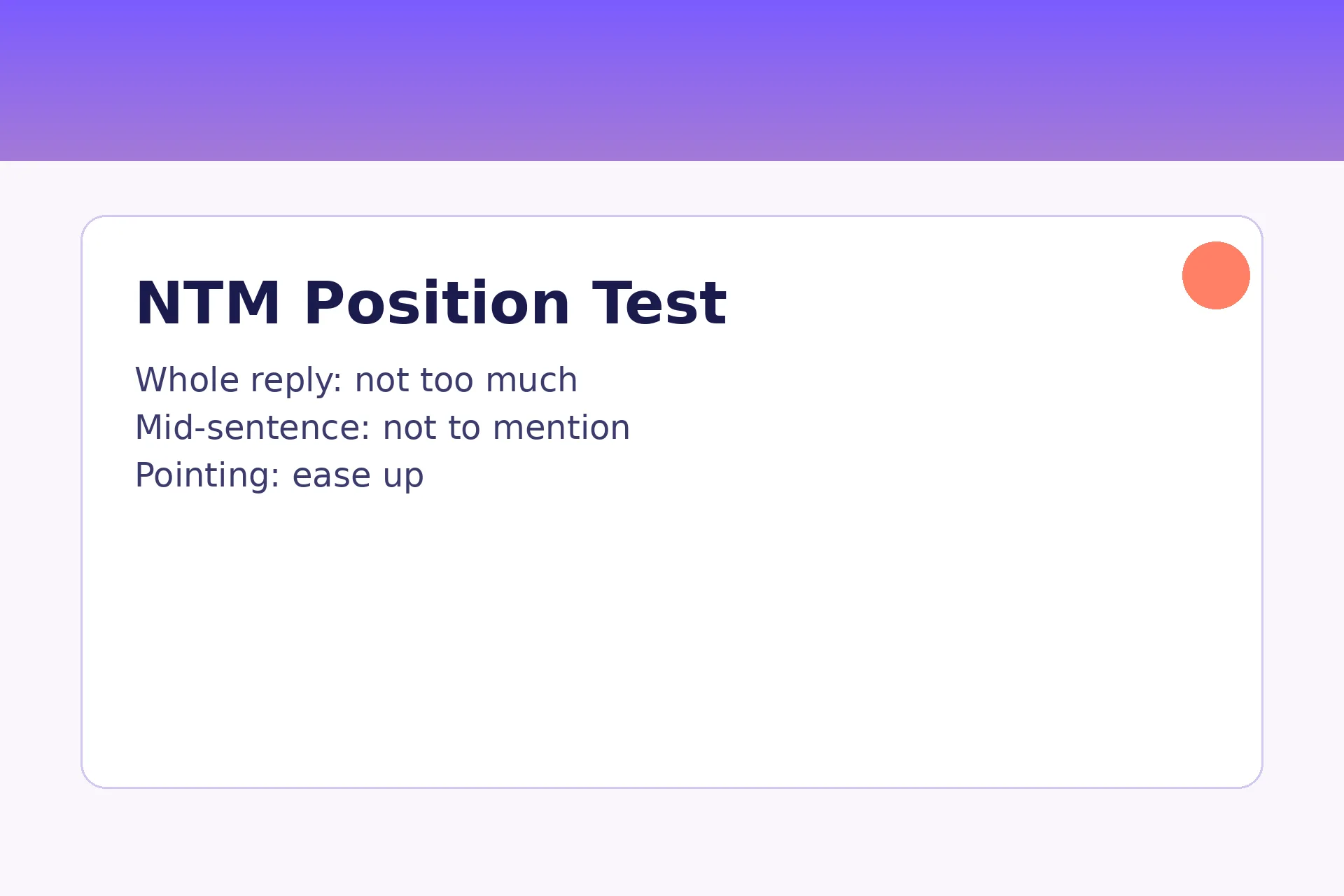
Here is this article's named reader test, the NTM Position Test. It has three positions, and position beats platform every time.
Position one: NTM is the whole reply, or the whole reply plus a short activity and a question back. "NTM, just watching TV. You?" or simply "NTM." This is the default meaning: not too much, nothing much. If the message before it asked what someone is doing, stop here. No further decoding is needed.
Position two: NTM sits in the middle of a sentence, joining one complaint or detail to another. "The flight was delayed three hours, ntm they lost my bag." Here NTM means "not to mention." The giveaway is the grammar. A reply meaning would not sit between two clauses like a conjunction, and "not to mention" fits the slot perfectly. This use is less common in quick back-and-forth chats and more common in longer texts, captions, and venting messages, where the sender is building a list of grievances.
Position three: NTM comes before a name, a show, a team, or a creator, often with "on." "NTM on that show, it is a masterpiece" means "do not do too much" — do not criticise it, do not exaggerate, ease up. This defensive use is most visible in TikTok and comment threads, where fans use it to shut down criticism of something they love. The giveaway is the target that follows it. If NTM points at something, it is defending that thing, not reporting a quiet day.
NTM Means Not to Mention, and the Defensive "Don't Do Too Much"
The "not to mention" use deserves its own section because it is the easiest to miss. It sounds formal for slang, but it follows ordinary English: "not to mention" is a set phrase for adding an extra, often exasperating, point. Shortened to NTM, it keeps that job. "I have three assignments due tomorrow, ntm the shift I have to work tonight" is not a report of a quiet day. It is a list getting longer, and the NTM is the hinge between the items. Readers who only know the reply meaning will misread this completely, hearing "nothing much" where the sender meant "and another thing."
The defensive use is the mirror image. "NTM on my favourite team" does not report anything about the sender's day. It warns the reader: stop talking badly about this. It works like "don't do too much," a phrase that tells someone their criticism or drama has gone too far. This use grew up in comment culture, where a short, sharp defence travels better than a paragraph. It is also the use most likely to confuse an outsider, because the same letters that mean "nothing much" in a chat suddenly mean "back off" in a comment. The target after NTM is the clue. No target, no defence.
NTM on TikTok, Snapchat, Instagram, and in Texting
In plain texting, NTM is almost always the core reply. It answers "wyd?" and "what's up?" and it captions a lazy day: "NTM kinda day" means a day with nothing demanding in it. In texting it can also be sarcastic, as noted above, but sarcasm needs a signal — an ellipsis, an emoji, or a detail that contradicts the shrug — or the reader will take it straight.
On TikTok, all three positions appear. Captions use the core reply for lazy-day content, and comments use the defensive position to protect a creator or a song. A comment that reads "NTM on this song" is not a status update. It is a fan drawing a line.
On Snapchat, NTM behaves like texting, only faster. It fills a chat reply, a streak message, or a story caption when the sender has nothing new to share but wants to stay in contact. A snap captioned "NTM rn" is a placeholder with a friendly shrug attached. On Instagram, the same pattern holds across direct messages, comments, and story replies, with one difference: a bare "ntm" left as a public comment can read colder than the same reply in a private message, because public comments are judged by strangers. Adding an emoji or a few words warms it up.
Tone and Sender Context: Who Is Saying NTM, and Why It Lands Differently
NTM is a low-energy reply, and low energy reads differently depending on the relationship and the moment. Between close friends, "ntm" is comfortable. It says we do not need a performance to stay in touch. Between new acquaintances, the same reply can read as closed, as if the sender does not want to talk. In a conversation where the other person has just shared something important, "ntm" can read as dismissive, because it answers a check-in with a shrug at exactly the moment a fuller answer was wanted.
How to Reply to NTM, and When to Spell It Out
Reply to the position, not the letters. For the core reply, the natural answer mirrors it and adds a little: "Same here," or "Nice, I am just watching something, want to chat?" Both acknowledge the shrug and keep the thread alive. If the sender added a question back, answer it. If they did not, you can still continue, but do not be surprised if the conversation stays light. That is what the reply invited.
Spell NTM out when the reader may not know it, when the conversation is serious, or when you are writing to someone older, a client, or a teacher. "Nothing much, just resting" costs two words and cannot be misread. And never use NTM with a French-speaking reader or in a French-language context without understanding the warning in the next section. That is not a style tip. It is a real risk of serious offence.
The French Warning: The One Reading You Must Not Miss
In French, NTM is the abbreviation of a vulgar phrase, and it is a severe insult, not casual swearing. This article gives it once, in masked form only — "Ne ta me" — and does not spell it out in full anywhere in its headings, metadata, or images. The phrase is aimed at someone's mother, and French speakers recognise the abbreviation instantly. It gained wide recognition partly through Suprême NTM, a French hip-hop duo formed in the late 1980s that took the phrase as its name.
The practical rule is simple. In English-language chats with English speakers, NTM is harmless. In any French-language context, or with a reader you know to be French-speaking, do not use it casually at all. The same three letters that mean "nothing much" in London or Los Angeles mean something genuinely offensive in Paris. International group chats and gaming lobbies are the danger zone, because players from different language backgrounds meet there without realising they are reading different meanings. When in doubt, write the full phrase "nothing much" instead. It costs nothing and removes the risk entirely.
NTM vs Related Terms
NTM's nearest neighbours are other short replies, and the differences are about energy and information. The guide to WDYM on this site covers a question, not an answer: WDYM asks for clarification, while NTM declines to give detail. The HBU guide covers the question NTM often answers in return: "how about you?" is the partner that turns a shrug into a conversation, and the WBU guide does similar work in a different phrasing.
Three more cousins sharpen the picture. The BRB guide is a temporary absence promising a return, while NTM promises nothing. The GTG guide is a departure closing a conversation, while NTM keeps one open at low heat. The NVM guide cancels a previous point, the opposite of the "not to mention" use. And the TBF guide shows how to add a frank qualification without hiding behind a shrug.
Debunked: What NTM Does NOT Mean
Several readings that appear in single guides should be treated as weak or omitted. "Need to meet" appears in a few gaming and event-planning guides, but with thin and inconsistent examples, and it is easily confused with the core reply in the same chats. "Next to me" appears in one guide with a flirty example and in no other, which is too thin to present as established. "Nice to meet you" and "nothing to me" appear in listicles without usage examples at all. This article grades all four as weak and leaves them out of the main body, because presenting every listicle entry as a real meaning would mislead more readers than it helps.
When Not to Use NTM
Skip NTM in professional messages, in messages to teachers or clients, and in any conversation where a fuller answer is owed. A bare "ntm" in reply to a serious question reads as indifference, even when the sender meant only to be brief. In those settings, "Nothing major so far, I will update you later" does the same job with warmth included.
Quick Answers
What does NTM mean in text?
NTM usually means "not too much" or "nothing much." It is a casual reply to "what's up?" or "what are you doing?", meaning nothing exciting is happening.
What does NTM mean on TikTok?
On TikTok it usually means the same thing in captions, but in comments it can also be defensive: "NTM on that show" means "do not criticise it" or "ease up."
What does NTM mean on Snapchat?
On Snapchat it means "not too much" or "nothing much," used as a quick chat reply, a streak message, or a story caption when the sender has nothing new to share.
What does NTM mean on Instagram?
On Instagram it means "not too much" or "nothing much" in direct messages, comments, and story replies. A bare "ntm" as a public comment can read colder than the same reply in a private message.
What does NTM mean in the middle of a sentence?
In the middle of a sentence it usually means "not to mention," adding another point: "The flight was delayed, ntm they lost my bag."
Is NTM rude?
Not in English-language slang, where it is neutral and casual. It can feel dismissive if used in a serious conversation, and in French it is a severe insult, so context matters.
What does NTM mean in French?
In French it abbreviates a vulgar insult aimed at someone's mother. This article gives it masked only, once, and never in headings or metadata. Avoid using NTM casually with French-speaking readers.
Can I use NTM at work?
Better not. At work, write "Nothing major so far" or "No major updates." Those carry the same information without the slang and without the cross-language risk.
Final Thoughts
NTM is a shrug with three jobs, and the Position Test tells them apart: a whole reply means not too much, a middle-of-sentence NTM means not to mention, and an NTM pointed at something means do not do too much. Reply to the position, spell it out when clarity matters, and never carry it into a French-language conversation. A three-letter reply should make life easier, not start an argument in another language.
