
"They are my OTP." "Sorry, I am OTP right now." "Enter the OTP we sent you." Three messages, three different worlds, and the same three letters in all of them. The otp meaning in text cannot be given as a single definition, because OTP lives in three separate communities that never agreed to share. In fandom it means "one true pairing," a favourite couple. In a personal text it often means "on the phone." And in a message from a bank or an app it means "one-time password," a temporary security code. The sender, not the letters, decides which one you are reading.
That three-way split is the whole story, and it is why OTP confuses more readers than most abbreviations. A fan, a friend, and a bank can all use OTP correctly and mean entirely different things. The good news is that the clues are usually loud. Fandom words point one way, availability words point another, and numbers, logins, and the word "code" point a third. This article sorts the three meanings, gives you a test based on who sent the message, and warns you about the one meaning that must never be shared with another person.
OTP is an initialism, pronounced "oh-tee-pee," letter by letter. Wiktionary records several senses, including the fandom sense, the one-time password sense, and the gaming sense discussed below, and Dictionary.com lists both the fandom and the security meanings. The fandom phrase has a documented history going back to a 1984 fanzine summary that called a pairing "our one true pairing," with the acronym appearing online by 2002. No single inventor is documented, and this article claims none.
What OTP Means in Text
Start with the three meanings in plain form. "One true pairing" is a fan's favourite romantic pairing in a show, book, film, game, or celebrity fandom. It is the pairing the fan backs above all others in that story, whether or not the pairing ever becomes official. "On the phone" is a status update: the sender is on a call and cannot reply properly right now. "One-time password" is a temporary code, usually numeric, sent to verify a login, a payment, or a password reset, and valid for one use or a short window.
The OTP Sender Test: Who Sent It?
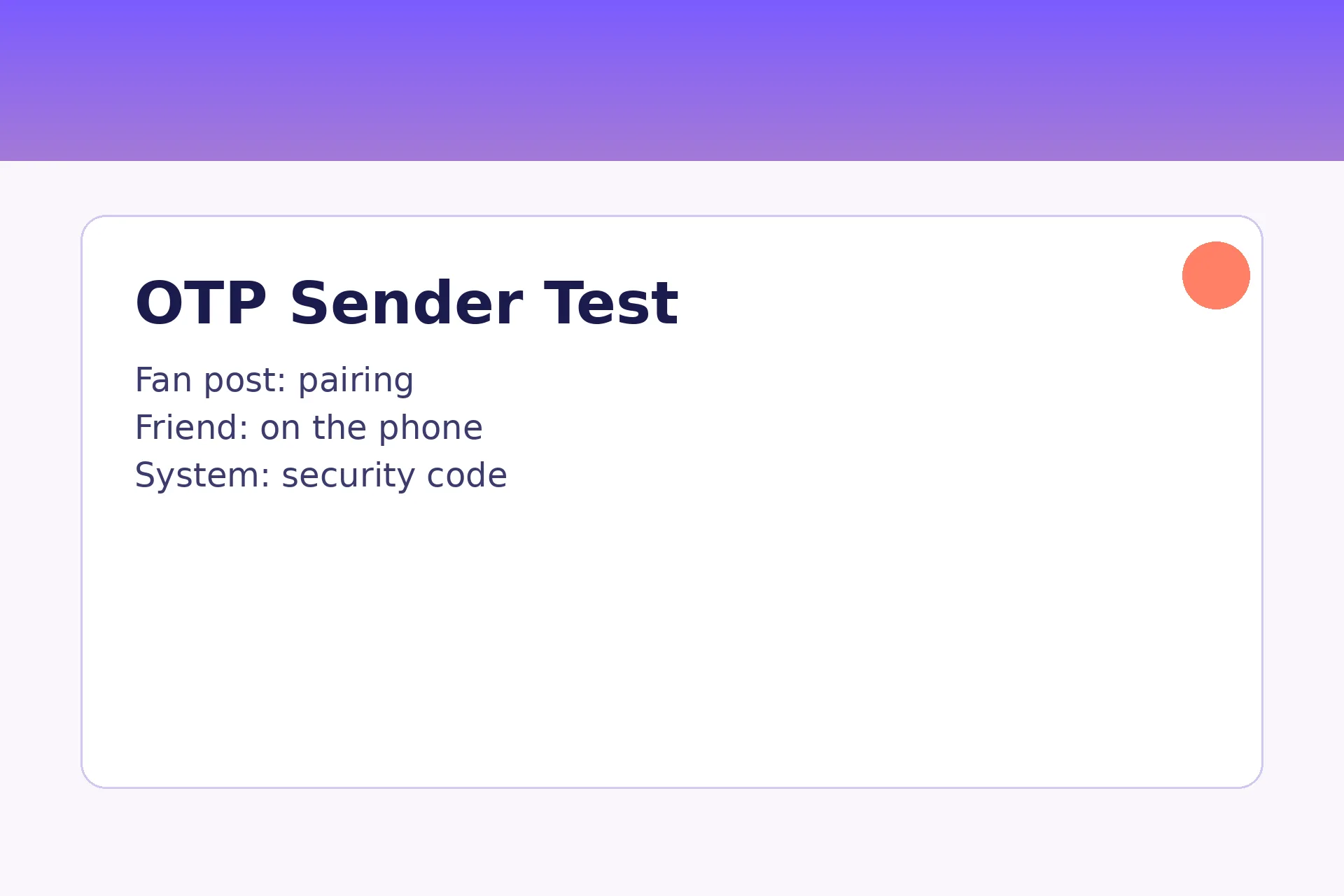
Here is this article's named reader test, the OTP Sender Test. Ask who sent the message before you ask what OTP means.
If the sender is a fan account, a commenter, or a friend talking about a show, OTP means "one true pairing." The subject will be characters, couples, episodes, or chemistry. If the sender is a person you know, replying to you or explaining a delay, OTP means "on the phone." The subject will be availability: they cannot talk, they will call back, they were on a call. If the sender is a short code, a business name, or an automated system, OTP means "one-time password." The subject will be verification, and the message will usually include the code itself.
OTP Means One True Pairing
In fandom, OTP is the top of a small vocabulary. A "ship" is any pairing a fan supports, from "relationship." Shipping is the act of supporting it. An OTP is traditionally the fan's single favourite ship, the one they would defend in the comments. Modern use is looser: many fans now have an OTP per fandom, or use OTP to mean simply "my favourite ship," rather than one exclusive pairing for all time. That loosening is documented by fan sources, and it is worth knowing, because older fans may use the word more strictly than newer ones.
OTP Means On the Phone, and OTP Means One-Time Password
In personal texting, "on the phone" is the everyday meaning, and it is the one most often missed by readers who only know the fandom sense. "OTP, call you back," "can't talk rn, otp," and "sorry, was otp all morning" are all status updates. The tone is casual and practical. The sender is not discussing a couple. They are explaining why they cannot reply, and the expected response is patience, not a comment about a show. This use grew out of SMS shorthand, the same impulse that produced "omw" and "brb," and it needs no fandom knowledge at all.
The safety rule for this meaning is absolute and deserves its own paragraph. Never share a one-time password with another person, even if they claim to represent your bank, your employer, or a delivery company. Genuine services ask you to enter the code into their own app or site, never to read it out to someone who contacted you. A message asking "what is the OTP you just received?" in a banking or login context is asking for a security credential, and treating it as slang would be a costly mistake. If you receive a code you did not request, do not enter it anywhere. Contact the provider through its official channel instead.
OTP on TikTok, Snapchat, Instagram, and in Texting
In plain texting between people you know, OTP most often means "on the phone," especially as a standalone reply or an explanation for a delay. That is the dominant personal-text meaning in the guides reviewed, and it is the reading to try first when a friend sends it with no show or couple in sight. The fandom meaning appears in personal texts too, but only when the conversation is already about a show, a book, or a pairing.
On TikTok, the fandom meaning leads. Fan edits, couple edits, anime content, and comment sections use OTP for favourite pairings, and TikTok's own business material has used the phrase "one true pairing" in anime contexts. Security references appear on TikTok as well, but only when the subject is account safety, not when it is a couple. On Snapchat, both personal meanings appear: a chat saying "OTP rn" means on the phone, while a story or comment about a couple means one true pairing, and an account-security message means one-time password. There is no Snapchat-only definition. The conversation decides.
Tone and Sender Context: Who Is Saying OTP, and Why It Lands Differently
Tone follows the meaning, not the letters. A fandom OTP is warm, enthusiastic, and often playful. It can also be intense: fans invest real emotion in pairings, and a dismissive reply to someone's OTP can feel personal in a way a disagreement about a show would not. The kind response to a fandom OTP is to engage with the enthusiasm or leave it alone, not to argue the pairing out of existence in the first reply.
A phone-status OTP is neutral and practical. It asks for patience, and the kind response is to wait or to say "no rush." Reading it as a fandom statement — replying to "I am OTP" with a comment about a couple — is a small social misfire, but a common one for readers who only know the fandom meaning. A security OTP has no tone at all. It is procedural, and the only emotional content is urgency, which is exactly what scammers exploit. Treat urgency in a security message as a reason to slow down, not to hurry.
How to Reply to OTP, and When to Spell It Out
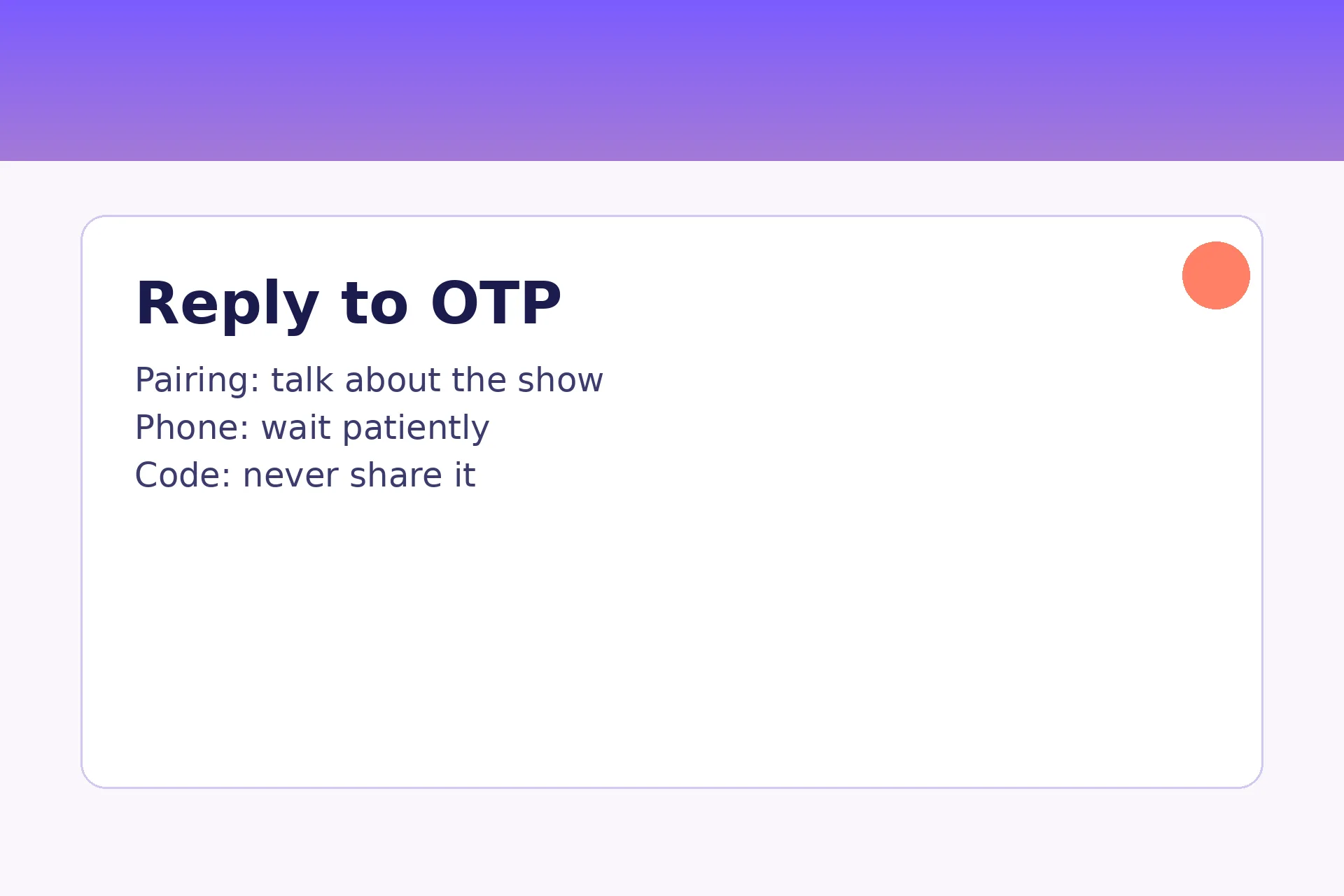
Reply to the meaning you found. For a fandom OTP, reply about the pairing: agreement, a joke, or a question about the show keeps the conversation in its own world. For a phone-status OTP, reply with patience: "No worries, call when you can" is the whole job. For a security OTP, do not reply to the sender at all in the usual sense. Enter the code only into the trusted service that requested it, and only if you initiated the login or transaction yourself.
OTP vs Related Terms
OTP's neighbours split by meaning, so this section splits too. On the fandom side, the closest terms are ship, canon, and endgame. A ship is any supported pairing, canon is what the story confirms, and endgame is the pairing a fan believes or hopes will be final. The guide to IYKYK on this site covers a different kind of fan language: an in-group signal that something needs no explanation, while OTP names the pairing itself. The ISTG guide covers an emphasis marker fans also use when defending a pairing, and the IRL guide marks the boundary between fiction and real life that OTP deliberately blurs.
On the personal-text side, the neighbours are status updates. The MHM guide covers a minimal acknowledgement, the MK guide covers a casual affirmation, and the ND guide covers a short reply in the same family of brief messages. The NFS guide is a useful contrast, because NFS also has three jobs decided by context.
Debunked: What OTP Does NOT Mean
Three claims need rejecting. First, OTP does not have one universal "most common" meaning. Guides that crown one meaning are counting one room and presenting it as the whole house. The fandom meaning leads on social media, the phone meaning leads in personal texts, and the security meaning leads in system messages. Any article that picks one winner without naming its room is misleading.
Second, "one-trick pony" is a real gaming sense — a player who plays only one champion or character, as in "an Ahri OTP" — but it is a niche, community-specific use, not a general texting meaning. Presenting it as a fourth everyday meaning would mislead a reader who meets OTP in a chat. This article records it here, graded as contextually supported in gaming only, and keeps it out of the main body for that reason.
Third, OTP is not a code word for a secret relationship or a hidden message. It is not a signal that two real people are dating, and it is not a password in the fandom sense. The security code and the fandom pairing share letters and nothing else. Treating a bank's OTP as a romantic hint, or a fan's OTP as a login code, are the two classic misreadings, and both come from ignoring the sender.
When Not to Use OTP
Skip OTP in professional messages, where the abbreviation saves little and risks confusion: write "I am on a call" for the phone meaning and "verification code" for the security meaning. Skip it, too, in any message where the reader may not know which room you are in — a fan, a friend, and a bank all read the same letters differently, and a wrong guess costs more than the full phrase.
Finally, never use OTP as a request for someone else's code. Asking "what is the OTP you just received?" in a banking or login context is asking for a security credential, not slang, and a genuine service will never ask for it that way.
Quick Answers
What does OTP mean in text?
OTP has three main meanings: "one true pairing" in fandom, "on the phone" in personal texts, and "one-time password" in security messages. The sender and the surrounding words decide which one applies.
What does OTP mean on TikTok?
On TikTok it usually means "one true pairing," a favourite couple in a show, anime, or fandom, used in fan edits and comments. Security messages on TikTok still mean one-time password.
What does OTP mean on Snapchat?
On Snapchat it depends on the conversation. In a chat, "OTP rn" usually means on the phone. In a story or comment about a couple, it means one true pairing. An account-security message means one-time password.
What does OTP mean on Instagram?
On Instagram it usually means "one true pairing" in captions and comments about couples, and "on the phone" in direct messages explaining a delay. The subject of the post decides.
What does OTP mean in a message from a bank?
It means "one-time password," a temporary code for logging in or confirming a payment. Never share that code with another person. Enter it only into the trusted service that requested it.
What is the difference between OTP and a ship?
A ship is any pairing a fan supports. An OTP is traditionally the fan's favourite ship, ranked above the others. You can ship many pairings, but an OTP is the one you back most.
Does OTP mean one-trick pony?
In competitive gaming, yes, as a niche use: a player who plays only one champion or character. That meaning does not apply in ordinary texting or fandom posts.
Can I use OTP at work?
For the phone meaning, better to write "I am on a call" in full. For security, write "verification code." The abbreviation saves little and risks confusion in professional messages.
Final Thoughts
OTP rewards one habit above all: check the sender. A fan post means one true pairing, a personal contact explaining a delay means on the phone, and a system message with digits means one-time password. Keep the safety rule separate from the slang: a code is never shared, whatever the letters around it spell. With the Sender Test in hand, three letters stop being a puzzle and start being three clear messages in three clear rooms.
