
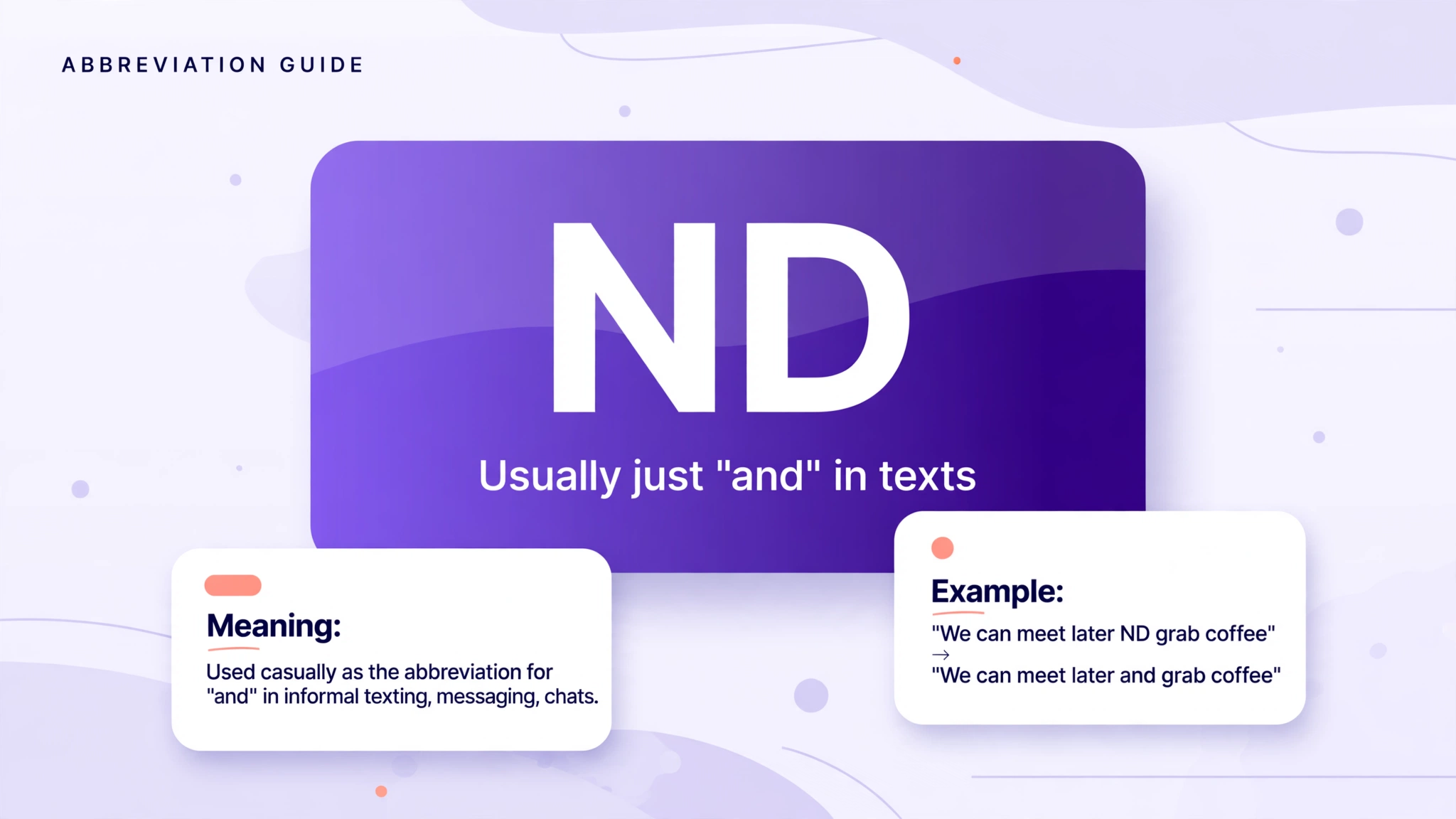
Someone texts you “me nd Sarah are going shopping later” and you read it without a second thought. Someone else writes “vibes only, ND” under a party plan and the same two letters feel like a rule, not a connector. The nd meaning in text is usually the first one — “and” — but ND is one of the most overloaded two-letter abbreviations in English, so the sentence around it always gets the final vote.
In short: in a casual message, ND almost always means “and.” It is not standard English, and it does not change meaning from app to app. The Join Test below tells you in one question whether you are reading the connector or another sense.
What ND Means in Text
ND in a text message is a shortened spelling of “and.” Every competitor guide read for this article agrees on that as the leading texting sense, and dictionary reference material backs it up: Wiktionary lists “nd” as a conjunction meaning “and,” and a dictionary summary describes it as a typo or short form of “and,” entered on Urban Dictionary in 2003. No exact birthday is claimed — 2003 is the earliest listing found, not proof of first use.
Why “nd”? Because “and” spoken quickly already leans toward “nd”: say “bread nd butter” fast and the “a” nearly disappears. That is also why ND sits between things: a connector joins, it does not stand alone. “Coffee nd chaos,” “mom nd dad are coming” — in each case ND does the exact job “and” does. It carries no attitude of its own. It works between nouns (“tea nd coffee”), verbs (“sleep nd eat”), and clauses (“I have a test tomorrow nd I’m nervous”).
Case is style, not a separate meaning: uppercase ND reads more deliberate, lowercase nd reads more casual. ND is also a weaker shortcut than its rivals: the ampersand (&) and “n” (“rock n roll”) are both more widely recognized. One competitor warns plainly that ND should be reserved for informal conversations with people familiar with slang.
The Join Test
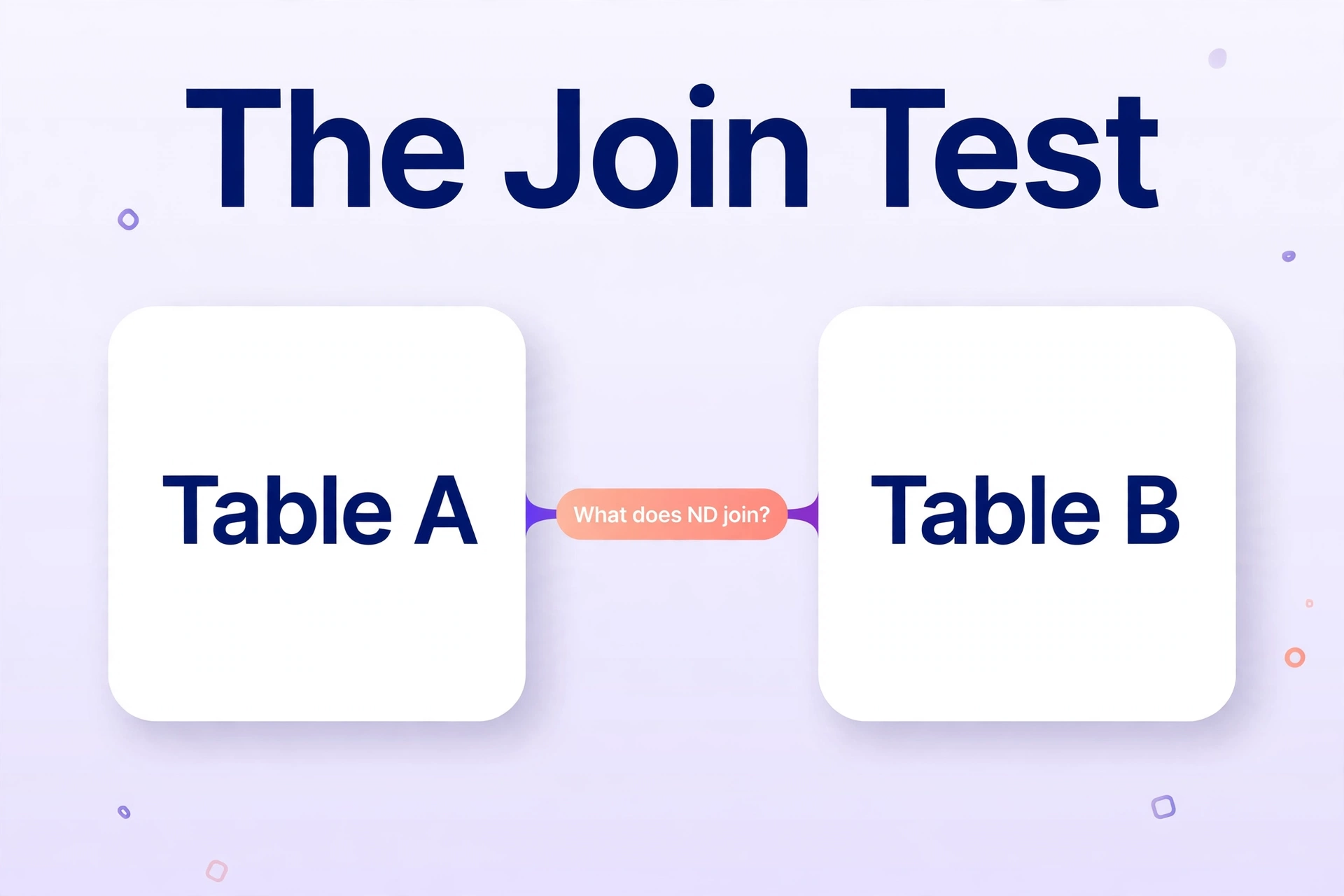
Here is this article’s named method, the Join Test. It asks one question: what does ND join?
If ND sits between two things — two people, two foods, two clauses — it means “and.” “Me nd Sarah” joins me and Sarah. “Snacks nd drinks” joins snacks and drinks. If you can point to one thing on each side of ND, the reading is settled.
If ND joins nothing — standing alone at the end of a message, labelling a person or post, or sitting where a noun phrase should be — then it is not the connector, and you move to the other senses graded below. “Vibes only, ND” is a candidate for “no drama.” “Proudly ND” is a candidate for “neurodivergent.” “Flying to ND next weekend” is a place, North Dakota, in a destination slot.
Earlier guides on this site used removal tests for emphasis words. The Join Test is different on purpose: ND is not an emphasis word you can delete, it is a connector you can point through. Delete ND from “me nd Sarah” and the sentence breaks — “me Sarah” is not a sentence at all. That breakage is itself the evidence.
ND on TikTok, Snapchat, Instagram, and in Texting
ND means the same thing on every platform. In plain texting, ND is at home: threads where friends plan, list, and gossip at speed. “You nd I should go see that new movie” — the connector does quiet work, and full context means a reader rarely has to guess.
On Snapchat, ND gets shorter and punchier, because the photo supplies half the meaning: a snap captioned “hair done nd nails” needs no further grammar. Snapchat is also where the “no drama” sense shows up most plausibly, but the connector still dominates.
On Instagram, ND lives in captions and comments, where its casualness becomes a style choice rather than a speed choice. “Booked nd busy,” “the one nd only” — nobody saves meaningful time dropping one letter from a caption they spent a minute composing. In DMs it behaves like texting, and the same caution applies: if the reader does not know your shorthand, “and” is clearer.
On TikTok, ND appears in comments and captions as the same connector, often inside quick-fire lists: “music, coffee, nd good vibes.” No TikTok-specific meaning was found in any source read for this article. The sentence decides, not the app.
Tone and Sender Context: Who Is Writing ND, and Why It Reads Differently
ND carries casualness, not tone. The tone comes from the words it joins and who sends them — the same lesson as the TBH guide on this site. From a close friend, “me nd you forever” reads warm because of “forever.” From a crush, “you nd I should go see that movie” reads like a low-stakes invitation. From family, ND usually reads as speed.
Age and familiarity matter more than platform. A teenager writing “nd” to friends is using shared shorthand. An adult writing “nd” to a colleague risks a misread: as a typo, as carelessness, or as something else entirely. ND is for people who already know you write that way; with anyone else, “and” costs one letter and removes all doubt.
How to Reply to ND, and When to Spell It Out
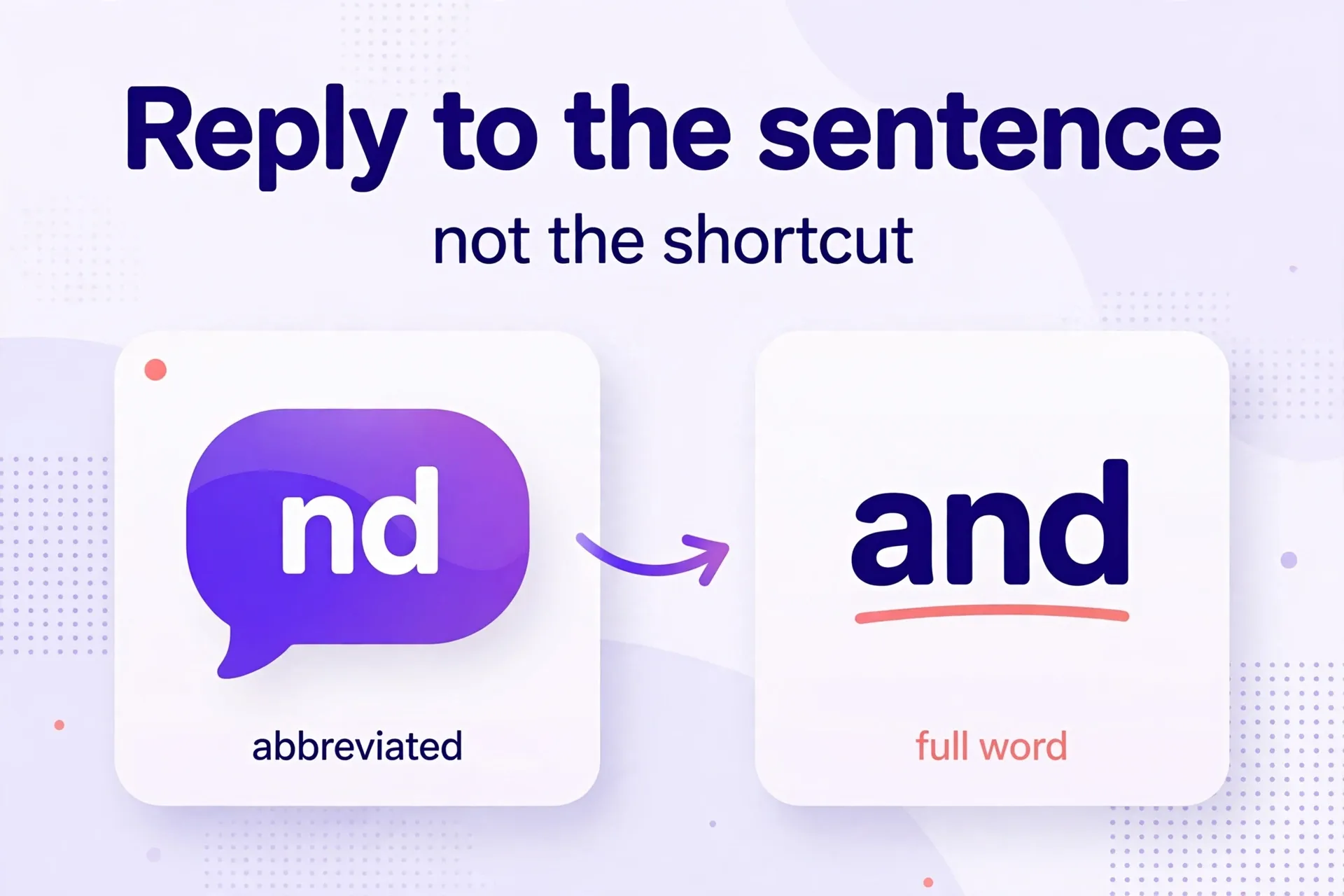
Reply to the sentence, not the shortcut. If ND joins two things, answer the plan, list, or question as if “and” had been written, because that is what was meant. “Me nd Sarah are going shopping later” wants “have fun,” not a comment on spelling. Match their energy with “nd” back, or be clearer with “and.”
If ND joins nothing, reply to the sense the Join Test points to. A “no drama” ND wants agreement: “agreed, tonight stays chill.” A neurodivergent identity ND wants the respect any self-description gets. A North Dakota ND wants a normal travel reply. The reply follows the meaning, and the meaning follows the position.
If you are sending ND, ask whether the reader will pass the Join Test without thinking. Writing to close friends who use it too? ND is fine. Writing to anyone else, spell “and” out. The BTW guide makes the same point: a shortcut should never carry more weight than the message.
ND vs Related Terms
ND-as-“and” sits in a small family of “and”-shortcuts.
| Term | What it is | How it differs from ND |
|---|---|---|
| ND | Shortened spelling of “and” | Least standard “and” form: casual, sometimes a typo. |
| & (ampersand) | Standard symbol for “and” | Accepted formally and informally; the safe shortcut. |
| n | Single-letter “and” (“rock n roll”) | More established than ND, especially in fixed phrases. |
| FR | For real | Confirms or agrees; an attitude marker, not a connector. |
| IDC | I don’t care | States indifference; a complete stance, not a joining word. |
| LMK | Let me know | A request for a reply; it ends a thought, while ND joins two thoughts. |
| WDYM | What do you mean | Asks for clarification; the honest question when ND is unclear. |
| HBU | How about you | Returns a question to the sender; a turn, not a connector. |
Two near-misses: “rock nd roll” reads as a typo against fixed “rock n roll”; and “DND” (do not disturb) is a boundary, not a connector.
Other Meanings of ND, Honestly Graded
This section grades each other sense openly instead of printing a flat list as if all senses were equal. Only the connector sense leads this article.
No drama — Contextually supported. Multiple guides list ND as “no drama” in social and party contexts: a wish for a conflict-free night or a rule for a group chat. No dictionary entry found for this sense makes it weaker than the connector, but the pattern is consistent: a standalone label or rule.
No damage — Contextually supported. Listed by several guides as a reassurance after a disagreement — “it’s all good, ND” — and in gaming for a hit that dealt no damage. Do not confuse it with “no drama”: damage is about harm done, drama is about conflict ahead.
No date (n.d.) — Strongly supported outside texting. In academic writing, “n.d.” means a source has no publication date, and established dictionaries list “no date” as a sense of “nd.” It belongs in citations, not chat threads.
Neurodivergent — Contextually supported. Multiple guides list ND as a self-description for neurodivergent people (“proudly ND”), and dictionary summary material notes it as an occasional abbreviation for neurodivergent. It appears as a standalone identity label, never as a connector.
North Dakota — Strongly supported outside texting. ND is the official USPS abbreviation for North Dakota, listed by every dictionary source checked. In a chat it appears where a place belongs: “flying to ND.” A travel or origin verb points here, not to the connector.
Naturopathic doctor (ND) — Strongly supported outside texting. A professional title and degree in naturopathic medicine. In texting it appears only around healthcare credentials (“I visited an ND”).
No doubt — Weak. Listed by a few guides as an agreement marker, but with no usage examples distinguishing it from “no doubt” or “fr,” and no dictionary backing found. Ask, using the WDYM pattern, rather than assuming.
Not drinking — Weak. Listed by two guides as a party-context sense (“ND tonight, I’m the designated driver”), but with thin examples and no independent backing found. Rule out the connector first: “dinner nd drinks” is “and.”
Debunked: What ND Does NOT Mean
Short letters collect false meanings. First, ND does not have a fixed meaning per platform: one guide claims Snapchat ND “typically” means “no drama” while Instagram ND means “and,” but the evidence does not support a platform rule. The sentence decides, not the app.
Second, ND does not mean “nice day.” One low-quality page lists it as a well-wish, but no other source repeats it, no usage example distinguishes it from saying “nice day,” and the abbreviation logic fails: “nice day” shortens to “ND” only by initials. Grade: Omit. Third, ND carries no hidden intimate or romantic meaning: one sensational page hints at flirty-text secrets but offers no examples, definition, or source, and this article rejects the claim openly.
Fourth, ND is not formal or standard in its connector sense — and the reverse error is just as common: seeing “ND” in a formal list (North Dakota, naturopathic doctor, no date) does not make the chat spelling standard. The chat spelling is informal by definition. Finally, no popularity ranking is printed here. Competitors call ND “most common” without citing any frequency study, and no such study was found. This article prints no percentages and no rank.
When Not to Use ND
Skip ND when formal: job applications, professional emails, and school assignments are not places for a one-letter saving a reader may parse as a typo. “And” is three letters; the risk is a first impression you cannot take back. Skip it when the audience may misread it: anyone who knows ND first as North Dakota will parse your connector through that sense.
Skip it when the sentence already has ambiguity: “dinner nd ND” is a puzzle, not a message. Skip it when the message matters — apologies, condolences, serious news all deserve “and” spelled out. Skip it, finally, when you are not sure the reader knows it. Use “and,” or “&” if you truly need brevity.
Quick Answers
What does ND mean in text?
In a casual message, ND almost always means “and.” Run the Join Test: if ND sits between two things, it is “and.”
How can I tell which ND I just received?
Ask what ND joins. Between two things, it means “and.” Standing alone, check the other senses: no drama, neurodivergent, North Dakota, or a professional title.
Does ND mean “no drama”?
Sometimes, as a secondary sense: standing alone as a rule for a conflict-free time (“vibes only, ND”), “no drama” is contextually supported. Between two things, it is “and.”
What does ND mean on Snapchat?
Usually “and” (“hair done nd nails”). The “no drama” sense appears too, but only in a standalone, rule-setting position.
What does ND mean on Instagram?
Usually “and” in captions (“booked nd busy”), used as a casual style choice.
Is lowercase “nd” different from uppercase “ND”?
No. Both mean the same thing; case only changes how casual the message looks, and never decides a reading.
Can I use ND at work or school?
Better not. In formal writing, always write “and” in full; the one keystroke saved is not worth the misread.
What does ND mean when someone writes “proudly ND”?
That standalone position points to “neurodivergent,” a community self-description. Do not use the label about someone unless they use it themselves.
Final Thoughts
ND is a small shortcut with a large shadow: two letters that usually mean the plainest word in English, and sometimes mean a state, a doctor, a missing date, or a wish for a quiet night. The Join Test keeps them apart with one question — what does ND join? If it joins nothing, slow down and let context name the sense.
