
"PU tonight!" "PU, that stinks." "Can you PU the phone?" Two letters, three messages, and no shared meaning between the second and the first. The pu meaning in text is decided by the sentence around it, because PU is not one abbreviation with one expansion. It is a small cluster: "pull up" when someone is coming over, "pop up" when someone is appearing in a chat, "pick up" when something or someone is being collected, and the much older exclamation "P.U.!" for something that smells bad. The punctuation and the verb in the sentence tell you which one you are reading, and this article gives you the test.
That cluster is why PU confuses people more than its size suggests. Most abbreviations shorten one phrase. PU shortens several, and one of its meanings is not an abbreviation at all. "P.U.!" is an English interjection recorded by the Oxford English Dictionary as early as 1604, used to express disgust, with spellings that include "pugh" and "pew." The texting meanings grew up separately, from the same impulse to type less. Treat them as neighbours who happen to share letters, not as one word with a secret meaning, and the confusion mostly disappears.
No established dictionary was found to record the texting senses of PU in this check, and the guides reviewed disagree about which texting meaning leads. Some put "pick up" first, others "pull up," others "pop up." That disagreement is itself evidence: PU has no single dominant texting meaning across all communities. This article therefore grades all three texting readings as strongly supported in their own contexts, and refuses to crown one overall winner.
What PU Means in Text
In everyday texting, PU most often falls into one of four uses. "Pull up" means come over, join, or show up: "PU tonight" invites someone to a place or an event, and "I will PU in 20" promises arrival in twenty minutes. "Pop up" means appear or message: on a story it invites someone to appear in the sender's inbox, as in "bored, PU," and in a chat it can mean show up unexpectedly. "Pick up" means answer, collect, or fetch: "PU the phone" asks someone to answer a call, and "can you PU my order?" asks them to collect something.
The PU Verb Test: What Verb Is Missing?
Here is this article's named reader test, the PU Verb Test. Ask what verb PU is standing in for, and the answer is the meaning.
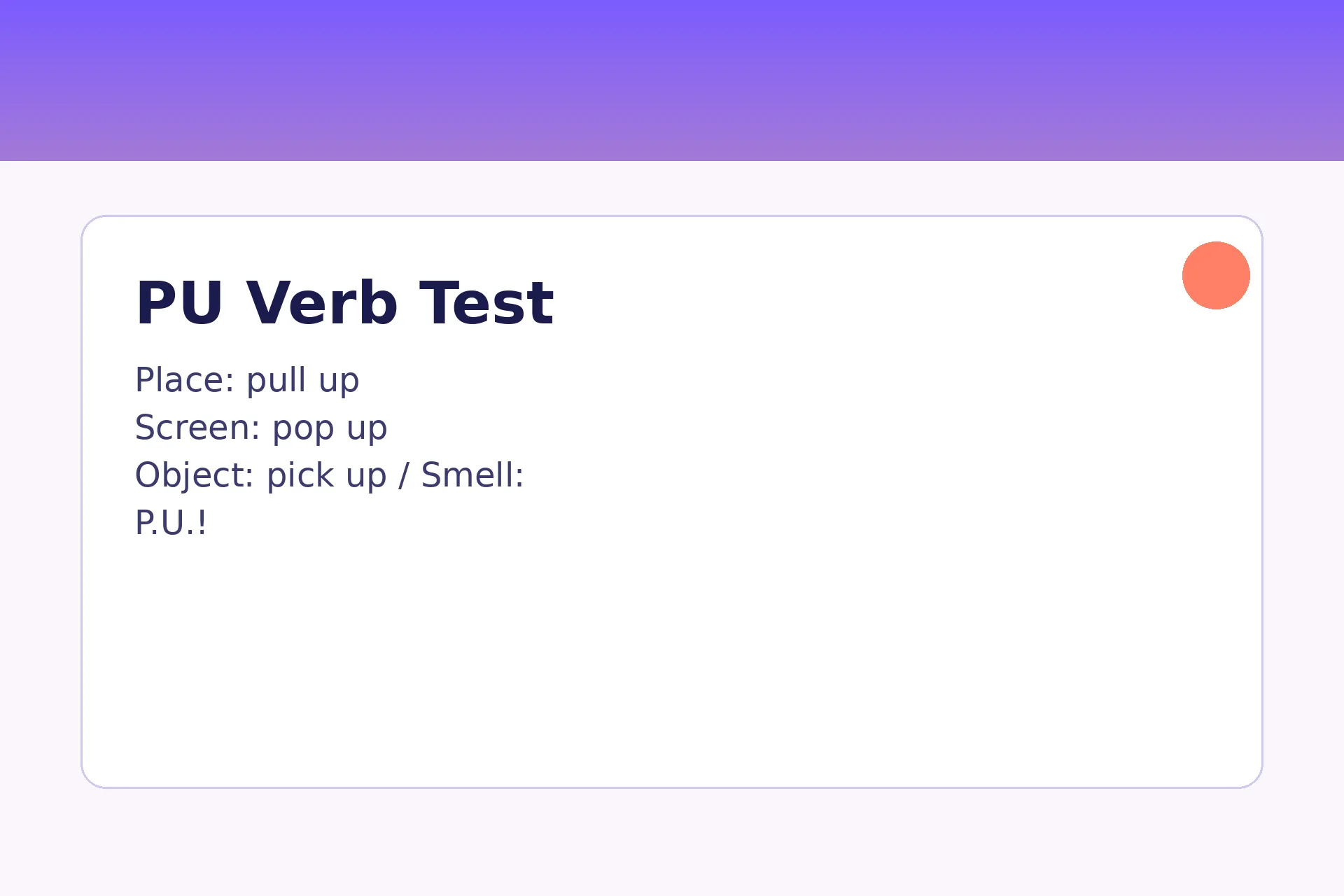
First, look for a place, a time, or a gathering. "PU tonight," "PU to the party," "PU in 20," and "PU on me later" all point to arrival. PU is standing in for "pull up": come over, join us, show up. The giveaway is movement toward the sender or toward an event.
Second, look for a chat, an inbox, or a screen. "PU if you miss me," "bored, PU," and "PU in the chat" point to appearing online. PU is standing in for "pop up": message me, appear here, start a conversation. The giveaway is a private or on-screen destination rather than a physical place.
Third, look for a phone, an item, or an errand. "PU the phone," "PU my package," and "PU the groceries" point to collecting or answering. PU is standing in for "pick up." The giveaway is an object or a call that needs fetching or answering.
Fourth, look for a smell, a gross detail, or an exclamation mark with no verb at all. "P.U.! That stinks" is the exclamation, and it needs no verb because it is not an instruction. If none of the first three tests fits and the sentence is reacting to something disgusting, stop here. That is the answer.
PU Means Pull Up, and PU Means Pop Up
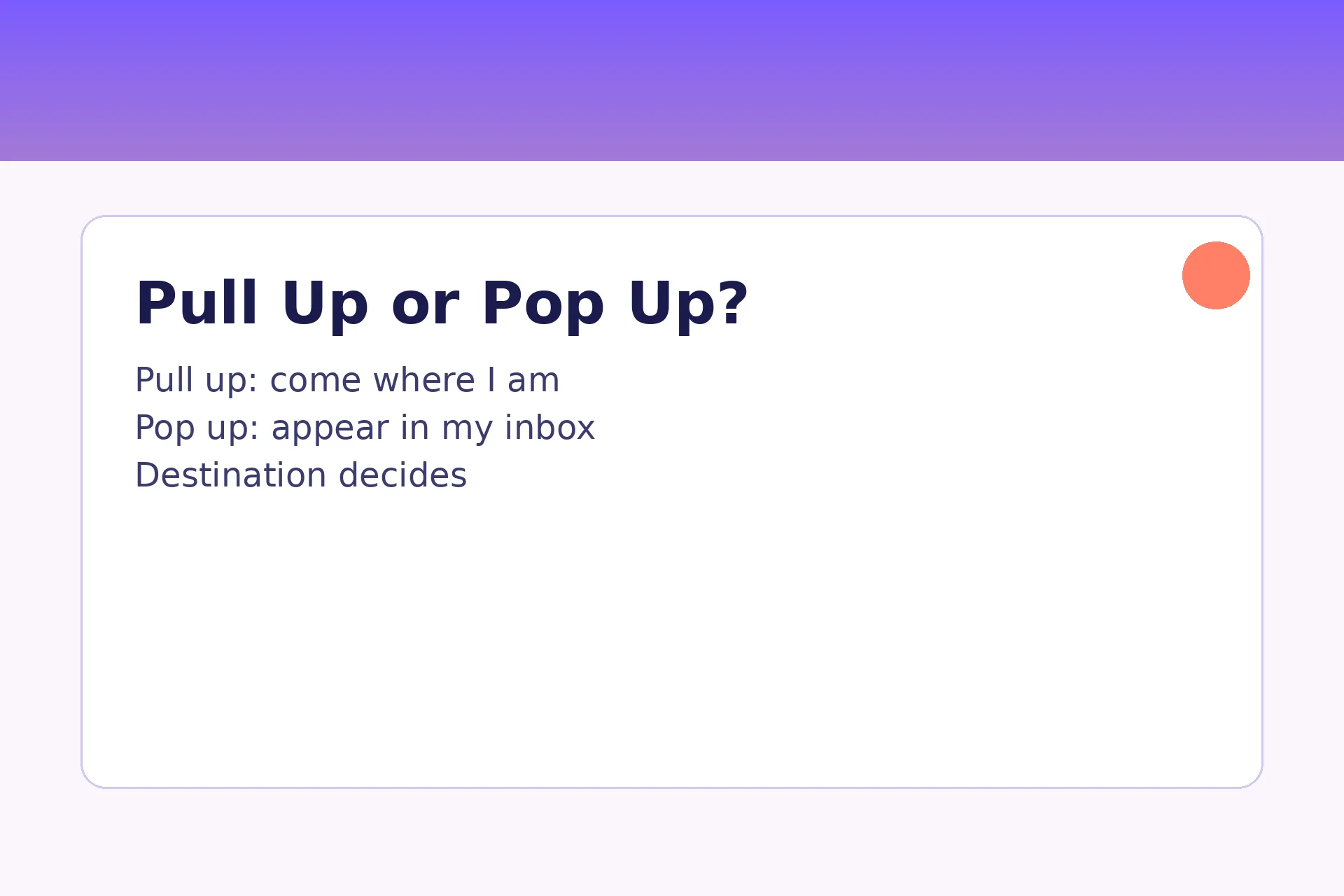
"Pull up" is the invitation meaning, and it is the one most visible on social media. It means come over, join, or arrive, and it extends beyond physical places. "PU VC" in a gaming chat means join voice chat. "PU lobby" means join the game lobby. "Everyone PU to the live" means join the livestream. In each case the destination changes — a house, a party, a call, a stream — but the job stays the same: the sender wants you to show up somewhere they are.
"Pop up" is the inbox meaning, and it is the one most visible on stories and in captions. A story that reads "bored, PU" is asking followers to message privately. A caption that reads "PU if you want the details" is inviting direct messages rather than public comments. The difference from "pull up" is the destination: a chat, not a place. "Pop up" says appear in my messages. "Pull up" says appear where I am. That distinction resolves most confusion between the two, because stories point at inboxes and party invitations point at places.
PU Means Pick Up, and P.U. Means Something Smells
"Pick up" is the practical meaning, and it is the one most visible in logistics and in family chats. "PU the phone" asks someone to answer a call. "Can you PU the groceries?" asks them to collect shopping. "PU your order" in a delivery message means the order is ready for collection. The same meaning appears in shipping and transport, where "PU" on a schedule means a pickup time or location. That professional use is not slang, but it shares the same expansion, which is why readers who meet PU at work and PU in a chat can still understand each other.
The exclamation deserves a paragraph of its own because it is so often mistaken for the abbreviation. "P.U.!" is not short for anything. It is a sound written down, the noise a person makes at a bad smell, and it has been in English for over four hundred years. In texts it appears as "P.U.!", "PU!", or "pew," usually beside a smell, a joke about a smell, or a disgusted emoji. "Opened the fridge and PU" needs no further decoding. The fridge is the context, and the context is the smell. Readers who only know the texting meanings will misread this as an instruction, but no instruction is being given. The sender is reacting, not requesting.
PU on TikTok, Snapchat, Instagram, and in Texting
In plain texting, PU does all four jobs, and the sentence decides. A text about a call means pick up. A text about a party means pull up. A text that says only "PU" after a missed call means pick up, and a text that says only "PU" after a joke about a smell means the exclamation. Texting is the most context-rich setting for PU, because the conversation before it usually contains the place, the object, or the smell that disambiguates it.
On Snapchat, PU leans toward "pop up" and "pull up." Stories use "PU" with an eye emoji to invite viewers to message or to check a link, a usage that grew out of the old swipe-up gesture. Chats use it for "pick up" when someone wants a reply or a call, and for "pull up" when inviting someone to hang out. On TikTok, PU appears in captions and comments as an invitation to join a livestream or an event, and as a reaction to something gross, where the exclamation meaning surfaces in comments. On Instagram, PU appears in stories and captions as a direct-message invitation, and in comments as an invitation to a launch, a party, or a meet-up.
Tone and Sender Context: Who Is Saying PU, and Why It Lands Differently
PU is a short, blunt message, and short messages carry tone poorly. "PU." with a full stop and no softening can read as cold or annoyed, even when the sender meant only to be brief. "PU whenever, no rush" reads warm, because the softening words do the emotional work the abbreviation cannot. Repeated "PU. PU. PU." after being ignored reads as frustrated or nagging, because repetition turns an invitation into a demand. The fix is simple in every case: add a word. A time, a please, or an emoji changes the temperature without changing the meaning.
How to Reply to PU, and When to Spell It Out
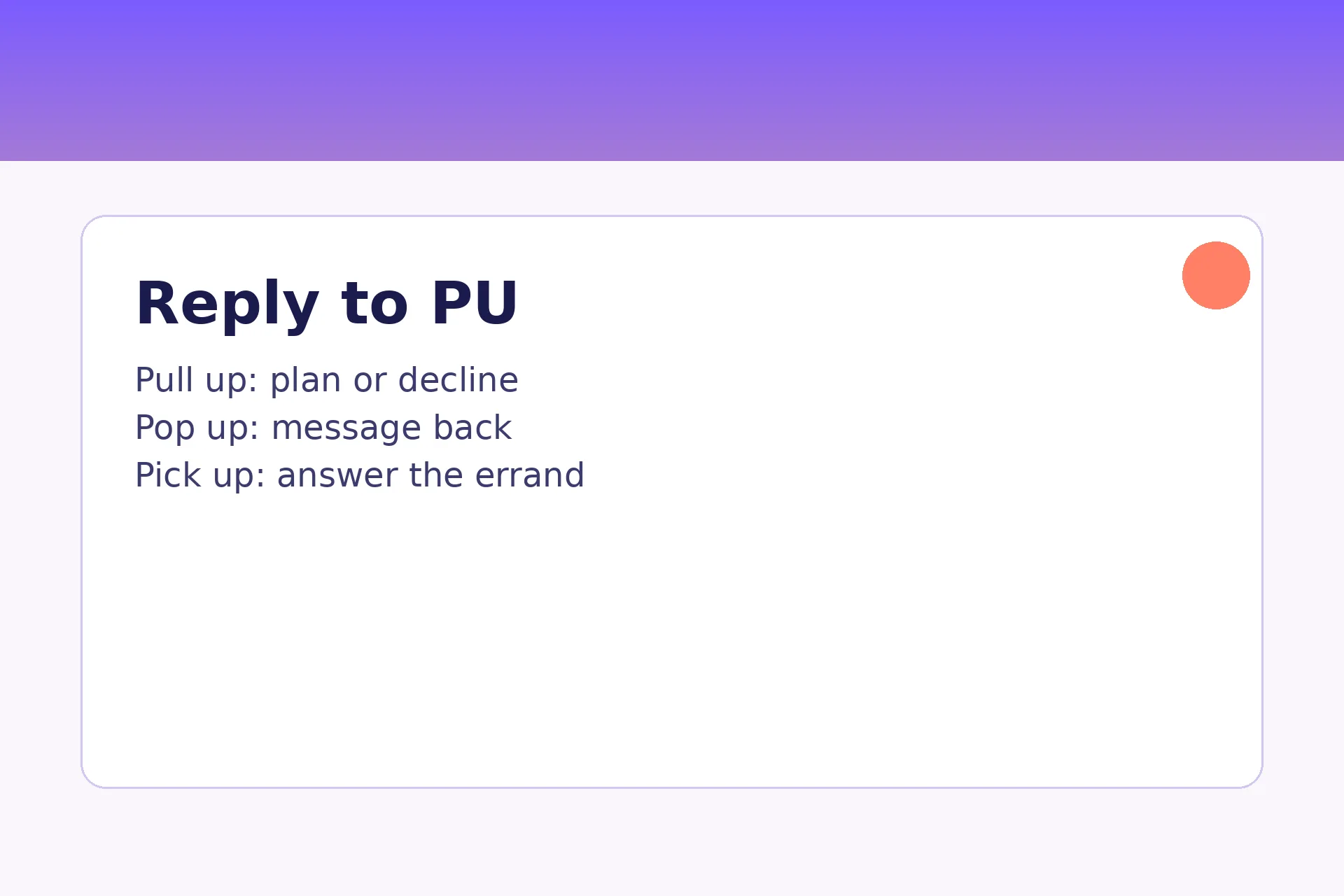
Reply to the verb, not the letters. For "pull up," answer with a plan or a decline: "I will be there by seven," or "Cannot tonight, another time?" For "pop up," answer in the channel the sender invited: a direct message, or a public reply if you prefer to stay public. For "pick up," answer the errand: "On my way," or "I will call in ten minutes." For the exclamation, laugh or agree: "Throw it out, honestly" is the whole conversation.
PU vs Related Terms
PU's neighbours are other short invitations and instructions, and the differences are about destination. The guide to OFC on this site covers an agreement marker, not an invitation: OFC says yes, while PU says come here or message me. The DW guide covers reassurance, which is the opposite job: DW calms a worry, while PU creates a plan. The TYSM guide covers thanks, which often follows a PU that was accepted: you pull up, and then you say thank you.
Three more cousins complete the picture. The CYA guide is a farewell, the mirror image of an invitation: CYA ends contact, PU starts it. The FYA guide is a heads-up, which can precede a PU: a warning first, an invitation second. The TGIF guide marks a moment — the end of the week — when PU invitations multiply, because Friday is when "PU tonight" is most often sent. And the BMS guide covers a term from a different corner of slang entirely, a reminder that not every short form is an invitation, and that context, not length, decides the job.
Debunked: What PU Does NOT Mean
Several readings that appear in single guides should be treated as weak or omitted. "Power up" appears in gaming guides as a PU meaning, but the examples are thin and the phrase is usually written in full in games, where "PU" more often means join the lobby. "Prank you" appears in one guide as a joke meaning, with no consistent usage examples. "Put up" appears in one guide with a hosting example, but it is indistinguishable in practice from "pick up" or "pull up" in the same sentences. This article grades all three as weak and leaves them out of the main body.
When Not to Use PU
Skip PU in professional messages, in messages to teachers, clients, or managers, and in any conversation where clarity matters more than speed. A clipped "PU the documents" to a client reads as careless, not efficient. Skip it with new contacts who may not know the abbreviation, and skip it in sensitive conversations, where a two-letter message can feel dismissive.
Quick Answers
What does PU mean in text?
PU usually means "pull up" (come over), "pop up" (message me), or "pick up" (answer or collect), depending on the sentence. As "P.U.!" it is an old exclamation for something that smells bad.
What does PU mean on Snapchat?
On Snapchat it usually means "pop up" (message me privately) in stories, and "pick up" or "pull up" in chats, depending on whether the message is about a call, a hangout, or a story reply.
What does PU mean on TikTok?
On TikTok it usually means join or show up, as in "PU to the live," or it is a reaction to something gross, where it means the "P.U.!" exclamation.
What does PU mean on Instagram?
On Instagram it usually means "pop up" in stories and captions, inviting direct messages, and "pull up" in comments inviting people to an event, a launch, or a meet-up.
What does "PU on me" mean?
"PU on me" leans toward "pull up on me," meaning come see me or meet me somewhere. It is an invitation to visit, not a request to message.
What does P.U. mean when something smells?
"P.U.!" is an old English exclamation for disgust at a bad smell, recorded as early as 1604, with spellings including "pugh" and "pew." It is a reaction, not an instruction.
Is PU flirty?
It can be, when sent by someone close, with playful timing or emoji. On its own, from a stranger, it is not flirty. It is unexplained, and the relationship and timing create the flirtation, not the letters.
Can I use PU at work?
Better not. At work, write "Please collect your order," "Please return my call," or "Let us meet at six." Those are clearer, politer, and cannot be misread as an invitation or an insult.
Final Thoughts
PU is four messages in two letters, and the Verb Test sorts them: a place means pull up, a screen means pop up, an object or a call means pick up, and a smell means the old exclamation. Reply to the verb, spell it out when clarity matters, and never let a two-letter message pressure you into a place or a chat you did not choose. The shortest messages deserve the clearest reading.
