
Your boss writes “FYA: the updated contract” in an email subject. Your friend comments “this song is fya 🔥” on a TikTok. Same three letters — and not the same word at all. Welcome to one of the trickiest abbreviations in texting, because the fya meaning in text isn’t one meaning. It’s two completely different words that happen to share a spelling, and telling them apart is the entire game.
Here’s the key that unlocks everything: uppercase FYA is an initialism (usually “for your action” or “for your attention”), while lowercase fya is a phonetic spelling of “fire” — as in excellent, impressive, 🔥. Different word-formations, different pronunciations, different worlds. Let’s decode both.
What FYA Means: The Four Jobs
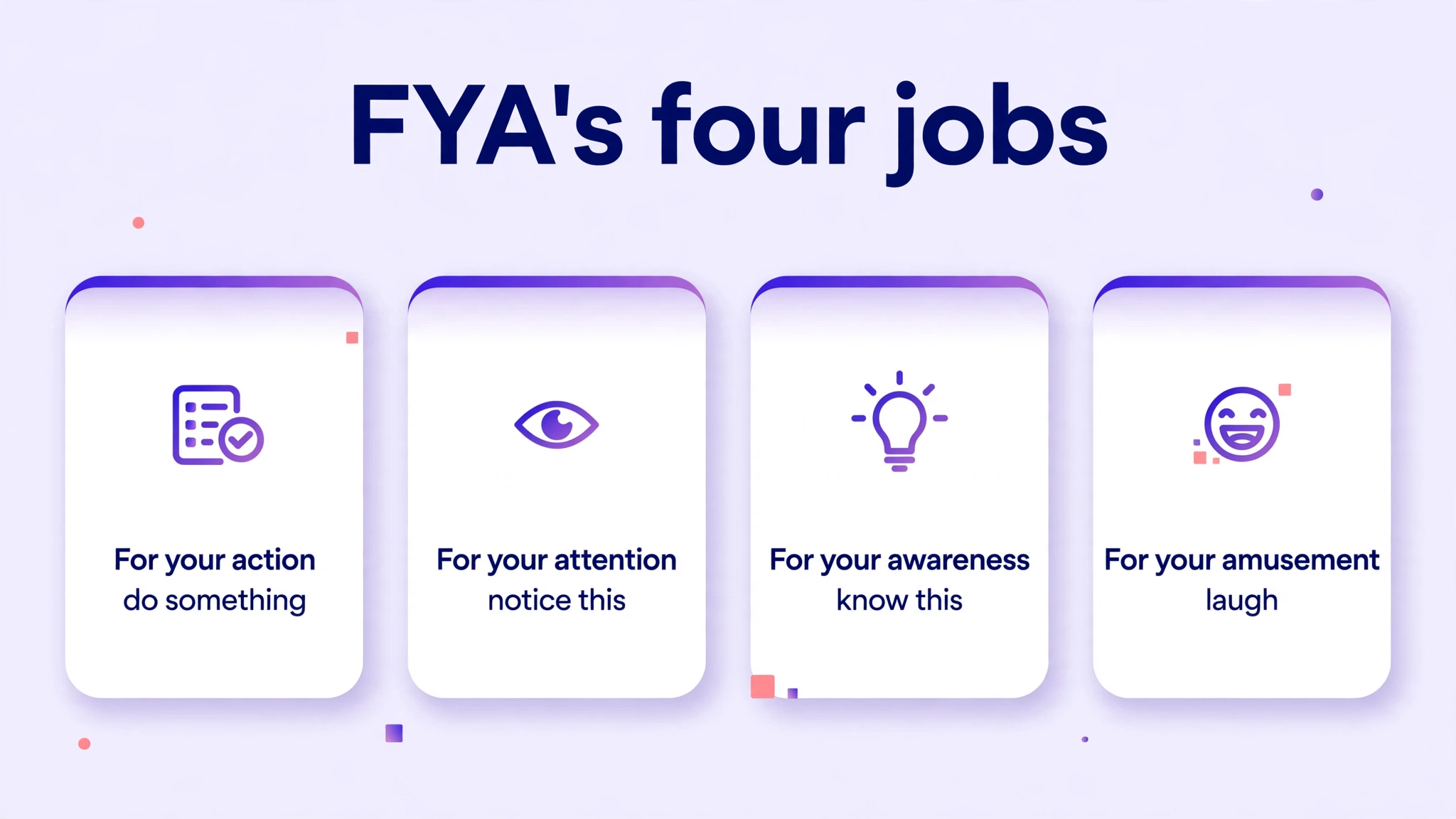
Forget one definition. FYA does four jobs, and which job it’s doing depends on case and context. Here’s the honest map, graded by evidence:
Job 1: “For your action” (work emails and subject lines). The dominant professional meaning. Wiktionary defines it as a business initialism used in corporate email forwarding, and every usage guide agrees. “FYA: Review the updated contract terms” means: here’s something, and you need to do something about it. It’s a task label, not a greeting.
Job 2: “For your attention” (work notices and captions). Wiktionary’s second definition, corroborated by most guides. Softer than “action” — it means “notice this,” with an implied “and probably do something.” In practice, senders blend the two: most workplace FYAs mean “notice this AND probably act on it.”
Job 3: lowercase “fya” = “fire” (slang for excellent). This is the big one for texting and social media, and it’s the insight no competitor makes central: lowercase fya is not an initialism at all. It’s a phonetic spelling of “fire” — pronounced “FYE-uh,” not “eff-why-ay.” “That song is fya” = “that song is fire.” Slang references document it widely as a synonym of “cool” and “excellent.” In casual DMs and comments, this is the most common reading by far.
Job 4: “For your amusement” (sharing memes and funny videos). Attested across usage guides: someone forwards a meme with “fya” meaning “this is for your entertainment.” It’s real, but secondary — mostly a forwarding label, and mostly in casual contexts.
The honest hierarchy: at work, it’s Job 1 or 2. In texts and comments, it’s Job 3. Forwarding something funny, it’s Job 4. And “for your awareness”? That one’s the rarest expansion — likely just FYI-confusion in the wild, worth knowing but rarely the intended meaning.
The Case-and-Job Test
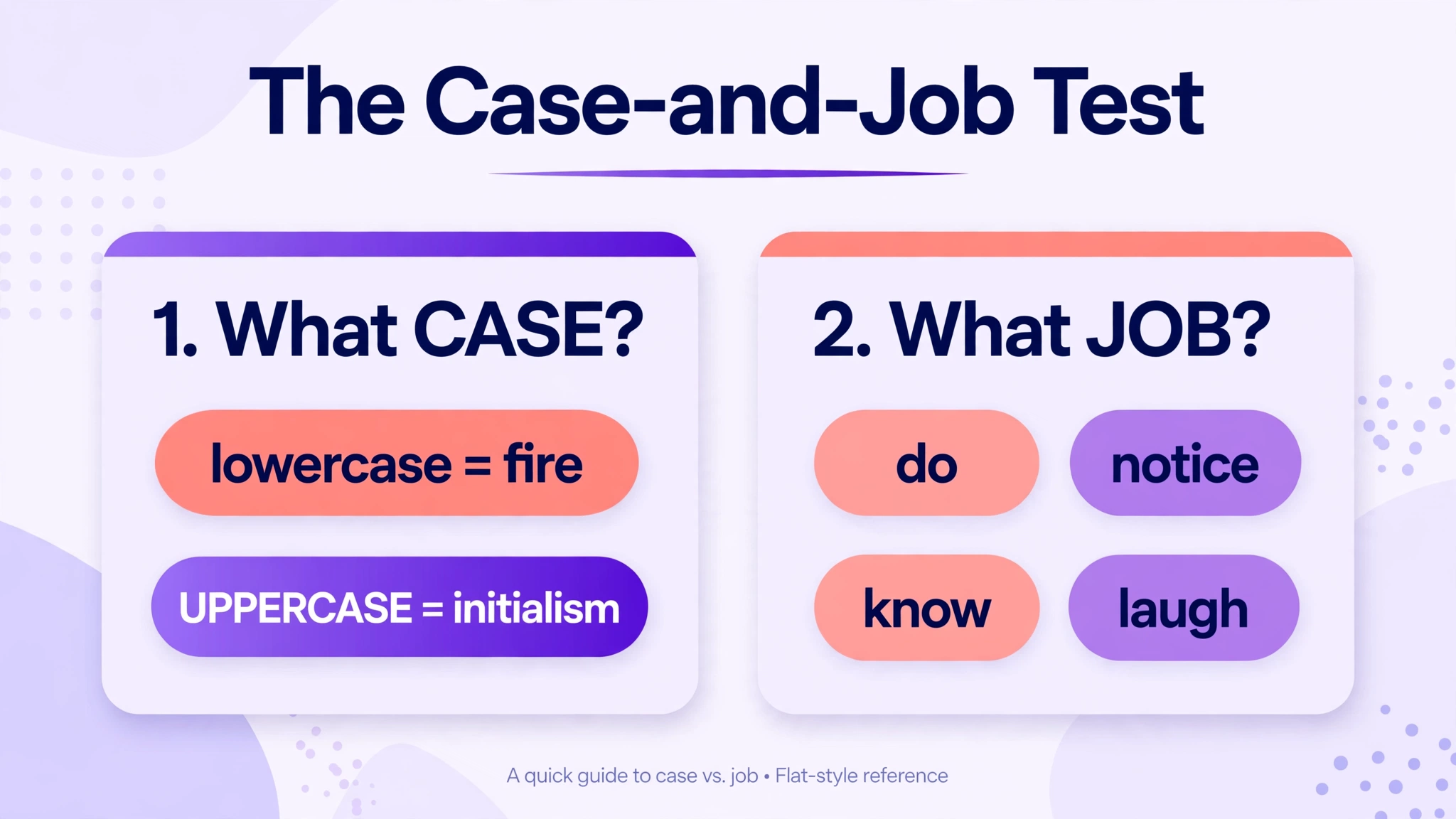
Here’s the named method for reading any FYA in five seconds. It’s called the Case-and-Job Test, and no other explainer frames it this way.
Question 1: What CASE is it?
- Lowercase “fya” → it’s “fire.” Read it as FYE-uh, the compliment. “that fit is fya” = “that fit is fire.” Done — the test ends here 90% of the time in casual contexts.
- Uppercase “FYA” → it’s an initialism. Pronounced “eff-why-ay,” and now you need Question 2.
Question 2: What JOB does the sender want from you?
- DO something → “for your action.” There’s a task attached: review, approve, fix, send.
- NOTICE something → “for your attention.” A heads-up with weight: read this, be aware.
- KNOW something → “for your awareness.” The softest reading — informational, FYI-flavored.
- LAUGH at something → “for your amusement.” A meme, a video, a joke forwarded your way.
Case tells you the word. Job tells you the intent. Together they resolve every FYA you’ll ever meet — including the genuinely confusing case of a boss who writes “fya” lowercase (read it as the initialism anyway; bosses don’t usually call contracts “fire”). And if the case itself is ambiguous — autocorrect lowercased everything, or the message came through a system that strips caps — ask. A WDYM-style one-liner (“quick check: did you mean fire, or for your action?”) settles it in a single message.
Who Sent It Changes Everything: Sender Context
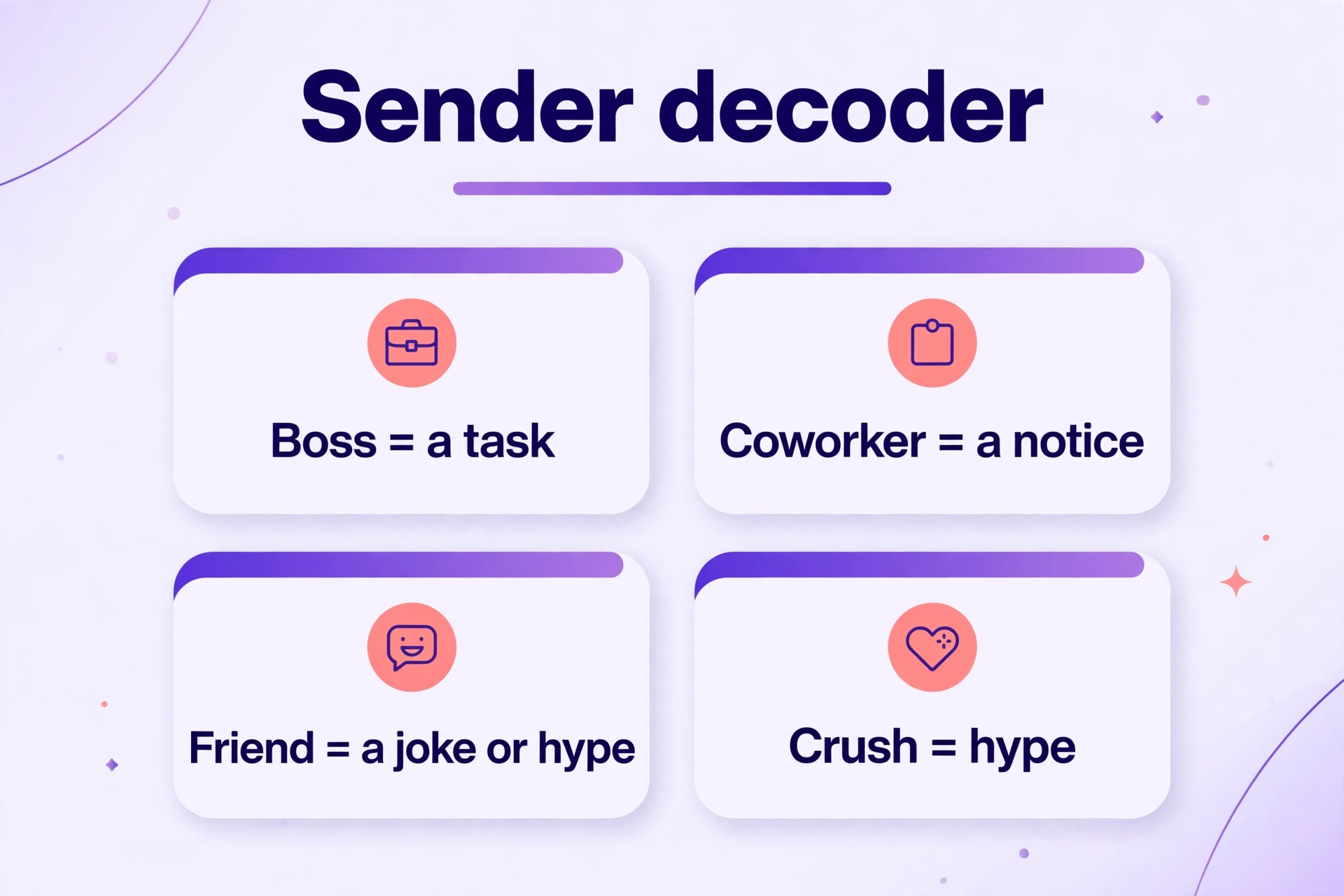
FYA is one of those terms where the sender is the decoder ring. Same letters, completely different message depending on who’s typing:
Your boss or manager. It’s a task. “FYA: Q3 numbers” means open it, read it, and do the thing. Treat it like a TBD-style action item with someone’s name on it — yours. Reply with confirmation, not emojis.
A coworker. Usually “for your attention” — a notice, a heads-up, something you should know but might not need to act on. “FYA, the client moved the call” = noted, adjust. Lighter than the boss version, still professional.
A friend forwarding something. “For your amusement” territory: the meme, the reel, the ridiculous screenshot. The correct reply is a reaction — laugh, react, send one back. Nobody forwards a meme expecting a project plan.
A friend hyping something. Lowercase “fya” = “fire”: “bro this album is fya.” It’s a compliment with the volume up. Agree, disagree, or ask for the link — but read it as enthusiasm, not a task.
A crush. Lowercase fya from a crush is flirt-adjacent hype: “you looked fya last night 🔥” is about as direct as texting compliments get. The fire emoji is doing half the talking.
A stranger’s caption. “FYA” in a TikTok or Instagram caption is an attention grab — “for your attention,” marketing-flavored. It’s the creator saying “stop scrolling.” Read it as promotion, not conversation.
The TBH-honest summary: the letters don’t change, but the job does — and the job is always written on the sender’s forehead. Read the sender first.
FYA Across Texting, TikTok, Instagram, Snapchat, and Email
No platform gives FYA a different definition — the case split does that work instead. But the distribution of jobs across platforms is real and documented:
Email (professional). Job 1’s home. “FYA” in subject lines is a routing label: it tells the recipient this email contains something for them to act on. It’s the corporate cousin of the FYI — except FYI says “know this,” while FYA says “know this AND do something.” That distinction is the entire reason both abbreviations exist.
Texting and DMs. Job 3’s home. Lowercase “fya” as “fire” is a texting-native compliment — quick, warm, emoji-adjacent. Uppercase FYA in a text usually means someone’s forwarding something funny (Job 4) or being mock-formal for comedic effect (“FYA: we’re out of snacks” from a roommate).
TikTok. Both worlds collide. Creators use uppercase FYA in captions as an attention label (“FYA: new drop Friday”), while commenters use lowercase fya as hype (“this transition is fya 🔥”). The case tells you which room you’re in — creator broadcast vs. audience reaction.
Instagram. Similar split: stories and captions carry the attention-grab FYA (tag-a-friend energy), while comments carry the fire-fya (“this look is fya”). Same letters, different jobs, one scroll apart.
Snapchat. Playful and quick: lowercase fya as a snap-caption compliment, or FYA as a jokey forward label between friends. The platform’s speed favors the shortest reading — and the shortest reading is “fire.”
The platform honesty line, stated plainly: casing decides the word, not the app. Don’t let anyone sell you “FYA means something different on TikTok” — it doesn’t. It means something different in lowercase.
FYA vs FYI: The Cousin Confusion
The single most common FYA question is really a comparison: what’s the difference between FYA and FYI? Here’s the clean answer:
FYI (“for your information”) is a heads-up. It says: here’s something you should know; no action required. It’s informational, neutral, complete in itself.
FYA (“for your action”) is FYI with a job attached. It says: here’s something you should know, AND there’s something in it for you to do. It’s the same envelope with a task inside.
In practice: “FYI, the meeting moved to 3” = noted. “FYA: the meeting moved to 3, update the invite” = do the thing. If your FYA has no task in it, your sender probably meant FYI — and that’s the most common FYA mistake in offices everywhere. When in doubt about which label a message deserves, a BTW-style honest aside in the body (“btw, no action needed on this one”) clears it up faster than any subject-line label.
On social media the confusion runs the other way: people use FYA as a generic attention label where FYI would be more accurate. It’s harmless — nobody’s filing a complaint about a mislabeled meme — but knowing the difference makes you the person who uses both correctly.
How to Use and Reply to FYA
Using FYA at work. Put it in the subject line, followed by a colon and the actual topic: “FYA: approve the vendor invoice by Friday.” Keep the body short — the label already did the routing work. If the action needs input before it can happen, pair the label with a clear LMK: “FYA: approve the vendor invoice — lmk if the numbers look off.” And make sure there’s actually an action in there; an action-less FYA trains people to treat your labels as FYIs.
Using fya (“fire”) casually. Lowercase, no ceremony: “that goal was fya,” “ur fit is fya ngl.” It pairs naturally with the fire emoji but doesn’t need it. One caution: it’s enthusiastic slang — using it about your own work (“my presentation was fya”) reads as bragging. Aim it outward.
Replying to a work FYA. Confirm and commit: “On it — will have it done by Thursday.” The sender labeled it action; show the action. A bare NVM-style dismissal (“nvm, saw it”) undersells a task label.
Replying to “for your amusement” FYA. React like a human: laugh, quote the best part, send one back. “LMAOOO the second one” is a complete and correct reply.
Replying to lowercase fya (“fire”). Match the energy: “RIGHT??” / “ikr it’s so good” / “tysm, took me forever 😭.” Enthusiasm is the currency; spend it.
Replying to the vulgar reading. Yes, there’s one more: Wiktionary lists a vulgar Internet-slang expansion of FYA (an angry, dismissive “f*** you all”). It’s real as a dictionary entry and vanishingly rare as actual usage — and if someone fires it at you, the letters aren’t the problem. Don’t reply to the abbreviation; reply to the anger, or don’t reply at all. Per this site’s policy, the full expansion stays out of headlines and image text; one masked mention here is all it gets.
Debunked: What FYA Does NOT Mean
FYA has attracted more junk expansions than almost any abbreviation its size. Time for honest grading:
- “F*** yeah” — unsupported. One usage guide prints it in an intro; no dictionary, no other source, no attestation. Treat it as a typo that got published, not a meaning.
- “For you all” (“snacks are on the table FYA”) — invented. Single source, zero corroboration, smells like someone’s creative writing exercise. Leave it out of your vocabulary.
- “Free your a**” — song-reference framing, single source. Not a texting meaning; not worth your memory.
- “For your awareness” as the primary meaning — overstated. It’s the rarest of the four jobs, likely FYI-confusion. Know it exists; don’t lead with it.
- A foundation, a fire department, a youth organization — real, but not texting. The same letters abbreviate real organizations in the real world. In a chat, they’re irrelevant. (Same treatment as “HBU the university” — true elsewhere, never here.)
- “Flaming Yelling Avocado” and friends — jokes, not meanings. At least one competitor page is full of meme-spun fake expansions. They’re funny; they’re not definitions. Don’t quote them as knowledge.
When Not to Use FYA
FYA is two tools — a professional label and a slang compliment — and each misfires outside its room:
- Don’t use the initialism with people who won’t know it. Outside offices and email culture, uppercase FYA confuses more than it clarifies. Your group chat will read it as a typo.
- Don’t use lowercase “fya” upward. Texting your manager “that deck was fya” is a register collision. Enthusiasm is fine; slang it in full words: “that deck was excellent.”
- Don’t label an FYI as an FYA. If there’s no action, don’t promise one. Mislabeled FYAs teach people to ignore your labels — the boy-who-cried-action problem.
- Don’t use the vulgar reading, period. It exists in the dictionary; it doesn’t need to exist in your messages. There is no context where it’s the right choice.
- Don’t stack it. “FYA FYI ASAP” in a subject line is alphabet soup, not communication. One label per message.
Quick Answers
What does FYA mean in text?
It depends on the case: lowercase “fya” means “fire” (excellent, impressive) — pronounced “FYE-uh.” Uppercase “FYA” is an initialism, usually “for your action” (work: do something) or “for your attention” (notice this).
What’s the difference between FYA and FYI?
FYI (“for your information”) is a pure heads-up — no action needed. FYA (“for your action”) is FYI with a job attached: it signals the recipient should do something, not just know something.
Is FYA the same as “fire”?
Only in lowercase. “Fya” (lowercase) is a phonetic spelling of “fire” used as slang for excellent. Uppercase “FYA” is a completely different word-formation — an initialism with work-related meanings.
Can I use FYA in a work email?
Yes — “for your action” is standard in corporate email subject lines (“FYA: approve the invoice”). It’s the professional home of the abbreviation. Just make sure there’s actually an action attached.
How do you pronounce FYA?
Two ways: as “fire” (FYE-uh) when it means the slang compliment, or letter-by-letter (“eff-why-ay”) when it’s the initialism. The pronunciation follows the meaning, not the spelling.
Is there a vulgar meaning of FYA?
Wiktionary lists one vulgar Internet-slang expansion, but it’s extremely rare in actual use. If you encounter an angry all-caps FYA, respond to the tone, not the letters.
Pop-culture footnote: is there a song called “FYA”?
Yes — BTS released a track titled “FYA” (stylized in all caps) on their 2026 album Arirang. It’s a pop-culture coincidence, not a texting meaning — but it explains why the letters might suddenly be everywhere in fan spaces.
FYA is a masterclass in reading before reacting: check the case, ask what job the sender needs done, and read the sender before the letters. Do that, and the trickiest three letters in texting become one of the easiest.
