

You ask a simple question — “What time are we meeting?” — and the reply comes back as three letters: “idk.” Are they unsure, or done talking? That half-second of doubt is the whole story of idk meaning in text: the letters always mean the same thing, but the feeling changes depending on what follows — or on silence instead.
IDK is short for “I don’t know,” the quickest honest answer in digital conversation. This guide shows you how to read any IDK in a second — including the moment it stops being an answer and starts being a shrug, a softener, or a quiet exit.
What IDK Means in Text
IDK is an initialism of “I don’t know” — the I, the D, and the K taken from the three words of the phrase. Wiktionary, Merriam-Webster, and Oxford all define it the same way: an informal abbreviation used on social media and in text messages.
That is the whole definition — and it is also not the whole story. “IDK, let me check” is helpful and open. “IDK.” on its own can feel like a door closing.
The IDK Three-Word Test
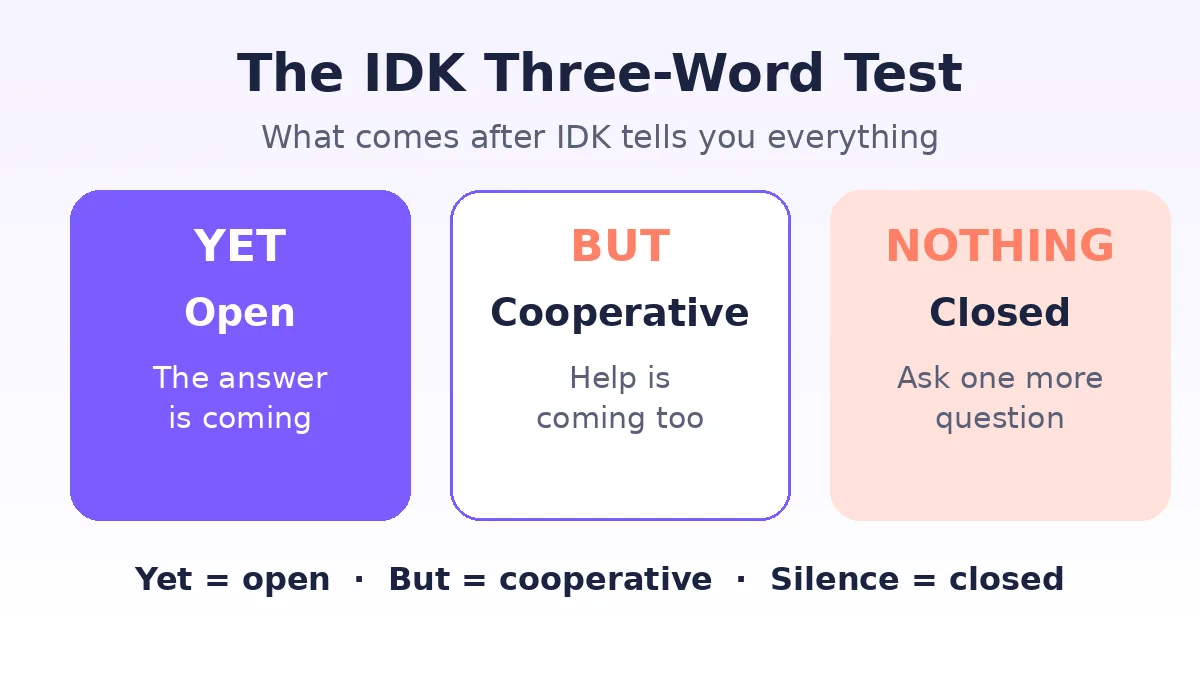
Here is the named reader test for this article: the IDK Three-Word Test. Do not stare at the three letters. Listen to what comes after them — or notice when nothing comes at all.
Word 1: “Yet” — the open IDK. If “yet” fits after IDK, the person is unsure for now and expects to know later. “IDK yet, I’ll check tonight” admits the gap and promises to close it.
Word 2: “But” — the cooperative IDK. If “but” fits, the person does not know the answer but is still helping. “IDK, but I can ask Alex” says: I do not have it, and here is what I can do instead.
Word 3: Nothing — the closed IDK. If nothing follows, the message is a shrug with no handle on it. A bare “IDK.” can mean the person is busy or genuinely stuck — or done with the topic. Do not guess which one it is. Ask a follow-up: “What part are you unsure about?”
Run the test on every IDK: yet means open, but means cooperative, silence means closed.
IDK in Real Conversations
Answering a question you genuinely cannot answer. The most common use of all.
Sam: “What time does the movie start?”
Alex: “IDK, let me check.”
Softening an opinion so it does not sound like a verdict. “IDK, that trailer actually looks pretty good.” The speaker clearly has an opinion; IDK simply makes it sound less absolute — the same softening job that what TBH means in text does, and the same reason people write “idk, but IMO it looks like a scam” instead of stating it flatly.
The playful dodge. Sometimes the sender knows perfectly well and is joking — “Who finished the last piece of cake?” — “IDK 👀.” Nobody believes it. That is the point: the emoji turns a denial into a joke.
Where IDK Sits in a Sentence

IDK can sit almost anywhere in a message, and its position changes how it feels.
Standing alone. “IDK.” as a complete reply is the fastest version — and the riskiest. After a serious question it can read as careless, because it gives the other person nothing to work with. Add one more clause: a reason, a next step, or a time.
At the start of a sentence. This is the most natural placement. “IDK what time we’re leaving yet” signals uncertainty right away, so the rest of the sentence reads as tentative instead of wrong.
In the middle of a sentence — or at the end of one. Here IDK works like a hesitation marker, the typed version of thinking out loud. “I told him I’d help, but IDK if I’ll have time” sounds more conversational than its IDK-free version, and “That was weird, idk” uses the letters as a shrug at the end of a thought.
How Capitalization, Punctuation, and Emojis Change IDK
IDK has no tone of voice, so the way it is typed does the job instead.
“idk” in lowercase is the relaxed default: casual, conversational, the version most people type without thinking. “IDK” in capitals is more direct and emphatic — not rude on its own, but louder. “Idk” with a capital I usually just means a phone auto-capitalized the first letter of a sentence.
Punctuation turns the dial further. “IDK.” with a period reads final, like a door closing. “idk…” with an ellipsis sounds hesitant, as if the sender is still thinking. “idk lol” softens everything: the laugh signals relaxed uncertainty.
Emojis can flip it entirely. The shrug 🤷 is IDK’s physical twin. “IDK 🤷” is neutral uncertainty. “IDK 😂” is amused or joking. “IDK 😭” is overwhelmed or laughing at the chaos. “IDK 🙄” is annoyed or dismissive. When an emoji carries a strong feeling, believe the emoji over the letters — the same rule that governs the tone notes in what NGL means in text.
IDK on TikTok, Snapchat, Instagram, and in Texting
In texting, SMS, and WhatsApp, IDK is at home: the quickest honest answer in a private chat, usually about plans, facts, or something nobody has checked yet.
On Snapchat, IDK lives in fast DMs and snap replies, often in lowercase — “idk where everyone went” after a confusing snap.
On Instagram, IDK appears in DMs, comment threads, and replies to Stories. In comments it often turns funny rather than literal: “IDK why this photo looks like an album cover” is a compliment wearing a shrug. In DMs it is usually the plain, honest version.
On TikTok, IDK is a comment-section regular, and here it is at its most playful. “IDK who needs to hear this, but clean your camera lens” uses the letters as a setup for a joke, not as a real admission of ignorance. The public setting makes the funny version more common — a pattern that also shows up in what FR means in text.
No major platform officially defines IDK. Short answers are the native language of fast chats, and what LOL means in text survives for the same reason.
Who Sent It Changes What It Means
From a close friend, IDK is almost always easy: genuine uncertainty, a joke, or a shrug you have seen a hundred times. You know whether “idk lol” is relaxed and whether a bare “IDK.” means they are busy or annoyed.
From a crush, IDK can be genuinely ambiguous. “idk, what do you want to do?” after you suggest plans might mean they are flexible — or not that interested. Do not read romance into the letters alone; read the follow-up. If they add a suggestion or a question, they are engaged. If every reply is a bare “idk,” the message is the pattern, not the letters.
From a parent, IDK usually means simple, honest uncertainty: “IDK what Dad wants for his birthday” is a real question, not a brush-off. From a boss or teacher, IDK needs a next step attached, or it can sound careless. “IDK yet, but I’ll confirm with finance” is cooperative; a bare “IDK” reads as if the sender stopped trying.
From a stranger or a new dating-app match, IDK is genuinely ambiguous, because you do not yet know their habits. In a group chat, IDK usually answers the last message, not the whole group — add a detail so everyone knows which question you are shrugging at. “IDK who’s driving, but I can take three people” keeps the group moving.
IDK vs the “I Don’t…” Family
IDK sits in a family of abbreviations that all start with “I don’t,” and mixing them up is the most common IDK mistake.
| IDK | IDC | IDTS | IDEK | IK | |
|---|---|---|---|---|---|
| Full form | I don’t know | I don’t care | I don’t think so | I don’t even know | I know |
| Core meaning | No answer yet | No interest | Doubt | Extra confusion | Confident |
| Tone risk | Can sound dismissive | Sounds dismissive fast | Gentle disagreement | Overwhelmed | Confident |
IDC — “I don’t care” — is the dangerous lookalike. It is one letter away from IDK and a world apart in meaning. “IDK what movie we watch” means you are open to anything; “IDC what movie we watch” can sound like you have checked out of the evening. If a message suddenly feels cold, check the middle letter before reacting. See what IDC means in text.
IDTS — “I don’t think so” — is doubt, not ignorance. “Is the store still open?” — “IDTS.” The sender has a view; they just are not certain of it. IDK says “I have no answer.” IDTS says “I have an answer, and it is probably no.” See what IDTS means in text.
IDEK — “I don’t even know” — is IDK with the volume turned up. It adds overwhelm: “IDEK who that is” means the confusion itself is the point. IDW — “I don’t want” — is a refusal, not uncertainty at all. And IK — “I know” — is the opposite of IDK: the answer, not the gap.
How to Reply When Someone Says IDK
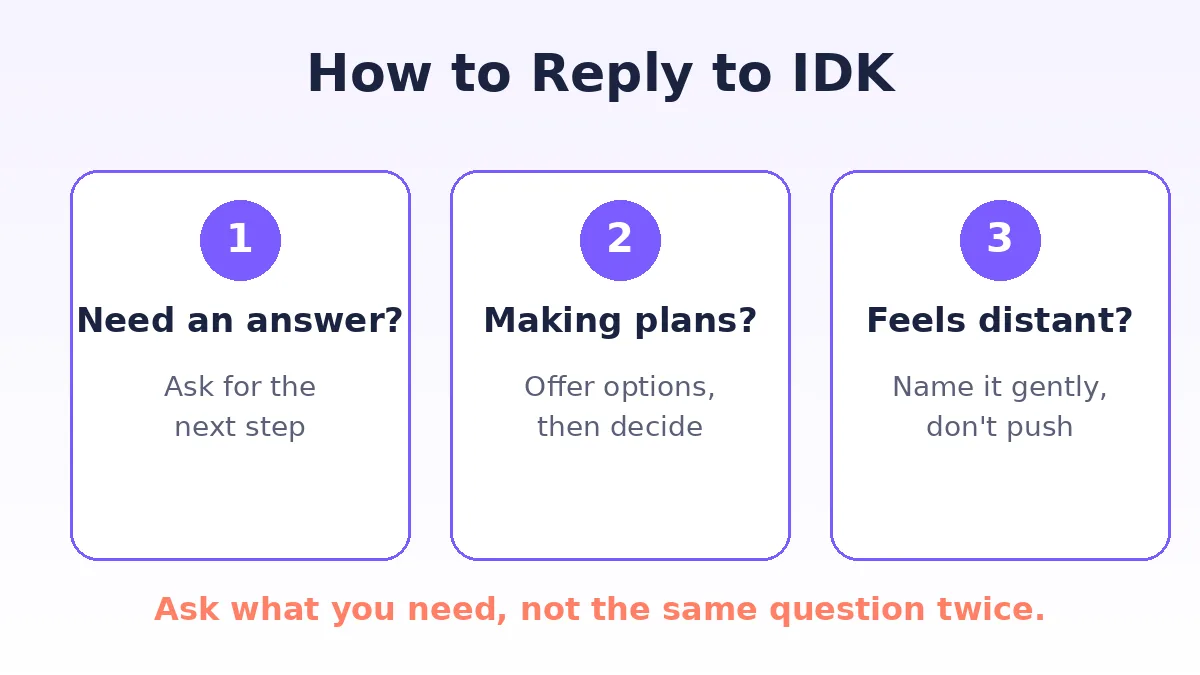
The right reply depends on what you need from them. Pick your script by your goal.
When you need a real answer, ask for the next step instead of repeating the question: “Can you check and tell me in 10?” or “Who would know? Want me to ask?”
When you are making plans, give options instead of leaving the conversation open-ended. “No worries. If you don’t know by 5, I’ll just book the later time” moves things forward without pressuring anyone. A bare IDK in a planning thread usually means “I am fine with whatever you pick” — so pick.
When the IDK feels distant, name it gently instead of pushing. “Are you unsure, or just not into it?” and “All good. Want to switch topics?” both give the other person a way back in. If they sound annoyed, do not push unless it is urgent: “Okay, no problem. Let me know if you figure it out” keeps the door open.
When IDK is not enough, say so plainly: “I get that you’re not sure, but I need to decide today. What is your best guess?” The question behind “IDK wdym?” is answered in what WDYM means in text.
When Not to Use IDK
Leave IDK alone in professional emails, job applications, and messages to customers, where three letters read as careless no matter how honest they are. Skip it in schoolwork and academic writing, where “the cause is unclear based on the available data” says the same thing more seriously.
Skip it when someone needs reassurance. If a friend is stressed or asking for support, a short “IDK” can feel cold even when you mean it kindly: “I’m not sure what the best option is, but I can help you think it through” keeps the conversation open. And do not use IDK as your only reply too often — if every answer is “idk,” people feel you are not contributing. Add a suggestion or a next step, and the same uncertainty reads as engagement instead of absence.
Quick Answers About IDK
What does IDK mean in text?
IDK means “I don’t know.” It is an informal abbreviation used in texting and online chats to say you do not have an answer or are unsure.
What does IDK mean on TikTok?
On TikTok, IDK usually means “I don’t know.” It appears in comments, captions, and replies, often used humorously rather than as a literal admission.
What does IDK mean on Snapchat?
On Snapchat, IDK means “I don’t know” in DMs and snap replies, usually written in lowercase. It often follows a confusing snap, and because snaps disappear, the question it answers may already be gone.
What does IDK mean on Instagram?
On Instagram, IDK means “I don’t know” in DMs, comments, and Story replies. In comments it often introduces a joke or an opinion; in DMs it is usually plain and honest.
Is IDK rude?
IDK is not rude on its own, but a bare “IDK.” can feel dismissive, especially when someone asked for help or is making plans. Adding a reason or a next step — “IDK yet, I’ll check” — keeps it kind.
What is the difference between IDK and IDC?
IDK means “I don’t know” and IDC means “I don’t care.” They are one letter apart but communicate completely different ideas: IDK is uncertainty, IDC is disinterest.
What does “IDK tbh” mean?
“IDK tbh” means “I don’t know, to be honest.” It sounds more personal than a plain IDK, because the speaker is flagging that the uncertainty is genuine.
When should I not use IDK?
Avoid IDK in professional emails, formal messages, academic writing, customer service, and serious conversations. If clarity matters more than speed, write the full phrase instead — “I’m not sure, but I’ll find out.”
The Bottom Line on IDK
IDK is three letters doing one honest job: admitting you do not know. It is a shrug you can type, and like a real shrug it can mean “I genuinely have no idea,” “I’m still thinking,” “I’m open to suggestions,” or “I’m done with this topic.” The letters never tell you which one — the three words after them do. “Yet” means the answer is coming. “But” means help is coming. Silence means you need to ask one more question.
