
Someone asks a question you are pretty sure has a “no” answer, but you are not ready to plant a flag on it. So you type four letters: “idts.” If you have ever received those letters and wondered whether you had been disagreed with, doubted, teased, or gently refused, this guide settles it. In short, the idts meaning in text is “I don’t think so”: a soft, hedged way of saying no, or of saying something probably is not true.
That hedge is the whole point. A flat “no” closes a door; “I don’t think so” leaves it slightly open, because the speaker admits they could be wrong. That is why IDTS can feel polite in one chat and dismissive in another: the letters never change, only how certain the sender sounds.
What IDTS Means in Text
IDTS is an initialism for “I don’t think so.” Wiktionary lists it directly as internet slang and text messaging, an initialism of that exact phrase, and the Farlex Dictionary of Idioms defines it the same way, noting it is used primarily in text messages and often spelled in lowercase. Spoken aloud it would be letter by letter, but almost nobody says it out loud; it is a writing shortcut.
What makes IDTS different from a plain “no” is the thinking part. “No” states a fact; “I don’t think so” states a judgement, and a judgement can be wrong. That uncertainty lets IDTS disagree without starting a fight. Compare it with TBH, which certifies that the speaker means what follows in full: TBH raises the stakes of a sentence, IDTS lowers them.
IDTS usually answers a claim or a question, not a request. “Do you think it will rain?” gets an IDTS. When it refuses an invitation, it does so by doubting the plan rather than rejecting the person: “IDTS, that place will be open” really means “I doubt the plan works,” not “I don’t want to go with you.” One honest note: IDTS carries no second, secret texting meaning. Every guide checked for this article gives the same single expansion. The puzzle is never “which definition is this?” It is always “how hard is this no?”
The Certainty Dial Test
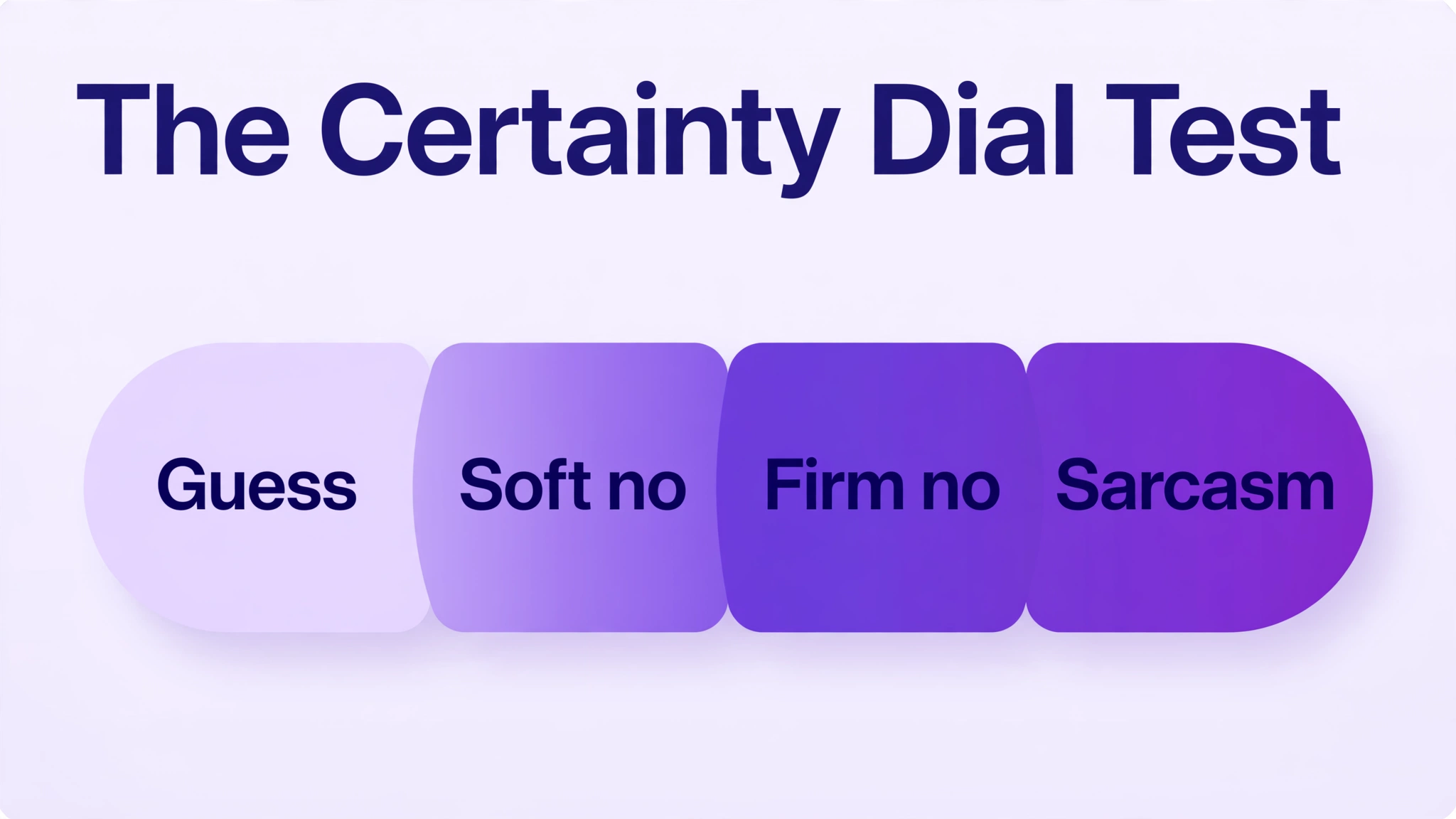
Here is this article’s named method, the Certainty Dial Test: a four-position dial that tells you how firm the IDTS you received actually is. Find the sentence it answers, then check the punctuation and the relationship.
Position 1 is the uncertain guess. The sender does not know, and IDTS means “probably not, but check.” The tells are a follow-up question or a hedge nearby: “IDTS, but let me check.” Treat this as an invitation to supply evidence, not as a verdict.
Position 2 is the soft disagreement. The sender leans no but leaves the door open. The tells are a friendly emoji, a laugh, or a reason attached: “IDTS 😂” or “IDTS, the traffic was awful last time.” This is the most common IDTS in friendly chats, and the one most often misread as cold when it was meant as light.
Position 3 is the firm refusal dressed as doubt. The sender has decided but uses the hedge to stay polite. The tells are a full stop, no emoji, and no follow-up: “IDTS.” sent alone after a direct question. Do not argue the facts here; pushing will only wear the politeness thin.
Position 4 is the sarcastic shutdown. The sender understood you perfectly and uses IDTS to say your claim was not worth serious consideration. The tells are a mocking context or a quoted-back claim: “IDTS, sure, and I’m the queen.” The sarcasm lives in the sentence around it, not in the letters. The same question answered with “idts lol, he never does” sits at position 2, while a bare “IDTS.” after an argument sits at position 3 or 4.
The Four Shades of One Meaning
Because IDTS has only one expansion, its variety lives entirely in force. Think of it as one phrase spoken at four volumes.
The first shade is doubt about a prediction: “IDTS it rains today, the sky is clear” is a forecast, not a disagreement with a person. The second is disagreement with a claim: “That movie was the best of the year” answered with “IDTS 😅” says “I see it differently” without saying “you are wrong.”
The third shade is the gentle refusal: “Wanna get up at 5 a.m. to work out?” answered with “IDTS 😴” refuses the early alarm, not the friendship. The fourth shade is sarcasm and teasing: “You will finish that whole cake alone” answered with “IDTS… maybe half” is playful between close friends. From a stranger, the same words read as mockery, which is why the relationship matters more than the letters. What IDTS never means is “yes,” “maybe,” or “I don’t know.” It always leans no; the only question is how hard it leans.
IDTS on TikTok, Snapchat, Instagram, and in Texting
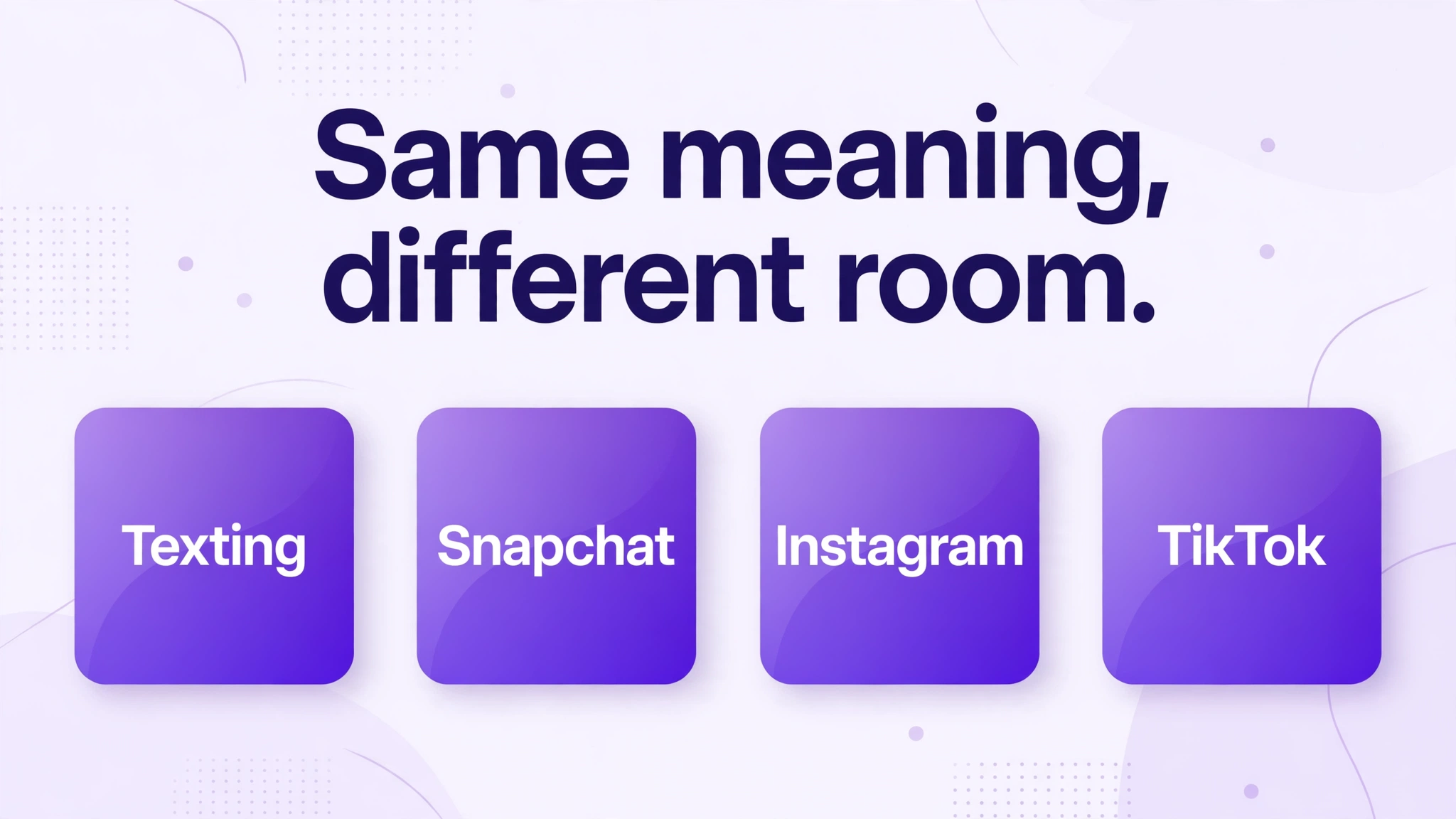
The app never changes what IDTS means. What changes is which room you are standing in, and therefore which dial position you are most likely to meet.
In plain texting, IDTS is at home: one-to-one chats and group threads where someone floats a plan or claim and someone else doubts it. A reply that cancels rather than doubts is a different job, covered by the NVM guide.
On Snapchat, IDTS moves fast and light, favouring the soft and teasing shades, often lowercase with an emoji doing the softening work. A snap reply of “idts 😂” is banter at Snapchat speed, almost never a serious verdict.
On Instagram and TikTok, the split is private versus public. In direct messages, IDTS behaves like texting. In comments, it gets louder, because comments are performances: an “IDTS!!” under a bold claim is usually the sarcastic or firm shade, playing to an audience. The meaning did not change; the audience did.
Tone and Sender Context: Who Is Saying IDTS, and Why It Lands Differently
From a close friend, IDTS is almost always light: a way to disagree without denting the friendship. Answering a friend’s bantering “idts” with a serious defence would be the real misread.
From a crush, IDTS needs a slower read. “IDTS, you’re not that bad at this” is reassurance wearing disagreement clothes: they are doubting your doubt, not you. But an “IDTS.” after you suggest meeting up may be a gentle refusal of the plan.
From a partner, IDTS is usually honest and low-drama. From family, it often arrives as plain doubt; take it at face value and answer with the facts.
From a stranger, IDTS is at its bluntest, and can feel dismissive because no relationship softens it — though it remains one of the milder ways to disagree in public. At work, it is a judgement call: honest doubt in a relaxed team chat, careless in an email or to a client, because it doubts without explaining. If the doubt matters, spell it out with the reason.
How to Reply to IDTS, and When to Spell It Out
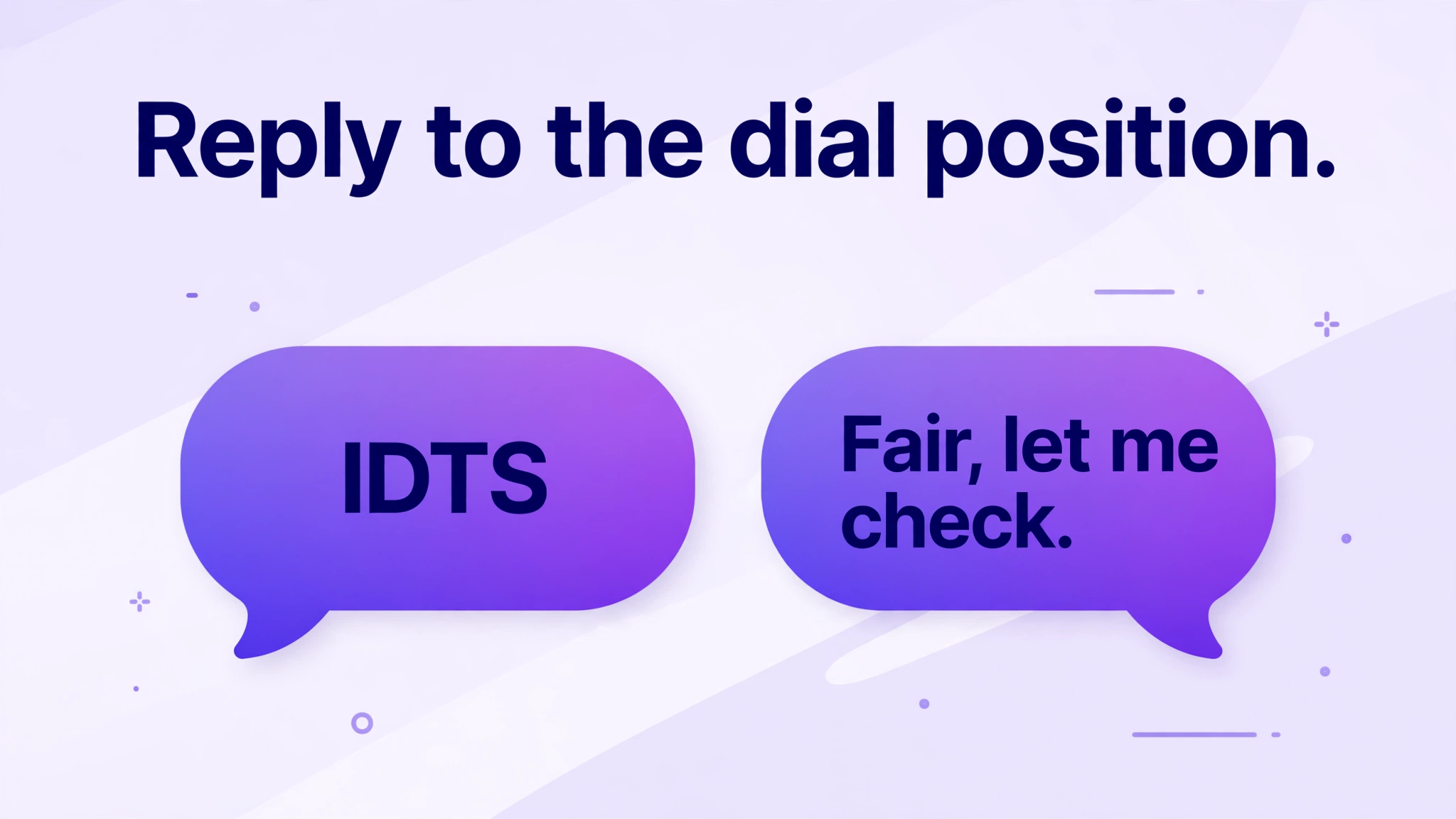
Match the dial position and keep it short. For an uncertain guess (position 1), supply what is missing: “Fair, let me check and confirm.” For a soft disagreement (position 2), answer lightly: “Haha, fair point, but hear me out.” If you sent the IDTS, add the reason to soften it: “IDTS, last time it took twice as long” lands far warmer than a bare “IDTS.”
For a firm refusal (position 3), accept it gracefully: “Okay, no worries, what else could work?” Arguing with a polite no turns it into an impolite one. For sarcasm (position 4), do not take the bait in the same tone; a calm “Okay, what makes you say that?” either exposes the joke or starts a real conversation. When a doubt genuinely confuses you, the WDYM guide explains how to ask for clarification without starting a fight.
Spell it out instead for professional contacts, for anyone who may not know the slang, and whenever the doubt itself is the news, adding the reason and an alternative: “I don’t think so, because the venue closes at nine, but the other place stays open late.” Capitalisation changes tone, not meaning. And when the conversation matters, do not reply with a shorter abbreviation: a bare “ok” after someone’s doubt reads as hurt silence. One real sentence keeps the chat alive, a principle the HBU guide makes its central rule.
IDTS vs IDK, IDC, NVM, TBH, and OFC
| Term | Full form | What it actually does |
|---|---|---|
| IDTS | I don’t think so | Doubts a claim or prediction; leans no, but leaves room to be wrong. |
| IDK | I don’t know | Admits ignorance; takes no position at all. |
| IDC | I don’t care | Withdraws interest; refuses to engage with the topic. |
| NVM | Never mind | Cancels the sender’s own message; ends a thread, not a debate. |
| TBH | To be honest | Certifies the speaker’s candour; raises the stakes of what follows. |
| OFC | Of course | Confirms with certainty; the opposite end of the certainty dial from IDTS. |
IDTS versus IDK is the pair to memorise: “IDTS” says “I have a view, and it leans no”; “IDK” says “I have no view.” IDTS versus IDC saves friendships: IDTS disagrees while staying in the conversation, IDC steps out of it. IDTS versus OFC is the whole dial in two words: OFC is the certain yes, IDTS the hedged no.
Two more neighbours complete the picture. TBF (“to be fair”) balances a criticism with context, where IDTS simply doubts it. BTW (“by the way”) can carry a disagreement sideways, but smuggling a real one in through a side door reads as evasive. And DW (“don’t worry”) calms a worry instead of debating a claim.
Debunked: What IDTS Does NOT Mean
IDTS does not mean a different thing on each app. The idea that Snapchat, TikTok, or Instagram each assign it a private definition is contradicted by every guide that actually shows usage: the expansion is identical everywhere, and only the room and the tone change.
IDTS is not a firm “no.” Treating it as one over-reads the sender. The phrase exists precisely because of its hedge: “I don’t think so” is what people say when they lean no but are not certain. IDTS is also not always rude, and not always polite. Both blanket claims appear in guides, and both are wrong. Rudeness lives in the dial position and the relationship, not in the letters.
IDTS is not a technical term in a chat: the same letters stand for systems and schedules in specialist fields, but none belongs in a text thread. Finally, IDTS is not a precise statistic. One guide reports its first Urban Dictionary definition in 2004 — attestation, not a birth certificate — and no study measures how often people use it, so this article prints no percentage or popularity rank.
When Not to Use IDTS
Skip IDTS when the setting is formal (emails, clients, applications: spell out the doubt and the reason); when the reader may not know it; when the doubt is actually a decision (say no kindly and clearly instead of hiding it in a hedge); when the conversation is serious or emotional (a bare “idts” after heavy news reads as dismissal); when you mean it sarcastically to a stranger (without a shared relationship, sarcasm lands as mockery); and when clarity matters more than speed (if someone must act on your answer, give a certain answer, or say plainly what would settle it).
Quick Answers
What does IDTS mean in text?
IDTS means “I don’t think so”: a soft, hedged way of disagreeing, doubting a claim, or gently refusing a plan.
Is IDTS the same as saying no?
Not quite. “No” is flat and final; IDTS leans no but admits the sender could be wrong, so it sounds softer and invites evidence in return.
Is IDTS rude?
Not by default. From a friend it is usually light; as a sarcastic shutdown or a bare “IDTS.” after a serious message it can sting. Run the Certainty Dial Test.
What does IDTS mean on Snapchat or TikTok?
The same as everywhere else: “I don’t think so.” No platform gives it a different definition.
What is the difference between IDTS and IDK?
IDTS takes a position that leans no. IDK takes no position at all: it admits not knowing. Use IDTS when you doubt something, and IDK when you genuinely do not know.
What is the difference between IDTS and IDC?
IDTS disagrees with an idea while staying in the conversation. IDC withdraws interest from the topic itself. IDTS debates; IDC disengages.
Can I use IDTS at work?
In a relaxed team chat, yes, when honest doubt is useful. In emails, to clients, or to managers, spell it out: “I don’t think so, because…” with the reason attached.
How should I reply to IDTS?
Match the dial position: evidence for a guess, lightness for a soft disagreement, grace for a firm refusal, calm for sarcasm.
Final Thoughts
IDTS is four letters doing the work of a careful sentence: “I lean no, but I could be wrong, and I am not looking for a fight about it.” Run the Certainty Dial Test before you read it and before you send it, and IDTS stays what it should be: the politest way to say you are not convinced, and an open door for someone to convince you.
