
You send the video — the one you have already watched four times — and the reply comes back in under a minute: “LMFAO 😂😂.” No sentence, no follow-up. You know they laughed. What you do not know is how: were they doubled over, being sarcastic, or laughing at you instead of with you? That is the puzzle of the lmfao meaning in text — the definition takes ten seconds, and the reading takes the rest of this article.
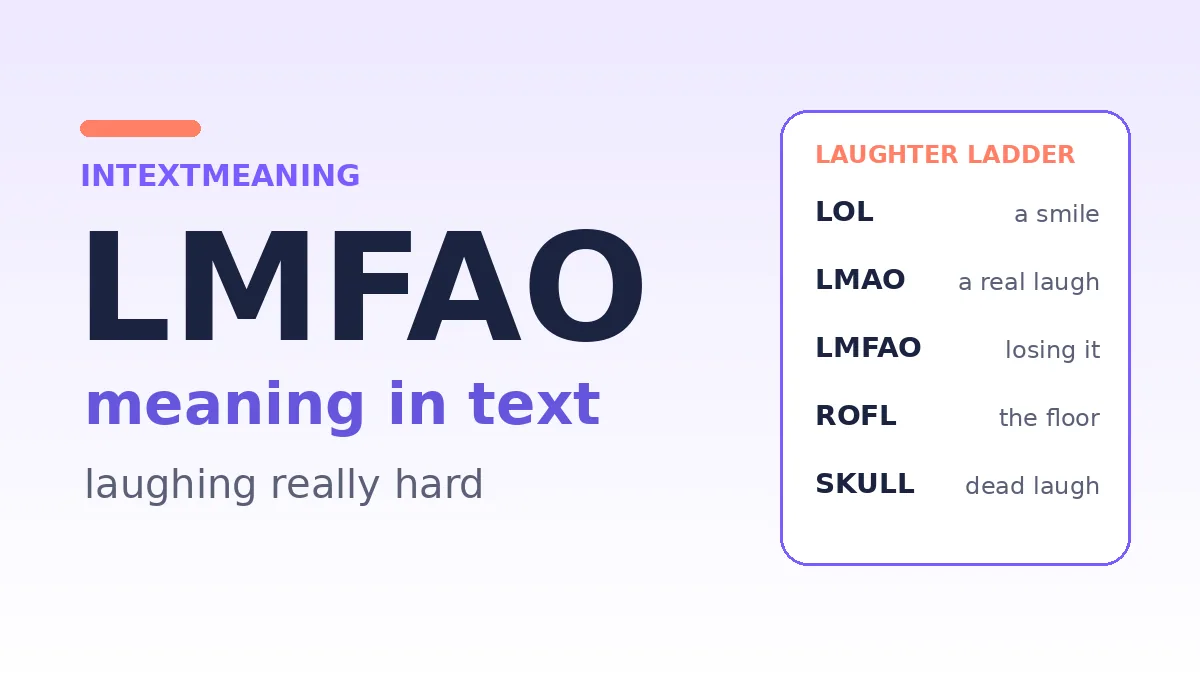
LMFAO means laughing really hard — the strongest, loudest laugh reaction in everyday texting, sent when something is so funny that a plain “haha” would undersell it. It is a reaction, not a sentence.
The Short Answer: LMFAO Means Laughing Really Hard
Here is the one literal explanation this article gives, spelled out once and masked, because the term requires it: LMFAO stands for “laughing my f***ing a** off.” Wiktionary lists it exactly that way — internet slang and text messaging, marked vulgar — and calls it a more emphatic form of LMAO. Its etymology is just as plain: LMAO with an additional F. That single letter is the whole upgrade.
The “freaking” version in family-friendly guides is a clean swap, not a second meaning. Everywhere else here, LMFAO means “laughing really hard.”
It is not literal — nobody typing it has actually laughed anything off.
The Laughter Ladder: Five Rungs From a Smile to Losing It

Here is the named idea of this article — the Laughter Ladder. Internet laughter is a volume knob with five settings, and LMFAO sits near the top.
Rung 1: LOL — the polite smile. “Laughing out loud,” though almost nobody is actually laughing out loud. LOL is the default for something mildly funny, and the safe, all-ages setting.
Rung 2: LMAO — the real laugh. “Laughing my a** off” — one step up, one step more casual. LMAO meaning in text is the everyday strong laugh: warm, common, and still safe enough for most group chats.
Rung 3: LMFAO — losing it. The F is the difference between laughing and losing it. LMFAO says the joke did not just land — it knocked you over. Use it when LOL would be a lie and LMAO would still undersell it.
Rung 4: ROFL — the floor laugh. “Rolling on the floor laughing” — on paper stronger than LMFAO, in practice older and rarer, a relic of early chat rooms. Rung 5: 💀 — the dead laugh. The skull emoji means “I am dead.” On TikTok and in group chats, 💀 has quietly taken over the top rung among younger users, and LMFAO plus 💀 together is the current maximum.
The ladder matters because picking the wrong rung changes how you sound. Answer every joke with LMFAO and your reactions stop meaning anything.
Wait — the Band? Clearing Up the One Big Confusion
Ask ten people what LMFAO means and one of them will say “the band.” LMFAO was also the name of the American electronic dance duo Redfoo and Sky Blu, famous for “Party Rock Anthem” in 2011. But the slang came first: the acronym was already circulating in late-1990s and early-2000s chat rooms, and the duo adopted it as their stage name in 2006. Context always settles it: “I still listen to LMFAO’s Party Rock Anthem” is the band; “LMFAO 😂 that video was hilarious” is the laugh.
What the F Actually Does: Why One Letter Changes Everything
The strangest fact about this word is that the difference between LMAO and LMFAO is a single letter, and that letter is a swear word. Why does adding profanity make a laugh bigger instead of just ruder? Because in internet slang, the F is an intensifier, the same way “so” turns “funny” into “so funny.” The extra letter is a volume control.
That is also why the letters themselves are not treated as a swear word: the abbreviation does the laughing while the full phrase stays folded away inside it.
The practical consequence: LMFAO is almost never angry. The swear word is doing the job of a laugh track, not a weapon. The exceptions — sarcasm, mockery, the softened jab — are real, and they are the next section. But the default reading is simple: somebody found something very funny.
The Laugh Check: Three Clues That Tell a Real Laugh From Sarcasm
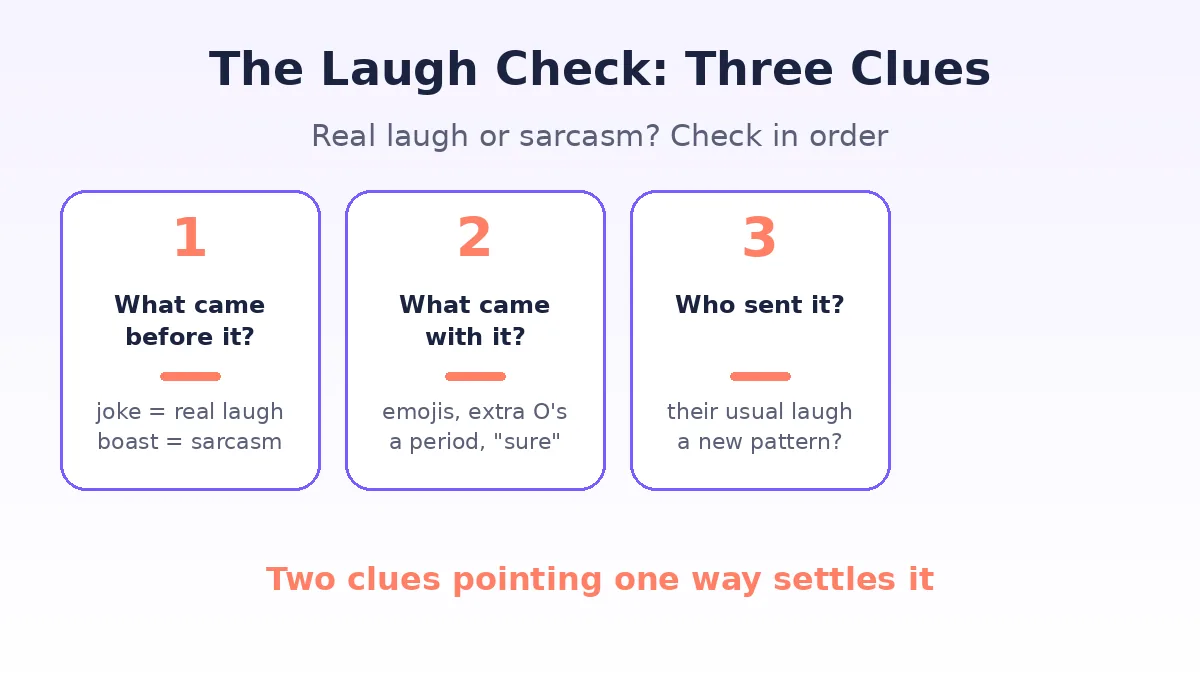
Here is the named test for this article — the Laugh Check. Three clues, checked in order, settle almost every LMFAO you will ever receive.
Clue 1: What came before it? If the message before it was a joke, a meme, or an embarrassing confession, the laugh is almost certainly real. If it was a claim, a boast, or a bad idea (“I am going to text my ex”), the same five letters are probably sarcastic: “LMFAO sure, like that is going to happen.”
Clue 2: What came with it? Real laughter brings 😂, 🤣, or extra O’s — LMFAOOOO. Sarcasm brings a period, a “sure,” or a “yeah right”: “LMFAO. Okay.” A lone LMFAO with no emoji and no extra letters is genuinely ambiguous — and that is when Clue 3 decides it.
Clue 3: Who sent it, and what is the pattern? A friend who sends LMFAO after every meme is not being sarcastic; that is just how they laugh in text. But five sarcastic replies in a row, every time you share something, is a habit of laughing at you.
Two clues pointing one way settles it. If the clues split, ask once, lightly — “Ha, wait, are you laughing with me or at me?”
Where LMFAO Shows Up: TikTok, Snapchat, Instagram, and Plain Texting
LMFAO means the same thing everywhere — laughing really hard. No platform gives it a secret new meaning. What changes by platform is the room it walks into.
TikTok is where LMFAO is loudest — and most public. In comment sections, it is a crowd reaction: thousands of strangers typing the same five letters under a video, each one a tiny vote that the video earned its laugh. A top comment that just says “LMFAO 😂😂” can outrank a paragraph of praise, because on TikTok the laugh is the review.
Snapchat is where LMFAO is fastest. The reply to a funny selfie or a silly filter is often just the acronym plus an emoji, sent before the snap even disappears — five letters that say “that killed me.”
Instagram sits in the middle. On Reels and meme pages, LMFAO is the standard comment under anything funny. In DMs it is warmer: a friend replying LMFAO to your story is saying “I saw it, it got me, keep going.”
Plain texting — SMS, WhatsApp, iMessage — is where LMFAO matters most, because these are the threads where the relationship lives. In a group chat, an LMFAO is a shared laugh. In a one-on-one thread, it lands harder: the difference between “I read it” and “I loved it.”
Who Sent It: Crush, Friend, Group Chat — Same Laugh, Different Weight
The expansion never changes. The weight does.
From a crush. If a crush sends you LMFAO, it usually means they genuinely found something funny — good news, but not a flirt signal. The acronym itself does not mean “I like you.” Judge interest by the rest of the conversation: questions, speed, and whether they keep the thread alive.
From a close friend. This is LMFAO’s home turf: the default strong laugh for embarrassing stories, inside jokes, and memes only the two of you understand. Friends also use it as a softener: “You are always late LMFAO” is a jab with the sting taken out. If a friend’s LMFAO ever feels sharp, run the Laugh Check.
From a group chat. In a group, LMFAO is a chorus: one person sends the meme, three people answer LMFAO, and the thread moves on. The only risk is pile-on — when the whole group answers LMFAO to one person’s embarrassing story, the person at the centre can feel laughed at.
When LMFAO Backfires: Four Rooms Where It Does Not Belong
LMFAO is a wonderful reaction in the right room. In the wrong room it is a small disaster, and the reasons are all the same reason: the hidden swear word, and the volume.
At work. Work emails, job chats, client messages, and anything that gets archived should stay free of LMFAO — a message with a hidden profanity attached to your name in a permanent record is a bad trade for a laugh. Use “That is funny” or a plain LOL meaning in text instead.
At school. Among classmates, LMFAO is normal. In a message to a teacher or a school platform, it is not. The line is the audience, not the app.
With family — especially across generations. Parents and grandparents who did not grow up texting often read LMFAO literally, or do not read it at all. In family group chats, a simple “haha” carries the same warmth with none of the risk.
In serious moments. Never answer bad news, a personal problem, or an emotional message with LMFAO — even if you mean it kindly. Laughter in the wrong moment reads as dismissal, and no emoji fixes it. And one quieter mistake: sending it so often it stops meaning anything. The loudest laugh on the ladder only works because it is rare.
How to Reply: A Reply Bank Keyed to What You Just Read

Most reply lists give you a pile of lines and hope one fits. This one is keyed to the reading the Laugh Check just gave you.
If the Laugh Check says real laughter: the joke landed, so keep it going. “Right?? I was dying.” “Wait until you see part two.” A shared laugh is an invitation to continue.
If the Laugh Check says sarcasm: do not argue with the laugh; answer the point underneath it. “Okay, fair — but hear me out.” Sarcasm answered with defensiveness escalates; answered with confidence, it ends the bit.
If it was a shared joke in a group chat: match the energy, briefly. “LMFAO same, I have watched it five times.”
If you are not sure which it was: ask once, lightly. “Ha — laughing with me or at me?” If you still cannot tell, stop reading the letters and start reading the pattern.
If someone sent LMFAO at work by accident: do not correct them in front of everyone. A simple “Glad you enjoyed that” moves the thread on.
One last note: you do not have to match LMFAO with LMFAO. The best reply is often the next part of the joke. When the conversation turns to agreement, IKR meaning in text is the natural next step, while SMH meaning in text is for when the joke stops being funny.
Quick Answers
What does LMFAO mean in texting?
It means laughing really hard — the strongest laugh reaction in everyday texting. The full phrase is spelled out, masked, once in the definition section above.
What does LMFAO stand for?
It stands for the five-word phrase spelled out — masked — in the definition section above. In plain words: laughing really hard.
Is LMFAO stronger than LOL and LMAO?
Yes. On the Laughter Ladder, LOL is a polite smile, LMAO is a real laugh, and LMFAO is losing it — the F is an intensifier that turns a strong laugh into an extreme one.
Is LMFAO rude?
Not by itself. Among friends it is harmless, everyday slang. But it contains a hidden swear word, so in formal, professional, or family settings it can read as rude or inappropriate. Know the room before you send it.
Does LMFAO mean someone is flirting?
No — not by itself. Laughter makes a conversation feel warm, but the acronym is a laugh, not a flirt signal. Judge interest by the whole conversation.
What does LMFAO mean from a crush?
It still means laughing really hard — the meaning does not change by sender. Whether they like you is a question for the rest of the conversation, not for five letters.
What does LMFAOOOO mean with extra O’s?
The same thing, only louder. Extra O’s stretch the laugh the way stretching a word stretches it in speech — “so funny” versus “soooo funny.”
Can I use LMFAO at work or school?
Avoid it. Work emails, job chats, school assignments, and messages to teachers should stay free of it. Use “That is funny” or a plain LOL instead — and if a conversation is wrapping up, TTYL meaning in text is the clean way to step out.
The Final Word on LMFAO
LMFAO is five letters doing the job of a laugh track: it tells the room how hard the joke landed, in less time than it takes to type a sentence. It is the top of the Laughter Ladder, the reaction you save for the joke that actually got you — and like any loud reaction, it works best when it is rare.
The skill is not memorising the expansion. The skill is the reading: knowing whether the laugh you just got was real or sarcastic, whether the room can take it, and whether the joke earned the loudest laugh you own.
And when someone sends you LMFAO, remember the simplest rule in this guide: do not answer a laugh with a dictionary. Answer it with the next part of the joke. If you want to be honest instead of hiding behind a laugh, NGL meaning in text and TBH meaning in text are the labels for that — and when someone agrees with you completely, FR meaning in text is the one-word way to say so.
