
It is 11:47 at night. Your phone lights up. Two words: “night, luv.”
Is that a confession? A friendly sign-off? A habit they have with everyone? Luv meaning in text is the kind of search people run at midnight because the answer changes what they do next.
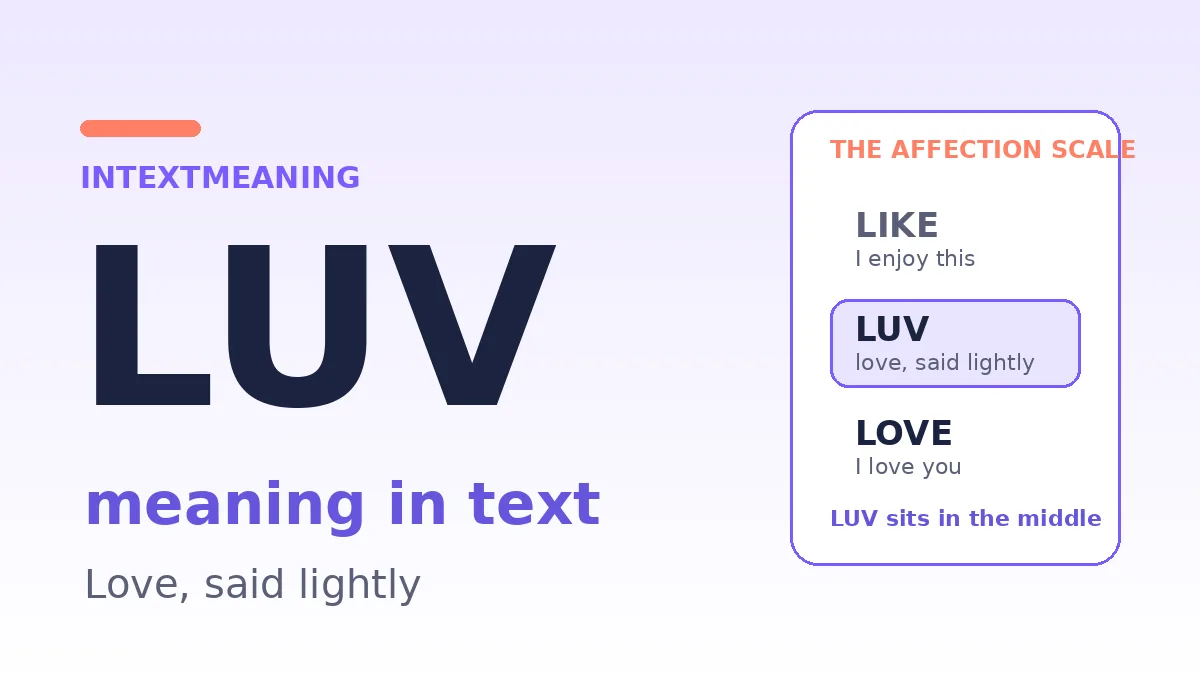
Here is the answer up front: LUV means “love,” spelled the way it sounds — the same word with the weight taken off. But that sentence is not the whole story, because LUV does three different jobs depending on where it sits in the message, and the job tells you how much feeling is inside it.
Love, Said Lightly: The Answer in One Sentence
LUV is love, written softly. Wiktionary calls it a deliberate misspelling of love and an internet-slang form of the word; Dictionary.com lists LUV as an abbreviation meaning love. It is the word love, spelled the way it sounds when someone says it quietly, with a smile.
That softer spelling changes how the message lands. “I love you” can feel like a confession, even when the sender only means “thanks for today.” “I luv you” keeps the warmth and drops the weight, so the reader can answer lightly too. Grammarly notes the spelling has been in use since at least 1825, and today it mostly expresses affection of a lesser magnitude than love.
So LUV is not a weaker love. It is love with the volume turned down on purpose. The same three letters can also address someone, or act as a verb aimed at a thing — and that is where most of the confusion comes from.
The Position Test: Where LUV Sits Tells You What It Is Doing
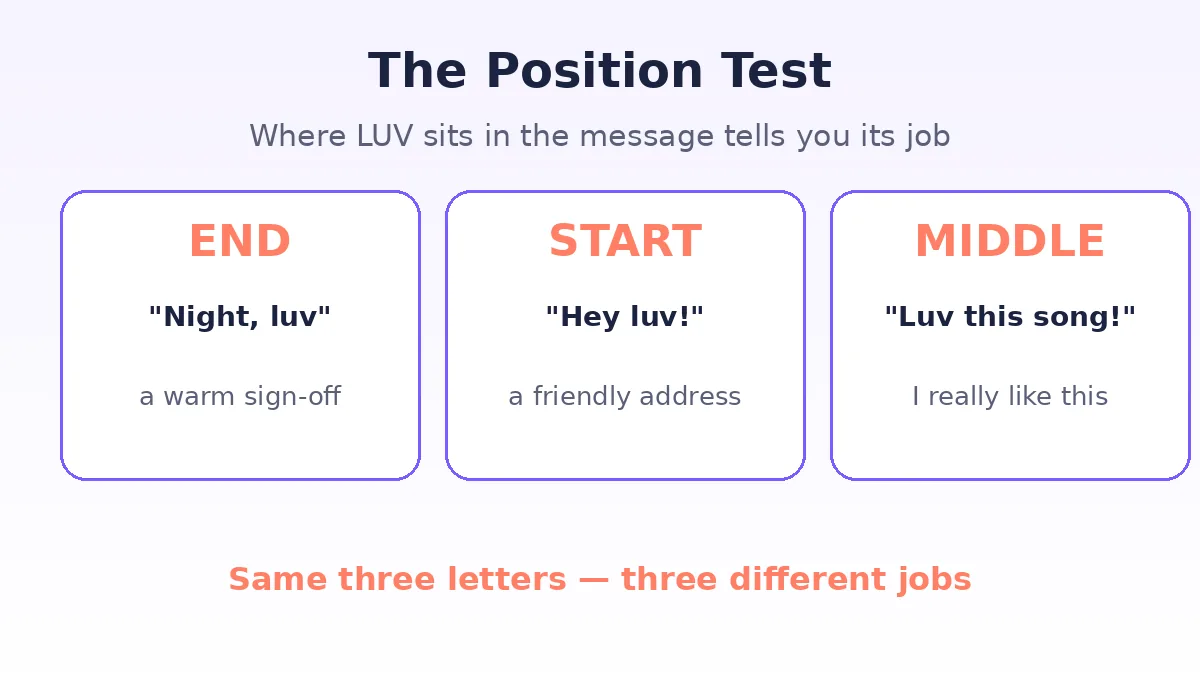
Forget decoding the letters. Read the sentence instead: LUV does three jobs, and its position tells you which one. Call it the Position Test — find the LUV, look at what is around it, and the meaning mostly settles itself.
At the end of a message, LUV is a warm sign-off — its most common job. “Thanks, luv.” “Night, luv.” “Take care, luv.” “Miss you, luv.” Here it wraps the message in warmth rather than describing a feeling; the sentence would work without it — the LUV is the tone. A friend, a partner, a mum — same position, same job, different depth, and the depth comes from who sent it, not from the letters.
At the start of a message, LUV is a way of addressing someone. “Luv, can you grab milk on your way home?” “Alright, luv?” “Hey luv, how was your day?” Here it names the person, warmly, the way other people say “mate,” “dear,” or “hun” — the old British use, still alive in texting. The Oxford Advanced Learner’s Dictionary defines luv as an informal way of spelling love used as a friendly way of addressing somebody. When LUV opens a message, it is almost never a confession — just a greeting.
In the middle of a message, LUV is usually a verb aimed at a thing. “Luv this song.” “Luv your new haircut.” “I luv this place.” Here it means “I really like this” — fondness for an outfit, a photo, a meal, a video. Wiktionary’s own examples work this way (“she luvz it”). Nobody is confessing love to a haircut. When LUV points at a thing, it is admiration, not affection for a person.
Run the test before you reply. End of message? A warm sign-off — answer the message, not the LUV. Start? A friendly address — say hello back. Middle, aimed at a thing? A compliment — say thanks. Most midnight panics disappear the moment you notice where the word is sitting.
Why People Write LUV Instead of LOVE
Two reasons, both about tone rather than spelling.
First, it softens a heavy word. Typed in full, love can sound like a confession even when the sender means something small. LUV keeps the warmth and drops the weight, so a thank-you or a goodnight does not turn into a big moment.
Second, it fits the speed of texting. Three letters, no autocorrect fight, and it looks cute on a screen. A comment under a photo has to be warm in a few words, and “luv this” does that job better than a long sentence — the same instinct behind TYSM instead of “thank you so much.”
None of this makes LUV a lesser word — it makes it a different tool. The spelling tells the reader, before they finish the sentence, that this message is meant to be light.
LUV Is Not an Acronym — and That Changes How You Read It
Here is the fact most guides skip: LUV does not stand for anything. It is not an acronym, and there is no hidden expansion to look up. It is a phonetic spelling of love — the word itself, written the way it sounds.
That matters because it changes how you decode it. With a real acronym, you expand the letters and you have the meaning. With LUV, expanding the letters gets you nowhere; you have to read the room instead. The sentence around it, the person who sent it, and the platform it arrived on are the definition. Anyone selling you a four-word expansion is inventing it: the backronyms floating around online appear in no dictionary and have no second source, so this guide leaves them out.
LUV on TikTok, Snapchat, Instagram, and in Plain Texting
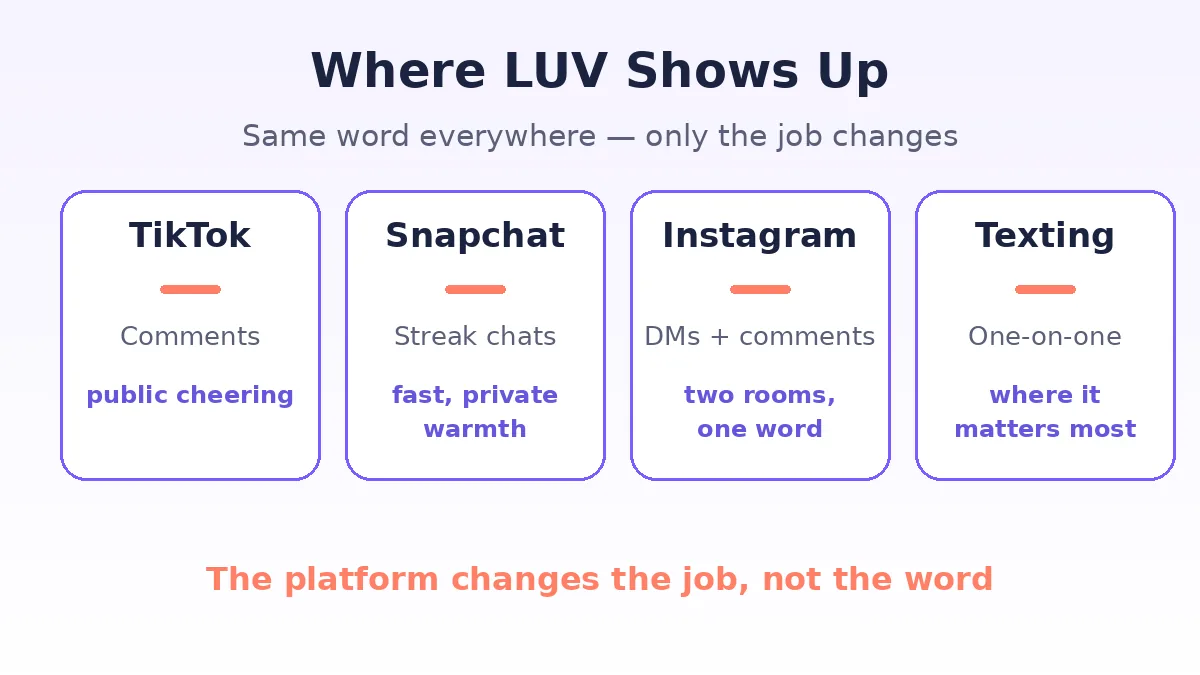
LUV does not change its meaning from platform to platform — it changes its job, because each platform is a different kind of room.
On TikTok, LUV is public cheering. It lives in comments and captions, usually aimed at a thing: “Luv this trend!” “Luv this vibe!” Admiration, fast and visible, aimed at the video — not at you. Treat a TikTok LUV as applause, not as a message to you.
On Snapchat, LUV is fast, private warmth. It shows up in streak chats and as a reply to a snap: “Luv your outfit!” “Goodnight, luv.” Snapchat typing is quick and the chats disappear, so the spelling fits — warm, short, gone in a moment. Because the chat is private, a Snapchat LUV carries a little more weight than a TikTok comment.
On Instagram, LUV splits in two. In comments it works like TikTok — public support for a post: “Luv this picture!” In DMs it works like texting — private, personal, and worth reading carefully. The difference is not the word — it is the audience.
In plain texting, LUV is at its most honest. iMessage, WhatsApp, SMS — no audience, no algorithm, no performance. The message before it is a real conversation with someone you know, and that is why the Position Test works best here. “Thanks for helping me today, luv” from a friend is gratitude with warmth. “Miss you, luv” from a partner is real affection. The answer is in the thread, not in the letters.
The Same Word From Three Different Senders
The word does not change. The sender does. Here is how the same LUV reads from three different people:
From a crush, LUV is the safest way to test the water. “Goodnight, luv” says “I like you” without saying it out loud — and if you do not answer in kind, they can pretend it was just friendly. The flirtation is in the context, not the word: compliments, late-night timing, a thread that was already warm. One LUV alone is neither a confession nor proof of one.
From a best friend, LUV is punctuation with feelings. “Luv you, bestie!” “Thanks, luv, you saved me.” The BFF who writes LUV is not suddenly in love with you — they are saying the friendship out loud in the smallest possible way.
From family, LUV is the everyday version of love. “Take care of yourself, luv.” “Luv you, see you Sunday.” Parents and grandparents use it because the full word can feel formal in a quick text.
One thing worth saying plainly: there is no gender-specific meaning. A LUV from a girl does not mean something different from a LUV from a guy — the meaning follows the relationship and the thread, not the sender’s gender.
LUV vs LOVE vs ILY vs LIKE: The Affection Scale
LUV sits in the middle of a scale, warmer than liking something and softer than declaring love.
| Word | What it says | How heavy it feels |
|---|---|---|
| LIKE | I enjoy this | Light — fondness for a thing or a moment |
| LUV | Love, said lightly | Warm — affection that stays casual |
| LOVE | I love you | Heavy — serious, sometimes a confession |
| ILY | I love you, spelled out | Direct — the feeling said to a person, in full |
LIKE is the lightest; LOVE is the heaviest. LUV sits between them: warmer than like, softer than love. That middle step is the whole reason the word exists — there are a hundred messages a day that need more than “like” and less than “love.”
ILY is a different kind of thing: a phrase, not a spelling — “I love you” compressed into letters, said out loud to a person. LUV softens the word; ILY shortens the sentence. And AWW is the sound of the reaction LUV often causes: the soft, warm noise someone makes when a message lands gently. They are neighbours, not synonyms — as is BB, the pet name for baby or babe.
Where LUV Does Not Belong
LUV is a warm word, and warm words have rooms they should not enter.
Do not use it at work. “Thanks for the report, luv” sounds too personal, and in a professional chat it reads as familiar in a way nobody asked for. Write “thanks so much” in full instead.
Do not use it to confess real feelings for the first time. If you actually love someone, the soft spelling hides what you mean — and if they answer lightly, you will never know whether they understood. Save the full word for the moment that deserves its weight.
How to Answer LUV Without Overthinking It
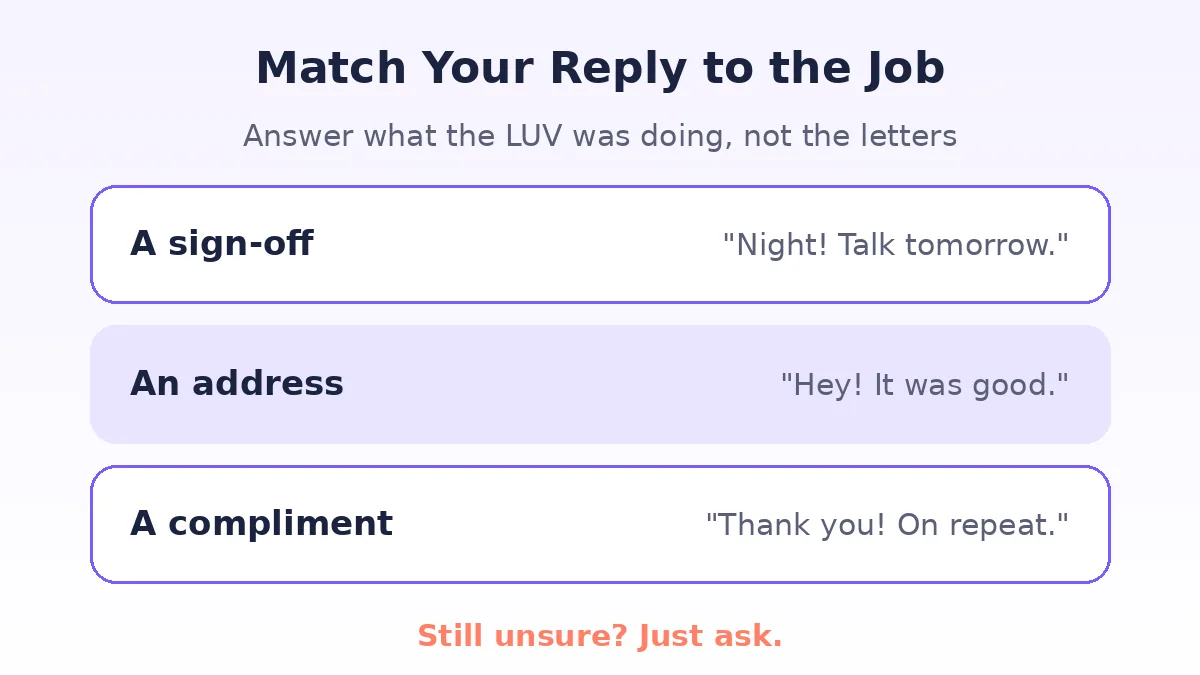
Match your reply to the job the LUV was doing, not the letters you received.
If it was a sign-off — “Night, luv,” “Thanks, luv” — answer the message, not the LUV. “Night! Talk tomorrow.” A warm YW works here too.
If it was an address or a compliment — “Hey luv, how was your day?” or “Luv this song!” — answer the question or say thanks. A greeting is a greeting, and a compliment needs only a thank-you.
If it was affection from someone you care about — “Miss you, luv” — match the warmth. “Miss you too.” That is the IMY feeling in its softest spelling.
If you genuinely cannot tell what it meant, ask lightly: “Is that friendly luv or something more?” A direct question beats a week of wondering.
Your LUV Questions, Answered Straight
What does LUV mean when someone texts it to you?
It means “love,” spelled softly — warmth, care, or closeness without sounding serious. Run the Position Test: end of message = warm sign-off, start = friendly address, middle = “I really like this.”
Is LUV short for something?
No. LUV is not an acronym and does not stand for anything. It is a phonetic spelling of the word love — the same word, written the way it sounds. Any four-word expansion you see for LUV is invented.
Does “night, luv” mean they like me?
It means they care enough to end the day warmly, and nothing more on its own. From a partner, it is real affection. From a friend, it is a friendly goodnight. From someone you have been flirting with, it may be a soft test of the water — but the proof is in the thread, not the two words.
Why do people write LUV instead of LOVE?
Because love can sound like a confession even when the sender means something small. LUV keeps the warmth and drops the weight, so a thank-you or a goodnight does not turn into a big moment. It also sounds like casual speech and fits the speed of texting.
Is LUV British slang?
Partly. In British English, “luv” has been used for decades as a friendly way of addressing someone — “Alright, luv?” — the way others say “mate” or “dear.” In texting everywhere, it is the casual spelling of love.
What does LUV mean on TikTok comments?
On TikTok it usually means public support or admiration for a video — “Luv this trend!” is applause, not a message to you. In a private DM it works like texting. The platform changes the job, not the word.
Can I say LUV to a friend without it sounding romantic?
Yes, and friends do it every day. “Thanks, luv” and “Luv you, bestie” are friendship, not flirtation. The BSF who writes it is saying the friendship out loud in the smallest possible way. Romance needs a romantic thread around it; the word alone does not create one.
Is LUV okay to use at work?
No. It is informal and affectionate, and in a work chat it can sound too personal. Use “thanks so much” or “appreciate it” in full instead.
One Last Thing Before You Reply
LUV is the smallest possible version of the biggest word there is. It means love, spelled softly, for all the moments that need more than “like” and less than “love”: the thank-you that deserves warmth, the goodnight that deserves a little feeling.
Read it by position, not by panic: end of message, a sign-off; start, a greeting; aimed at a thing, admiration. From someone you care about, in a thread that was already warm, it is exactly what it looks like — love, said lightly.
Save the full word for the moments that deserve its weight, and let LUV carry the everyday warmth. The next time your phone lights up at 11:47 with “night, luv,” answer the message, not the mystery.
