
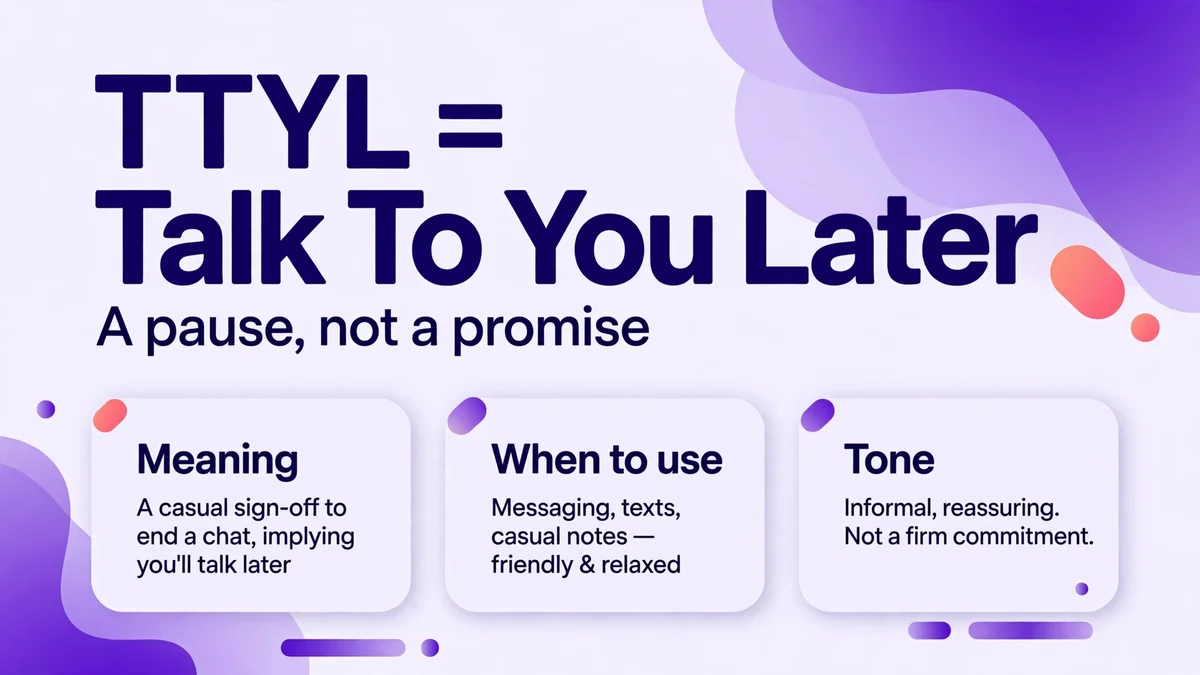
"Gotta go, TTYL." Four letters, and the conversation is over — but is the relationship? If you have ever watched those letters arrive and wondered whether "later" meant tonight, tomorrow, or never, you have felt the exact trap this article exists to defuse. The ttyl meaning in text is simple to state, and dangerously easy to over-read.
TTYL means "talk to you later" — a friendly way to end a conversation for now while leaving it open. That is the whole definition. The useful part is the second half of this article's title: TTYL is a pause, not a promise. "Later" sets no time, guarantees no reply, and never says who will message first — and learning to hear that is worth more than memorizing the expansion.
What Does TTYL Mean in Text?
TTYL is an initialism, and its letters spell the phrase out: Talk To You Later. It is a conversation-closing signal: it tells the other person that replies are about to stop, without making them wonder whether the conversation is over. Where silence alone is ambiguous — did they leave, or did they just stop caring? — TTYL answers the question: they left, and the door is open.
The phrase itself is older than the internet. People said "talk to you later" face to face and on phone calls for years before it shrank to four letters in 1990s chatrooms and on AIM, ICQ, and MSN, where logging off a shared family computer was an event worth announcing. It stuck around through SMS and into every messaging app since, and unlike some slang, it earned dictionary recognition: the Oxford Advanced Learner's Dictionary lists TTYL as an informal abbreviation meaning "talk to you later," and it was added to the Oxford English Dictionary in 2016. This one is dictionary-backed, and the article can say so plainly.
Real-world TTYL, done right:
- "I have to go now, TTYL." — Leaving with a reason, door open.
- "My class is starting—ttyl." — The trigger is named, the pause is explained.
- "Sounds good. TTYL." — A completed conversation, closed politely.
Notice what every good example has: a reason, or a completed topic. TTYL works best when the rest of the sentence does the explaining, because the four letters on their own explain nothing except that you are going.
The Pause-or-Promise Test
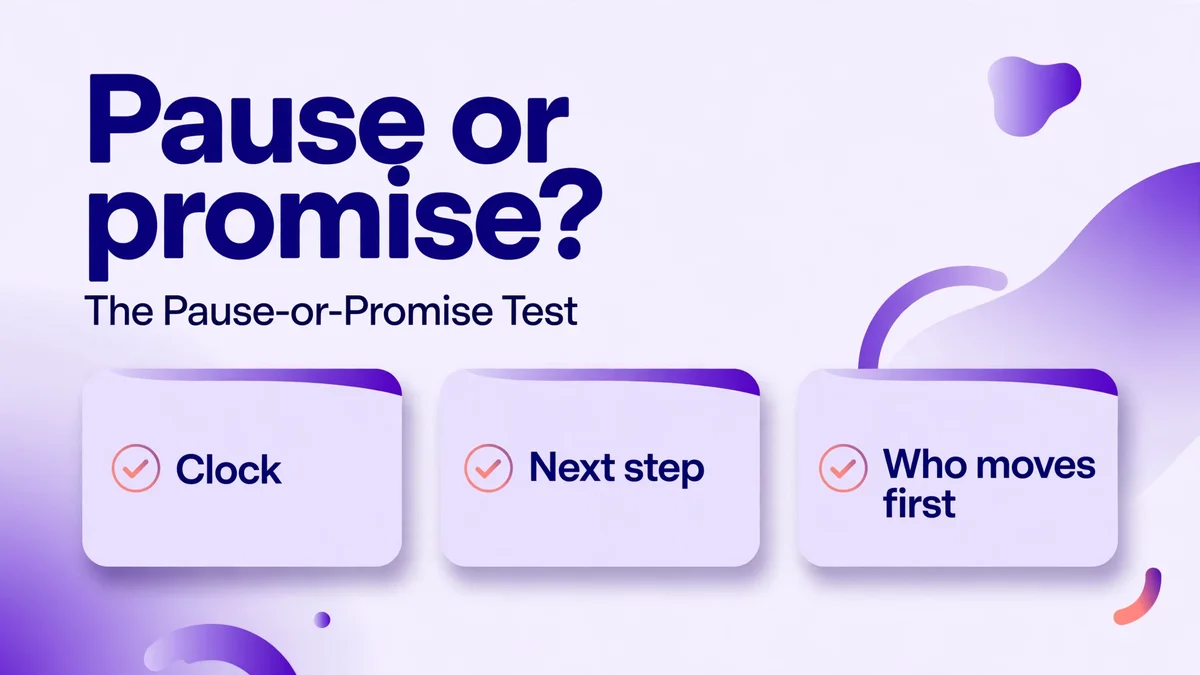
Here is this article's named method. Call it the Pause-or-Promise Test: three checks, run in order, on any TTYL you receive or are about to send.
Check 1: Is there a clock? A time attached to TTYL changes everything — but the time comes from the rest of the sentence, never from the letters. "TTYL tonight" is time-specific. "TTYL after my appointment" points to a window. Bare "TTYL" with no time attached leaves "later" completely open: tonight, tomorrow, next week, or never. If there is no clock, there is no appointment.
Check 2: Is there a next step? An action promised is not a time promised. "TTYL, I'll send the pics" commits to sending pictures, not to a moment. "TTYL, I'll call after work" commits to a call after work — the "after work" is doing the timing work, not the TTYL. Separate the action from the clock, and you will stop misreading both.
Check 3: Who moves first? TTYL never says. It does not promise that the sender will message first, and it does not ask you to. If it matters who reopens the conversation, say so: "Message me when you're free" turns a vague pause into a clear invitation. If you needed a time and got only "TTYL," the honest move is to ask for one rather than treat "later" as one.
Run all three and the verdict is almost always the same: a pause, not a promise. A TBH-style honest read applies here: the letters carry no promise at all. Any promise you hear lives in the rest of the sentence — or only in your hopes.
TTYL vs Goodbye, BRB, GTG, and HMB: The Ladder of Exits
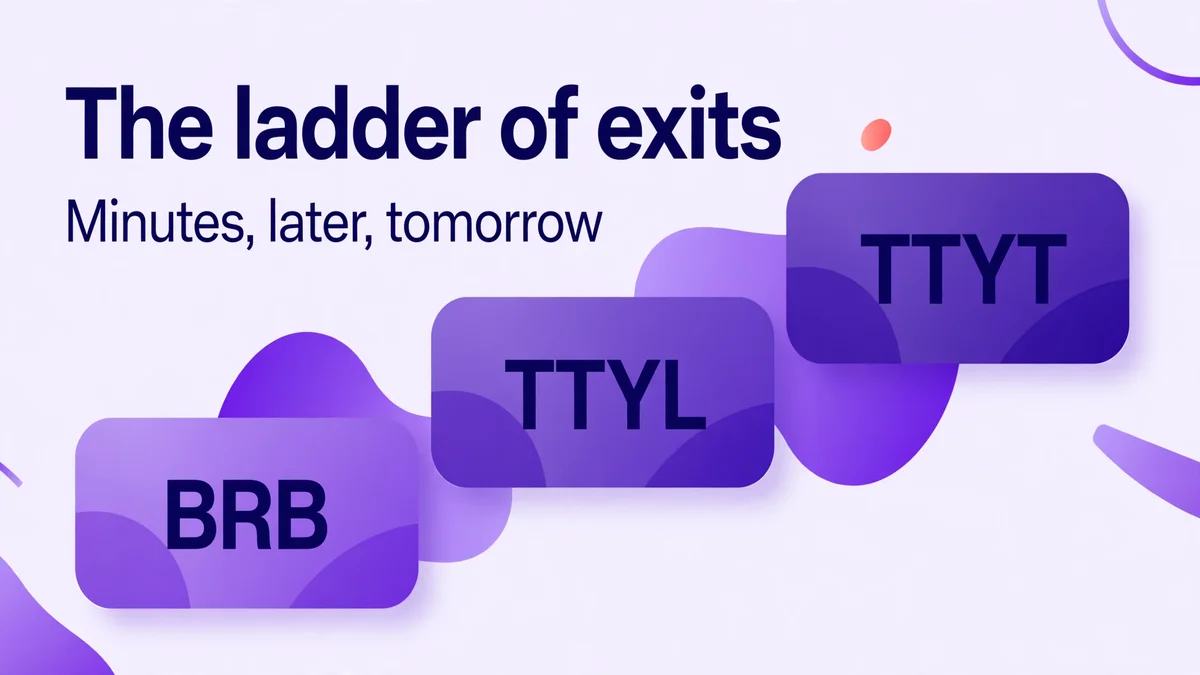
TTYL sits on a ladder of exits, and each rung pauses the conversation for a different length of time. Confusing the rungs is how people misread every goodbye on it.
| Term | Full form | What it actually does |
|---|---|---|
| BRB | Be Right Back | A pause measured in minutes — back soon |
| GTG | Got To Go | Announces the exit itself — leaving right now |
| TTYL | Talk To You Later | A pause measured in "later" — unspecified, could be hours or days |
| TTYT | Talk To You Tomorrow | A pause with a day attached — tomorrow, specifically |
| Goodbye | — | Ends the conversation — no promise of return |
| HMB | Hit Me Back | The opposite direction — asks for a reply, keeps the conversation going |
The useful contrasts: BRB is minutes, TTYL is "later," and TTYT is tomorrow — if someone wanted tomorrow, they would have written TTYT. GTG announces that the leaving is happening now ("GTG, ttyl" pairs the exit with the friendly pause). Goodbye ends things; TTYL pauses them. And HMB is the mirror image: where TTYL closes a conversation, HMB asks for it to continue. If a friend writes "hmb," they want an answer; if they write "ttyl," they want a pause.
TTYL Tone: Warm Pause or Cold Door?
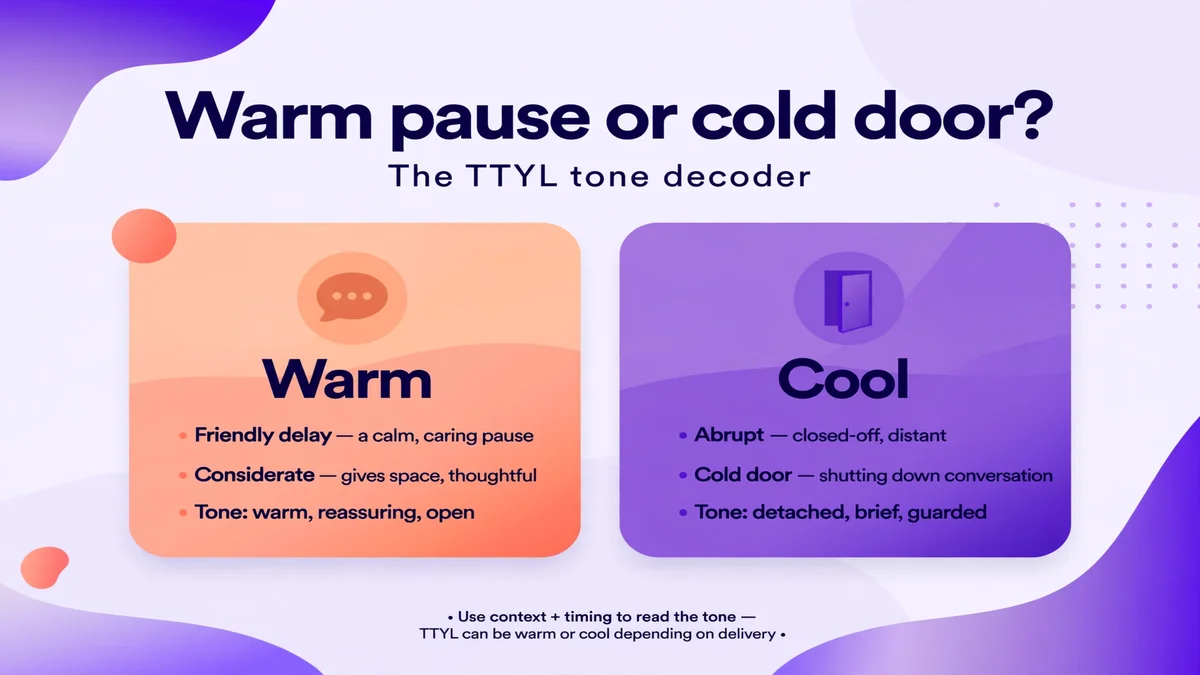
TTYL's default tone is warm and casual. But the same four letters can sound like a hug or a door closing, and the difference is never the letters — it is everything around them.
Warm: a reason plus TTYL. "I have to drive, so ttyl" explains the pause. "It was really good catching up. TTYL!" comments on the conversation before leaving. "Get some rest. TTYL." adds care to the exit. In all three, the sender did the social work before the sign-off.
Neutral: bare TTYL at a natural stopping point. "Okay, ttyl." after plans are settled is neither warm nor cold — it is a routine close, and reading more into it is over-reading.
Cold: bare TTYL where warmth was owed. "We need to discuss this." "TTYL." lands like a shutdown, because the serious question deserved an answer and got an exit instead. "You aren't listening. TTYL" uses the sign-off to end an argument, not a conversation. The letters still mean "talk to you later" — but the room makes them feel like "I'm done with this."
A soft note on styling: lowercase "ttyl" often feels more relaxed, "TTYL!" with an exclamation mark reads more upbeat, and bare caps can look emphatic — but these are perceptions, not rules, and the preceding message matters far more than the casing. A BTW-style softener warms any exit: "btw, loved catching up" before TTYL turns even a quick departure into a kind one.
Sender context matters by relationship, not by gender. From a friend, TTYL is the default room: plans, pauses, and "ttyl, heading into a meeting." From a crush, judge interest by what they do over time, not by the sign-off — "I enjoyed talking, but it's late. TTYL" is polite and interested, and it is still not a promise of a next message. From a boss or coworker, TTYL fits an informal work chat, but when timing matters, the full phrase wins: "I'll follow up this afternoon" says what TTYL cannot. From a stranger, TTYL is a perfectly fine sign-off that needs no relationship behind it.
Where You'll See TTYL: Texting, DMs, and Group Chats
TTYL means the same thing on every platform: a pause, not a promise. What changes is the room, not the meaning — and no platform gives it a special definition.
Texting (SMS, WhatsApp, iMessage). This is TTYL's home. One-to-one chats, usually with a reason attached: "Battery's low. TTYL." The sender is about to go unreachable, and TTYL explains the silence in advance.
DMs (Instagram, Snapchat, TikTok). Same job, faster rhythm: "Going to class, ttyl" tells the other person why replies are about to stop. In a public comment thread, it may simply mark that someone is leaving the discussion.
Group chats. Here TTYL addresses the whole channel: "I've got to log off. TTYL, everyone." It tells the group not to expect replies, without singling anyone out.
Gaming lobbies. "Last match for me. TTYL." The player is leaving the game chat for now — and the abbreviation does not promise they will return for the next match.
The pattern: the letters stay the same, but the room changes the temperature. Private rooms pause; public rooms perform. And the pause is always unspecified unless the rest of the sentence specifies it.
How to Reply to TTYL
Your reply depends on what you need from the pause.
If it was a routine close: mirror it. "Okay, ttyl" or "See you later" is enough. "Take care! Message me when you're free" adds warmth and leaves the next contact open without demanding it.
If you need a time: ask for one instead of treating "later" as one. "Sounds good — tonight?" turns a vague pause into a plan. "TTYL" after a question that needed an answer ("Will you send the document today?") deserves a direct answer, not a mirrored sign-off: "Yes, I'll send it by five."
If it was cold: don't chase the sign-off. If the issue matters, propose a time instead: "Can we agree on a time to talk?" That reopens the conversation on your terms, without pretending the cold TTYL was warm.
If they were stressed or busy: a DW-style comfort pairs well — "dw, take your time" answers the pressure behind the exit. And a LMK-style open door keeps it kind: "lmk when you're free" leaves the return in their hands, politely.
When Not to Use TTYL
TTYL is a joy in its habitat and a misfire outside it. Skip it when:
- Someone needs a definite answer or time. "Will you send the document today?" cannot be answered with "TTYL" — the practical question stays unresolved. Answer it directly.
- The conversation is serious. An apology owed, a grief shared, a conflict open — TTYL as an exit reads as dismissal. Stay, or name a real time to return.
- The setting is formal. Emails, client messages, anything where timing matters — write it out: "I look forward to speaking with you again," or "I'll follow up this afternoon."
- You don't intend to talk again. TTYL as a polite lie is still a lie. If the conversation is over, a clean goodbye is kinder than a false "later."
- You already wrote "later." "Ttyl later" repeats the idea and adds nothing. Drop the second later.
Debunked: What TTYL Does NOT Mean
Short letters collect false meanings, and TTYL has collected a few:
- No alternative meaning. Unlike many abbreviations, TTYL has no widely established second expansion in ordinary texting. Anyone selling you one is inventing it.
- "Goodbye forever" — a myth. TTYL is the opposite of final: it exists precisely to avoid finality. If someone meant forever, they would have said goodbye.
- "A promise to message tonight" — a myth. "Later" is unspecified by design. Only the rest of the sentence can promise a time, and bare TTYL promises nothing.
- Popularity claims — refused. The old article called TTYL "one of the most popular" and "most recognized" abbreviations. No usage study supports any ranking, so this article prints none. TTYL's value never depended on a league table.
- "Ta-ta, you all" — a charming but unproven folk theory. Some writers suggest TTYL descends from the 1980s British farewell "ta-ta, you all." It is a nice story, and no source proves it — so it stays labelled as a theory, not a fact.
- TTYLS ("talk to you later soon") — less established, adds nothing. If the timing matters, name the time instead of stacking adverbs.
- NVM is not TTYL's cousin. NVM cancels something ("forget I asked"); TTYL pauses something. Different jobs, and confusing them turns a pause into a retraction.
Quick Answers
What does TTYL mean in text?
TTYL means "talk to you later" — a friendly, casual way to end a conversation for now while leaving it open for later.
Does TTYL mean they'll message me tonight?
No. "Later" is unspecified — it could mean tonight, tomorrow, or next week. Only the rest of the sentence can promise a time, and bare TTYL promises nothing.
Is TTYL the same as goodbye?
No. Goodbye ends a conversation; TTYL pauses one. "Goodbye" can feel final, while TTYL says the conversation may continue another time.
Is TTYL rude?
Usually not. Its default tone is friendly and casual. It can feel cold when sent bare after a serious message or mid-argument, but the letters themselves are neutral — the room makes the difference.
Can I use TTYL at work?
In an informal work chat, yes. In formal communication, or whenever timing matters, write it out: "I'll follow up this afternoon" says what TTYL cannot.
TTYL vs BRB — what's the difference?
BRB ("be right back") is a pause measured in minutes — back soon. TTYL is a pause measured in "later" — unspecified, and usually much longer.
TTYL is four letters doing the work of a wave from the door — "I'm going, and this isn't over." Run the Pause-or-Promise Test before you read a promise into it: check for a clock, check for a next step, and ask who moves first. Get that right, and TTYL stays what it should be — a warm pause, not a vague promise and not a cold door.
