
Most texting abbreviations are little shortcuts for things you feel — a laugh, a frustration, a goodbye. SMS is the odd one out: it isn’t a feeling at all. It’s a road. If you’re looking up the sms meaning in text, here it is: SMS stands for “Short Message Service” — the cellular system that carries plain text messages between phone numbers, over your carrier’s network instead of the internet. And because it’s a road rather than a word, it asks a different question: not “what does it mean?” but “which road is my message on right now — and why does that matter?”
This guide answers both. You’ll get the plain definition, the honest technical explainer (the 160-character limit, green bubbles, why SMS still works when nothing else does), and a simple three-question check — the Channel Test — that tells you which channel any message is travelling on. That’s the part almost no “SMS meaning” page bothers with, and the part you’ll actually use.
SMS Meaning at a Glance
| Full form | Short Message Service |
| What it is | The cellular standard for sending plain text messages between phone numbers — no internet needed |
| In practice | “Sms me” = “text me” (also a verb: SMSed, SMSing) |
| Example | “no wifi down here — sms me instead” |
The Channel Test: Which Road Is This Message On?
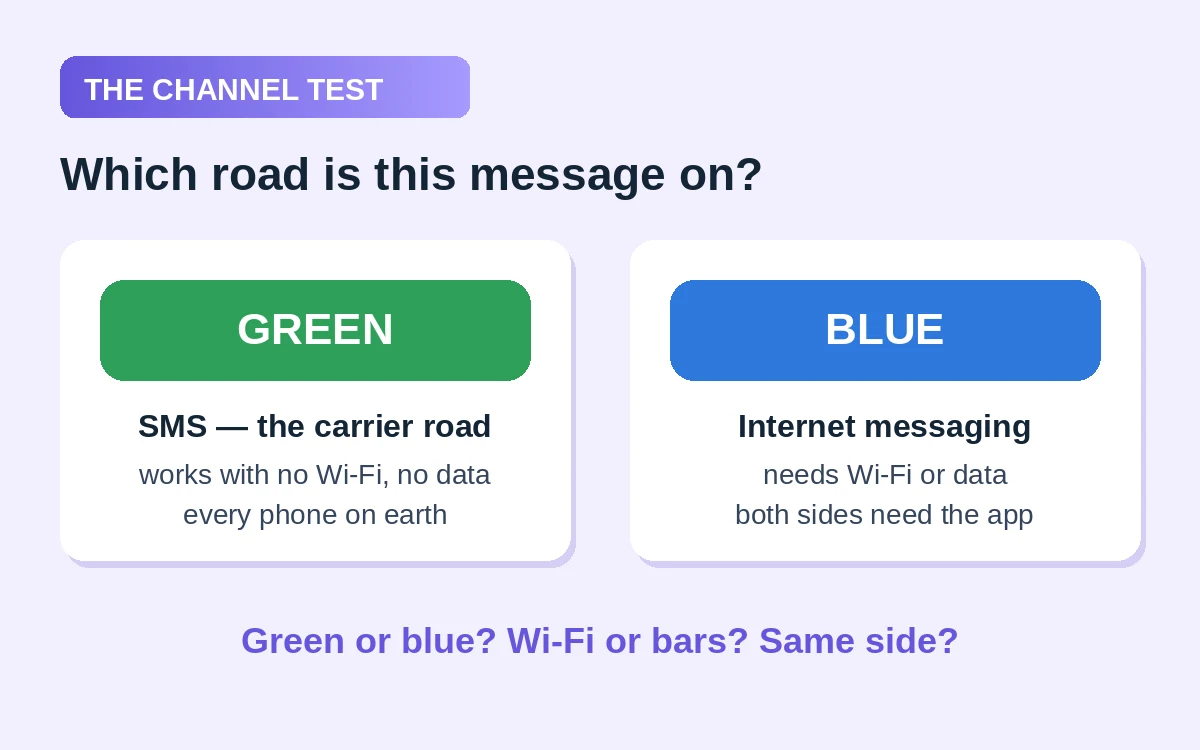
Every text travels one of two roads: the internet road (WhatsApp, iMessage, RCS — services that need data or Wi-Fi) or the carrier road (SMS — your phone network’s own signalling). The Channel Test is three questions that tell you which road you’re on. The answers decide real things: whether your photo sends, whether your message arrives at all, and why your group chat suddenly looks different.
Question 1 — Green or blue? On an iPhone, the bubble colour is the channel report. Blue bubbles are internet messages (iMessage). Green bubbles are SMS: the message left Apple’s system and travelled as a plain carrier text. That’s why features vanish in green bubbles — no reactions, no read receipts, no typing dots, photos arriving blurry and late. The green bubble is the phone telling you the message took the plain road.
Question 2 — Wi-Fi or bars? SMS rides the cellular signal, not the internet. Dead Wi-Fi, mobile data off, no data left on a prepaid plan — none of it stops a text. If your message left your phone with no internet involved, it was almost certainly SMS. Basement parking, packed concerts, roaming with data off, a 2FA code landing where data shows “No Service” but carrier bars remain — the carrier road is the last one standing.
Question 3 — Everyone on the same side? Apps work when both people have the app. SMS works when both people have a phone number — any phone, any era. But add one Android phone to an iPhone group chat and the whole thread drops to SMS, losing reactions and full-quality photos. SMS is the only road every phone shares.
Run the test on any confusing message moment and it resolves instantly. Photo stuck at “Not Delivered”? You’re on the carrier road — shrink it or switch to the internet road.
What SMS Actually Is (And What It Isn’t)
Stripped to the facts: SMS is the standard your carrier uses to send short texts between phone numbers. Wiktionary’s entry is refreshingly boring about it — “a system enabling cell phones to send or receive text messages” — and Merriam-Webster calls it “a technology for sending short text messages between mobile phones.” Three things define it:
- Text only. Letters, numbers, symbols — no images, no video, no formatting. (Pictures-over-text is MMS — “multimedia messaging service” — a different standard entirely.)
- Capped at 160 characters per segment. (More on what that really means below.)
- Carrier-routed, not internet-routed. Your message goes to your carrier’s message center, which forwards it to the recipient’s carrier, which delivers it. Phone off? The carrier holds the message and retries.
And the distinction the internet muddles daily: “SMS” and “text message” aren’t the same thing. “Text message” is the everyday word; SMS is one technical road a text can travel. A blue-bubble iPhone message is a text message that is not an SMS. Keep the road and the message separate, and the next two sections make sense.
“Sms me” as a verb. The dictionaries don’t stop at the noun. Wiktionary lists SMS as a verb with real print attestations — I SMSed him, she is too busy SMSing her friends — so “sms me when you land” is just “text me when you land,” wearing a slightly more technical coat.
The 160-Character Rule That Isn’t Quite a Rule
Every SMS explainer says “limited to 160 characters” and stops, which leaves the wrong impression — that you’ll be cut off mid-thought at character 161. The honest version is more interesting.
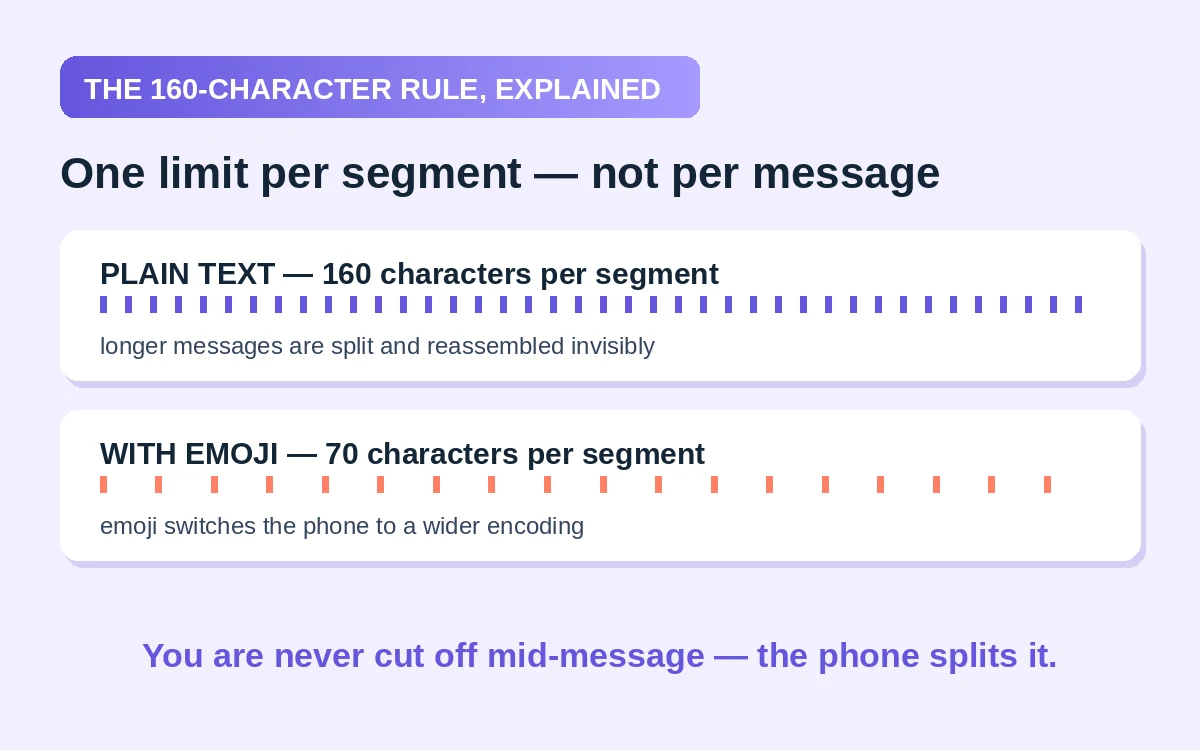
The 160-character cap is real per segment. It comes from the old GSM standard (and yes, the old phone guides were right about the number). But modern phones hide it completely: type a 400-character message and your phone silently splits it into segments and the recipient’s phone reassembles them, so the whole thing arrives looking like one message. You will never be stopped at 160 — though on some prepaid plans, each segment can still bill as a separate text, which is where the limit quietly still matters.
The twist is the emoji tax. Standard texts use an encoding that fits 160 plain characters per segment; add an emoji or a non-Latin character and the phone switches to a wider encoding, and the segment shrinks to 70 characters. So the practical rule isn’t “keep it short” — it’s “if your message costs you per text, watch the emojis, not the words.”
Why 160 at all? It was set in the 1980s GSM standard to fit the signalling channels that carry texts — originally meant for carrier alerts, not conversation. The first-ever SMS, sent in December 1992, read “Merry Christmas.”
Why SMS Refuses to Die
Every few years someone declares SMS dead. It keeps outliving the predictions for three structural reasons:
It needs nothing the recipient hasn’t got. No app, no account, no data plan. Any phone number on earth can receive a text. That’s why your bank, your airline, your two-factor authentication, and your dentist all text you instead of WhatsApping you: SMS is the only channel that reaches every customer.
It’s the last channel working when the internet isn’t. Dead Wi-Fi at a festival, data off while roaming, a rural road with one bar of signal — SMS keeps moving because it rides the signalling path phones maintain for calls.
It’s boring on purpose. No read receipts, no typing indicators, no algorithmic sorting — a text is a text. Much of the most functional communication of your day (reminders, codes, “I’m outside”) happens on SMS precisely because it does nothing extra. RCS — the carriers’ planned successor — may absorb this role eventually, but until it works everywhere, the plain road stays open.
Who Says “SMS Me” — and What It Signals
The same three words land differently depending on who sends them, because the sender is really telling you which road they need you on:
A friend at a festival, a concert, or travelling: “sms me, my data’s off.” Translation: the internet road is down or expensive; meet me on the carrier road.
A delivery driver, a tradesperson, a new contact: “sms me the address.” They have your phone number, not your app list. SMS is the neutral channel between people who aren’t “contacts” anywhere else. (The natural reply habit here pairs with LMK — “lmk when you’re outside” — small practical words doing big coordination work.)
A business or service: appointment reminders, delivery windows, one-time codes. Automated SMS — and the signal is: don’t reply like it’s a person. Short codes rarely read replies; codes are time-sensitive, so treat them that way.
A stranger, out of nowhere, with a link or an urgent claim: the smishing check (next section). A real business never asks you to “verify your account” by clicking a texted link.
A friend wrapping up: “gtg, sms me later” — talk later, with the channel specified. As casual as GTG gets, and evidence the verb has fully settled into everyday speech.
Smishing: The One Real SMS Danger
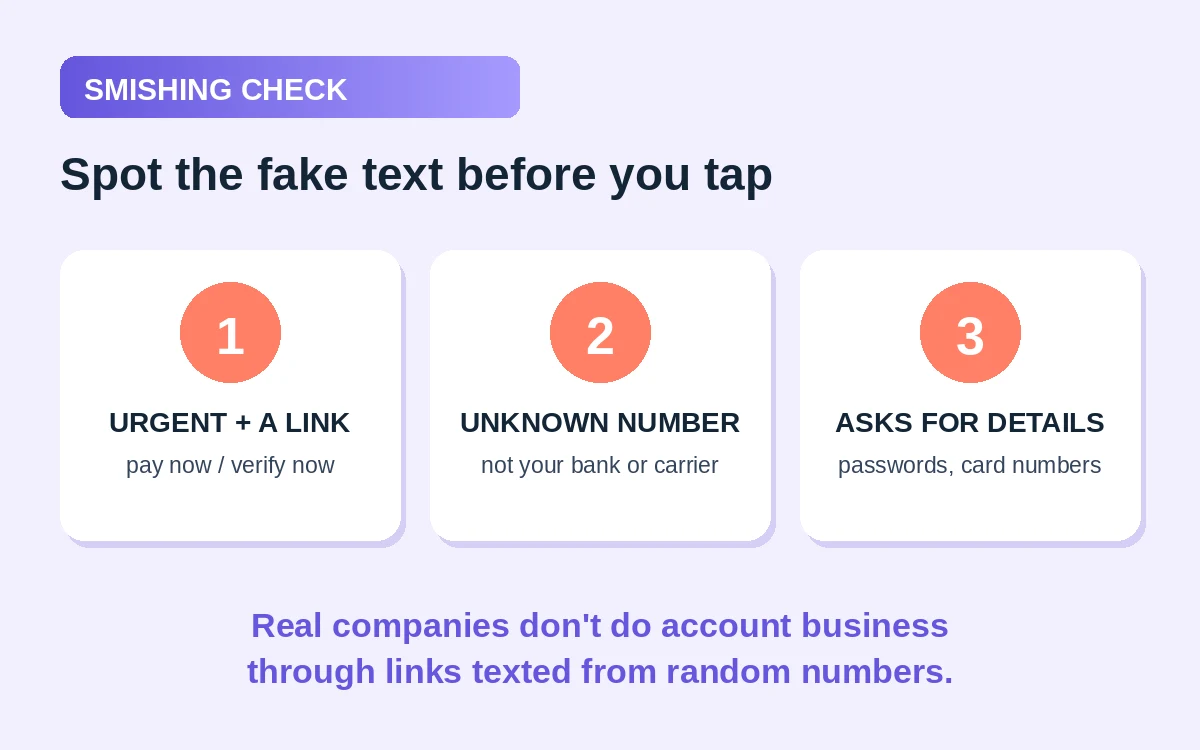
SMS’s universality is also its attack surface. Smishing — SMS phishing, documented in the dictionaries alongside the main entry — is the fake text: the “package held” delivery scam, the “bank account locked” scare, the “you’ve won” refund bait. It works because texts feel personal and urgent, and because the carrier road carries no proof of who’s really sending.
The defence is one rule: real organisations don’t do account business through links in texts from random numbers. Your bank will never text you a link to “secure your account.” A delivery company won’t ask you to pay a redelivery fee from an unknown number. Urgency plus a link plus your details? Smishing until proven otherwise — delete it, and contact the company through its own app or website if you’re unsure.
Two habits close the gap: never call back a number from a suspicious text (look the number up independently), and never reply — replying confirms your number is live. The irony is neat: the most reliable road in messaging is also the one where you should trust the sender least.
SMS in Real Conversations
The exchanges below are illustrative examples, not real messages.
The festival coordination
- Priya: “signal is terrible in here lol anyone got data?”
- Sam: “nope, roaming is off. just sms me where you are”
- Priya: “north gate by the food stalls”
- Sam: “otw“
The Channel Test, run live: internet road down → carrier road it is. No HYD survives this crowd; plain SMS does.
The verification code
- Bank (automated): “Your one-time code is 458921. It expires in 10 minutes. Never share this code.”
- Maya: copies it, logs in
No greeting, no reply expected — the FYI of the messaging world. Codes arrive by SMS because it’s the channel that reaches everyone.
The smishing dodge
- Unknown number: “USPS: your package is held. Pay $3.20 redelivery: bit.ly/xyz92”
- Leo: deletes it, then warns the group chat — “almost clicked a fake delivery text — mb everyone, just delete those”
Leo did the right thing. Urgency + link + unknown number = delete.
The green-bubble complaint
- Nora: “tbh the green bubbles drive me crazy in the group chat”
- Alex: “same — that’s sms for ya”
That exchange is the Channel Test, run as a complaint.
Quick Answers
What does SMS mean in text?
SMS stands for “Short Message Service” — the cellular standard for sending plain texts between phone numbers, no internet needed. In everyday use, “sms me” just means “text me.”
Is SMS the same as a text message?
Nearly. “Text message” is the everyday word; SMS is one specific technology a text can travel on. An iPhone’s blue-bubble message is a text message sent via iMessage — not SMS. Green bubbles are SMS.
Why are some iPhone texts green and others blue?
Blue means the message travelled Apple’s internet service (iMessage); green means it went as plain SMS over the carrier network — usually because the other person doesn’t use an iPhone, or iMessage was unavailable. Green threads lose reactions, read receipts, typing indicators, and high-quality photos.
Does SMS work without Wi-Fi or data?
Yes — its defining trait. SMS travels over your carrier’s cellular signalling, not the internet, so texts send with data off or Wi-Fi dead, as long as you have carrier signal.
What is the SMS character limit?
160 characters per segment for plain text; 70 if you include emojis or non-Latin characters. Phones split longer messages and reassemble them, so you won’t be cut off — but per-text billing plans may charge per segment.
What is smishing?
Smishing is phishing by SMS — scam texts pretending to be deliveries, banks, or refunds. Real organisations don’t resolve account problems through links texted from unknown numbers. Urgency plus a link? Delete it and contact the company directly.
The Short Version
SMS is “Short Message Service” — not a slang word, but the carrier road your texts travel when the internet road isn’t available. Green bubbles mean SMS. The 160-character limit is per segment, and phones hide it. “Sms me” just means “text me.” And whenever messaging gets confusing, run the Channel Test: green or blue, Wi-Fi or bars, everyone on the same side? Answer those and you’ll always know which road you’re on.
