
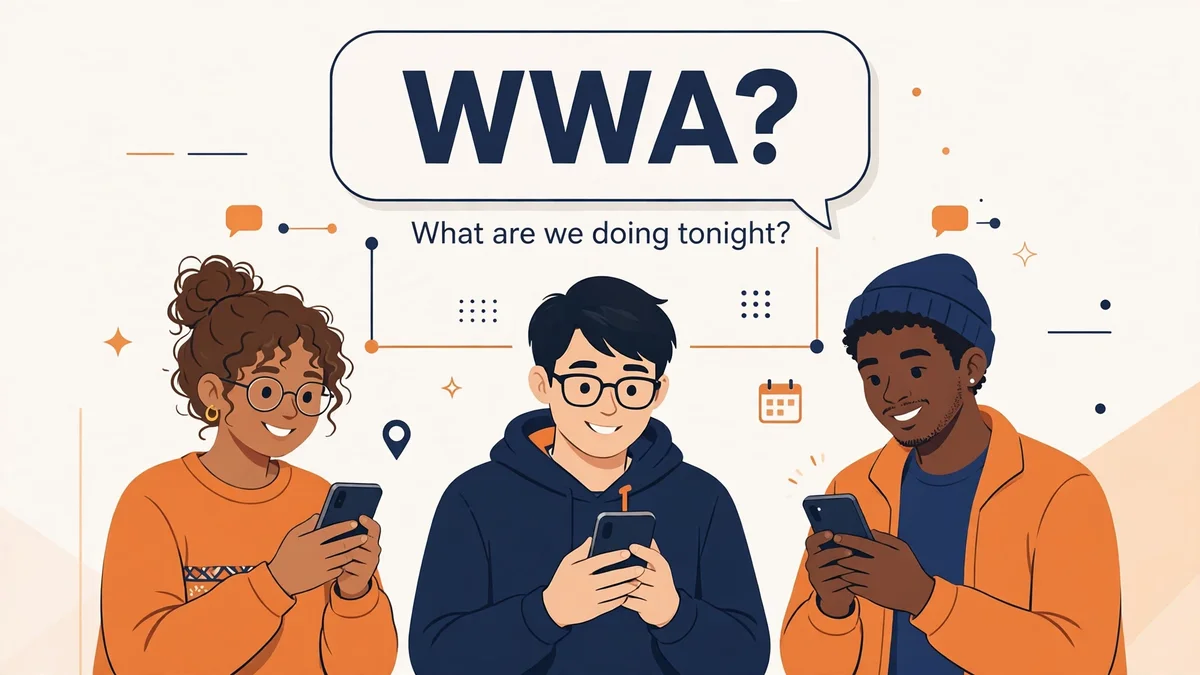
It is Friday evening, the group chat has been quiet all day, and then one message lands with no greeting and no explanation: “WWA tonight?” Three letters, and suddenly you must decide what the evening is. Is your friend asking where everyone is, what the plan is, or whether anyone is even in the mood to go out? Answer the wrong question and the conversation stalls. That confusion is why the wwa meaning in text deserves a proper unpacking, not a one-line answer.
Here is the short version. WWA is a group check-in question, a compressed form of “Where we at?” or “What we at?” — in plain English, “What are we doing, and where do we stand?” It is almost always addressed to a group, or to someone as part of a group, and it asks for a status, a place, or a plan. It is not a greeting, not a statement, and not a yes-or-no question. See it as one question with three facets — plan, place, and mood — and almost every WWA you receive becomes easy to read.
This update admits where the evidence is thin, which the old version did not. WWA is slang, not a dictionary word, and the guides explaining it disagree loudly. So this article grades every reading, keeps only the ones real exchanges support, withdraws the old article’s unsupported claims in plain sight, and gives you a test — the Headcount Test — that works even when the sender gives you almost nothing.
What WWA Actually Means — and Why the Guides Disagree
WWA stands for “Where We At?” or “What We At?” — two spellings of the same spoken question, not two different meanings. Both come from casual spoken English, the shortened questions friends use while sorting out an evening. The “we” is the most important clue in the whole term. WWA is plural by design: where a one-to-one check-in asks about you, WWA asks about us.
That plural is also why the guides disagree. No established dictionary entry for this slang sense could be verified at research time, so every guide works from usage examples and guesswork, and guesswork fills gaps with invention. One guide crowns “When We Are” as the main meaning, with example sentences nobody actually texts. Another insists the top meaning is “Who Wants Action.” A third offers “What a World Awaits,” an inspirational phrase dressed as slang. None survives contact with a real group chat. They are backronyms, and this article refuses to count them.
What the better guides agree on, and what real exchanges confirm, is the core: a casual question about a group’s status, plans, or location. “Where we at?” leans toward place and progress. “What we at?” leans toward activity. A third shade, “What we about?” — what are we in the mood for — leans toward intention. These are facets of one question, and treating them as three separate meanings, as the old article did, is the first error this update corrects. A sender writing “WWA tonight?” is asking one open question, and the time word, the thread, and the group tell you which facet they mean.
The old article’s second error was confidence it had not earned. It called WWA “short and popular” and “widely used,” and presented its three-way split as settled fact. No count, survey, or study supports a popularity claim for WWA, and the guides themselves disagree about which reading is primary — so this update withdraws the popularity claims outright. WWA is a real term used in real friend groups, but a medium-frequency one, nowhere near the reach of the biggest texting abbreviations.
Run the Headcount Test
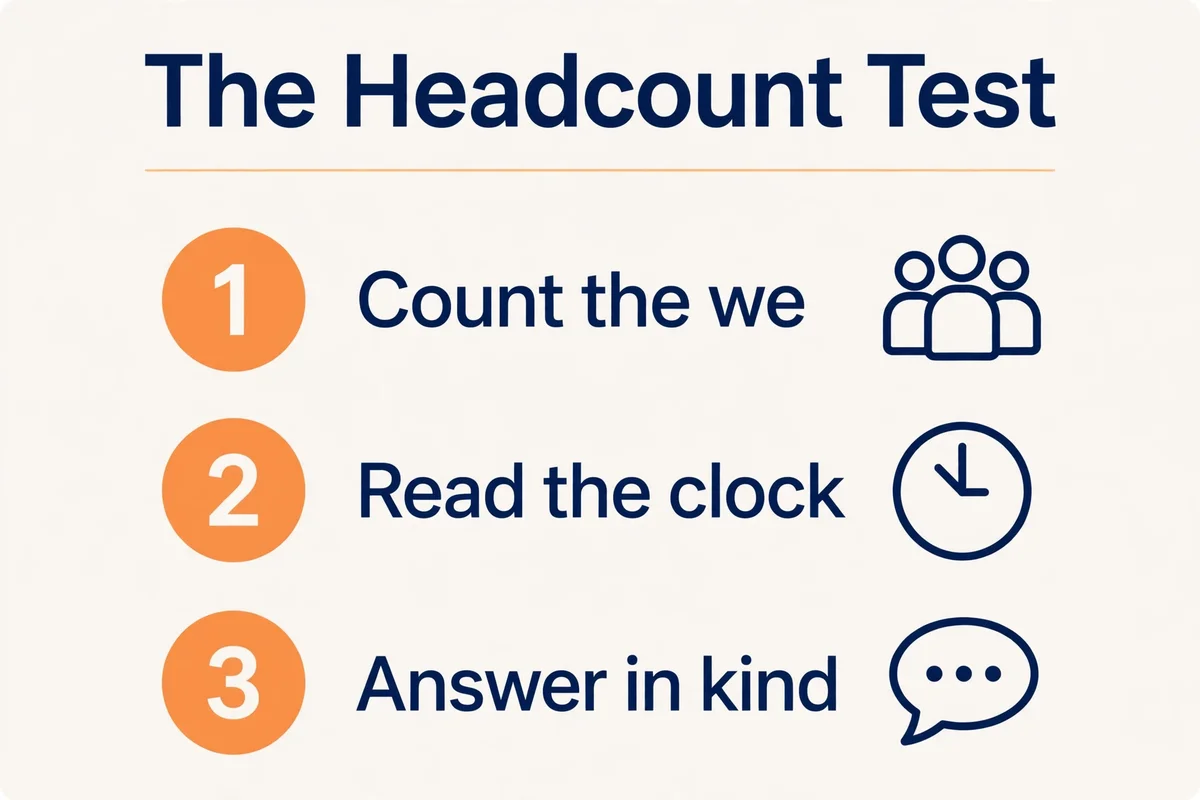
Here is the new reader test for this article, built for the hardest version of WWA: the bare message, no context, no time word, no emoji. Call it the Headcount Test, because its first move is literally to count heads.
Check one is COUNT THE WE. Who is the “we”? In a group chat, the “we” is everyone in that chat, and the sender is asking the group to declare itself: who is in, who is out, what is happening. One-to-one, the “we” is you and the sender together — smaller, but still shared. If you cannot find a “we” at all, WWA is probably the wrong reading. The “we” is the test’s anchor because it never changes.
Check two is READ THE CLOCK. Let a time word choose the facet. A future time word — tonight, tomorrow, this weekend — points to the plan facet: what is the group doing then? A present time word — right now, rn — points to place and status: where is everyone, and where does the plan stand? No time word points to the open check-in: a bare “WWA?” lets the group decide what it means. Punctuation is a hint, not a code: “WWA tonight??” reads excited, while a flat lowercase “wwa” reads like a low-effort poke.
Check three is ANSWER IN KIND. Match the facet you found. A plan question earns a plan answer: an idea, a time, or “I’m free, what are you thinking?” A place or status question earns a status answer: where you are and where the plan stands. An open check-in earns a status plus an invitation. The classic mistake is answering across facets — “I’m home” to a plan question, or a restaurant pitch to someone who only asked where everyone is. Try it: group chat, 6 p.m., “WWA tonight?” Count the we: the whole group. Read the clock: tonight, so a plan question. Answer in kind: “I’m free after 7, dinner or a movie?”
Plan, Place, or Mood: The Three Facets of WWA
The plan facet is the most common, and the one the old article got most nearly right. “WWA tonight?” “WWA this weekend?” “WWA later, are we going out?” Each asks the group to settle something unsettled. It is future-facing and decision-seeking: the sender wants a decision, not a report. So “I’m free” alone is a weak answer to a plan WWA. “I’m free, want to do dinner at seven?” is the same information, upgraded into the decision the sender actually wanted.
The place and status facet sounds almost identical, which is why it causes the most misreads. “WWA right now?” “WWA, where is everyone?” “WWA with the tickets?” Here a plan may already exist, and the sender is checking progress: where are we, literally or figuratively? And one aside worth remembering: WWA is never a yes-or-no question, even when it looks like one. “WWA tonight?” cannot be answered with “yes”; it demands a status, a place, or a plan.
The mood and intention facet is the softest, and the one most guides either miss or overstate. “WWA today, chill or party?” “WWA, what are we feeling?” The sender is not asking for a plan or a location; they are asking the group to declare its mood, so a plan can follow from it. The old article listed “What We About” as a separate third meaning, and it was right that this shade exists but wrong to fence it off as its own sense. Mood is what the plan facet sounds like before anyone has committed, and the right answer names a mood before a venue — “I’m feeling low-key tonight, anyone else?”
WWA on Instagram, Snapchat, and WhatsApp
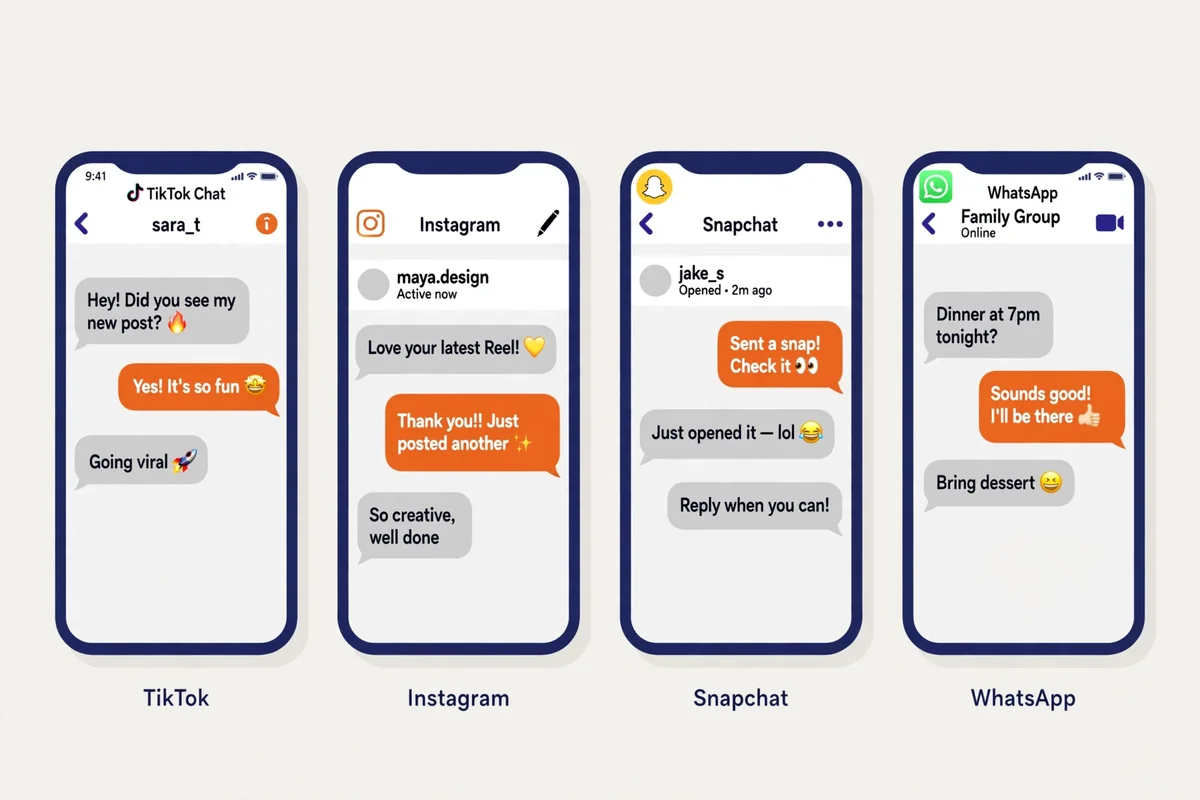
In plain text messages and WhatsApp group chats, WWA is at its most natural, because that is where groups actually make plans. A WhatsApp group chat is the native habitat of the plan facet: “WWA this weekend?” is a genuine attempt to settle something and deserves a genuine answer. One-to-one texting narrows the “we” to two people, but the question keeps its shared shape.
On Instagram, WWA most often arrives in direct messages, frequently as a reply to a story. Someone watches your story and sends “WWA?” The story gave them a reason to ask, so an Instagram WWA is usually warmer and more specific than a cold one, and more likely a place or status question, because the sender has just seen evidence of where you are. On Snapchat, the same question goes lighter and faster: chats feel low-stakes and snaps disappear, so a Snapchat “WWA?” is often a casual poke rather than a serious plan attempt.
Who Sent It: Friend, Crush, Group Chat, or Stranger
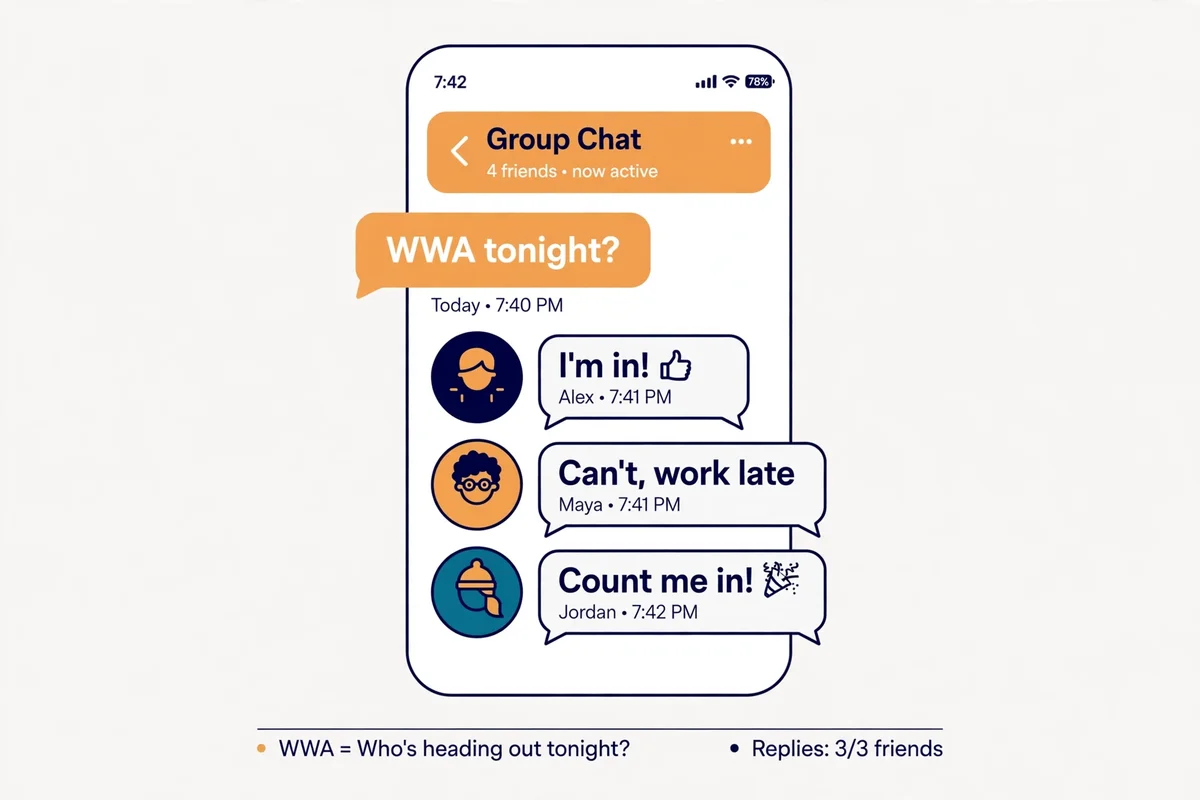
From a close friend, WWA is usually pure logistics with warmth underneath. A friend sending “WWA tonight?” is trying to make an evening happen, and the best reply is fast and concrete: your availability plus an idea, or your availability plus a question that narrows the options. The only real mistake is the slow, vague reply — “idk, maybe” — which answers a decision-seeking question with a shrug and quietly kills the plan.
From a crush, WWA does quiet extra work, and the tell is how much effort surrounds it. A bare “WWA?” is a low-risk opener: they want to talk but do not want to risk a big, vulnerable invitation, so they send the smallest possible check-in and let your answer set the temperature. A crush who adds a detail — “WWA tonight, are you going to the party?” — is investing more, and the right move is to invest back with a detail of your own. WWA alone never proves romantic interest.
From a group chat, WWA is at its most literal, and one dynamic is worth naming: the first person to answer a group WWA sets the direction for everyone else. “I’m free, dinner?” and suddenly the group has a plan; “I’m busy, sorry” and the group waits for someone else to lead. If you want the plan to happen, answer early and concretely. From a stranger or distant acquaintance, WWA is thinner — sometimes a mass message sent to several people at once — and it deserves a light answer or none at all.
How to Answer WWA Well: The Plan-Status-Mood Playbook
Move one: name the facet before you type. Plan, place, or mood — pick one before your fingers move. This single pause prevents almost every cross-facet misfire, because most bad WWA replies are not rude; they are simply answers to a different facet than the one asked.
Move two: lead with the matching information. Plan question: availability plus an idea — “Free after seven, want to grab food?” Place or status question: where you are and where things stand — “Still at work, tickets aren’t booked yet.” Mood question: a feeling first — “Feeling low-key tonight, anyone else?” Each is one sentence, and each gives the sender exactly what they asked for. If the plan needs a small aside, the guide to btw meaning in text shows how a by-the-way note fits without derailing the thread.
Move three: hand the group its next move. An answer that ends in a dead end — “I’m free.” — puts the work back on the sender. An answer that ends with a thread — “I’m free after seven, dinner or a movie?” — lets the group pick rather than invent. If you want to keep the door open without deciding on the spot, a light “lmk what you all decide, I’m probably in” hands the group the next move without pressure, and the guide to lmk meaning in text shows how that handoff works. When the plan is settled, the guide to ttyl meaning in text covers the clean exit.
Move four: when you cannot make it, say so fast and warmly. “Can’t tonight, work ran late — have fun though” is a complete answer: it reports your status, declines the plan, and releases the group. Speed matters more than eloquence; a fast “can’t, sorry” beats a polished paragraph sent two hours later, after the group has already gone out without you. If you need to step away from a conversation entirely, the honest move is a pause word rather than silence, and the guide to brb meaning in text shows how that pause works; when the evening ends, the guide to gtg meaning in text covers the goodbye that closes what WWA opened.
WWA vs Similar Terms
WWA sits in a small family of check-in abbreviations, and confusing it with its cousins is the second most common misread after the facet mistake. WYA asks about one person: “Where you at?” The guide to wya meaning in text explains why that singular question expects a location, not a plan. WWA asks about a group and expects a status, a place, or a plan for that group. Send a WYA answer — just your location — to a WWA question and you have answered only your own part of a group question.
WTM asks about the move: “What’s the move?” The guide to wtm meaning in text shows a term narrower than WWA, because it only ever asks for a plan. WWA is broader: it can ask for a plan, a place, or a mood, or be an open check-in with no decision attached. If the sender wants a plan and nothing else, WTM is the sharper tool; if they want to know where the group stands in general, WWA is the roomier one. The old article called WWA “more flexible” than WTM without explaining the cost — ambiguity, and another chance to answer the wrong facet.
Mistakes and Meanings This Article Refuses to Count
A slang article that lists every claimed meaning without grading them is not comprehensive; it is a junk drawer. Here are the readings investigated and declined, and why. First, “When We Are,” the top meaning of one guide, with example sentences about growing older together. No real exchange uses WWA that way; people write “when we are older” in full. Not counted.
Second, “Who Wants Action,” the top meaning of another guide, presented as a bold invitation to a game or challenge. No example exchange supports it, and the phrase sounds like a poster slogan, not a text. Third, “What a World Awaits,” an inspirational phrase offered as the primary meaning by a third guide. A motivational poster wearing a slang costume; nobody texts it. Not counted.
Fourth, the wrestling and organisational meanings — World Wrestling Association, World Wakeboard Association, and similar initialisms from acronym dictionaries. These are real initialisms in their own fields, not texting meanings. The room decides: if the conversation is about a wrestling promotion, the WWA in it is not asking about anyone’s evening. Fifth, the spelling traps. WAWA, the convenience-store chain, is a different word that shares sounds, not a meaning of WWA. If you receive a WWA fitting none of the three facets, the likeliest explanations, in order, are a typo, an inside joke in that group, or a meaning from another field. Ask, rather than guessing from a list.
Finally, the old article’s own mistakes, corrected here in one place. It presented “What We At,” “Where We At,” and “What We About” as three separate meanings with separate sections; this update treats them as three facets of one group check-in question. It claimed WWA was “popular” and “widely used”; those frequency claims are withdrawn, as no evidence supports them. Its tone section treated punctuation as a fixed code; punctuation is a hint, not a code. And it ran to twenty-three headings with a FAQ section in plain text; this update replaces that sprawl with a test, three facets, and properly headed questions.
Quick Answers
What does WWA mean in text?
WWA means “Where We At?” or “What We At?” — a casual group check-in question asking what a group is doing, where it stands, or what the plan is. It expects a status, a place, or a plan in reply, not a yes or no.
Is WWA the same as WYA?
No. WYA asks one person where they are, while WWA asks a group where it stands. The difference is the “we”: WYA wants your location, WWA wants the group’s status, place, or plan. Answering a WWA with only your location leaves the group’s question unanswered.
Is WWA formal or informal?
WWA is informal, and it belongs in casual chats between friends, not in professional or formal writing. In a work email or a message to a teacher, write the question out in full: “Where do we stand on this?” or “What are our plans for tonight?” The abbreviation saves seconds and costs clarity where clarity matters.
Can WWA be misunderstood?
Yes, easily, and in two directions: a plan question misread as a place question, and vice versa — the facet mistake the Headcount Test is built to prevent. WWA can also be misread by someone who only knows one of its refused meanings. When a WWA confuses you, the fastest fix is a clarifying question: “Do you mean tonight’s plan, or where everyone is right now?”
Should I use WWA every day?
Use it where it fits: in group chats and casual one-to-one chats where everyone already knows the shorthand, and where a group check-in is genuinely what you want. Do not use it with people who may not know it, in formal contexts, or as a cold opener to a stranger — a bare “WWA?” from someone unknown reads as a mass message, not a personal invitation. If you want a specific plan, proposing one beats asking the group to invent one.
What is the best reply to WWA?
Match the facet. For a plan question, reply with availability plus an idea: “Free after seven, want to grab food?” For a place or status question, reply with where you are and where things stand. For a mood question, reply with a feeling first: “Feeling low-key tonight, anyone else?” The Headcount Test — count the we, read the clock, answer in kind — turns any WWA into a reply that moves the conversation forward.
Final Thoughts
WWA carries a large lesson: the shortest messages are often the hardest to read, not because they hide meaning, but because they leave the reader to supply it. The old version of this page tried to solve that by listing more meanings, and ended with a longer list and the same confusion. This update solves it the other way, with fewer meanings and a better tool: one group check-in question, three facets, and the Headcount Test. Count the we, read the clock, and answer in kind.
