
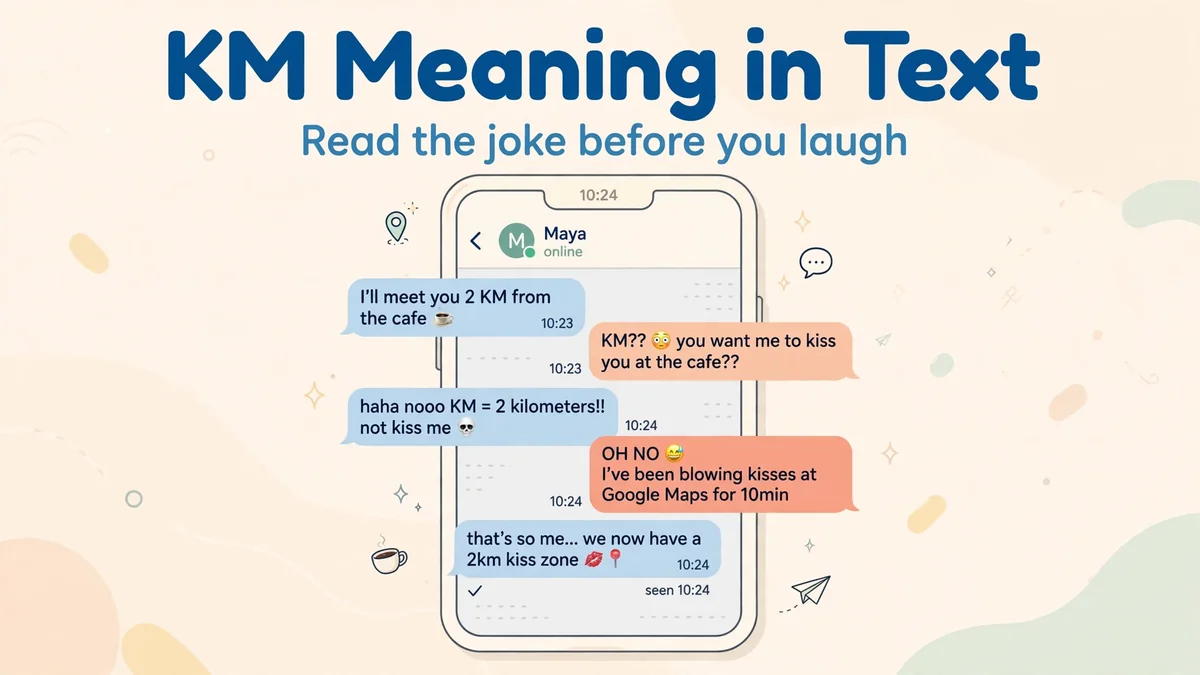
You are mid-conversation when a friend drops two letters on the screen: KM, with no explanation, after a story about tripping in front of a whole lecture hall. Is your friend upset? Joking? Flirting? Asking for help? The km meaning in text is worth getting right precisely because the letters look so small and the possible readings feel so far apart — and because getting this one wrong in either direction has a real cost. Laugh at a genuine cry for help and you have failed a friend; treat an obvious joke as a crisis and you have turned a funny moment into an awkward one.
This article does the work the old version of this page did not: it states what KM means, grades how sure we can be about each reading, corrects the old article’s invented senses and unsupported popularity claims, and gives you a repeatable way to tell a joke from something serious. That method is called the Laugh-or-Literal Test, and you will be able to run it in about ten seconds on any KM you receive.
What KM Actually Means — and the Correction This Update Makes
In texting, KM is a joking, exaggerated reaction to embarrassment, frustration, or a small disaster. The full expansion is “Kill Me,” used as hyperbole: the sender is saying, in effect, that a moment was so awkward, annoying, or unlucky that it felt unbearable — while meaning nothing of the kind literally. The feeling is real; the wording is theatre. Almost every guide that covers KM agrees on this core reading, and the examples are consistent across them: a spilled coffee, a missed train by seconds, calling a teacher “Mom” in front of a class, tripping in public. Small disasters, big reaction, everyone in on the joke.
That non-literal character is the most important thing about KM, and what makes it different from most slang. Many abbreviations describe a feeling; KM performs one. When someone writes “Forgot my homework again, KM,” they are staging the feeling, inviting you to laugh at the disaster with them. The humour works because the reaction is wildly out of proportion to the event, and both sender and reader know it.
Two corrections to the old version of this article belong here, stated plainly. First, the old article listed “Okay, Message” and “Keep Me” as secondary meanings of KM. This update withdraws both: no dictionary, slang reference, or attested usage found in this research supports either as a live texting meaning, and repeating them only teaches readers to misread real messages. Second, the old article repeatedly described KM as “widely used” and “very common.” Those frequency claims are also withdrawn — no usage study was cited for them then, and none was found now. KM is familiar to many online readers, but familiar is not measured, and this article will not dress up familiarity as data.
One more disambiguation before the method. Outside of texting, lowercase km is the international standard abbreviation for kilometre, equal to 1,000 metres. “The office is 10 km away” is a distance, not a reaction: a number next to km means measurement; a story about an embarrassing moment next to KM means the slang reaction.
A responsible note belongs here too, before any jokes, because the expansion of KM touches on self-harm language even when the use is humorous. In its slang use, KM is virtually never literal: hyperbole among people who understand the joke, aimed at small embarrassments and everyday bad luck. Never present it or treat it as encouragement of anything literal. And the exception matters as much as the rule: if someone seems genuinely distressed — real bad news, KM repeated alongside talk of hopelessness, or a tone that suddenly stops being funny — take it seriously and do not brush it off as slang. The test below is built to catch exactly that case.
Run the Laugh-or-Literal Test
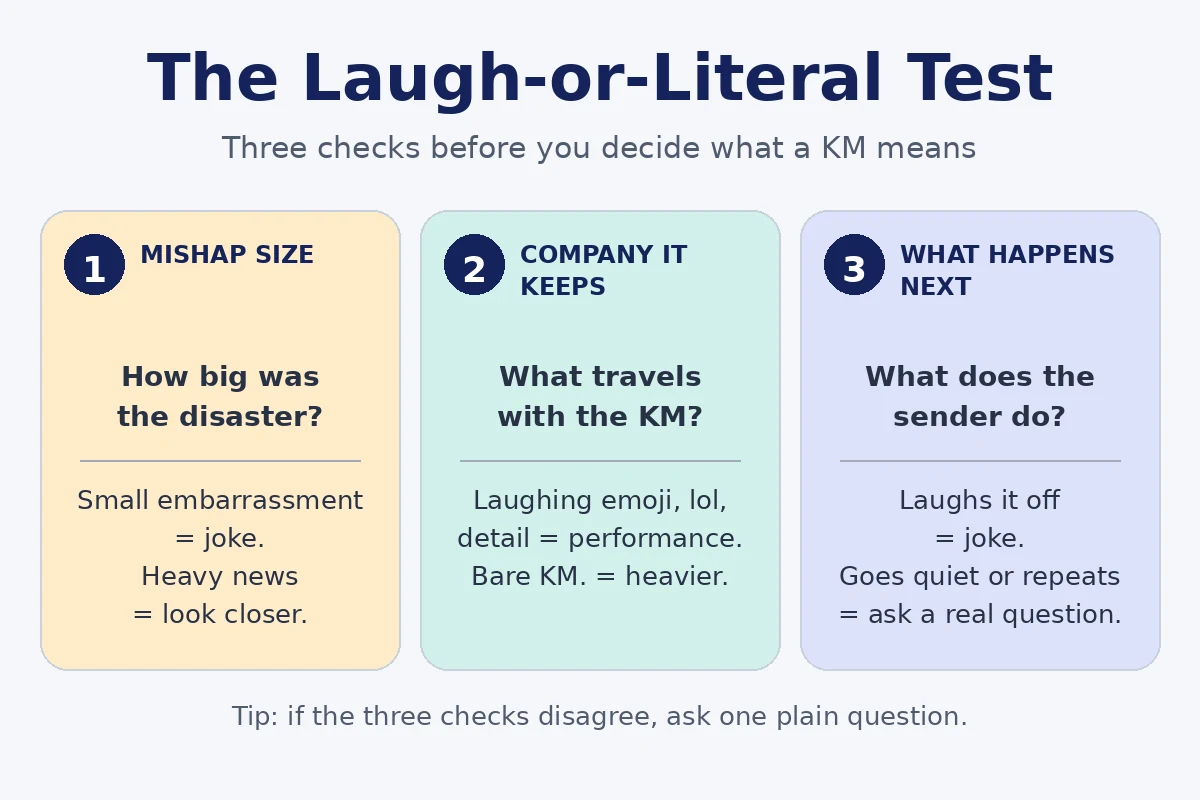
Here is the tool this article is built around. Do not ask what KM means in isolation: the same two letters can be a joke, a flirtation, or a warning sign, and the letters alone will not tell you which. Run the Laugh-or-Literal Test instead — three checks, in order, letting them vote together.
Check one is the SIZE OF THE MISHAP. What happened just before the KM? If the trigger is a small, specific, survivable embarrassment — a typo sent to the wrong group, a fall in front of strangers, a phone dropped in a puddle — the joking reading starts far ahead. If the trigger is genuinely heavy — a bereavement, a lost job, a relationship ending — the joking reading loses its footing, because hyperbole needs a small target to be funny.
Check two is the COMPANY IT KEEPS. What is travelling with the KM? A laughing emoji, a “lol,” a ridiculous detail, a follow-up joke — all of these flag the message as performance. A bare KM standing alone, in capitals, with a full stop, after a message with no joke in it, waves no such flag. Capitalisation nudges the temperature too: lowercase “km” at the end of a funny story reads lighter, while a standalone capital “KM.” reads heavier and more final.
Check three is WHAT HAPPENS NEXT. Does the sender laugh it off, add a detail, or move on? Then it was a joke, and your job is to laugh along. Does the sender go quiet, repeat the KM, or steer every reply back to how bad things feel? Then the literal alarm has gone off, and your job changes from audience to friend: stop joking, ask a real question, and stay. This is the check most readers skip, and the one that matters most, because a joke that keeps returning is no longer behaving like a joke.
Now put the three checks together. The default case — small mishap, laughing company, sender moves on — is the joking reaction, and it covers the overwhelming majority of KMs you will meet. The romantic case — a partner or someone flirting, in a warm, private exchange with no mishap at all — is the second reading, covered next, and it only fires when relationship and context both point that way. The serious case — heavy trigger, bare KM, sender does not move on — is rare, but it is the case the test exists for: when all three checks point away from the joke, believe them over the letters.
One honest limit: the test is a reading aid built from attested usage patterns, not a diagnostic instrument. If the three checks disagree — a small mishap but a bare, repeated KM, for example — do not pick the most comfortable reading. Ask one plain question instead: “Are you okay, or is this a funny-bad day?”
The Second Reading: When KM Means Something Softer
There is a second, genuinely attested reading of KM, and the one most likely to embarrass you if you miss it. In romantic or flirtatious exchanges — between partners, or between people clearly flirting — KM can mean “Kiss Me.” The evidence is real but narrower than for the joking reaction: it appears across several slang guides and abbreviation lists, always with the same framing, a playful message between people who already have that kind of relationship. Grade it as contextually supported, not strongly supported — but supported, and ignoring it would leave readers unprepared for the exact message where it appears.
The gate on this reading is the relationship, not the letters. “KM” from your partner after a sweet message is a plausible invitation; “KM” from a classmate after a story about failing a test is the joking reaction, and reading romance into it would be a category error. The rule is strict: never default to the romantic reading. It fires only when three things are true at once — the sender is someone you are romantic with or clearly flirting with you, there is no mishap for the joking reaction to attach to, and the tone is warm rather than annoyed. If any one is missing, stay with the joke.
Two neighbouring claims deserve a brief burial, because readers will meet them in rival guides. One rival guide claims KM primarily means “Keep Moving,” as encouragement. No dictionary or attested usage found in this research supports that as a live texting meaning, and the guide’s own examples point back to the joking reaction; treat it as weak and unattested. Older slang lists also record “Keep Mum” for KM, but that behaves like a legacy list item, not a meaning people use in current chats. The pattern is that KM attracts invented expansions because it is short and ambiguous; the defence is to demand attestation, and most expansions fail that test.
KM also has a close family worth separating cleanly. KMS is a distinct abbreviation, generally a stronger, self-directed variant of the same joking reaction, carrying the same serious-case warning with more force: a KMS after genuine bad news deserves the literal check first, not the laugh. KMN means “Kill Me Now,” the intensified form, following the same logic at higher volume. None of these is KM itself, and none should be used to decode it.
KM on TikTok, Instagram, Snapchat, and in Text Messages
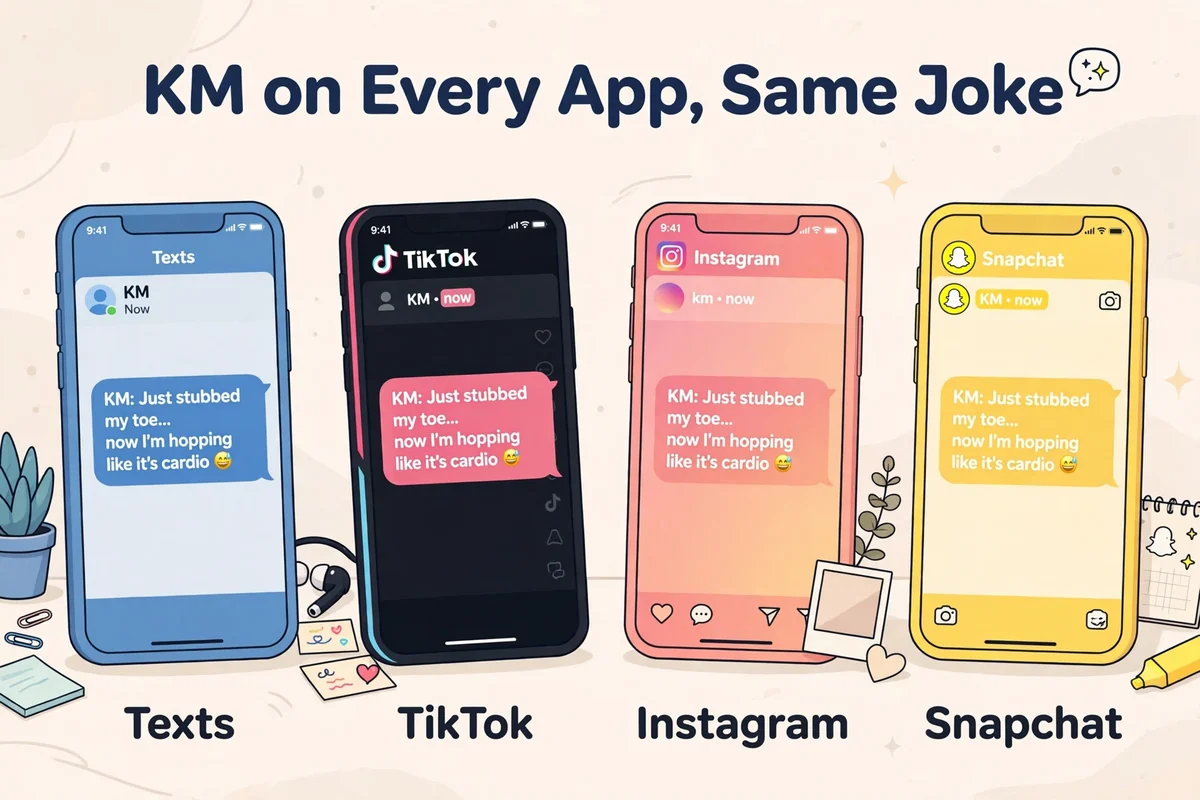
The core meaning of KM does not change from one app to another. What changes is the room it arrives in, and the room changes how the same joke lands — described here honestly, without inventing a separate meaning per platform, because no source supports one.
In plain text messages, KM is at its most classic. A one-to-one chat is where the joking reaction lives naturally: a friend tells you about a small disaster, you both know its scale, and KM lands as shared laughter. The stakes feel higher here precisely because there is no audience — if you misread a friend’s KM, nobody else is in the room to correct you.
On TikTok, KM mostly shows up in comments, and comments are a public stage. A lone KM under a fail video reads as a communal groan, performed for an audience that gets the joke, and it is also used ironically under something obviously fine — which is why TikTok KMs are the easiest to misread at face value. A KM with a hundred likes is a punchline, not a confession.
On Instagram, KM appears in captions, comments, and direct messages, and the three spots differ. In a caption, it is usually self-deprecating framing: “Dropped my phone again, KM” tells followers to read the post as a funny disaster, not a complaint. In a comment, it behaves like TikTok. In a DM, it behaves much more like a text message, and the romantic reading becomes possible there in a way it rarely is in public. Ask which room it arrived in before deciding.
On Snapchat, KM is casual and fast, tucked into snaps or streak updates when plans fall through. Because snaps disappear and chats feel light, a KM there rarely carries the weight it can in a text thread; treating it as a verdict is the most common Snapchat misreading. The exception, as everywhere, is the repeated or bare KM after real news — the platform does not cancel the literal check.
The practical point is simple: do not carry a TikTok reading into a text thread, or vice versa. The joke is the same, the room is different, and the room is part of check two.
KM vs FML, SMH, and LMAO: Picking the Right Reaction
Comparisons are only useful if they draw real lines, so here are three. KM versus FML: both are exaggerated reactions to bad luck, but they differ in scope. FML is the long-running complaint, the punchline after a day of things going wrong, and the guide to fml meaning in text shows how it became a whole genre of disaster anecdote. KM is the single-moment groan, tied to one embarrassment rather than a cursed day. If the sender is listing a third disaster in a row, FML fits better; if they just tripped once, KM is the right size.
KM versus SMH: SMH reacts to someone else’s foolishness with disappointment, while KM reacts to your own disaster with exaggerated despair. SMH points outward, and the guide to smh meaning in text traces that gesture back twenty years. KM points inward: the sender is the victim of their own story, and the joke is at their own expense. Swap them, and you swap sympathy for judgment.
KM versus LMAO: LMAO laughs at something funny, while KM groans at something embarrassing. They often appear together — “tripped in front of everyone, KM, lmao” is natural — but they do different jobs, and the guide to lmao meaning in text shows the laughter side of that pair. LMAO says “that was hilarious”; KM says “that was mortifying.” The first invites more jokes, the second invites sympathy first. Laughing before sympathising is the most common way to mishandle a friend’s KM.
A final contrast. Where KM performs a feeling, TBH certifies one, and the guide to tbh meaning in text shows what that certification does. And where KM can close a conversation with a groan, IDC closes it with a shrug, as the guide to idc meaning in text explains: a KM invites a response, an IDC declines one, and confusing the two means missing the invitation.
How to Reply to KM — and When Not to Send It
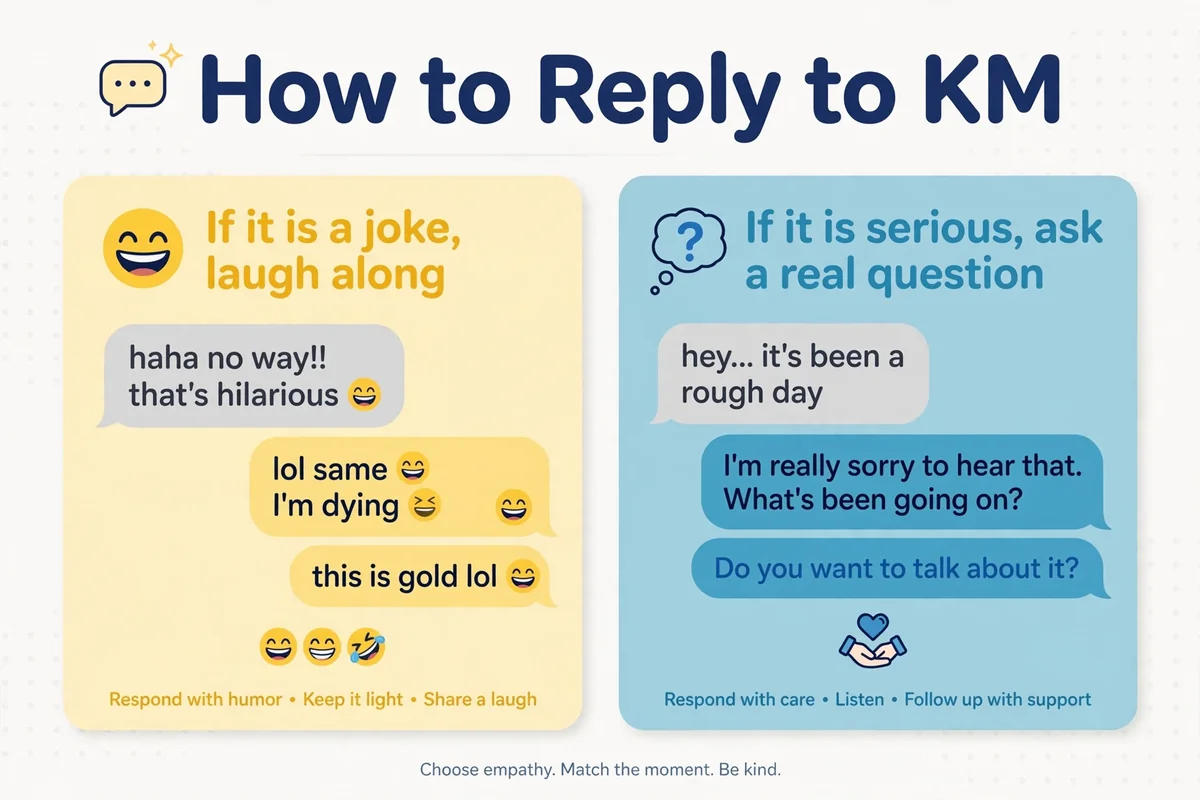
Replying well to a KM is mostly about passing the test before you type anything. If the test says joke, your job is to be the laugh track with sympathy attached. “Honestly, same” and “I feel your pain” accept the performance without upstaging it. “Nooo, stop, it really is not that bad” argues with the exaggeration while accepting the feeling underneath. Asking what happened works when the KM came without a story, giving the sender the stage their groan was asking for. All three treat the KM as an invitation, not a problem.
If the test says serious — heavy trigger, bare KM, sender not moving on — stop performing and switch registers entirely. Drop the jokes and ask one real question: “Hey, are you actually okay?” Then listen. If the answer is reassuring and the sender steers back to humour, you have lost nothing. If it is not reassuring, stay, take what they say seriously, and encourage them to talk to someone they trust. That switch, from audience to friend, is the whole point of having a test.
Two softer moves cover the middle cases. When someone apologises and you want to defuse it, the reassurance abbreviation is the right tool, and the guide to dw meaning in text explains why “dw about it” lands as comfort rather than dismissal. And when a KM needs a follow-up rather than a reaction, the natural pivot is to ask for the next step, as the guide to lmk meaning in text shows: sympathy first, logistics second.
When should you not send KM at all? Do not send it in formal communication — emails, workplace chats, professional messages — where the expansion, even as a joke, reads as unprofessional. Do not send it in serious or sensitive conversations, where it can sound dismissive or be read literally by someone who does not know you well. Do not send it to someone genuinely distressed, and do not send it repeatedly: overuse drains the exaggeration, and a KM on every minor inconvenience stops being funny. Never aim KM at another person as an insult: it is a self-directed groan, and pointed outward it becomes something else entirely.
One last sending rule: if you are not sure the reader will get the joke, write the feeling out instead. “That was so embarrassing, I wanted to disappear” says everything KM says, with no ambiguity. Abbreviations are a shortcut for shared understanding; when that understanding is not shared yet, the shortcut is a detour.
Quick Answers
What does KM mean in text?
In texting, KM is a joking, exaggerated reaction to embarrassment, frustration, or a small disaster — the full expansion is “Kill Me,” used as hyperbole and virtually never meant literally. Run the Laugh-or-Literal Test: check the mishap’s size, the company the KM keeps, and what the sender does next.
Is KM meant literally?
Virtually never in its slang use — a performance of despair about small embarrassments, understood as a joke by both sides. The exception is the serious case: KM with real bad news, repeated, or not followed by humour should be taken seriously, with a real question instead of a laugh.
Can KM mean “Kiss Me”?
Yes, but only in a narrow, relationship-gated case: between partners or people clearly flirting, in a warm, private exchange with no mishap for the joking reaction to attach to. Never default to this reading.
Does KM mean kilometre?
Outside of texting, yes: lowercase km is the standard abbreviation for kilometre, equal to 1,000 metres. A number next to km means distance (“10 km away”); a story about an embarrassing moment means the slang reaction.
Is KM appropriate for formal use?
No. It is informal, and its expansion makes it doubly unsuitable for emails, workplace chats, or professional messages, even among people who would get the joke. In formal settings, write the feeling out in full words.
How should I reply to KM?
If the test says joke, match it with sympathy and humour: “Honestly, same,” “I feel your pain,” or “What happened?” If it says serious, drop the jokes, ask plainly “Are you actually okay?” — then listen.
Final Thoughts
KM is two letters carrying a large job: a joke, a groan, a flirtation, and — rarely — a warning sign, all in one package. The old article treated it as a simple definition with invented extras. The Laugh-or-Literal Test is the whole method in one line: weigh the mishap, read the company it keeps, and watch what happens next.
Two habits will carry you further than any list of meanings. First, default to the generous reading — a joke about a small disaster — until the checks tell you otherwise, because most KMs really are just jokes. Second, when the checks point away from the joke, believe them over the letters and switch to a real question. A joke misread as a crisis costs an awkward moment; a crisis misread as a joke costs much more.
